Karma and Rebirth — If There Is No Permanent Self, Who Is Reborn?
Karma is often reduced to cosmic justice: do good and the universe rewards you; do harm and punishment returns. Buddhist teaching is more complex — especially when karma is joined to rebirth without a permanent self.

Karma is one of the most widespread Buddhist terms in modern language. “Karma will catch up with you.” “That is his karma.” “What goes around comes around.” The word has almost become synonymous with cosmic justice: do something good and the universe will reward you; do something bad and sooner or later you will be punished. Buddhist teaching is considerably more complex. An even greater problem appears when karma is connected with rebirth. If Buddhism rejects a permanent self or unchanging soul, who is reborn? If nothing travels from one life to another, how can an action in this life affect a future birth? And if the future being is not completely identical with the present one, why should it inherit that person’s karmic consequences at all?
These are not merely modern objections. Buddhist traditions have been dealing with them for centuries.
Karma Means Action — But Not Every Action in the Same Way
The Sanskrit word karma and the Pāli kamma mean action. But intention is crucial to Buddhist ethics. In the Aṅguttara Nikāya, the Buddha says that kamma is intention: having intended, a person acts through body, speech, and mind. This does not mean that only what happens “inside the head” matters. It means that the moral structure of an action is not determined by outward movement alone. If we hurt someone accidentally, the situation is not the same as when we hurt them intentionally. The external result may be similar. The intention is not. Karma is therefore not merely a list of things we have done. It is intentional action shaped by greed, hatred, delusion, or their opposites — generosity, goodwill, and clearer understanding.
Karma Is Not Fate
When karma is linked with past lives, it is very easy to slide into fatalism. Illness? Past karma. Accident? Past karma. Poverty? Past karma. Violence? The victim must obviously have done something bad in the past. But early Buddhist sources do not support such a simple theory. The Sīvaka Sutta rejects the view that all pleasant, painful, and neutral feeling arises from past actions. The text lists several other possible causes: bodily imbalances, climatic changes, carelessness, injury or assault, and other factors. Karmic result is only one among them. Buddhist teaching therefore should not be summarized as: everything that happens to me is the result of past karma. That is precisely the view the early text rejects.
Karma is not automatic cosmic payback. Another simplification is problematic as well: the same action always produces exactly the same punishment or reward. The discourse on the lump of salt uses a very effective analogy. A small amount of salt can make a cup of water almost undrinkable. The same amount of salt in a great river has far less effect. Similarly, in the text the same relatively minor bad action is connected with different results in differently developed people. Karmic operation is therefore not a simple equation: action X = always exactly consequence Y. The broader psychological and ethical context matters.
But Karma Is Still Not Merely a Metaphor for Psychology
We should not turn this into the opposite simplification. Today karma can be explained psychologically: if we repeatedly react with anger, we reinforce anger; if we repeatedly act generously, we cultivate generosity; if we repeat certain responses, we create habits. This is an important part of the Buddhist model. But early Buddhism goes further. Karmic results are also connected with future births. AN 6.63 speaks of results of kamma that may be experienced immediately, later, or still later, and the traditional Buddhist framework clearly includes multiple lives. Historically, it is therefore inaccurate to claim that rebirth is only a metaphor for psychological change within a single lifetime.
Rebirth Without an Eternal Soul
Here the central problem appears. In a model of an enduring soul, the explanation would be simple. A soul leaves one body. Then it enters another. But Buddhism rejects an unchanging ātman. What, then, moves? Consciousness, perhaps? An early text explicitly rejects that solution too.
Sāti’s mistake. In the Mahātaṇhāsaṅkhaya Sutta, the monk Sāti claims that he understands the Buddha’s teaching this way: the same consciousness moves and wanders through the round of rebirths. The Buddha sharply rejects his understanding. Consciousness, according to this teaching, is not an independent thing. It arises in dependence on conditions. Visual consciousness arises in connection with the eye and form. Auditory consciousness in connection with the ear and sound. Other types of consciousness likewise arise conditionally. The Buddhist answer is therefore not: the same consciousness leaves one body and enters another. If consciousness were a permanent, unchanging bearer of identity, it would very quickly become something like a soul.
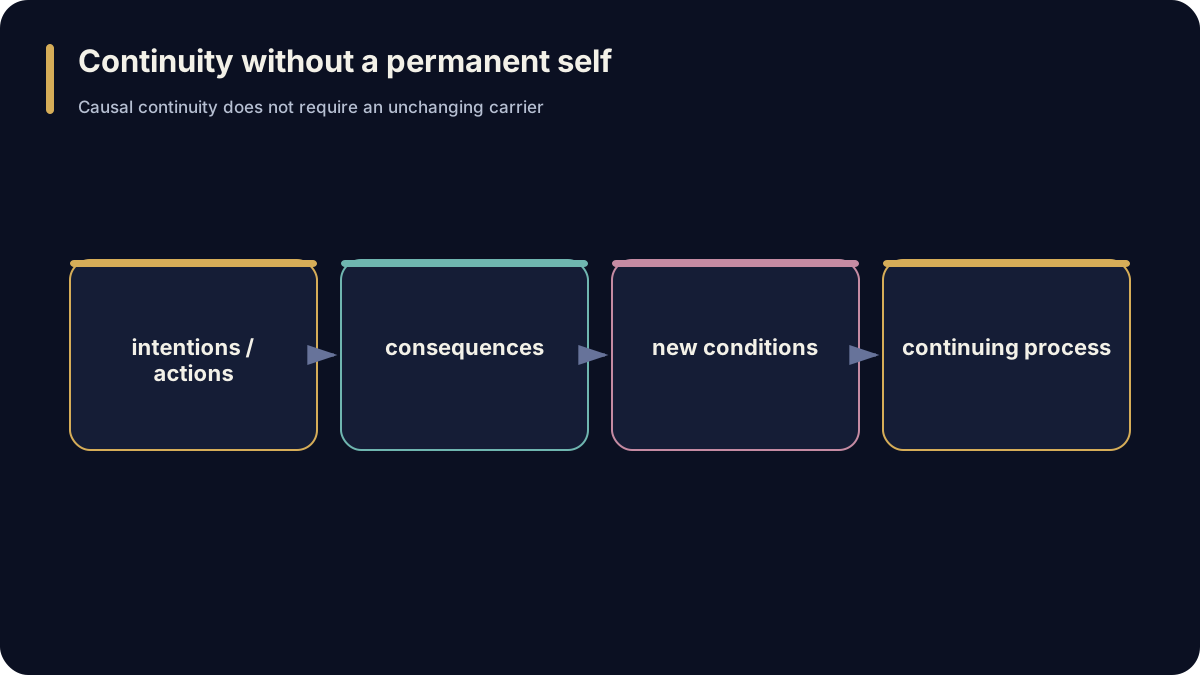
From thing to process. The Buddhist model therefore shifts from the question What travels? to the question What causes continuation? This is an important change of perspective. There need not be an unchanging thing between two moments in order for the second moment to arise because of the first. Causal continuity does not require substantial identity. We can see this already within the present life.
Are we the same as the child we once were? The body has changed. Memories have changed. Emotions have changed. Ways of thinking have changed. Much of the body’s material is no longer the same. Yet there is a sufficiently strong causal and biographical continuity for us to speak of one life story. The Buddhist model does not require an unchanging metaphysical core in order to speak about such continuity. Later traditions apply a similar logic to rebirth.
“Neither the same nor another.” One of the most famous formulations of this problem appears in the later Milindapañha. The king asks Nāgasena whether the person who is reborn is the same or another. The answer is: neither the same nor another. The text uses several examples. A person was once an infant and later became an adult. They are not unchangingly identical, yet neither are they unrelated to the child. The flame of a lamp changes throughout the night. The flame at a later moment is not numerically identical to the earlier one, yet there is uninterrupted causal continuity. Milk becomes curd, then butter, then clarified butter. The later state is not simply identical with the earlier one, but it arises causally from it. This is a later Buddhist explanation, not a verbatim formula of the earliest suttas. But it shows very well the problem a Buddhist theory of rebirth has to solve.
Why not completely the same? Because complete identity would require something unchanging that passes from life to life. That would come very close to a permanent self.
Why not completely different? Because karmic responsibility would then be broken. If a future being had no causal connection at all with the present person, it would be difficult to explain why that person’s actions should affect the future being. Buddhist philosophy therefore seeks a middle possibility: continuity without unchanging identity.
Dependent Origination
Here rebirth is connected with dependent origination. Ignorance conditions formations. Formations are connected with the arising of consciousness and the continuing stream of experience. Craving conditions clinging. Clinging conditions bhava — becoming or a continuing mode of existence. Becoming conditions birth. Birth conditions aging and death. The central idea is not that some metaphysical thing moves along the chain. The process continues because the conditions for its continuation are present.
Karma is part of this process. Intention and action are not isolated events. They change the conditions in which the stream of experience continues. This is already obvious within a single life. A lie can change relationships. Violence can generate further consequences. Repeating anger can strengthen the pattern of angry reaction. Generosity can change our relationship to possession and to other people. Traditional Buddhism extends this causal logic beyond the boundary of death. Karma participates in shaping the conditions of a future birth.
Karma is not punishment. The word “consequence” can quickly evoke the image of a judge. Someone sees our action, records it, and later distributes punishment or reward. Buddhist karma generally requires no such cosmic accountant. It functions as morally structured causation. That is not the same as a physical law. But neither does it necessarily require the decision of a supernatural judge. Intention, action, and result are connected through conditions.
Do people who suffer get what they deserve? That conclusion does not follow from the teaching of karma. If we see a sick person, a victim of violence, or someone in severe poverty, we have no basis for simply saying: “That is their karma.” The early text already rejects the theory that all painful feelings result from past actions. Moreover, within the traditional Buddhist model, ordinary people do not possess complete knowledge of another being’s karmic history. And the Buddhist ethical response to suffering is generally compassion and help, not moralistic condemnation of the victim. Karma must therefore not become religious language for blaming those who suffer.
Conditioning Does Not Mean Complete Determinism
Our present is not independent of the past. But neither is everything finally decided. If past karma completely determined every moment of the present, Buddhist practice could change nothing. MN 101 criticizes precisely a model according to which all present feeling would be merely the result of past actions and old karma would have to be exhausted through ascetic suffering. Buddhist practice presupposes the efficacy of present action. What we do now becomes a new condition.
That is why present intention matters. Past karma is often a more attractive topic than present karma. People want to know: Who was I? What did I do? Why did this happen to me? But the practical point of Buddhist teaching lies elsewhere. Even if we knew a thousand past lives, we would still have to decide: what will we do now? Present intention is part of the point at which the causal direction can change. Karma is therefore not a doctrine of hopeless inevitability.
An ancient karmic debt? Some Indian traditions developed models according to which past karma must literally be exhausted through suffering and ascetic practice. The Devadaha Sutta criticizes such a view among the Nigaṇṭhas. The problem is not merely philosophical. If all present suffering were the consequence of the past, then present intentional action would have almost no power. But the Buddhist path is grounded precisely in the possibility that present practice changes conditions.
The goal is not to accumulate infinite good karma. Good karma matters. Generosity, ethical conduct, and goodwill create more favorable conditions. Traditional Buddhism can also connect them with a more favorable future birth. But this is still not the final goal. Even the most pleasant birth remains within saṃsāra. Human life passes. Heavenly realms, according to traditional cosmology, are impermanent as well. The Buddhist path therefore aims not only at better karma. It also aims at the cessation of the karmic process that sustains continued saṃsāric becoming.
The cessation of kamma. AN 6.63 is especially interesting here. It does not speak only about kamma. It speaks about its cause, diversity, result, cessation, and the path to cessation. The important point is that the goal is not a perfect karmic bank account or a state in which we possess an infinite number of good points. The final goal is liberation.
Theravāda systematizations. Later Theravāda works out moments of consciousness and karmic continuity in great detail. In these models there is no unchanging self that travels. Later Abhidhamma and commentarial systematization speaks of the final moments of one life and the conditioned arising of rebirth consciousness. It is important to identify this as a later systematization. The earliest suttas do not present this technical model in the same form. The basic idea, however, remains: continuity without an eternal soul.
Yogācāra and karmic seeds. Mahāyāna Yogācāra develops another highly influential model. Actions leave bīja — seeds or potentials. These potentials are connected with ālayavijñāna, storehouse or foundational consciousness. Under appropriate conditions they can ripen into new experiences. The system thus seeks to explain long-term karmic continuity. But ālayavijñāna is not intended as an unchanging soul. It is a conditioned stream. Its karmic potentials also arise and change. In several classical Yogācāra systems, ālayavijñāna itself ceases in its afflicted function at liberation. It should therefore not be turned into a hidden ātman.
“My” karma. At the everyday level Buddhist texts normally say: I act, I am the heir to my actions, I will experience their consequences. Such language is necessary for ethics. At the analytical level, however, Buddhism finds no eternal owner of karma. There is a causally connected stream of intentions, actions, results, feelings, perceptions, and other processes. “Person” is the conventional name for this connected history. Moral responsibility therefore does not require an unchanging soul.
Transfer of merit. Here an interesting later topic appears. Buddhist traditions very often include practices of dedicating or “transferring” merit to other beings, deceased relatives, or all beings. At first glance this is difficult to reconcile with the idea that the fruit of a karmic action belongs to the one who performs it. Historical traditions, however, developed several different explanations. “Merit” need not be presented as a solid substance or quantity that moves from one karmic account to another. In Theravāda, practices of pattidāna develop; in Mahāyāna, dedication or direction of merit, pariṇāmanā, plays an important role. Different Buddhist settings have understood these practices differently. The word “transfer” should therefore not create an overly literal picture.
Collective karma. The expression “collective karma” requires similar caution. Various later and modern Buddhist traditions speak of shared karmic conditions, shared actions, or consequences experienced by communities. But this is not one single unified doctrine of early Buddhism. It is especially problematic when the term is used to explain catastrophes: an earthquake happened because of the victims’ collective karma, a war because of a population’s collective karma, a genocide because of some group’s collective karmic debt. Such claims require far more than the early teaching can straightforwardly justify, and they can quickly become a way of blaming victims. They should therefore be used with great caution.
Psychological interpretations of rebirth. Modern Buddhism often develops symbolic interpretations as well. The six realms of birth can be understood as psychological states. Hell as the experience of extreme hatred. The realm of hungry ghosts as insatiable craving. Divine realms as states of extraordinary pleasure and self-satisfaction. Such readings can be practically very useful. But historically it is not fair to proclaim them the only original meaning. Traditional Buddhist worlds generally understood rebirth also as continuation after bodily death.
What Is a Historical Question, and What Is a Modern Choice?
We need to distinguish these. The historical question is: Did early Buddhist sources teach rebirth across multiple lives? The evidence strongly indicates that they did. A second question is: Must a modern person accept that interpretation? Here the answers differ. Some Buddhists accept it literally. Some remain agnostic. Others develop psychological interpretations. Some believe they can practice much of Buddhism without taking a position on life after death. These are legitimate modern positions. But they are not automatically historical descriptions of the earliest Buddhism.
What about science? Modern discussions sometimes go further. Individual studies of alleged past-life memories are presented as proof of rebirth. But we cannot simply conclude from such studies that science has proven the Buddhist theory of rebirth. Traditional Buddhist cosmology includes much more than isolated unusual memories. At the same time, the philosophical question of whether some form of continuity after death might exist is not exactly the same as the empirical question of whether a particular alleged memory case has been reliably demonstrated. The article therefore needs neither apologetics nor advance dismissal. It needs only a clear boundary between traditional teaching and modern attempts at proof.
Memories of past lives. Early Buddhist texts attribute to the Buddha and to some highly developed meditators the ability to remember past lives. Within the traditional system, such descriptions form part of the evidential and religious framework of saṃsāra. A modern reader may assess their epistemic value differently. We therefore again need to distinguish what the text claims from what we can today proclaim as an independently confirmed fact.
Karma is not a complete theory of cosmic justice. One of the most attractive modern ideas says that no one escapes justice. If a criminal is not punished today, punishment will come later. If an innocent person suffers today, it is probably the consequence of a previous life. Such a system can sound fair. But it can also become extraordinarily cruel. If every instance of suffering is explained as a deserved karmic consequence, we no longer see a person in distress primarily as someone who needs help. We see them as someone paying a debt. Early Buddhist teaching does not give us permission to reason so simply.
Karma and compassion. If someone suffers, the Buddhist ethical response is not: “You probably deserved this.” It is much closer to: “Suffering is here. What can we do to reduce it?” This is an important practical consequence of understanding karma correctly. Karma emphasizes responsibility for actions. It does not give us omniscience about the causes of another person’s suffering.
What, Then, Is Reborn?
If we expect a thing, the Buddhist answer will be unsatisfying. We do not find an eternal soul. We do not find an unchanging self. MN 38 also blocks the simple solution according to which the same consciousness travels through all lives. What we do find are intentions, actions, karmic potentials, craving, clinging, becoming, conditioned consciousness, and birth. The Buddhist model is therefore better summarized like this: no unchanging thing migrates; a causally conditioned process continues.
Is the future being then “me”? At the conventional level we can say that a person reaps the consequences of their actions. At the analytical level the answer is subtler. The future being is not the same unchanging self that left the present body. But neither is it a completely unrelated being. The later formula of the Milindapañha — “neither the same nor another” — tries to express precisely this middle possibility. Causal continuity remains. There is no unchanging substance.
The most important question is not “what travels?” That question may already be shaped by the model of a soul. If we ask What leaves the body?, we expect an object. The Buddhist model asks instead: Which conditions cause continuation? If ignorance is present, conditions for further clinging arise. If craving is present, clinging continues. If clinging is present, becoming continues. When the conditions are removed, the process does not continue in the same way. Here karma and rebirth connect directly with nirvāṇa.
Karma Without a Soul
This may be the most distinctive feature of the Buddhist theory. There are actions. There are moral consequences. Traditional Buddhism teaches rebirth. But there is no eternal personal substance that is their unchanging owner. At first glance this seems contradictory. Buddhist philosophy addresses the problem by shifting the center of gravity: from things to processes, from substance to conditions, from unchanging identity to causal continuity. Karma is therefore not primarily cosmic bookkeeping. It is part of an explanation of how intention and action jointly shape the conditions of continued experience. Rebirth is not the migration of an eternal soul. It is the continuation of a conditioned process for as long as the conditions for its continuation remain. And for that reason the final Buddhist question is less What part of me will live forever? and more What causes the cycle to continue — and what must cease for it to end?
Sources and Literature
Primary Texts and Reference Editions
- SuttaCentral: AN 6.63, MN 101, and MN 38, translated by Bhikkhu Sujato.
Research and Verification Literature
- SuttaCentral. Early Buddhist texts, translations, and parallels. For English Pāli translations, principally Bhikkhu Sujato. Dynamic digital corpus; cite individual text IDs where possible.
- Siderits, Mark. “Buddha.” The Stanford Encyclopedia of Philosophy, Summer 2026 ed., edited by Edward N. Zalta and Uri Nodelman.
Note: verification sources are part of the editorial apparatus. Where the original edition used during reconstruction was not preserved, a standard reference edition is not presented as the article’s presumed original source.