Karma: Action, Consequence, Intention and Free Will
Karma is not one formula. From the Upaniṣads and Bhagavad Gītā to Buddhism and Jainism, it names different models of action, intention, consequence, rebirth and freedom. What is historical doctrine, what is personal interpretation, and where does fatalism begin?
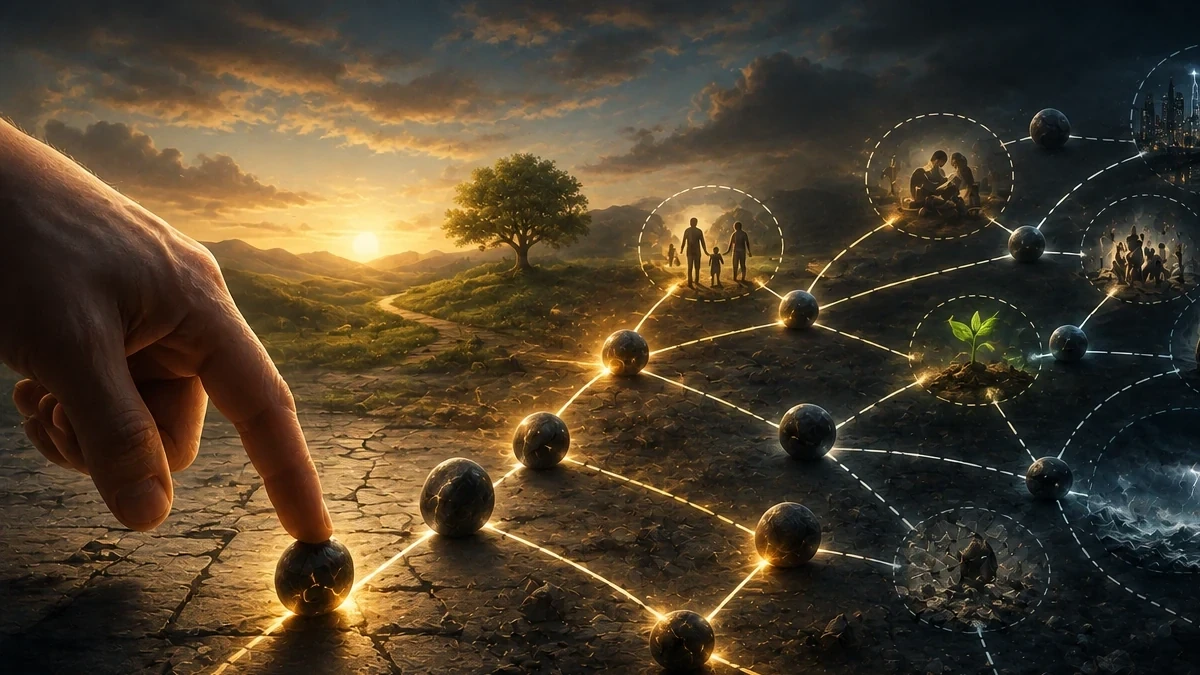
In the West, karma is often reduced to the slogan “what goes around comes around” or to the image of invisible cosmic bookkeeping. Indian traditions present a far more diverse picture. Karman basically means action; over centuries it developed into several different accounts of how deeds, intentions and character help shape future experience and, in some traditions, future rebirths.
This article therefore does not search for one single “correct formula of karma.” It compares early Hindu sources, the Bhagavad Gītā, early Buddhism and Jainism. They share a broad moral intuition — action is not without consequence — but differ substantially over what counts as karma, how a result is produced, and how much room remains for present choice.
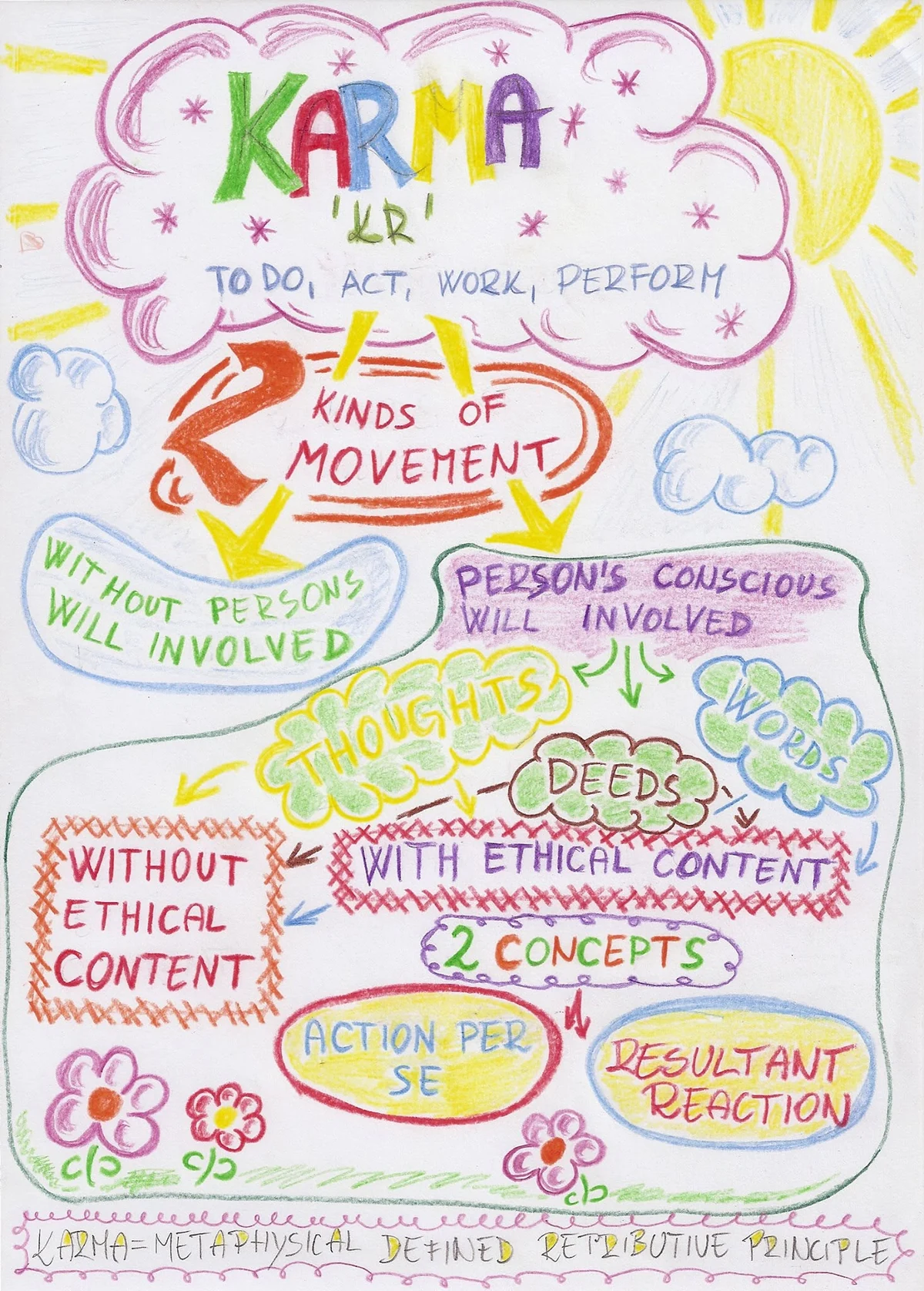
There is also a personal layer for me. My daughter and I drew a picture in which karma branches from will through thoughts, words and deeds toward consequence. It began as a family attempt to understand the idea that our choices leave traces. In this article it is used as an authorial interpretation, not as an ancient diagram or proof of a metaphysical law.
The most useful boundary is therefore twofold. On one side are ordinary consequences we can observe directly: habits shape character, words alter relationships, and decisions change the probabilities of future events. On the other are claims that the cosmos morally balances every event or that consequences are transmitted with precision across lives. Those are religious and metaphysical claims that deserve accurate presentation, not substitution for experimentally established physical causation.
From ritual to moral causation: how the idea of karma changed
The oldest sense of Sanskrit karman is simply action or work, often ritual action in the Vedic setting. The history of the doctrine is not a single straight line: scholars debate how much later karma grew directly from Vedic ritualism and how much it was shaped by the wider north Indian milieu in which Buddhism, Jainism and Ājīvika also emerged. It is therefore better to speak of development than of one moment of invention.
In the early Upaniṣads, action is already linked to moral formation. Bṛhadāraṇyaka Upaniṣad 4.4.5 connects conduct, desire, will and deed: through good action a person becomes good, through bad action bad. The important point is that karma is not merely an external punishment arriving later from somewhere else; action also shapes the actor.
That shift matters throughout this article. A consequence can be imagined as a future life circumstance, a transformation of character, a karmic fruit after death, or some combination of these levels. Saying “karma is the law of cause and effect” is therefore too thin: different traditions mean different things by both cause and effect.
Hindu accounts: action, rebirth and karma-yoga
Hindu traditions do not share a single mechanics of karma. The Upaniṣads, Vedānta, Sāṃkhya-Yoga, Nyāya-Vaiśeṣika and other schools offer different accounts of soul, rebirth and the transmission of karmic results. Their broad common core is that the moral quality of action matters and that the present life stands within a wider causal network that is not exhausted by one moment.
The Bhagavad Gītā adds the especially influential idea of karma-yoga. In 2.47 Krishna tells Arjuna to act without claiming ownership over the fruits of action and without using uncertainty about results as a reason for inaction. The point is not that outcomes are irrelevant, but that the agent controls the quality of the deed far more directly than the whole web of consequences beyond it.
This is an important correction to the popular picture of karma as passive fatalism. The Gītā is set inside a crisis of decision and directs the person back into responsible action. The outcome remains uncertain; the duty to judge and act remains. The question of free will appears precisely inside this tension between conditioning and present choice.
Buddhism: karma is centrally intention — and it does not explain everything that happens
Early Buddhism sharpens the picture further. In Aṅguttara Nikāya 6.63 the Buddha links karma to intention or volitional action: having intended, one acts through body, speech and mind. Two outwardly similar deeds therefore need not be karmically identical when they arise from very different motives, ignorance, or deliberate malice.
At the same time, an early Buddhist discourse explicitly rejects the simple claim that everything a person feels is caused by past karma. The Sīvaka Sutta (SN 36.21) lists bodily disorders, climate, carelessness, assault and other causes as well. Karma is one causal factor, not a universal label that turns every illness, accident or act of violence into deserved repayment for the past.
This matters ethically. Buddhist karma stresses responsibility for intentional choices, but it does not license telling a victim, “you caused this yourself.” Past conditions coexist with present conditions, the actions of other people and physical processes; present practice can in turn alter what happens next.

Jainism: the most literal mechanics of karma
Jainism develops one of the most concrete classical theories of karma. In the Tattvārthasūtra and later Jaina philosophy, karma is not merely a moral record but a subtle kind of matter that becomes bound to the soul (jīva) through actions, passions and attachment. Speech, body and mind participate in bondage; liberation requires stopping new influx and shedding karma already bound.
This model differs both from the common Western metaphor “the universe sends it back” and from the Buddhist emphasis on intention. Jaina philosophy develops classes of karmic matter and a detailed soteriology in which right view, knowledge and conduct gradually reduce bondage. Its ethical consequence is an exceptionally strong emphasis on nonviolence, self-restraint and responsibility for even small forms of harm.
That is why comparison matters: Hindu, Buddhist and Jaina uses of karma are not three versions of the same popular slogan. They are related but philosophically distinct systems of causation, personhood, liberation and moral action.
Free will or fate? Karma as conditioning rather than necessarily a closed script
If past karma determined every present thought, decision and event down to the last detail, it would be difficult to explain why moral effort today should matter at all. Indian traditions resolve this tension in different ways, but many leave genuine room for present effort, practice and a change of direction.
Hindu thinkers differ over the relation between inherited karmic conditions and freedom; modern Hindu thought has often rejected the equation of karma with fatalism. Jainism emphasizes disciplined self-effort. Buddhism, rather than positing an unconditioned sovereign will, describes a conditioned process in which a new intention becomes a new cause. A person is not without a past, but the past is not the only force acting in the present.
For that reason, the most useful image for me is a branching tree, not an already recorded film. Conditions created in the past constrain and channel, but present action opens new branches. This is an authorial metaphor, not one doctrine shared by every tradition, yet it captures a common practical question: what will I do with the conditions in front of me now?
What we can actually verify: ordinary consequences are not yet proof of a cosmic law
At the level of ordinary life, part of the karmic intuition is almost mundane. Repeated behavior changes habits; habitual lying changes relationships and the probability of being trusted; violence creates physical, legal and social consequences; practicing patience makes a different response more likely next time. These are ordinary psychological and social causal chains.
That does not automatically establish the stronger claim that an invisible universal mechanism precisely balances every good and bad action — still less that a specific misfortune lets us infer deeds from a previous life. Traditional doctrines may make such metaphysical claims, but they are not equivalent to an experimentally established law of physics.
Nor should Newton’s action–reaction law be used as scientific proof of karma. Physical force and moral responsibility belong to different categories. The value of karma can therefore be examined on several levels: as historical doctrine, as metaphysical explanation, as an ethical model of responsibility, and as the practical observation that actions really do alter future possibilities.
The author’s drawing and a modern formulation: responsibility without blame for everything that happens
In the drawing my daughter and I separated movement without conscious will from thoughts, words and deeds in which will is involved. That resembles some traditional distinctions between mere events and morally significant action, but the picture is not an attempt to reconstruct one historical school. It is a personal map of the question: where in the chain between inner state and outer effect can I take responsibility?
A modern formulation by Dharma-Pravartaka Acharya that served as context for this article stresses four ideas: actions have consequences; thoughts, words and deeds shape our inner and outer world; the individual is responsible for his or her conduct; and the future is not completely closed because new choice remains possible. The article treats these emphases as a modern interpretation, not as a literal summary of every Indian tradition.
One element of such modern formulations requires particular caution: the claim that people deserve everything that happens to them. That is much stronger than personal responsibility for one’s own actions. Early Buddhism directly resists this kind of total explanation, and modern philosophical literature warns that karma can become a framework for victim blaming. Responsibility for one’s deeds can be liberating; attributing another person’s abuse or misfortune to the victim’s presumed guilt is a different claim.
Karma as practice: act consciously, accept consequences, but do not declare the future already written
If we temporarily set aside the metaphysical details unique to particular religions, a strong practical core remains. Intention matters. Actions have consequences. Repetition shapes the person. A present response becomes part of the conditions for the future. A person can use this core even while remaining agnostic about rebirth or cosmic moral balancing.
Karma should not become an excuse for passivity. If someone is in danger, we help; if a system is unjust, we evaluate the deeds of people and institutions; if we make a mistake, we do not repair it by assuming “the universe will take care of it,” but by apology, restitution and changed behavior. The future consequence also begins in the present deed.
I would therefore condense karma as a life question in this way: What have I inherited from past decisions and circumstances? What is genuinely within my power now? What trace will the action I choose next leave? Traditions differ about the metaphysics, but they approach one another here: freedom is not the absence of all causes. It is the capacity to add a new cause consciously to the network of causes.
Karma is not permission to explain another person’s pain. It is first a question we ask ourselves: what kind of cause am I creating with my next action?
Sources and further reading
- Medhananda, Swami. *Karma and Rebirth in Hinduism* (Cambridge Elements in Religion and Monotheism): history, Upaniṣadic sources, classical Hindu variations and debates about karma/rebirth.
- Bṛhadāraṇyaka Upaniṣad 4.4.5 — action, conduct, desire, will and what a person becomes.
- Bhagavad Gītā 2.47 — public-domain translation comparison; action, fruits and non-attachment to inaction.
- Aṅguttara Nikāya 6.63 (SuttaCentral) — intention/volition as the heart of kamma and body, speech and mind as fields of action.
- Saṃyutta Nikāya 36.21, Sīvaka Sutta — rejection of the claim that every felt experience is entirely caused by past kamma.
- Meyers, Karin. “Intention in the Pali Suttas and Abhidharma.” Oxford Research Encyclopedia of Religion (2023).
- Harvey, Peter. “Karma.” *The Oxford Handbook of Buddhist Ethics* (2018): intention, karmic fruit, conditionality and responsibility.
- Stanford Encyclopedia of Philosophy — Ethics in Indian Buddhism: intention, karmic consequence, rebirth and Buddhist moral reasoning.
- Stanford Encyclopedia of Philosophy — Jaina Philosophy: karmic matter, bondage, stoppage, shedding and liberation.
- Chapple, Christopher Key. “Free Will and Voluntarism in Jainism.” In *Free Will, Agency, and Selfhood in Indian Philosophy* (Oxford, 2013).
- Sharma, Arvind. “Karma.” In *Modern Hindu Thought: An Introduction* (Oxford, 2005): modern Hindu engagements with fatalism and agency.
- Burley, Mikel. “Karma, Morality, and Evil.” *Philosophy Compass* 9(6), 2014: free will, practical guidance and the victim-blaming objection.
- O’Flaherty, Wendy Doniger (ed.). *Karma and Rebirth in Classical Indian Traditions* — historical debates on Vedic roots and later doctrines.
- Dharma-Pravartaka Acharya — modern reflection on karma supplied by the author as contextual inspiration; not used as historical evidence for classical doctrine.
- Wikimedia Commons / Library of Congress — *Bhagavad Gita, a 19th century manuscript*, North India; public domain.
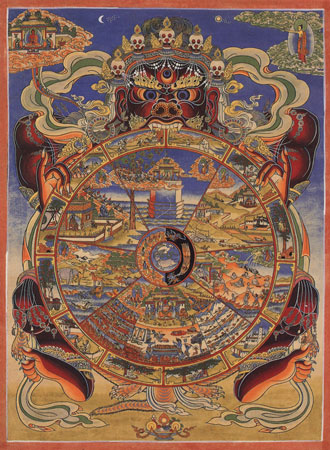
- Wikimedia Commons / Library of Congress — *Bhavachakra*, c. 1900; public-domain historical representation of the Buddhist Wheel of Becoming.