Does Authority Remove Personal Responsibility?
When an order-giver, an operator, an organization, and coercive circumstances all contribute to the same act, responsibility does not disappear — but it is not necessarily distributed equally.

When something harmful happens inside a large system, responsibility often begins to travel up and down the hierarchy. The operator says, “I was only following instructions.” The manager says, “I did not carry it out.” The executive says, “That was the department’s decision.” The organization says, “Individuals failed to follow policy.” Each statement may contain part of the truth, yet together they can produce a strange result: the act happened, harm occurred, and responsibility seems to belong to no one.
Follow an Order or Follow Your Conscience? asked what to do when an order collides with conscience. Does Authority Remove Personal Responsibility? takes the next step: when several people participate in one outcome while possessing different roles, knowledge, power, and alternatives, how should responsibility be distributed fairly?
Responsibility can be shared among several people. It does not disappear merely because it is divided.
Responsibility has several layers
First: responsibility hides several different questions When we say “he is responsible,” we may mean several things. Someone may have causally contributed to an outcome, may hold a role-based duty to supervise something, may be morally responsible for a choice, or may be responsible in a precisely defined legal sense. These levels often overlap, but they are not identical.
The Stanford Encyclopedia of Philosophy explicitly distinguishes moral responsibility from mere causal responsibility: a person can cause an outcome without being fairly assigned full moral blame for it, for example when the consequence could not reasonably have been foreseen. That is already a reason why searching for one single “culprit” can oversimplify a complex act.
Causal contribution, duty, moral responsibility, and legal responsibility are not synonyms.
One outcome can have several responsible agents Imagine a company in which senior management knows a procedure is dangerous, a department head passes the instruction downward, and a technician starts the machine despite warning signs. If an accident follows, the question “who is responsible?” is misleading if it assumes that only one answer is allowed.
The executive may bear responsibility for policy and decision, the manager for transmission or failed supervision, the technician for the concrete act, and the organization for an incentive structure in which warnings were routinely ignored. This does not mean everyone is equally blameworthy. It means different contributions to the same outcome can be morally evaluated at the same time.
Collective responsibility does not erase individual responsibility Philosophical work on collective responsibility therefore distinguishes the responsibility of a group from the responsibility of its members. The fact that a corporation, state, or other organized collective may bear responsibility does not by itself tell us how much blame belongs to each individual member. Nor does collective responsibility require that every member be equally morally blameworthy.
This blocks two opposite mistakes: “nobody is responsible because the system is responsible” and “everyone is equally responsible because they belong to the system.” Membership is not enough. We need the person’s actual role, contribution, knowledge, power, and alternatives.
Orders, authority, and divided responsibility
“I did not make the decision” matters — but it does not settle everything A subordinate may be entirely right to point out that they did not design the policy or issue the original order. That matters morally. The person who creates a harmful procedure and the person who performs one small step inside it are not automatically in the same position.
But “I did not make the original decision” does not imply “I made no decision at all.” Depending on the circumstances, an operator may still decide whether to proceed, raise a warning, request clarification, use a protected channel for objection, conceal consequences, or refuse participation in an obviously impermissible act. How many of those alternatives were genuinely available is a separate question that must be investigated.
Greater authority can mean greater responsibility A leader normally has more capacity to shape an entire process than a single operator. Yet a box on an organizational chart does not determine responsibility by itself. What matters is effective control, available information, and a real capacity to act.
Article 28 of the Rome Statute illustrates this logic in a highly specific legal setting. For crimes within the jurisdiction of the International Criminal Court, it regulates responsibility of military commanders and other superiors where the required effective control, knowledge standard, and failure to take necessary and reasonable measures are present. Does Authority Remove Personal Responsibility? does not turn that doctrine into a rule of ordinary employment law; the useful principle is narrower: authority can create a special duty to supervise and intervene.
Power does not only create more opportunities to decide. In some roles it creates more opportunities — and duties — to prevent harm.
The person giving the order is not neutral simply because someone else performs the final act Hierarchy creates physical and psychological distance. A superior may say, “I did not strike anyone” or “I did not press the button.” That can be literally true, yet it does not answer who designed, ordered, enabled, or deliberately directed the action.
The Rome Statute likewise does not limit individual criminal responsibility to the final physical perpetrator; under legally defined conditions it addresses ordering, soliciting or inducing, aiding and abetting, and other contributions. ICRC materials similarly document responsibility for ordering war crimes. The legal doctrines are specific, but the broader moral lesson is straightforward: a person may make a major causal and moral contribution through the actions of others.
The subordinate does not become a machine either Follow an Order or Follow Your Conscience? examined the other side of the relationship. Customary international humanitarian law requires combatants to disobey manifestly unlawful orders, and superior orders do not remove criminal responsibility when the subordinate knew the act was unlawful or should have known because its unlawfulness was manifest.
This is not a general rule for every disagreement between an employee and a manager. It is, however, a clear example of a legal system refusing to treat a subordinate as a morally empty instrument. Formal subordination can affect responsibility without turning a person into a device without judgment.
Coercion, choice, and knowledge
Coercion can change responsibility dramatically Responsibility cannot be assessed fairly while ignoring coercion. A threat of an uncomfortable meeting, dismissal, imprisonment, severe violence, or death does not create the same situation. Philosophical work on coercion emphasizes that there is no single generally accepted formula by which every threat reduces responsibility in the same way; the effect depends partly on the kind of act and its moral context.
Article 31 of the Rome Statute also uses a narrow legal standard for duress: among other conditions, it refers to a threat of imminent death or continuing or imminent serious bodily harm, necessary and reasonable action to avoid the threat, and no intention to cause greater harm than the harm avoided. This is why “I was under pressure” matters without functioning as a universal excuse.
Break “I had no choice” into the choices that actually existed In real conflicts, a better question is “what alternatives did I have, and what did they cost?” A person may technically be able to refuse while facing extreme danger. In another case refusal may risk comfort, status, or career. Both involve pressure, but they are not morally equivalent.
This does not invite comfortable observers to demand heroism from people under severe threat. It asks us to describe control and coercion accurately. Responsibility may be reduced, shared, or under precise legal conditions excluded, but none of those conclusions follows from the word “order” alone.
Knowledge is one of the major dividers of responsibility Imagine three people in the same process. The first does not know that a small technical task serves a harmful purpose and could not discover this through ordinary care. The second suspects it but deliberately avoids learning more. The third knows the harm and actively helps conceal it. All participate in the same chain, but their epistemic positions are very different.
It is therefore useful to distinguish “I did not know,” “I could not have known,” and “I did not want to know.” Moral responsibility depends not only on physical contribution, but also on what an agent understood and what they could reasonably have learned.
Systems, division of labor, and diffused responsibility
Division of labor can divide the sense of authorship Complex organizations must split work into small tasks. That efficiency can have a side effect: each person sees only one fragment and finds it increasingly difficult to experience the final outcome as something in which they participate.
Albert Bandura explicitly included displacement and diffusion of responsibility among the mechanisms of moral disengagement. He also noted that harmful activities can operate through legitimate organizational networks in which otherwise ordinary people contribute through disconnected subdivisions of function. This does not prove every member guilty; it shows how structure can weaken the felt sense of personal agency.
Diffusion of responsibility also exists without formal orders A related psychological problem appears among bystanders. John Darley and Bibb Latané’s classic 1968 study placed diffusion of responsibility at the center of research on emergency intervention: when several potential helpers are present, a person may feel less uniquely responsible for acting.
Inside an organization this can sound like “legal will handle it,” “management already knows,” “someone must have reported it,” or “that is outside my area.” Sometimes those divisions are correct. But when everyone assumes responsibility belongs elsewhere, a problem can remain without an actual responder.
A system is not a person, but systems shape people’s options When we say “the system is at fault,” we may be referring to bad incentives, missing oversight, a culture of concealment, opaque procedures, or fragmented information that prevents anyone from seeing the whole. Those are real factors and should not be reduced to one person’s character.
Yet the word system must not become a smoke screen. Systems are designed, maintained, and changed by people with unequal levels of power. We can therefore analyze structure and individual choice simultaneously. One level does not erase the other.
Membership in an organization is not collective guilt The opposite extreme is equally misleading. If an organization causes harm, not every member becomes equally blameworthy simply by belonging to it. A night cleaner is not responsible for executive accounting fraud merely by working in the same corporation, and citizenship alone does not make each citizen personally guilty for every act of a state.
For individual responsibility we need a more concrete connection: what did the person do, know, support, control, and have a duty to address? Collective responsibility can be discussed without assigning equal collective guilt to all members.
Mapping responsibility: actions, omissions, and repair
A responsibility map is better than searching for one target For a complex case, draw the chain: who set the goal, designed the procedure, held authority, supplied resources, performed the act, knew about consequences, should have foreseen them, could stop the process, and later concealed the harm?
Such a map may show one person carrying a large share of responsibility, another a small share, and a third almost none. The point is not to distribute blame at any cost. It is to stop responsibility from vanishing between organizational boxes.
Responsibility can also arise from omission A leader is not relevant only for what they explicitly order. In some roles, what they fail to do also matters morally and legally. When a person has a special duty of oversight, actual information about danger, and a realistic ability to act, omission can become part of the responsibility picture.
But “you could have done something” is not enough. In theory, each of us could act on thousands of problems. We need a special relationship between agent and problem: authority, proximity, knowledge, capacity, and a reasonable cost of action.
Responsibility is not only backward-looking blame After harm occurs we usually ask, “who is to blame?” There is also a forward-looking question: “who can and should now prevent recurrence or repair the damage?” Philosophical work on collective responsibility distinguishes backward-looking attribution from forward-looking responsibility for bringing about a better state of affairs.
A new manager may not have created an old policy but can now change it. A new administration may not have caused a previous failure but may have the resources to repair it. This kind of responsibility is not necessarily blame; it can arise from present capacity to act.
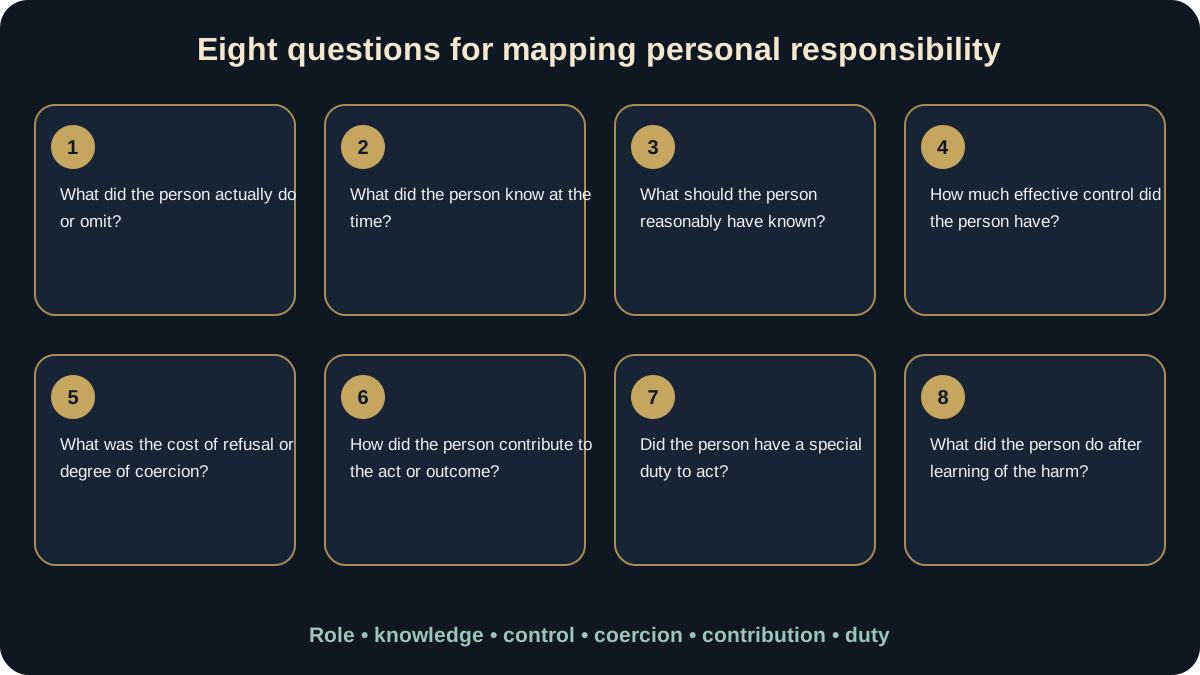
Eight questions for mapping personal responsibility
- What did the person actually do or fail to do?
- What did the person know at the time?
- Given the role and available information, what should the person reasonably have known?
- How much effective control did the person have over the decision or outcome?
- What was the cost of refusal and how strong was the coercion?
- How did the person contribute: decision, order, execution, assistance, approval, or concealment?
- Did the person have a special duty to supervise, warn, or intervene?
- What did the person do after learning about the problem or harm?
These questions are not a mathematical formula. They do, however, let us distinguish more fairly between people who occupied the same system without possessing the same knowledge, power, or freedom.
Natural law and the limit of outsourcing moral judgment
Natural law and the limit of outsourcing moral judgment For a natural-law inquiry, the central question is whether moral rightness can be reduced entirely to the will of whoever holds authority. If whatever legitimate authority orders were automatically morally right, an individual would only need to discover who stands above them. What Is Natural Law? and Natural Law Is Not a Matter of Belief have already taken a more demanding approach: positive law, a moral claim, and objective moral truth are not the same category.
It does not follow that each individual becomes an infallible moral judge. Follow an Order or Follow Your Conscience? rejected blind confidence in conscience for the same reason. The minimal boundary is simply this: neither an external order nor an internal feeling can by itself replace reasons, facts, and responsibility for consequences.
Authority changes responsibility — it does not erase it The title question therefore does not deserve a simple yes or no. Authority can reduce freedom, alter access to information, fragment labor, raise the social or material cost of refusal, and shift a large share of responsibility toward people with greater power. Coercion can sometimes reduce responsibility dramatically and, under precise legal conditions, may exclude criminal responsibility.
But authority does not create an automatic moral vacuum. The person giving an order may answer for the order, the operator for knowing execution, a superior for failed oversight, an organization for a harmful structure, and coercive circumstances for diminished freedom. Each actor must be assessed according to the position they actually occupied.
Do not ask only “who was above me?” Ask “what did I know, what could I do, and which part of the act was actually mine?”
This closes the six-article sequence: from distinguishing fact from interpretation, through healthy skepticism, source evaluation and group pressure, to orders, conscience, and distributed responsibility. The common thread is the same: responsible judgment cannot be outsourced to a crowd, a source, a title, or an authority without checking what the reasons and evidence actually support.
Power is not the same as the right to command
Power, Responsibility, and the Right to Command Are Different Things Greater actual power can mean greater capacity to cause or prevent harm and therefore greater responsibility. It does not follow that greater power automatically creates a moral right to command. Responsibility arising from power and the legitimacy of authority are different claims.
The fact that someone is responsible for how they use power does not prove that they had the right to exercise that power.
Why Should I Obey? The question is not merely whether a superior or state can issue a directive, but why I have a moral duty to comply because it came from that person or institution. Sometimes we have very good reasons: an accepted role, a promise, expertise, coordination, or protection of others’ rights. But in each case the reason is more than the title of the person issuing the order.
The existence of a superior explains who issued the order. It does not yet explain why I have a moral duty to obey.
Internal Monarchy and Authorship of One’s Actions
Self-government does not mean rejecting all guidance. It means remaining a moral subject responsible for one’s actions. We can listen to expertise, accept roles, and honor agreements, but we cannot simply deposit basic moral responsibility on a superior’s desk.
If an order cannot assume my moral responsibility, it cannot without further argument assume my moral judgment either.
Sources and further reading
- Stanford Encyclopedia of Philosophy. Moral Responsibility. Substantive revision 2024. Source
- Stanford Encyclopedia of Philosophy. Collective Responsibility. Source
- Stanford Encyclopedia of Philosophy. Coercion. Source
- Rome Statute of the International Criminal Court, Articles 25, 28, 31 and 33. Source
- ICRC Customary International Humanitarian Law, Rule 152 — Command Responsibility for Orders to Commit War Crimes. Source
- ICRC Customary International Humanitarian Law, Rules 154–155 — Obedience to and Defence of Superior Orders. Source
- Bandura, A. (1999). Moral Disengagement in the Perpetration of Inhumanities. Personality and Social Psychology Review, 3(3), 193–209. DOI: 10.1207/S15327957PSPR0303_3. Source
- Darley, J. M. & Latané, B. (1968). Bystander Intervention in Emergencies: Diffusion of Responsibility. Journal of Personality and Social Psychology, 8(4), 377–383. DOI: 10.1037/h0025589. Source