Why Conformity Often Overrides the Facts
A person can see the correct answer and still hesitate to say it when a unanimous group says something else. Conformity often grows from the need to understand reality and remain part of the group.

Imagine a very simple task. One line appears on the left and three on the right; your job is to choose the one that matches the first in length. The difference is obvious enough that an error seems almost impossible. Then several people before you, one after another, select a clearly wrong line, and the task is no longer merely visual.
When your turn arrives, the question “which line is the same length?” is joined by another: “How can everyone else be seeing something different from me?” Solomon Asch used precisely this conflict between personal perception and a unanimous majority in his classic conformity research. Under his standard conditions, roughly a third of responses on critical trials followed the incorrect majority, yet most individual responses remained independent and about a quarter of participants never yielded at all.
Conformity does not show that people simply believe the majority. It does show that a unanimous group can influence judgment even when relevant evidence is directly in front of us.
Why does the group influence us so strongly?
Conformity is not the same as stupidity In everyday language, “conformist” often sounds like an insult. Psychology uses the term more neutrally: conformity is a shift in judgments, opinions, or behavior toward the norms or positions of other people. The outward behavior may look the same while the internal reasons differ greatly.
Someone may agree publicly while privately believing the group is wrong. Another person may genuinely begin to doubt their own judgment because they assume others possess information they lack. Conformity is therefore not simply a failure of intelligence or courage; it often grows out of ordinary mechanisms of social learning, belonging, and uncertainty management.
Two reasons we listen to the group Deutsch and Gerard’s 1955 distinction between normative and informational social influence remains useful. Normative influence concerns acceptance, rejection, and the social consequences of fitting in; informational influence arises when we treat other people’s judgments as evidence about what is probably correct.
Both processes can be reasonable. Exclusion can have real costs, and no individual can independently verify everything needed for everyday life. The problem is not that we listen to groups, but that group opinion can become a substitute for evidence even where the evidence is available for direct inspection.
“Everyone says so” contains information — but not always the information we think If ten people independently perform the same measurement and obtain the same result, their agreement can be a strong evidential signal. If ten people are repeating the same article, speech, or social-media post, we have ten voices but not ten independent pieces of evidence.
How to Evaluate a Source showed how many apparently separate sources may trace back to one root. The same question applies to group opinion: did consensus emerge from independent checking, or from social transmission of one conclusion? The number of believers tells us how widespread a belief is; the origin of their agreement tells us how much it should change our view of reality.
Unanimous majorities, uncertainty, and social cost
Why is a unanimous majority so powerful? When one person disagrees with us, it is easy to treat them as mistaken. When everyone around us gives the same answer, we become the only exception and face two possibilities at once: perhaps we are wrong, or perhaps we are right but will have to oppose everyone else alone.
Bond’s meta-analysis of 125 Asch-type studies showed that the relationship between majority size and conformity is not one simple linear function. Response format, direct contact with the majority, and the balance between normative and informational influence all matter. There is no magic number at which an individual simply “loses independence.”
Groups matter more as information when the world is ambiguous Asch’s task was striking because the perceptual answer was comparatively clear. Real life is usually harder: we judge people’s intentions, the quality of a study, the state of an economy, a political event, or the meaning of an ambiguous recording. Under uncertainty, other people are not only social pressure; they are potential sources of information.
Informational influence is often useful because we learn from people who know more than we do. A paradox appears when everyone watches everyone else on the assumption that somebody else must know. A confident consensus can then emerge from very little independent knowledge. The useful question is not only “how many agree?” but “how many independent routes lead to this conclusion?”
Groups also tell us what is safe to say Groups have norms, some explicit and others unspoken. Members may learn that a certain person is not criticized, a particular question is not asked, or “serious people like us” are expected to hold a certain view. Such norms can shape public expression even when private judgment is different.
When expressing an opinion, a person may therefore be solving two problems at once: “what is true?” and “what will happen to my status, relationships, or reputation if I say this?” When the social cost of dissent is high, public behavior becomes a poor proxy for what group members privately believe.
The social cost can be measurable In 2023, Lawson, Anand, and Kakkar followed 51,537 Twitter user dyads across two time periods. Group members who did not match others’ behavior in sharing fake news experienced reduced social interaction over time; the authors supplemented this longitudinal analysis with another large digital field study and five experiments.
The research does not claim that conformity explains all misinformation sharing. It supports a narrower and important point: the social cost of deviating can be one factor influencing willingness to share questionable material. An information environment therefore affects not only what we see, but what feels socially safe to reject.
Which group and which period matter
It matters which group holds the opinion Five strangers and five people we experience as “our people” do not necessarily exert the same influence. Identity, belonging, and the value of the relationship can alter both the weight we give a group’s judgment and the cost of departing from it.
A person may be highly critical of outside groups while rarely examining dominant claims inside their own community. How to Recognize Your Own Blind Spots is especially relevant here: biases are easiest to identify in other people, while our own standards tend to feel natural and neutral.
Culture and historical period change the results Asch’s results should not be turned into one universal constant of human behavior. Bond and Smith’s 1996 meta-analysis assembled 133 studies from 17 countries and found important cultural and historical variation; conformity declined over time in the U.S. studies and higher conformity was associated with measures of collectivism.
Capuano and Chekroun’s 2024 systematic review identified 48 relevant articles published from 2004 through 2022 and emphasized the diversity of questions, methods, and moderators in modern conformity research. The classic Asch paradigm is therefore best treated as a vivid demonstration of a mechanism, not as a percentage that defines every person in every setting.
Dissent, silence, and shifting the boundary of normal
One dissenting voice can change the situation Asch also manipulated unanimity. When a partner broke with the majority and gave the correct answer, conformity fell sharply; even a dissenter who did not fully agree with the participant could weaken the majority’s effect. Later work has shown that exact social support and merely breaking consensus can have somewhat different consequences, but the general lesson remains: a completely unanimous majority is psychologically distinctive.
The first person who calmly says “I am not convinced” does not prove that they are right. They may, however, make it possible for everyone else to express doubt.
Silence can create false consensus Imagine ten people, six of whom privately have doubts, while each believes they are almost alone. Nobody wants to be the first to create conflict, so everyone stays quiet and a public appearance of agreement emerges. This gap between private attitudes and perceived group norms is central to pluralistic ignorance.
Prentice and Miller documented such processes in students’ attitudes toward campus alcohol use: students believed they were personally more uncomfortable with drinking practices than the average peer. The broader literature therefore warns that a lack of public opposition is not always evidence of private agreement; it may also reflect mistaken beliefs about what others think.
When the Boundary of “Normal” Moves Step by Step Conformity does not operate only in a single moment when an individual decides whether to agree with a group. Over time, groups can also change the standard of what feels ordinary, acceptable, or worth objecting to. We learn social norms from what others do, what they approve, what they punish, and what they accommodate without response.
Contemporary research on norms emphasizes that such change is dynamic. How observers respond to a violation of an existing norm can affect its future trajectory: opposition can reinforce the old norm, quiet acquiescence can leave room for its erosion, and imitation or endorsement can help a new practice spread. The absence of resistance is therefore not the same as evidence that everyone privately agrees with the new practice.
There is another trap. Research on system justification suggests that, under some conditions, people can begin to experience the existing state of affairs not only as what currently is, but as more reasonable, natural, or desirable than they might judge it without that attachment to the status quo. This is not a universal law of human behavior, and people often resist existing norms. It does show why it is useful to separate “this is how things are” from “this is how things should be.”
Repetition does not turn a falsehood into truth and does not make harm morally right. It can, however, move the threshold at which we still notice it as unusual.
This is a more evidence-limited version of the question that the original THY-REALITY source line described as the “normalization of the absurd.” The word absurd is an evaluative judgment, not a psychological diagnosis. The underlying mechanism can still be examined: did our standard change because we gained better reasons and evidence, or mainly because we became accustomed to the new condition, because everyone expects it, or because objection became socially costly?
Norm change is not bad by definition. Societies have also normalized more humane and more just practices. The test should therefore not be nostalgia for an earlier status quo, but facts, consequences, rights, and principles. A useful temporal check is: what would I think of the same practice if I encountered it for the first time today and did not know that it had already become ordinary?
Conformity is not always an error — the reason matters
Conformity is not always an error None of this means that the ideal thinker always opposes the group. Automatically taking the minority position is not independent thought; it is another automatic rule. Majorities can be correct, expert consensus can be a powerful evidential signal, and social norms make cooperation possible.
Cialdini and Goldstein frame social influence around several basic goals: forming accurate perceptions of reality, building and preserving meaningful relationships, and maintaining a coherent self-concept. Conformity is part of ordinary human functioning. Critical thinking should calibrate it, not pretend we can remove it.
The better question is not whether we follow the group, but why We may follow a group because it has stronger evidence, more relevant expertise, or many genuinely independent checks. That is different from following because we fear looking foolish, losing status, or disappointing people whose approval matters to us.
How to Evaluate a Source helps separate the number of voices from the number of independent sources, while Openness Without Gullibility, Skepticism Without Dogma adds a symmetry test: would we accept the same argument if it came from a group we did not belong to? Together these questions turn social influence into something we can evaluate rather than something that quietly steers us.
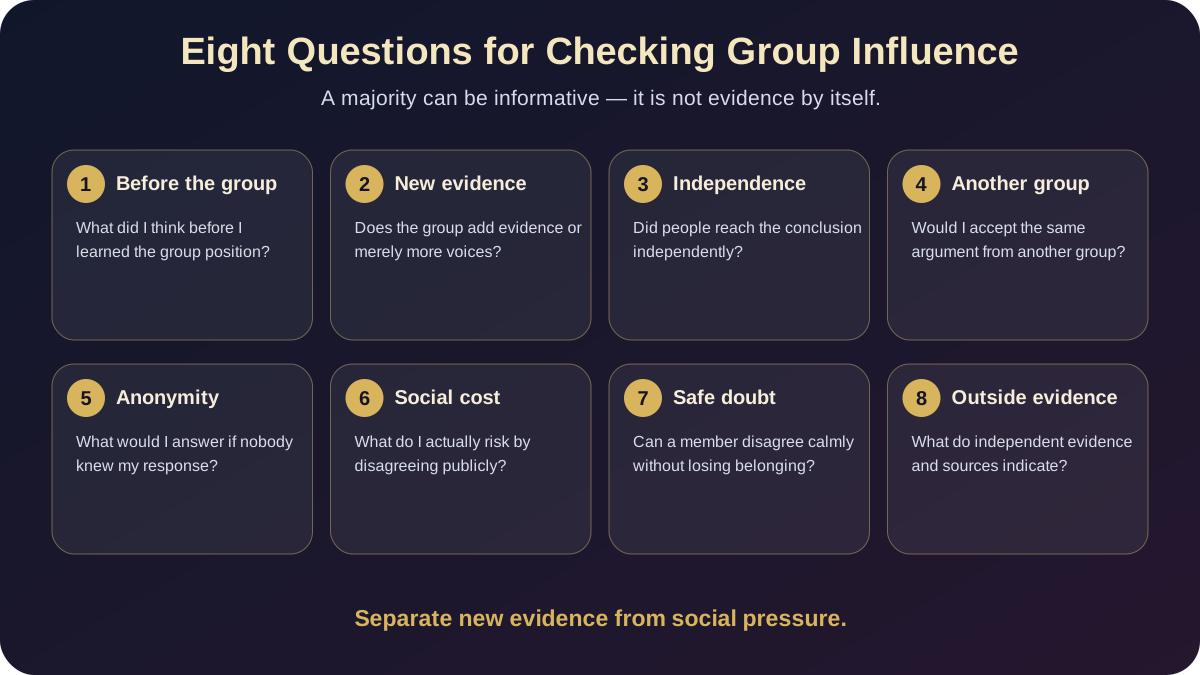
Eight questions for checking group influence
- What did I think before I learned the group’s position, and if my view changed, what new evidence changed it?
- Is the group bringing new evidence, or merely more people repeating the same conclusion?
- Did these people reach the conclusion independently of one another?
- Would I accept the same argument if it came from a group I do not belong to?
- What would I answer if my response were completely anonymous?
- What is the real social cost of dissent — awkwardness, reputation, relationship, status, or employment?
- Is there a safe route for disagreement and someone who can question the group without losing membership?
- What do evidence and independent sources outside the group indicate?
No single answer proves that conformity has occurred. Together, however, the questions help distinguish a change of mind caused by new information from one driven primarily by social pressure.
A healthy group needs safe dissent and contact with reality
Good groups need safe doubt The problem is not belonging to a group; it is an environment in which belonging requires intellectual uniformity. Jetten and Hornsey’s review of deviance and dissent emphasizes its dual character: groups may punish dissent as a threat to cohesion, yet dissent can also be functional by prompting reconsideration and change.
Better decisions therefore require more than unusually brave individuals. They require cultures in which the first doubt does not automatically cost a person their place. A healthy group does not require everyone to think differently; it allows members to disagree and remain legitimate members of the group.
A group cannot vote physical reality into existence A hundred people can decide which term a community will use or which rule an organization will adopt. They cannot vote a line into becoming longer or change the chemical composition of a substance by consensus. Empirical claims must retain contact with the reality they describe.
Consensus can still be highly informative when it arises from good measurements, relevant expertise, and independent verification. If the explanation ends with “because everyone says so,” however, we have gone in a circle: the group has become evidence for itself.
Independence does not mean distrusting everyone No human being is completely independent. Language, most of our knowledge, maps, measurements, and expert systems all come from other people. Critical thinking is not a project of isolation from society.
Its goal is to distinguish social influence that brings genuine information from social pressure that mainly reduces our willingness to report what we see or think. The distinction is difficult because both processes can operate at the same time.
Would I think the same without my group’s opinion?
Conformity usually does not defeat facts by making a person suddenly forget what they saw. The sequence is subtler: personal observation, a group signal, self-doubt, an assessment of social risk, and perhaps a change in public or private judgment. Sometimes that change is useful because the group genuinely knows more; sometimes the number of believers is mistaken for the quality of the evidence.
Fact, Interpretation, Hypothesis, and Speculation Are Not the Same distinguished fact from interpretation and hypothesis, Openness Without Gullibility, Skepticism Without Dogma developed symmetrical skepticism, and How to Evaluate a Source taught us to trace sources. Why Conformity Often Overrides the Facts adds another layer: even a careful evaluator remains a social animal, so important judgments should include a check on the social conditions under which they were formed.
Would I think the same if I did not know what my group thought?
Sources and further reading
- Asch, S. E. (1956). Studies of Independence and Conformity: I. A Minority of One Against a Unanimous Majority. Psychological Monographs, 70(9), 1–70. DOI: 10.1037/h0093718. Source
- Deutsch, M. & Gerard, H. B. (1955). A Study of Normative and Informational Social Influences Upon Individual Judgment. Journal of Abnormal and Social Psychology, 51(3), 629–636. DOI: 10.1037/h0046408. Source
- Bond, R. & Smith, P. B. (1996). Culture and Conformity: A Meta-Analysis of Studies Using Asch’s Line Judgment Task. Psychological Bulletin, 119(1), 111–137. DOI: 10.1037/0033-2909.119.1.111. Source
- Bond, R. (2005). Group Size and Conformity. Group Processes & Intergroup Relations, 8(4), 331–354. DOI: 10.1177/1368430205056464. Source
- Cialdini, R. B. & Goldstein, N. J. (2004). Social Influence: Compliance and Conformity. Annual Review of Psychology, 55, 591–621. DOI: 10.1146/annurev.psych.55.090902.142015. Source
- Lawson, M. A., Anand, S. & Kakkar, H. (2023). Tribalism and Tribulations: The Social Costs of Not Sharing Fake News. Journal of Experimental Psychology: General, 152(3), 611–631. DOI: 10.1037/xge0001374. Source
- Jetten, J. & Hornsey, M. J. (2014). Deviance and Dissent in Groups. Annual Review of Psychology, 65, 461–485. DOI: 10.1146/annurev-psych-010213-115151. Source
- Prentice, D. A. & Miller, D. T. (1993). Pluralistic Ignorance and Alcohol Use on Campus: Some Consequences of Misperceiving the Social Norm. Journal of Personality and Social Psychology, 64(2), 243–256. DOI: 10.1037/0022-3514.64.2.243. Source
- Prentice, D. A. & Miller, D. T. (1996). Pluralistic Ignorance and the Perpetuation of Social Norms by Unwitting Actors. Advances in Experimental Social Psychology, 28, 161–209. DOI: 10.1016/S0065-2601(08)60238-5. Source
- Capuano, C. & Chekroun, P. (2024). A Systematic Review of Research on Conformity. International Review of Social Psychology, 37, 13. DOI: 10.5334/irsp.874. Source
- Pryor, C., Perfors, A. & Howe, P. D. L. (2024). Bottom-up influences on social norms: How observers’ responses to transgressions drive norm maintenance versus change. Current Opinion in Psychology, 60, 101943. Source
- Kay, A. C., Gaucher, D., Peach, J. M., Laurin, K., Friesen, J., Zanna, M. P. & Spencer, S. J. (2009). Inequality, discrimination, and the power of the status quo: Direct evidence for a motivation to see the way things are as the way they should be. Journal of Personality and Social Psychology, 97(3), 421–434. DOI: 10.1037/a0015997. Source
- Tankard, M. E. & Paluck, E. L. (2025). The Power and Pitfalls of Social Norms. Annual Review of Psychology, 76, 583–606. Source