How Media Shape What We Think About
Why do some issues become the center of public attention? Agenda-setting explains how media selection and prominence can shape which questions people perceive as important.

Every day, more happens in the world than any one person could possibly follow. Political decisions are made, research is published, laws change, wars and agreements emerge, companies fail and grow, accidents and protests occur, technologies advance, and millions of entirely ordinary events unfold.
We notice only a small part of it.
Some of that we choose ourselves. Some reaches us through the people around us. But much of the public world becomes known to us through news media, websites, search engines, social networks, and recommendation systems.
This means that between our own lives and the wider world there is another layer: the selection of what will receive our attention.
That selection does not necessarily determine what we will think about a particular issue. But it can significantly affect something that happens earlier: which issues we notice at all as important, urgent, or worth thinking about.
The research tradition in mass communication calls this agenda-setting.
Media do not necessarily determine our answers. But they can play an important role in determining which questions we begin to ask.
Reality has no front page
A newspaper has a front page. A television newscast has limited time. A website has a top section. A social network has an order in which posts appear. Reality has none of these. In the real world, there is no predetermined rule saying which event must be today's ‘top story’. Thousands of important things may be happening at the same time, but no news outlet can show all of them.
Selection is therefore unavoidable.
An editorial team has to decide which event to cover, which story receives more space, what appears prominently, what becomes a brief item, and what is left out. Those decisions can involve judgments of public importance, timeliness, unusualness, availability of information, journalistic routines, time constraints, audience interest, the business model, and many other factors.
Selection alone changes the reader's information environment.
If one issue appears at the top of the news every day while another appears once a month, the two are unlikely to occupy the same place in our attention—even if we had no settled opinion about either one beforehand.
That is not, by itself, evidence of manipulation. It follows from a simple fact: human attention is limited while public reality is practically unlimited. One basic task of media literacy is therefore to distinguish between two questions: What is happening? and What has received the most attention?
They are not always the same thing.
Agenda-setting: when visibility becomes importance
In 1972, Maxwell McCombs and Donald Shaw published a study that became one of the foundational works of agenda-setting research.
During the 1968 U.S. presidential campaign, they interviewed one hundred voters in Chapel Hill, North Carolina, who had not yet firmly decided how they would vote. They compared the issues those voters considered most important with the content of newspapers, magazines, and television news to which the voters were exposed.
They found a strong relationship between priorities in media coverage and the issues voters perceived as important. The study by itself did not establish a universal one-way causal mechanism, but it helped launch a research tradition that has been tested across later decades, countries, media systems, and contexts.
The basic idea is relatively simple.
When an issue becomes more prominent in the media environment, it can also become more prominent in public awareness. People may begin to recognize it more often as important, current, or worthy of political and social attention.
Researchers describe this as a transfer of salience—the perceived prominence or importance of issues—from the media agenda to the public agenda. This does not mean that audiences passively accept everything they see.
Two people can give the same issue a great deal of attention and reach completely opposite conclusions. In its basic form, agenda-setting is not primarily about which position we ultimately adopt. It is about which issue becomes important enough for us to form a position on in the first place.
Visibility is not the same as truth. But visibility can influence what we begin to regard as important.
What we think about is not the same as what we think
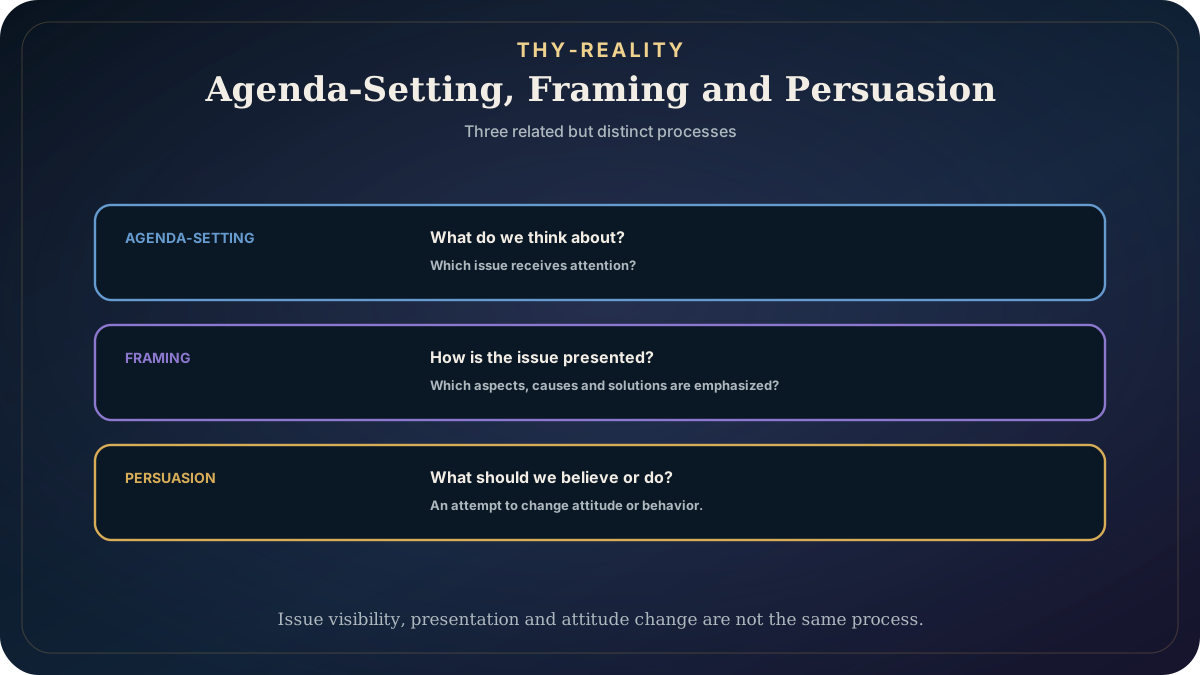
This is where one of the most important distinctions has to be made. Agenda-setting is not a synonym for propaganda, persuasion, or framing. If a news outlet reports on housing prices every day, housing may become more prominent in public attention. That is an agenda-setting question.
But the same problem can be presented as the result of insufficient construction, investment purchases, credit policy, demographic change, regulation, short-term rentals, or a combination of factors. At that point we are no longer asking only which problem is highlighted, but also how the problem is presented and interpreted.
This area of research is commonly known as framing.
Robert Entman described framing in terms of selecting certain aspects of perceived reality and making them more salient so that particular problem definitions, causal interpretations, evaluations, or remedies become more prominent. Agenda-setting and framing are therefore related, but they should not be treated as identical.
Direct persuasion is something else again: an attempt to move a person toward a particular belief, attitude, or action. A news environment can therefore increase the importance of an issue without successfully changing our opinion about it.
Something apparently paradoxical can even happen: two political camps may become equally convinced that a particular issue is the most important question of the moment because of the same media environment, while disagreeing completely about what that issue means and how it should be addressed.
That is why the simple claim that ‘the media tell people what to think’ misses an important part of the process. The influence is often subtler. First, the agenda of attention changes. Only then does the struggle over interpretation begin.
The media agenda is not the work of one secret editor
When we speak about ‘the media’, it is easy to imagine a single coordinated institution that decides the agenda somewhere and then transmits it to the public. The real system is much more complicated.
Different outlets compete with one another. Newsrooms monitor other newsrooms. Journalists follow public institutions, politicians, companies, researchers, wire services, local events, and social media. Political actors try to place issues in the news. Activists do the same. Companies organize events and issue press releases. Audiences signal attention through clicks, subscriptions, and sharing.
Sometimes an agenda begins with a political event. At other times it begins with a researcher, whistleblower, journalist, or citizen. Sometimes it starts on a social platform. Sometimes one television station or newspaper opens a topic that others then pick up.
Research on intermedia agenda-setting therefore examines how different media sources and producers influence one another. Analyses of U.S. elections, for example, show that different media systems can still be strongly aligned on broad topics, while influence is not simply one-way and can differ across types of media.
Muammar Gaddafi’s Green Book poses a sharper version of the same problem in its discussion of the press: can a privately owned medium automatically claim to speak for public opinion? Its answer is radical and THY-REALITY does not adopt it wholesale, but the underlying warning is useful. Media ownership, financing and governance are part of the environment in which editorial priorities emerge; a newspaper, broadcaster or platform should therefore not be casually equated with “the voice of the people.”
This does not mean that an owner dictates every headline or that every private outlet is a propaganda instrument. It means that agenda analysis should also ask who controls access to distribution, who bears costs, who can change editorial conditions, and which commercial or institutional interests shape selection. For this article, Gaddafi’s critique is therefore most useful as an additional question about representation: media can measure, summarize or shape public debate, but the public is not identical to the medium reporting on it.
That is an important correction to an overly simple picture. The useful question is not necessarily: ‘Who controls the media?’ A better question is:
Which processes determine what becomes visible, who can enter those processes, and which interests or criteria receive more weight?
That question can be investigated. A claim of hidden centralized control, like any other claim, would require separate evidence.
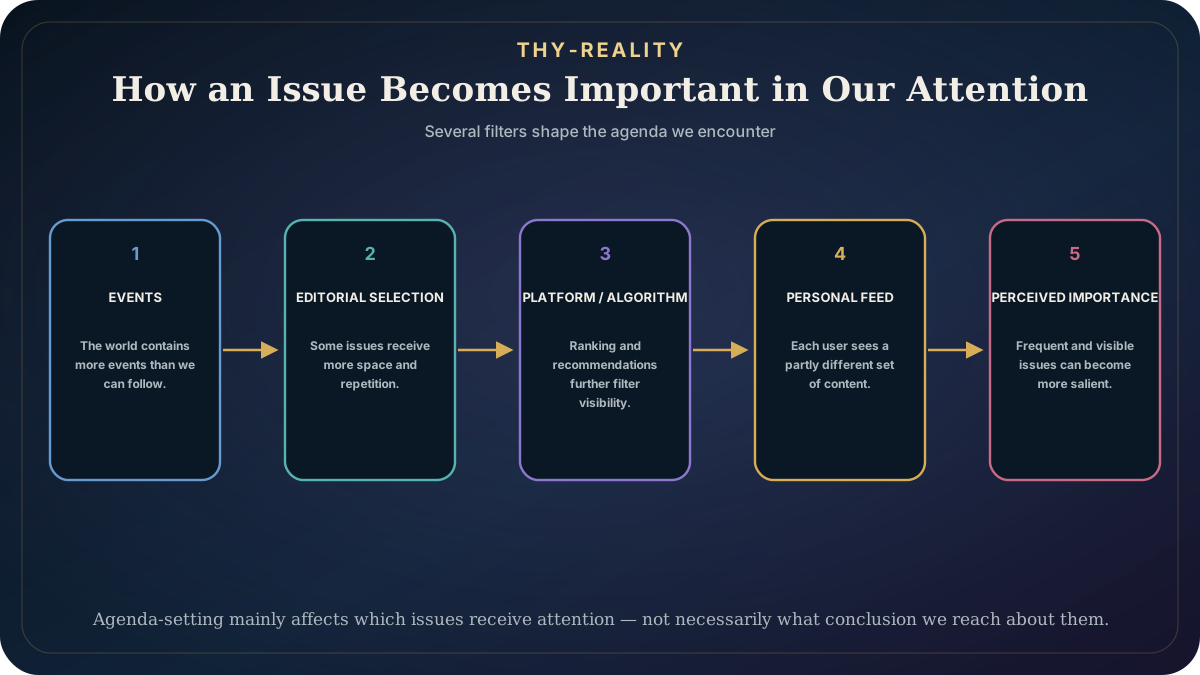
In the digital world, each of us gets a different front page
Classic agenda-setting research emerged when large numbers of people watched the same television newscasts and read a relatively limited range of newspapers. Today's information environment is different.
Two people can open the same social network and encounter almost entirely different information environments. The order of content can be influenced by past clicks, follows, friends, location, interests, behavior of similar users, and recommendation algorithms.
The traditional editor is therefore no longer the only gatekeeper of attention. Part of the selection is made by the user. Part by the user's social network. Part by traditional media. Part by the platform.
In an experimental study, Jessica Feezell found that exposure to political information through Facebook could increase the perceived importance of political issues even among people who were not actively seeking news. That suggests that agenda-setting mechanisms did not disappear with the shift to social media; the pathways through which exposure occurs changed.
But large claims still require caution.
A study of personalized news recommendations during Denmark's 2022 parliamentary election, involving tens of thousands of users, found statistically significant but small effects of a recommendation system on exposure to political content. Personalization was also associated with somewhat softer news and less diverse exposure to topics, actors, or issues. The authors therefore warn about possible cumulative consequences, but the results do not support the idea that an algorithm simply and completely programs a user's political mind.
The digital agenda is therefore both more personal and more complex. We no longer have only the question: ‘What is on the front page today?’
Why was this, specifically, on my front page today?
The power of attention is not proof of conspiracy
Once we understand agenda-setting, it is easy to slide into the opposite extreme. We may start searching for meaning in every story that was not published. ‘Why aren't they reporting this?’ can be a perfectly legitimate question. Sometimes it can reveal poor editorial judgment, political pressure, commercial interests, bias, or a genuinely neglected issue.
But the absence of coverage is not, by itself, proof of deliberate suppression.
Every day, media outlets leave countless real events uncovered simply because space and attention are limited. A journalist may not know about an event. The information may not be verifiable. The issue may be local. An editor may judge it less important. Another event may displace it. The audience may show little interest.
The methodologically sound question is therefore not only: ‘Are they reporting it?’
We should also ask: How often? Compared with what? How can the importance of the issue be assessed independently of the volume of coverage? Is there a recurring pattern? Does the same pattern appear across different outlets? What alternative explanations account for the difference?
This is where this article directly meets the theme of “When Too Much Information Leads to Less Understanding.” When there is too much information, something must inevitably be selected. Media perform part of that selection before information reaches us. Algorithms perform another part. We perform a third.
Our sense of ‘the most important things happening right now’ can therefore emerge through several successive filters. None of those filters is automatically malicious. But none is perfectly neutral either.
How to see the agenda without giving up on news
The point of understanding agenda-setting is not to stop following media. Rejecting all media does not give us unfiltered reality. It only replaces one system of information selection with another. A more useful approach is to start noticing the selection itself.
When an issue receives extraordinary attention, we can ask whether its objective importance has actually increased or whether the volume of coverage has mainly increased. We can compare different newsrooms and see whether they share the same priorities. We can examine the timeline and ask who first brought the issue forward. For statistical claims, we can check primary data and ask whether a dramatic individual case represents a broader trend. On social media, we can look for the original source of a piece of content and distinguish it from accounts that merely repeat it.
It is also important to notice the difference between selection and interpretation. First ask: Why am I seeing this issue? Then: How is it being presented to me? Only then: Is the explanation well supported?
That final question leads directly back to the article “From Belief to Verification.” A media source can bring an issue to our attention without requiring us to accept its interpretation uncritically. At the same time, it is not reasonable to reject a true claim merely because we recognized that someone selected it as important.
Media literacy is not distrust of everything. It is the ability to see the separate layers of the process. The event is one layer. Selection is another. Prominence is a third. The interpretive frame is a fourth. Our own interpretation is a fifth.
When we separate those layers, we can use media as sources of information without forgetting that no media stream is the whole of reality.
Media are not the world. They are one of the maps of our attention to the world. A mature relationship with information begins when, alongside what the map shows us, we also ask how the map was drawn.
Sources and further reading
- Cohen, B. C. (1963). The Press and Foreign Policy. Princeton University Press. Source
- McCombs, M. E. & Shaw, D. L. (1972). The Agenda-Setting Function of Mass Media. Public Opinion Quarterly, 36(2), 176–187. DOI: 10.1086/267990. Source
- McCombs, M. (2005). A Look at Agenda-setting: Past, Present and Future. Journalism Studies, 6(4), 543–557. DOI: 10.1080/14616700500250438. Source
- Entman, R. M. (1993). Framing: Toward Clarification of a Fractured Paradigm. Journal of Communication, 43(4), 51–58. DOI: 10.1111/j.1460-2466.1993.tb01304.x. Source
- Scheufele, D. A. & Tewksbury, D. (2007). Framing, Agenda Setting, and Priming: The Evolution of Three Media Effects Models. Journal of Communication, 57(1), 9–20. DOI: 10.1111/j.0021-9916.2007.00326.x. Source
- Feezell, J. T. (2018). Agenda Setting through Social Media: The Importance of Incidental News Exposure and Social Filtering in the Digital Era. Political Research Quarterly, 71(2), 482–494. DOI: 10.1177/1065912917744895. Source
- Chen, Y., Liu, Y., Singh, L. & Budak, C. (2024). Intermedia Agenda Setting during the 2016 and 2020 U.S. Presidential Elections. Proceedings of the International AAAI Conference on Web and Social Media, 18(1), 254–275. DOI: 10.1609/icwsm.v18i1.31312. Source
- Einarsson, Á. M., Helles, R. & Lomborg, S. (2025). Algorithmic Agenda-setting: The Subtle Effects of News Recommender Systems on Political Agendas in the Danish 2022 General Election. Information, Communication & Society, 28(2), 218–238. DOI: 10.1080/1369118X.2024.2334411. Source
- Gaddafi, Muammar. The Green Book, Part One: “The Solution of the Problem of Democracy — The Authority of the People”, section “The Press” — used here as a comparative critique of media ownership and claims to represent public opinion. Source