How to Recognize Your Own Blind Spots
We quickly notice interests, emotions, and biases in other people. In ourselves, we often feel that we simply see things as they are. How can we test our own judgment too?

We often notice quickly what might be influencing someone else’s judgment. A person defends the company they work for. Someone judges another person more harshly because they dislike them. Someone accepts mainly the information that supports an existing political, religious, or worldview commitment.
When we turn to ourselves, the picture changes. We know our reasons from the inside. We know that we thought, compared, and tried to be fair. It can therefore feel as if our position is not the result of bias at all, but simply the result of having considered the issue carefully.
Psychology documents a striking asymmetry: people often recognize the operation of bias more readily in others than in themselves. Emily Pronin, Daniel Lin, and Lee Ross called this the bias blind spot.
The feeling that we are objective is not evidence that we are objective.
What Does a “Blind Spot” Mean Here?
The phrase can be used broadly. A blind spot may be a recurring behavioral pattern, a reaction, an assumption, or an influence on a decision that we fail to notice in ourselves.
In judgment research, the bias blind spot has a more specific meaning: the tendency to see cognitive and motivational biases as operating more strongly in other people than in oneself. In the original studies by Pronin, Lin, and Ross, participants rated a range of familiar biases as more characteristic of others than of themselves.
Knowing the names of biases is therefore useful, but it is not an automatic vaccine against them. We can understand confirmation bias and spot it immediately in someone else while still evaluating evidence that supports our own view differently from evidence that challenges it.
Why We Do Not See Blind Spots Directly
When we ask whether we were biased, we often inspect our inner experience: Did I want to mislead anyone? Was I angry? Did I deliberately ignore evidence? If we find no such motive, we may conclude that our judgment was objective.
Yet many processes that shape judgment are not necessarily available as a direct conscious feeling. In an influential review, Richard Nisbett and Timothy Wilson argued that people do not always have direct introspective access to the higher-order cognitive processes that produced a response.
This does not mean that every explanation we give for our behavior is wrong. It means that introspection is not a perfect measuring instrument. If we search inside ourselves for the feeling of “being biased,” we may miss an influence that simply feels like ordinary judgment.
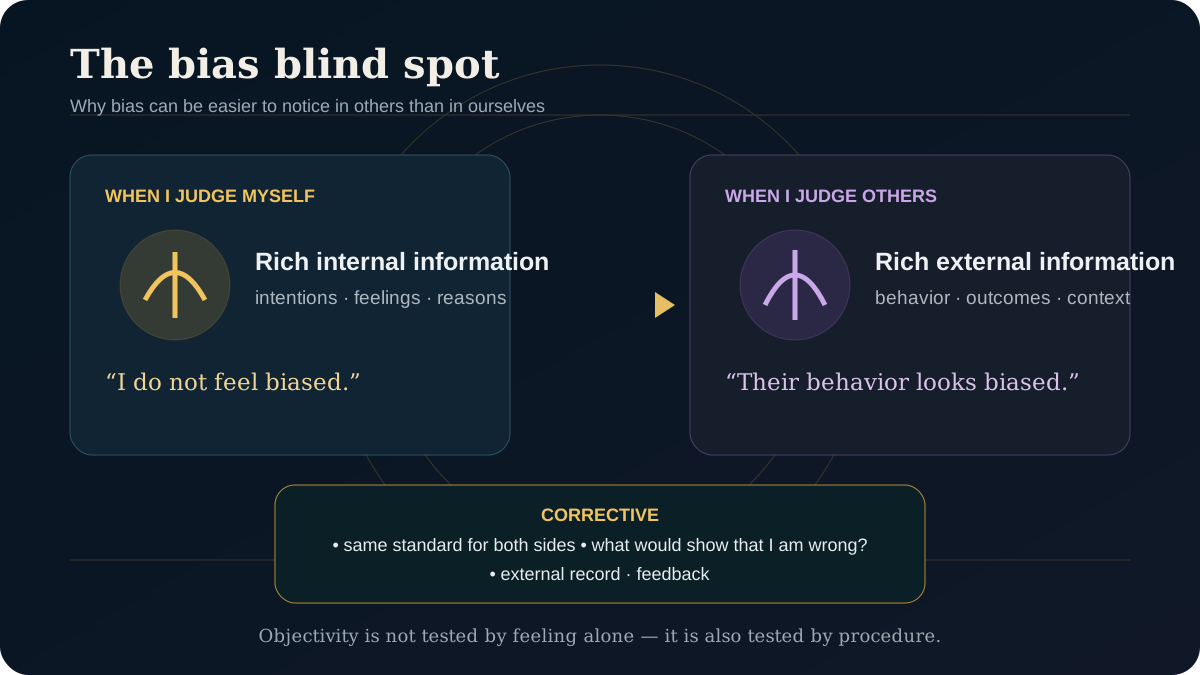
We do not have direct access to another person’s inner life, so we look at what they said and did, which evidence they accepted or rejected, what interests they have, and whether they apply the same standards across cases.
For ourselves, we also have access to our intentions and feelings—and those intentions are often good. Most people do not decide to be biased; they experience themselves as trying to work out what is true.
Research by Pronin and Matthew Kugler found that people give greater weight to introspective information when judging their own bias, while relying more on behavior when judging others. That difference can help produce the blind spot.
“I am just looking at the facts. You are looking through your ideology.” Two opposing sides can say the same sentence sincerely.
It might seem that people with stronger reasoning abilities should be far less susceptible to the bias blind spot. Research by Richard West, Russell Meserve, and Keith Stanovich found a more complicated pattern: measures of cognitive ability and reflective thinking did not eliminate the blind spot.
An important nuance is that the bias blind spot is not the same thing as actual susceptibility to every individual cognitive bias. West and colleagues did not find that having a smaller blind spot automatically meant showing fewer classic biases.
Scopelliti and colleagues treated the bias blind spot as a distinguishable metacognitive phenomenon and found, among other consequences, that a larger blind spot predicted a greater tendency to discount advice from others.
Being a better arguer does not automatically make someone better at correcting their own errors.
How to Detect a Blind Spot Indirectly
- We use a different evidential threshold for our own side: supporting evidence is accepted as plausible, while opposing evidence must be nearly conclusive.
- We explain other people’s views through psychology or interests, but explain our own mainly through facts and good intentions.
- A counterargument triggers an immediate need to respond before we have tried to understand it accurately.
- Changing our mind feels like defeat because the belief has become part of identity, group membership, or moral self-image.
None of these signs proves bias on its own. They are warning signals that it may be worth slowing down and checking whether we are truly applying the same standards to competing possibilities.
Predefined Criteria and Contrary Evidence
Charles Lord, Mark Lepper, and Elizabeth Preston showed in two experiments that prompting people to deliberately consider the opposite reduced the forms of biased social judgment examined in their studies.
Instead of asking only “Am I right?”, we can ask: “What would I expect if I were wrong?” and “What evidence would actually make me change my mind?”
If there is no possible answer to the second question, we may no longer be testing a hypothesis; we may be protecting it.
Before evaluating a study, candidate, political proposal, or argument, we can define some basic standards. What counts as a good source? What would be a serious methodological flaw? How much independent evidence do we need?
Then we apply the same standards when the result is not the one we hoped for. This moves part of the judgment from private feeling into a procedure that can be inspected.
Other People as a Mirror
Feedback is not useful because another person must be right. It is useful because they are not trapped inside exactly the same internal point of view.
Someone else may notice a shifting standard, a missed counterargument, or an assumption that feels so obvious to us that we no longer see it as an assumption. Feedback is most useful when we ask for criticism of a specific reason or piece of evidence rather than a general opinion.
Write It Down, Then Test It
If we record in advance what we expect, why we expect it, and what conditions would change our conclusion, it becomes harder to rewrite the story later so that it appears we “knew it all along.”
A written record is not perfect protection against bias. It is, however, an external trace of our earlier thinking that can be compared with the explanation we give afterward.
In two longitudinal experiments, Morewedge and colleagues found that structured training with feedback and practice reduced several of the biases they examined. Effects remained measurable at least two months after a single intervention, and games with personalized feedback and practice produced larger effects than instructional videos.
This does not mean a single training session removes all bias. It does suggest that systematic practice can do more than merely learning the vocabulary of errors.
A Short Test for Your Own Blind Spot
- What is the strongest evidence against my current conclusion?
- Would I accept the same evidence if it supported the other side?
- Am I using a softer standard for my view than for someone else’s?
- Which assumption am I currently treating as a fact?
- What would have to be true for me to be wrong?
- What would actually make me change my mind?
No answer guarantees objectivity. But framing the question so that our own error remains possible changes the way we investigate.
We Do Not Remove Blind Spots by Declaring That We Have None
Perception Is Not the Same as Reality showed that perception is not a perfect copy of reality. From Belief to Verification separated belief from verification. Self-Deception: When the Mind Defends the Story Instead of the Truth examined how the mind can defend a story, and Why We Need Certainty explored why certainty is attractive. This article adds the next step: the possibility that part of the problem lies in our own way of looking must be built into the method of inquiry.
This is not a call for endless self-doubt. If every decision ended with “perhaps everything I think is biased,” we would never act. A more useful position is: my judgment may be good, but I will not call it good merely because it feels objective to me.
Critical thinking is not only the ability to find a flaw in someone else’s argument. Its harder part is creating conditions in which we can discover a flaw in our own.
Sources and further reading
- Pronin, E., Lin, D. Y. & Ross, L. (2002). The Bias Blind Spot: Perceptions of Bias in Self Versus Others. Personality and Social Psychology Bulletin, 28(3), 369–381. DOI: 10.1177/0146167202286008. Source
- Pronin, E. (2007). Perception and Misperception of Bias in Human Judgment. Trends in Cognitive Sciences, 11(1), 37–43. DOI: 10.1016/j.tics.2006.11.001. Source
- Pronin, E. & Kugler, M. B. (2007). Valuing Thoughts, Ignoring Behavior: The Introspection Illusion as a Source of the Bias Blind Spot. Journal of Experimental Social Psychology, 43(4), 565–578. DOI: 10.1016/j.jesp.2006.05.011. Source
- Nisbett, R. E. & Wilson, T. D. (1977). Telling More Than We Can Know: Verbal Reports on Mental Processes. Psychological Review, 84(3), 231–259. DOI: 10.1037/0033-295X.84.3.231. Source
- West, R. F., Meserve, R. J. & Stanovich, K. E. (2012). Cognitive Sophistication Does Not Attenuate the Bias Blind Spot. Journal of Personality and Social Psychology, 103(3), 506–519. DOI: 10.1037/a0028857. Source
- Scopelliti, I., Morewedge, C. K., McCormick, E., Min, H. L., Lebrecht, S. & Kassam, K. S. (2015). Bias Blind Spot: Structure, Measurement, and Consequences. Management Science, 61(10), 2468–2486. DOI: 10.1287/mnsc.2014.2096. Source
- Lord, C. G., Lepper, M. R. & Preston, E. (1984). Considering the Opposite: A Corrective Strategy for Social Judgment. Journal of Personality and Social Psychology, 47(6), 1231–1243. DOI: 10.1037/0022-3514.47.6.1231. Source
- Morewedge, C. K., Yoon, H., Scopelliti, I., Symborski, C. W., Korris, J. H. & Kassam, K. S. (2015). Debiasing Decisions: Improved Decision Making With a Single Training Intervention. Policy Insights from the Behavioral and Brain Sciences, 2(1), 129–140. DOI: 10.1177/2372732215600886. Source