The Inner Compass and Clear Choice
An inner compass is not an infallible inner voice. It is the disciplined capacity to connect facts, emotions, values, conscience, consequences, and responsibility — without outsourcing moral judgment to impulse, the crowd, or authority.

Sometimes a decision is simple. If it rains, we take an umbrella. If we are hungry, we eat. If a deadline is approaching, we finish the task. But some decisions do not have such an obvious answer.
Should we stay or leave? Accept the offer or reject it? Speak or remain silent? Keep defending something we have believed for a long time, or admit that we may have changed our mind? And in some decisions the question is not only “what do I want?” but also “what do I believe is right — and what part of the responsibility am I willing to carry?”
In such decisions people often speak of an inner compass. The phrase is useful as long as we treat it as a metaphor. There is no special organ inside us that infallibly points toward the right decision. What feels like an “inner voice” can arise from experience, emotion, habit, values, conscience, unconsciously learned patterns, fear, social expectations, or a desire for a particular outcome.
For THY-REALITY, one further step matters. An inner compass is not merely a tool for choosing among options. It is part of inner self-government: the capacity to make one’s own judgment while using facts and reasons, listening to conscience and values, examining consequences, and refusing to hand moral responsibility automatically to an impulse, a crowd, a title, or an authority.
Inner sovereignty does not mean certainty that I am right. It means I do not outsource judgment — and I remain willing to test, revise, and take responsibility for my reasons.
Impulse, Habit, and the Inner Compass
Imagine receiving an unpleasant message. Your first impulse is to reply immediately. Your body is tense, thoughts assemble quickly, and you know exactly what you want to write. A few minutes later, the same situation may look different.
What changed? Not necessarily your values or the facts. The intensity of the current emotional state changed. Research on decision making shows that emotions are not merely an enemy of reason. They systematically participate in judgment and can help or harm depending on their source and relevance to the decision.
We therefore do not need to silence emotion. We need to identify and place it. The useful question is not “How do I decide without emotion?” but “What is this emotion telling me — and is it about the decision, about me, or about something else?”
Another candidate for the “inner voice” is habit. When a behavior is repeated often in similar circumstances, it can become a default response. Research on habits shows that recurring contexts can efficiently cue learned responses, while habits and deliberate goal pursuit often operate together.
We see this in ordinary life: we always take the same route, withdraw in the same kind of conflict, or say yes even when we want to say no. Because we have done something many times, it can begin to feel natural.
“This is what I always do” is not the same as “this is what I want to choose today.”
Values and the Influence of Others
For clear choice it helps to distinguish a desire from a value. A desire can be immediate: I want peace, an answer, victory, approval, or escape from an uncomfortable conversation.
Values are broader. In Schwartz’s theory of basic human values, values are desirable goals that transcend specific situations and guide evaluation and choice. The model also emphasizes that some values express compatible motivations while others can come into conflict.
This is why difficult decisions are often not a contest between good and bad. They can be a conflict between two things that matter: freedom and security, loyalty and honesty, peace and truth, growth and stability.
A clear decision therefore does not require discovering one hidden value that solves the problem automatically. It often begins by honestly recognizing the value conflict.
People do not make decisions in a vacuum. From childhood onward we learn what is acceptable, successful, safe, shameful, expected, and desirable. Some external standards become genuinely our own; others are followed mainly because of pressure, reward, fear of rejection, or guilt.
Ryan and Deci’s self-determination theory highlights autonomy: the experience of behavior as more volitional and self-endorsed rather than merely externally controlled. Through internalization, externally prompted reasons for action can become more congruent with one’s own values and identity.
It is therefore useful to ask: “I have to do this — but who or what is saying that I have to?” The answer is not necessarily problematic. Obligations and responsibilities are real. But the choice becomes clearer when we distinguish “I choose this” from “I mainly do this because I fear what will happen if I refuse.”
Conscience, Intuition, and Fear
When we speak of an inner compass, we quickly reach the idea of conscience. Conscience can be understood as one way we assess ourselves as moral agents: what we did, what we failed to do, what we are committed to, and what we are unwilling to betray in ourselves. But the history of the concept itself shows that conscience is not one universally understood mechanism.
An important limitation is that conscience can also contain rules learned from our surroundings. A person may feel guilty because they violated a sound moral principle — or because they violated a bad rule internalized from family, group, or culture. A strong feeling of guilt is therefore not automatic proof of moral guilt, just as the absence of guilt is not proof of innocence.
Conscience is most useful when it is not the end of reasoning but the beginning of examination. What is troubling me? What principle do I think has been violated? Would I accept the same rule if the roles were reversed? What do the facts show? Who bears the cost or harm of the decision? Can I explain my reason even to someone who disagrees with me?
Conscience deserves to be heard, not granted automatic infallibility. Moral judgment needs conscience, reasons, facts, symmetry, and a willingness to revise.
Intuition has an unusual place in discussions of decision making. Some people distrust it almost completely; others grant it an almost mystical access to truth. Both extremes are problematic.
Daniel Kahneman and Gary Klein, coming from different research traditions, identified an important point of agreement about intuitive expertise: intuition is most likely to be reliable when the environment contains sufficiently stable and predictable regularities and the person has had enough opportunity to learn from valid feedback.
This helps explain why an experienced professional can become very good at rapid pattern recognition in some domains, while years of confidence in an unpredictable environment do not by themselves create reliable intuition.
A strong feeling is not evidence that intuition is expert.
When something frightens us, we may conclude: “My body is telling me not to do this.” Sometimes that is a valuable warning. Sometimes fear simply signals that we are entering something new, important, or uncertain.
We can fear public speaking even when we want to speak, or fear an honest conversation even when we know it is needed. We can feel anxious about changing jobs even when the current job has become untenable.
Discomfort is not automatically evidence of the wrong direction — just as comfort is not automatically evidence of the right one.
Clarity, Certainty, and Moral Judgment
Before an important choice, we would like to know whether it will work. But the future is normally unavailable to us. We can know facts, estimate risks, identify values, and compare alternatives. We cannot always know what will happen.
It helps to distinguish certainty about the outcome from clarity about the process. We may not have the first. We can increase the second.
“I do not know whether this decision will turn out to be the best one. But I know what information I have, what I do not know, what matters to me, and which consequences I am prepared to accept.”
With matters of taste, we can often let someone else choose without much harm. In technical questions, it is reasonable to seek people who know more than we do. Moral judgment raises a different problem: a title, law, tradition, majority, or expert role may provide important information and reasons, but its mere existence cannot transform a harmful act into a right one.
This does not mean every individual is morally infallible, or that every authority, rule, and agreement should be rejected. It means something more modest: if I ultimately perform an action, I cannot erase my role in judging it simply by saying “others told me to.” The reverse is equally important: “this is what I feel” is not enough if I refuse to test my reasons.
Inner self-government is therefore more demanding than obedience and more demanding than rebellion. It asks us to accept expertise without moral capitulation, to consider community without blind conformity, and to trust ourselves without declaring ourselves infallible judges.
Self-government is not “I listen to no one.” It is “I listen, examine, decide, and do not hide my share of responsibility for the choice.”
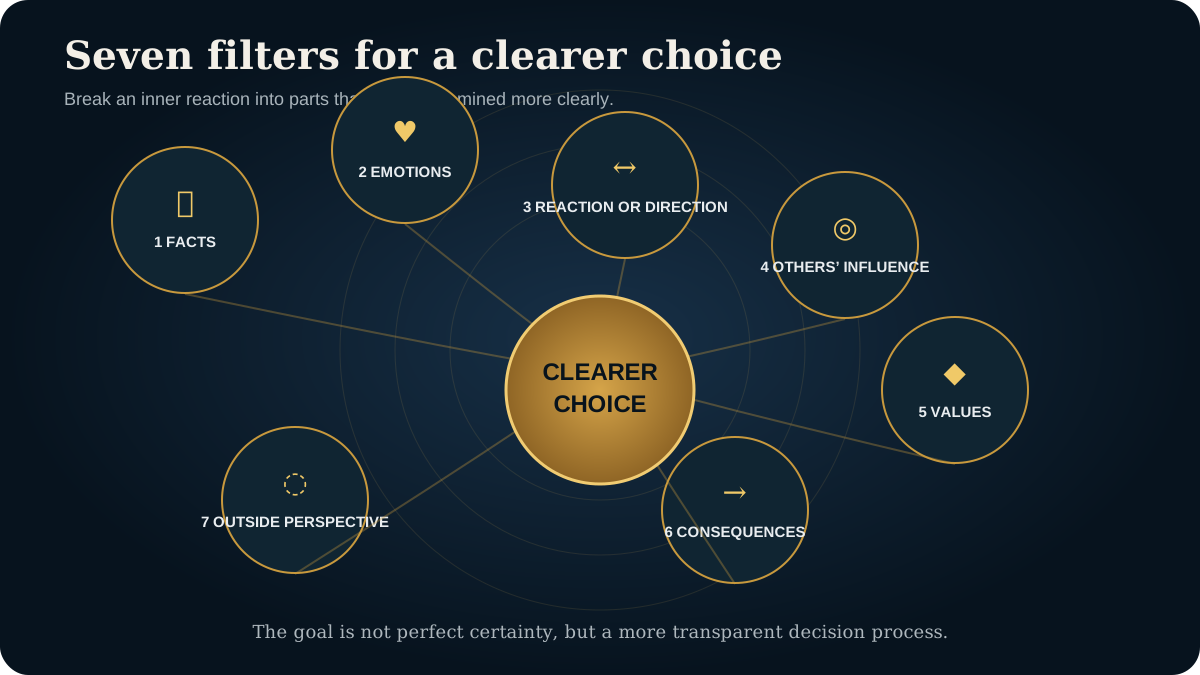
Seven Filters for a Clearer Choice
- What do I actually know? Separate facts from interpretation, assumptions, and expectations.
- What am I feeling right now? Name the emotion without declaring it evidence.
- Is this a reaction or a direction? If it is not urgent, ask whether you would want the same thing after the immediate emotional wave has passed.
- What is genuinely my judgment, and what have I absorbed from others? Then consciously return other people’s influence to the decision where it is justified.
- Which values and moral principles are in conflict here? Would I accept the same rule if the roles were reversed?
- What is this choice likely to cause for me, for others, and for the relationships between us — and who will bear most of the risk or harm?
- Can I explain my choice with reasons, revise it when new information arrives, and accept my fair share of responsibility for it?
No filter produces a universal answer. Together, however, they help break one powerful inner reaction into several components that can be examined. In moral decisions, it is especially important that an inner feeling also pass tests of facts, symmetry, consequences, and responsibility.
From Decision to Action
We can reach a very clear conclusion and still never carry it out. “I will set a boundary.” “I will spend less time on my phone.” “I will have the conversation.” There is a gap between intention and action.
Peter Gollwitzer studied implementation intentions — plans of the form “if situation X occurs, then I will do Y.” A meta-analysis by Gollwitzer and Paschal Sheeran covering 94 independent tests found a medium-to-large positive effect of implementation intentions on goal attainment (d = .65).
Instead of “I will set better boundaries,” an operational plan might be: “If the conversation becomes insulting again, I will say that I am willing to continue when we can talk without insults.” Such a plan does not guarantee success, but it translates intention into a recognizable cue and response.
The compass points toward a direction. We still have to take the step.
Internal conflict is not necessarily evidence that something is wrong with us. It often means that legitimate interests compete. One part wants safety, another growth. One wants belonging, another honesty. One wants to persist, another sees that it is time to change.
The task is not always to silence one of those voices. It is often more useful to understand what each of them is protecting. Only then can we choose more deliberately.
A Good Inner Compass Is Calibrated
A physical compass can point incorrectly near a strong magnetic field. Human judgment also needs calibration. Our “magnetic fields” can include intense emotion, habit, past experience, fear, the desire for approval, identity, personal interests, incomplete information, and blind spots.
This does not mean distrusting every feeling. It means helping the inner compass by comparing it with external landmarks: evidence, consequences, feedback, experience, values, and other people’s perspectives.
If new information shows that we were wrong, changing direction is not a failure of the compass. The ability to recalibrate is itself part of good navigation.
A Clear Choice Is Not Always an Easy Choice
The easiest decision is often the one in which nothing changes. We keep the same relationship, belief, behavior, or explanation. But clarity is not the same as comfort.
Sometimes the clear decision is: “I do not know enough, so I will wait.” At other times: “I know enough that I need to act.” Sometimes: “My emotion is an important warning.” At other times: “My emotion is real, but I do not want it to decide by itself.”
And sometimes the most important realization is simply: “This is not my value. I only believed for a very long time that it should be.”
From Blind Spot to Self-Government
In How to Recognize Your Own Blind Spots, we showed that we cannot automatically equate our own point of view with objectivity. Here we add the next step: even after accepting that we have blind spots, we still have to judge and choose. If our fallibility led us to outsource judgment every time, we would merely exchange one blind spot for another.
The answer is therefore not to stop trusting ourselves. Self-trust becomes more disciplined. We listen to feelings without mistaking them for facts. We respect experience while asking whether it was gained in an environment where intuition could actually learn. We identify values and conscience, but also ask where they came from. We listen to experts and other people without mistaking their position for moral infallibility. We examine consequences and remain willing to correct course.
An inner compass becomes morally useful when feeling becomes a reason, a reason becomes a considered choice, a choice becomes an action, and an action becomes responsibility.
This is the core of inner self-government. A sovereign person in this sense is not someone who always knows best. It is someone who does not leave moral judgment at the door of authority, the crowd, or personal impulse. They accept knowledge, criticism, and warnings from others, but remain able to take ownership of the final question: “Why do I believe this is right?”
A good decision is therefore less like a moment of revelation and more like navigation. We do not need a perfect map. We need enough landmarks to know which way we are going, enough character to take the next step, and enough humility to change direction when we discover that we were wrong.
Sources and further reading
- Lerner, J. S., Li, Y., Valdesolo, P. & Kassam, K. S. (2015). Emotion and Decision Making. Annual Review of Psychology, 66, 799–823. DOI: 10.1146/annurev-psych-010213-115043. Source
- Wood, W. & Rünger, D. (2016). Psychology of Habit. Annual Review of Psychology, 67, 289–314. DOI: 10.1146/annurev-psych-122414-033417. Source
- Schwartz, S. H. (2012). An Overview of the Schwartz Theory of Basic Values. Online Readings in Psychology and Culture, 2(1). DOI: 10.9707/2307-0919.1116. Source
- Ryan, R. M. & Deci, E. L. (2000). Self-Determination Theory and the Facilitation of Intrinsic Motivation, Social Development, and Well-Being. American Psychologist, 55(1), 68–78. DOI: 10.1037/0003-066X.55.1.68. Source
- Kahneman, D. & Klein, G. (2009). Conditions for Intuitive Expertise: A Failure to Disagree. American Psychologist, 64(6), 515–526. DOI: 10.1037/a0016755. Source
- Gollwitzer, P. M. (1999). Implementation Intentions: Strong Effects of Simple Plans. American Psychologist, 54(7), 493–503. DOI: 10.1037/0003-066X.54.7.493. Source
- Gollwitzer, P. M. & Sheeran, P. (2006). Implementation Intentions and Goal Achievement: A Meta-analysis of Effects and Processes. Advances in Experimental Social Psychology, 38, 69–119. DOI: 10.1016/S0065-2601(06)38002-1. Source
- Stanford Encyclopedia of Philosophy. Autonomy in Moral and Political Philosophy. Substantive revision 2025. Source
- Stanford Encyclopedia of Philosophy. Conscience. Substantive revision 2024. Source