Why We Need Certainty
Why can uncertainty feel harder than a poor answer? Explore intolerance of uncertainty, need for cognitive closure, and how to seek calibrated confidence.

Certainty gives us the sense that we understand the world, can anticipate what may happen, and know how to act. The desire for certainty is therefore not a mistake in itself. The problem begins when removing uncertainty becomes more important than the quality of the answer — when we would rather reach a quick conclusion than remain with a question a little longer.
In the article “I Don’t Know” as the Beginning of Knowledge, we saw that “I don’t know” can be the beginning of knowledge. But why can that sentence be so difficult to tolerate? Why does an open question sometimes produce more discomfort than a poor answer? Why might someone hold on to an explanation even while knowing that the evidence for it is still insufficient?
Part of the answer is practical. If we do not know what will happen, it is harder to prepare. If we do not understand why something happened, it is harder to decide what to do next. If we do not understand another person’s behavior, we may not know how to respond. Uncertainty is therefore not only a philosophical problem. It can affect decision-making, planning, and our sense of control.
In this article, we use the phrase “need for certainty” as a broad editorial expression, not as the name of a single psychological trait. The empirical research discussed below distinguishes several related constructs, including intolerance of uncertainty and need for cognitive closure.
The mind does not seek only correct explanations. To function, it also needs a sufficiently stable model of the world. The problem begins when the need for stability starts to outrun the quality of verification.
Uncertainty Is Not the Same as Danger
Imagine two situations. In the first, we know that something unpleasant will happen. In the second, we do not know whether it will happen. We might intuitively expect the first situation always to be more stressful because the negative outcome is certain. Yet in some circumstances, unpredictability itself can contribute substantially to an acute stress response.
Archy de Berker and colleagues studied learning about the probability of receiving an unpleasant electric shock in a laboratory task. Model-derived estimates of uncertainty predicted changes in participants’ subjective stress, pupil diameter, and skin conductance. Importantly, the authors were studying acute stress under uncertain threat, not proposing a general rule about every form of uncertainty or about chronic stress.
This does not mean that all uncertainty is dangerous or unpleasant. Uncertainty can be interesting, exciting, and necessary for discovery. Without the unknown, there would be nothing to investigate. But when uncertainty concerns safety, important decisions, or our future, unpredictability can make it difficult to know which response is appropriate.
It is therefore useful to distinguish between danger — something that may cause harm — and uncertainty, which means incomplete knowledge about what is happening, what will happen, or which outcome is more likely. The two can overlap, but they are not the same thing.
Sometimes it is not only the possibility of a bad outcome that troubles us. It is also not knowing which outcome to expect.
Intolerance of Uncertainty
Psychological research uses the term intolerance of uncertainty. It does not simply mean disliking ambiguity. It refers to a construct describing stronger negative responses to unknown or uncertain situations and to the absence of sufficiently clear information.
Nicholas Carleton has reviewed intolerance of uncertainty and fear of the unknown as important transdiagnostic constructs in research on anxiety and related difficulties. This does not mean that uncertainty is the source of every psychological problem or that discomfort with uncertainty by itself implies a diagnosis. It means that the way people respond to the unknown is an important dimension of psychological research.
The desire to reduce uncertainty is otherwise completely ordinary. If we hear an unusual noise coming from our car, we want to know what caused it. If we are waiting for an important result, we want an answer. If we do not know what will happen to our job, we want clarity.
The problem is therefore not the desire for information. The problem begins when it quietly becomes the rule that any answer is better than an open question. At that point, the psychological desire for closure can begin to move faster than the evidence.
Reducing uncertainty can be a reasonable goal. But reducing uncertainty is not the same as increasing knowledge.
Need for Cognitive Closure: Grabbing an Answer and Then Holding On to It
Donna Webster and Arie Kruglanski studied what they called need for cognitive closure. Within their framework, it refers to the desire for a definite answer to a question rather than continued ambiguity. Their original measurement work associated the construct with several aspects, including preference for predictability, order and structure, discomfort with ambiguity, decisiveness, and closed-mindedness.
Importantly, the theory does not treat need for closure only as a stable individual difference. Kruglanski and Webster also described it as a situationally evocable state: circumstances can increase the pressure to reach closure, especially when continued information processing is experienced as costly or when reaching a conclusion becomes urgent.
The framework is often described through two related tendencies captured by the terms seizing and freezing. Seizing refers to quickly embracing an available answer that permits closure. Freezing refers to preserving that answer and becoming less open to information that would require reconsideration.
Imagine a rumor in the workplace: “The company is going to make layoffs.” The available information is unclear. Someone hears that the director held a closed-door meeting. Under strong pressure to reach a quick conclusion, that limited fact may rapidly become: “So it’s true. The layoffs have already been decided.” From that moment on, new information is no longer merely information. It can begin to feel like a threat to an explanation that has already been formed.
Sometimes we accept a story quickly not because we like it, but because remaining without a story is difficult to tolerate.
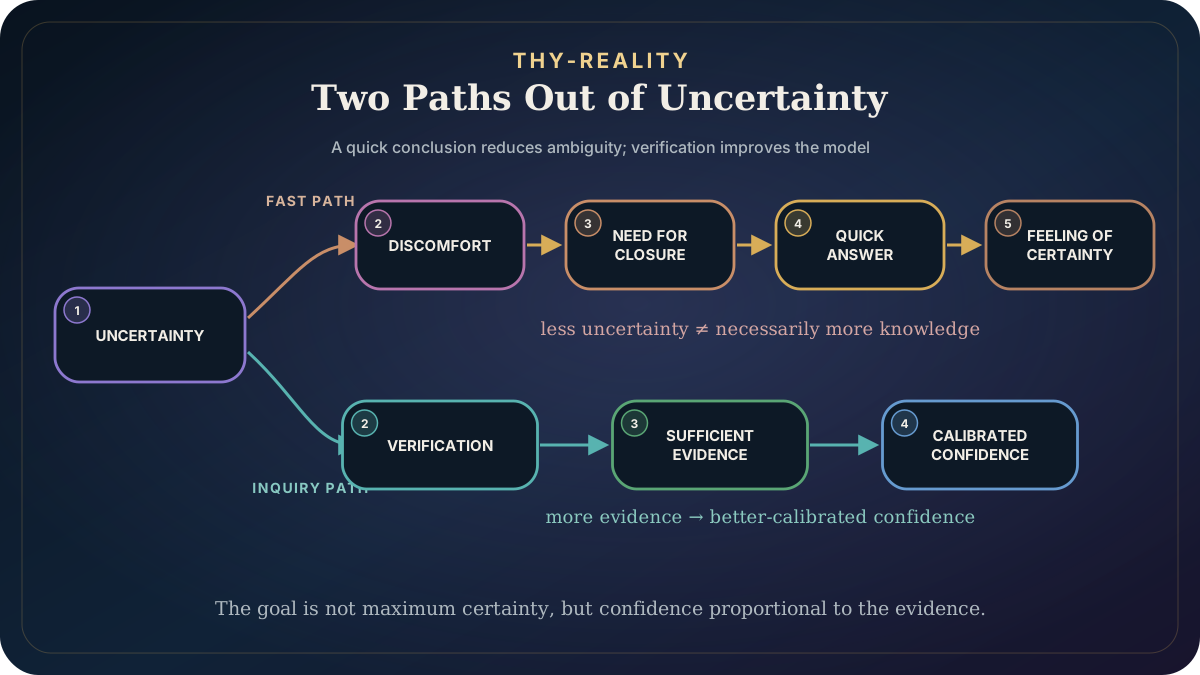
A Quick Answer Can Reduce Uncertainty Without Increasing Knowledge
Imagine three answers to the question “Why did this happen?” The first says: “We don’t know yet.” The second says: “Probably A, but we do not yet have enough evidence.” The third says: “Definitely A. There is no doubt.” The third answer provides the strongest feeling of closure, but its psychological satisfaction tells us nothing by itself about the quality of the evidence.
If the second answer is better supported, then it is epistemically better even if it feels less satisfying. Reducing uncertainty and increasing knowledge are therefore two different processes. A good answer can reduce uncertainty because we obtained better information. A poor answer can reduce uncertainty simply because we stopped asking questions.
Need for closure may also influence what happens after the initial conclusion. Dijksterhuis and colleagues examined perceptions of social groups in two experiments. Participants with a higher dispositional need for closure recalled relatively more stereotype-consistent information and judged the target groups as more stereotypical and homogeneous in their tasks; most of the first experiment’s pattern was replicated in a second, more complex experiment.
This does not mean that every person with a stronger need for closure is always stereotypical, nor that one psychological measure predicts behavior in every situation. The studies instead illustrate that, under certain conditions, a desire for a stable conclusion can influence which information receives more weight in memory and judgment.
The feeling “now I understand” is a psychological signal of closure. It is not independent evidence that the conclusion is correct.
Certainty, Groups, and Identity
Uncertainty is not always only the question “What is happening?” It can also be “Who am I?”, “Where do I belong?”, or “How should I understand my place in the world?” Michael Hogg’s uncertainty–identity theory proposes that, in some circumstances, group identification can reduce self-uncertainty because social identities provide shared prototypes, norms, and expectations that help people understand who they are and how they should act.
This does not mean that people join groups primarily because they cannot tolerate uncertainty. Belonging serves many functions: relationships, cooperation, culture, shared goals, and community. The theory suggests only that reducing certain forms of self-uncertainty can be one motivational process among others.
A highly structured system of answers can therefore be psychologically attractive before we know whether it is true. The world contains gray areas; the system turns them into black and white. The world contains open questions; the system closes them. Clarity is a property of an explanation. Truth is a question of how well the explanation fits the evidence. Those are not the same criterion.
THY-REALITY must also be careful about the opposite extreme. Once someone learns that certainty can be misleading, they may adopt a new absolute answer: “You can’t trust anyone,” “Everything is manipulation,” or “The official explanation is always wrong.” Such skepticism can serve the same psychological function as dogma if it provides an answer that can no longer be seriously threatened by any possible evidence.
The article “From Belief to Verification” therefore introduced a better principle: the strength of our belief should track the quality of the evidence. The article “I Don’t Know” as the Beginning of Knowledge added that “I don’t know” is a legitimate state of knowledge. The ability to tolerate some uncertainty gives new evidence time to change our answer.
Clarity can feel very good. But clarity and truth are not the same criterion.
When Authority Offers Certainty
The need for closure affects more than how quickly we accept an explanation. Another important question is who offers that explanation. An ideology, group, leader, media outlet, guru, or expert may provide a clear model of the world in which ambiguity is reduced and answers are ready-made. That model may be correct or incorrect; its psychological appeal tells us nothing by itself about the truth of its claims.
Research on need for cognitive closure and dogmatism finds associations between a stronger motivation to close open questions quickly, more closed belief systems, resistance to change, and some forms of authoritarian attitudes. These associations should not be turned into labels for individuals. A high need for certainty does not mean that a person will inevitably be obedient or authoritarian, and political and cultural context matters for how such motives are expressed.
Nor is relying on an expert itself a problem. No one can personally verify every laboratory measurement, legal detail, or technical system. Reasonable reliance on expertise is part of a functioning society. The distinction appears when a title or group identity begins to replace reasons: when a claim becomes untouchable because it came from “our” source, or when we grant someone moral and epistemic authority far beyond the domain in which we have reason to trust their expertise.
Authority can be a valuable source of information. It should not become a shortcut by which the need for certainty is mistaken for evidence.
The useful move is therefore from “Who said this?” to “What reasons and evidence support it — and in which domain is this source actually competent?” Later articles will connect this distinction to conformity, obedience, and conscience.
How to Live With Uncertainty Without Becoming Stuck in It
The goal is not to glorify uncertainty. If a question can be answered well, answer it. If we have strong evidence, form a conclusion. If a decision cannot wait, make it using the best information currently available. Perfect certainty before every action is often impossible. But demanding an immediate answer where the evidence does not yet support one is equally problematic.
For an important question, six steps can help:
- What exactly is uncertain here? Limit the uncertainty to specific components instead of declaring everything unknown.
- Do I need an answer now? Some decisions are time-sensitive. Others can wait for better information.
- Am I looking for new information, or mainly for relief? Rechecking sometimes produces knowledge; at other times it provides only temporary reassurance.
- How reliable does the answer need to be given the consequences? Greater consequences generally justify a stricter standard of verification.
- Can I make a decision under uncertainty? Often we do not need complete knowledge. It may be enough to understand the available options, their approximate probabilities, and what we will do under different outcomes.
- What would change my current assessment? This prevents a temporary conclusion from quietly becoming untouchable certainty.
This approach does not eliminate uncertainty. It makes uncertainty more manageable. Instead of “I must know,” we can ask: “What can I currently justify, and what will I do if new information appears?”
A good decision does not always require complete certainty. It requires a sufficiently good model, clearly marked uncertainties, and a willingness to update.
Certainty Is Not the Goal of Inquiry
Human beings need enough stability to function. The desire for order, predictability, and answers is therefore understandable. Certainty has psychological and practical functions. But the search for reality requires another ability: to tolerate the space between a question and an answer.
In that space, new evidence may appear, along with a better explanation, a correction, or the realization that the question itself was poorly framed. A conclusion reached too quickly closes that possibility. Refusing every conclusion indefinitely can leave us equally paralyzed.
The goal is therefore neither maximum certainty nor maximum doubt. The goal is calibration. Where the evidence is strong, a high degree of confidence is appropriate. Where the evidence is weak, more uncertainty should remain. Where we do not know, it should be acceptable to say: “For now, I don’t know.”
And where we must act despite uncertainty: “This is currently the best decision I can make based on the information I have. If the evidence changes, I will revise the decision as well.”
This article therefore does not argue for a world without answers. It argues for distinguishing between an answer that is well supported and one that is primarily psychologically reassuring. If we fail to make that distinction, we can quietly mistake our need for certainty for evidence that something is true.
Mature inquiry does not require a world without uncertainty. It requires that we do not mistake our need for certainty for evidence of truth.
Sources and further reading
- Webster, D. M. & Kruglanski, A. W. (1994). Individual Differences in Need for Cognitive Closure. Journal of Personality and Social Psychology, 67(6), 1049–1062. DOI: 10.1037/0022-3514.67.6.1049. Source
- Kruglanski, A. W. & Webster, D. M. (1996). Motivated Closing of the Mind: ‘Seizing’ and ‘Freezing’. Psychological Review, 103(2), 263–283. DOI: 10.1037/0033-295X.103.2.263. Source
- Carleton, R. N. (2016). Into the Unknown: A Review and Synthesis of Contemporary Models Involving Uncertainty. Journal of Anxiety Disorders, 39, 30–43. DOI: 10.1016/j.janxdis.2016.02.007. Source
- Carleton, R. N. (2016). Fear of the Unknown: One Fear to Rule Them All? Journal of Anxiety Disorders, 41, 5–21. DOI: 10.1016/j.janxdis.2016.03.011. Source
- de Berker, A. O., Rutledge, R. B., Mathys, C., Marshall, L., Cross, G. F., Dolan, R. J. & Bestmann, S. (2016). Computations of Uncertainty Mediate Acute Stress Responses in Humans. Nature Communications, 7, 10996. DOI: 10.1038/ncomms10996. Source
- Dijksterhuis, A., van Knippenberg, A., Kruglanski, A. W. & Schaper, C. (1996). Motivated Social Cognition: Need for Closure Effects on Memory and Judgment. Journal of Experimental Social Psychology, 32(3), 254–270. DOI: 10.1006/jesp.1996.0012. Source
- Hogg, M. A. (2007). Uncertainty–Identity Theory. Advances in Experimental Social Psychology, 39, 69–126. DOI: 10.1016/S0065-2601(06)39002-8. Source
- Gaffney, A. M. & La Vogue, N. (2020). Dogmatism and the Need for Closure. Oxford Research Encyclopedia of Psychology. DOI: 10.1093/acrefore/9780190236557.013.318. Source
- West, M. P. & Yelderman, L. A. (2024). The dispositional need for cognitive closure indirectly predicts mock jurors’ sentencing decisions through right-wing authoritarianism. Psychiatry, Psychology and Law, 31(2), 161–178. DOI: 10.1080/13218719.2023.2175072. Source