Obey an Order or Follow Conscience?
Many systems could not function without authority. But an order cannot think in place of the person who carries it out: when is obedience reasonable, and when must moral judgment intervene?

A doctor gives a professional recommendation to a nurse, an incident commander assigns tasks to a firefighting team, an air-traffic controller gives instructions to a pilot, a military commander issues an order to a soldier, and the law tells a citizen what they must or must not do. At first glance these cases look similar: one person or institution requires something of another.
Morally, however, they are not necessarily the same.
An expert may know more. A team leader may coordinate shared work in a voluntarily accepted role. A contract may define limited authority. Political authority makes a stronger claim: the right to impose binding rules even on people who did not personally accept each individual command, and under certain conditions to enforce them coercively.
If we call all these different relationships by the same word—authority—we can hide at the outset the very question we still need to examine.
Knowledge can justify trust. Agreement can justify a role. The right to rule another person requires its own moral justification.
Coordination, authority, and the right to rule
Coordination is not the same as a right to rule Large and complex systems need coordination. A surgical team cannot stop during an operation to vote anew on every movement. A firefighting unit needs clear information and assigned tasks. Air traffic requires shared procedures. Companies, associations and other organisations need agreed roles.
But it does not follow that coordination by itself proves the need for a person or institution with a moral right to rule others.
If I join a rescue team, I can voluntarily accept the rules of the role and the authority of the incident commander. If I hire an expert, I have good reason to take their professional judgment seriously. If I enter a contract, I accept certain obligations.
These are reasons for cooperation. They are not necessarily the same as political obligation.
Contemporary philosophy of legal and political authority distinguishes theoretical or epistemic authority—the authority of expertise—from practical political authority, which normally includes a claim to the right to decide and to a duty on others to obey. It is with the latter that the difficult question of legitimacy begins.
A society may need organisation. The need for organisation does not by itself establish a right to rule.
Four different things we often call authority For the rest of the discussion it is useful to distinguish at least four types.
Expert authority rests on knowledge. A cardiologist knows more about heart disease than a layperson. But that knowledge alone does not give the cardiologist a general right to command how the patient must live.
Functional authority arises from a limited role. An incident commander coordinates firefighters during an emergency. The authority is tied to the task, not to the whole lives of the other team members.
Contractual or voluntarily accepted authority arises when a person enters a relationship with known rules and can, at least in principle, consent to the role being accepted. Even such a relationship has limits.
Political authority makes a stronger claim. The state normally does not merely claim greater expertise, nor does it claim that each individual law is a contract we personally signed. It claims an entitlement within a territory to make and enforce rules and, under certain conditions, to use coercion.
Obey an Order or Follow Conscience? will therefore no longer use the doctor, the pilot and the state as evidence of one single general need for “authority.” We first have to ask what kind of relationship is actually involved.
Milgram, pressure, and the burden of personal choice
Milgram: what happens under authoritative pressure Stanley Milgram’s 1963 article reported one of the best-known laboratory studies of obedience. Participants believed they were taking part in a learning experiment and were instructed to administer increasingly severe electric shocks to another person after wrong answers. The learner did not actually receive shocks, but the participant did not know this; when participants hesitated, the experimenter pressed them to continue.
In the published baseline condition, 26 of 40 participants continued to the highest setting, labeled 450 volts. Milgram’s broader research program included many variations in which obedience changed substantially, so the famous 65 percent must not be treated as a universal human obedience rate or evidence that most people will carry out any order.
The classic result demonstrates situational power, not a fixed percentage of human obedience.
Would people behave differently today Jerry Burger published an ethically modified partial replication in 2009. To protect participants, the procedure stopped at 150 volts, so it cannot be treated as a direct replication of Milgram’s full 450-volt procedure.
In Burger’s study, 70 percent of participants had to be stopped as they were prepared to continue beyond 150 volts. The APA explicitly cautioned that absolute obedience rates cannot be directly compared across the two designs. The more useful question is therefore not whether modern people are “equally obedient,” but which situational mechanisms still affect willingness to continue.
“He is responsible; I am only carrying it out” Hierarchy can change the way people experience authorship of their own actions. A person may think, “I did not decide this,” “those are the instructions,” or “the responsibility belongs to the superior.” The person still performs the act, but psychologically its source is shifted upward in the chain.
Albert Bandura included displacement and diffusion of responsibility among the mechanisms of moral disengagement. The same framework also includes moral justification, euphemistic language, minimizing harmful consequences, blaming victims, and dehumanization. An order can therefore become one route by which a person reduces the felt sense of being the author of an act.
“I did not decide” may reduce the felt sense of agency, but it does not change who physically carried out the act.
Pressure can be real None of this means it is fair to treat a person under severe authority pressure as if they had exactly the same options as someone acting freely. Refusal may risk a job, punishment, prison, violence, or in extreme cases life itself. Moral and legal assessment therefore has to consider coercion, knowledge, realistic alternatives, and the consequences of refusal.
But influence and coercion are not automatically equivalent to the total disappearance of responsibility. The difference between pressure, choice, knowledge, and personal contribution is exactly why the problem of orders cannot be resolved by a single slogan.
Freedom Can Also Be a Burden Freedom is not only the absence of an external prohibition. It also means having to choose without complete guarantees, live with uncertainty, and accept the possibility that we ourselves will be responsible for our judgment. That is precisely why it can feel psychologically easier when someone else takes over the decision.
Erich Fromm historically described this paradox as an “escape from freedom”: when traditional bonds and certainties weaken, an individual may experience newly gained freedom not only as opportunity but also as isolation, powerlessness, or burden, and may seek security through submission, destructiveness, or automatic conformity. This is an influential interpretive model, not a diagnosis of every person and not evidence that every act of obedience is caused by fear.
More recent psychology supports a narrower formulation. Self-determination research distinguishes autonomous regulation, in which a person internally endorses their conduct, from controlled regulation, in which conduct is experienced primarily as driven by pressure. Other research suggests that perceived threat and need for cognitive closure can, in some contexts, be associated with greater authoritarian submission or support for stronger restrictions. None of these associations means that a desire for structure, rules, or expert guidance is itself evidence of an escape from freedom.
Sometimes a person does not look for a master because they love coercion, but because the burden of personal judgment is difficult. This explains one possible path toward obedience — it does not justify the command and it does not diagnose every act of obedience.
For this article, one additional question therefore matters: am I accepting an instruction because the reasons are good, the competence is relevant, and the agreement makes sense — or mainly because it lets me escape uncertainty and say “someone else decided”? The first can be reasonable coordination. The second can become a transfer of moral responsibility.
Conscience is not infallible: blind spots in orders and objection
Conscience is not a magical detector of moral truth If an order cannot automatically relieve us of judgment, the obvious alternative is to follow conscience. Yet the philosophical history of conscience is highly diverse. It has been understood as moral self-assessment, motivation toward duty, awareness of deeply held moral commitments, or an inward judgment of one’s conduct.
The Stanford Encyclopedia of Philosophy emphasizes that the concept of conscience does not itself contain one fixed substantive moral view. Two people can sincerely follow conscience and reach opposite conclusions. Sincerity is therefore not the same as moral correctness.
“My conscience tells me so” is morally important information, but it is not the end of the moral argument.
Conscience can inherit the errors of its environment People do not learn moral categories in a vacuum. Family, culture, religion, ideology, and historical circumstances shape what feels obvious, shameful, honorable, or forbidden. Conscience can therefore reproduce mistaken or unjust norms as well as challenge them.
This does not make conscience irrelevant. It means conscience must also answer: why? What reasons support the judgment, what consequences follow, and would the same rule be acceptable if we stood on the receiving end?
Orders and conscience can share the same blind spot At first glance, authority and conscience look like opposites: one comes from outside, the other from within. Yet both can become ways of stopping thought. “I did it because I was ordered to” and “I did it because my conscience demanded it” share a problem when neither is prepared to give reasons.
A more mature moral judgment asks what the act does, who can be harmed, which rights and duties matter, what facts are known, and what may be wrong in our own assessment.
Conscientious objection is not an automatic moral victory Conscience can also become a convenient justification. Personal interest or dislike of an unpleasant duty can be dressed in moral language. A conscientious objection is therefore not by itself proof that the objection is substantively correct.
Contemporary debates about conscientious objection accordingly examine sincerity, reasons, professional duties, the rights of others, and the point at which protecting one person’s conscience seriously burdens another. Conscience deserves serious consideration, not automatic infallibility.
Law and the question of obedience
What about law? A superior’s order and the law of a state are not the same, but the problem often overlaps. This opens one of political philosophy’s central questions: does the fact that something is law, by itself, create a moral duty to obey?
There is no single accepted answer. Theories of political obligation try to ground it in consent, fairness, the benefits of a shared system, a duty to support just institutions, membership in a political community, and other reasons. Each of these arguments also faces serious criticism.
It is important to distinguish three claims:
- a law can exist and be legally valid;
- a law can be morally justified in substance;
- an authority can claim that we have a duty to obey the law because it was issued by a competent authority.
These three claims are not the same.
If a law prohibits murder, we may have a very strong moral reason to comply even if we set the state aside: we do not kill because unjustified killing is morally wrong. The harder question arises with rules whose substantive moral reason cannot simply be identified with the existence of the law.
Law can correctly recognise a moral duty. It does not follow that law created the duty.
Philosophical anarchism: is there a general duty to obey the state? The word anarchism is often used as a synonym for chaos, violence or the absence of any order. In political philosophy, however, it also has a more precise meaning.
Philosophical anarchism is a skeptical theory of political legitimacy. It need not begin with the claim that the state must be abolished tomorrow; it begins by asking whether a general moral right of the state to rule has been adequately justified.
Robert Paul Wolff sharpened the problem through the conflict between autonomy and political authority. If a person is morally responsible for their own judgment, how can there simultaneously be a general duty to act on another person’s command merely because that person commanded it?
Contemporary literature does not treat this objection as a settled end to political philosophy. There are many arguments in defence of legitimate state authority. But there is also no general consensus that every reasonably just legal system thereby automatically creates a general moral duty of obedience.
The methodological consequence matters most:
The burden of justification does not lie only with the person who asks why they should obey. A claim to a right to rule also requires an argument.
Superior orders in international law
Nuremberg Principle IV: an order is not an automatic excuse After the Second World War, superior orders became an explicit issue in the development of international criminal law. In 1950 the UN International Law Commission formulated Nuremberg Principle IV: acting under an order of a government or superior does not by itself relieve a person of responsibility under international law when a moral choice was in fact possible.
The principle should not be turned into the slogan “orders never matter.” Coercive circumstances, a genuine possibility of refusal, knowledge of unlawfulness, and related issues can affect legal assessment. The narrower point is that the mere existence of an order is not an automatic shield from individual responsibility.
The Rome Statute uses a more qualified rule Article 33 of the Rome Statute of the International Criminal Court provides that a government or superior order does not normally relieve criminal responsibility unless specified conditions are met together: the person was under a legal obligation to obey, did not know the order was unlawful, and the order was not manifestly unlawful.
The same article states that, for its purposes, orders to commit genocide or crimes against humanity are manifestly unlawful. Follow an Order or Follow Your Conscience? is not a legal manual; the example matters because modern international criminal law itself treats the relationship between orders and individual responsibility as more nuanced than a simple on/off switch.
When obedience is reasonable and when alarms should go off
When obedience is reasonable An order deserves more initial trust when it comes from legitimate authority, the authority has relevant expertise, the task fits an accepted role, procedures are transparent, and there are mechanisms for correction or appeal. In such settings authority reduces the need for every person to re-derive every decision from scratch.
Yet any system that relies on obedience also needs a way to detect the point at which ordinary reasons for compliance no longer suffice. Reporting, review, and escalation procedures are therefore part of responsible hierarchy rather than threats to it.
Signals that should trigger moral scrutiny An order deserves much closer scrutiny when it asks us to knowingly cause serious harm, conceal material facts, falsify evidence, treat people by plainly unequal standards without justification, stop asking questions, or accept the claim that “you bear no responsibility because I am the superior.”
No single warning sign automatically proves that every act is morally wrong. Together, however, they are good reasons to pause before hierarchical routine replaces personal judgment.
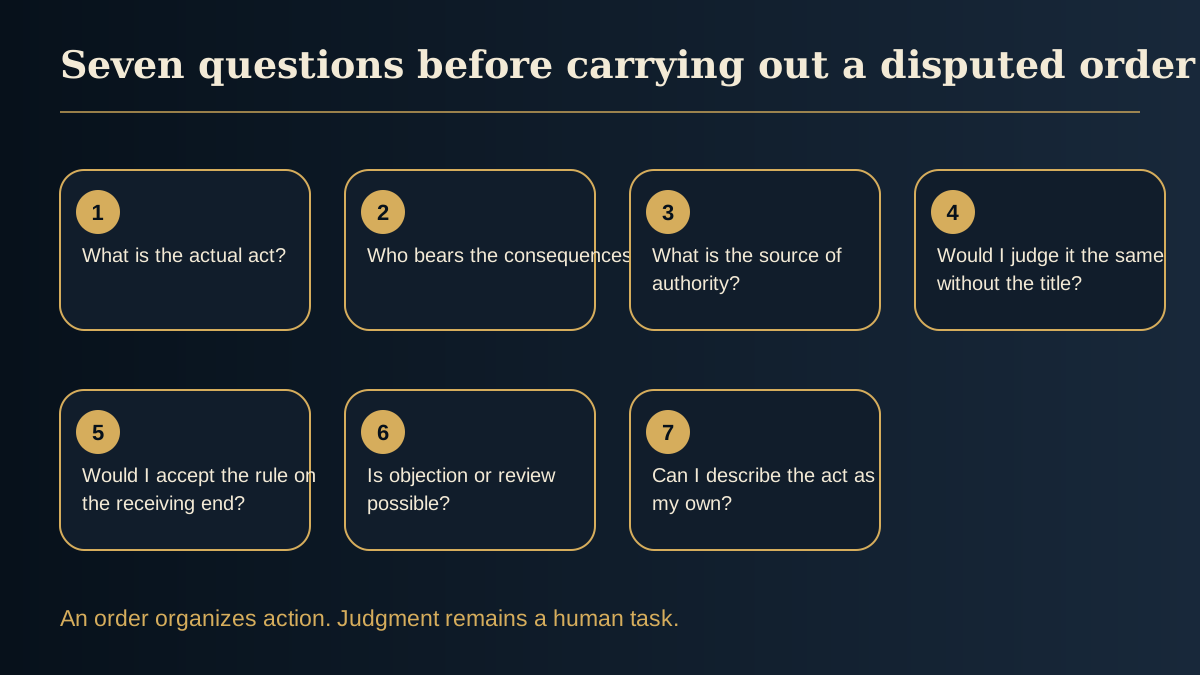
Seven questions before carrying out a disputed order
- What exactly am I being ordered to do? Separate the act from euphemistic or bureaucratic language.
- Who benefits, and who can foreseeably be harmed?
- Why does this person or institution have authority to issue this specific order, and where are the limits of that authority?
- Would I judge the act the same way if I did not know who ordered it?
- Would I accept the same rule if I were the person bearing its consequences?
- Can I request an explanation, objection, independent review, or alternative?
- Am I willing to describe the action as my own: “I did this because …”?
These questions do not create an automatic moral algorithm. Their purpose is to block the easiest escape route: transferring all judgment to a title, uniform, institution, or inner feeling.
Moral courage without automatic disobedience
Moral courage is not the same as automatic disobedience A person who refuses an order is not a hero merely for refusing. They may have bad information, act from prejudice, violate a voluntarily accepted obligation, endanger others, or simply be mistaken.
Automatic disobedience can be just as unreflective as automatic obedience.
Moral courage is willingness to bear the cost of a considered judgment while remaining willing to discover that the judgment itself may be mistaken.
This is central to the idea of inner self-government. Autonomy is not “I always know best.” It means that I cannot simply transfer responsibility for my moral judgment to someone else, while at the same time I must be willing to examine my own reasons.
Good coordination does not require moral surrender An organisation that works only because nobody may ask “is this right?” has a dangerous weakness. Good coordination needs clear roles, information, trust, procedures and the capacity for rapid action. None of that by itself requires the individual to cease being a moral agent. A leader who can explain a decision, and a system that permits error to be examined, are not weaker because they do not demand blind obedience. More importantly, if organisation can be explained through knowledge, agreement, responsibility and coordination, we should not leap without further argument to the conclusion that a general right of one person to rule others has therefore been established.
Natural law and the limit of command
Natural law and the limit of command Within THY-REALITY, natural law is treated as an inquiry into the thesis that moral rightness cannot be reduced solely to human will, custom, majority preference, or institutional command. What Is Natural Law? distinguished natural law in ethics from positive law, while Natural Law Is Not a Matter of Belief requires moral principles to survive tests of symmetry and scrutiny. If we take this seriously, a command cannot create moral rightness simply because an authority issued it. The same applies to law. And the same applies to conscience.
All three can point toward something right. None is an automatic source of moral truth. This leads to the more important question: if moral rightness does not arise from command, what exactly gives one person a moral right to command another? That question is not a call for chaos. It is a demand for justification.
Inner autonomy and external authority A person who needs an external order for every decision is not fully morally autonomous. But a person who rejects every rule merely because it comes from someone else is not autonomous for that reason either. Self-government is more demanding. It means understanding the consequences of one’s actions, respecting the legitimate boundaries of others, accepting voluntary obligations, using expert knowledge, cooperating on shared tasks, and taking responsibility for one’s decisions. Such a person can organise with others. The question THY-REALITY will later have to test is:
If people can build order through responsibility, agreement, knowledge and respect for universal limits, how much external coercive authority is still necessary—and what morally legitimises it?
Obey an Order or Follow Conscience? does not yet give a final answer.
From this point onward, however, it also does not close the question in advance.
Between blind obedience and blind self-will
There are two comfortable routes. The first says: “Just tell me what I have to do.” We move the decision upward.
The second says: “Nobody can tell me anything because only I decide.” We close all judgment inside ourselves. Both can become ways of escaping responsibility.
The more demanding path listens to other people’s reasons, recognises knowledge, respects voluntary agreements and understands the need for coordination—while refusing to accept that a position by itself creates moral truth or an unlimited right to obedience.
Would I still defend the same act if I could not say, “I was ordered to do it”?
And add a second question:
Would I still recognise the right to command if the same position were occupied by a person or institution I did not trust?
Why Conformity Often Overrides the Facts showed how a unanimous group can influence judgment. Obey an Order or Follow Conscience? adds formal authority and command. The next question is therefore unavoidable: if an act was carried out under authority, who is responsible for it—and can authority transfer responsibility at all? That is the subject of Does Authority Remove Personal Responsibility?
From orders to the question of legitimacy
The existence of authority explains who issued the order. It does not yet establish a moral right to rule. Philosophical anarchism can therefore be understood as skepticism about a general political obligation or right to rule, not as a synonym for chaos or rejection of organization.
Authority can exist as a fact while its legitimacy remains a question.
Sources and further reading
- Milgram, S. (1963). Behavioral Study of Obedience. The Journal of Abnormal and Social Psychology, 67(4), 371–378. DOI: 10.1037/h0040525. Source
- Burger, J. M. (2009). Replicating Milgram: Would People Still Obey Today? American Psychologist, 64(1), 1–11. Source
- Bandura, A. (1999). Moral Disengagement in the Perpetration of Inhumanities. Personality and Social Psychology Review, 3(3), 193–209. DOI: 10.1207/S15327957PSPR0303_3. Source
- Stanford Encyclopedia of Philosophy. Conscience. Substantive revision 2024. Source
- Stanford Encyclopedia of Philosophy. Legal Obligation and Authority. Substantive revision 2022. Source
- United Nations International Law Commission. Principles of International Law Recognized in the Charter of the Nürnberg Tribunal and in the Judgment of the Tribunal (1950), Principle IV. Source
- Rome Statute of the International Criminal Court, Article 33 — Superior orders and prescription of law. Source
- McLaughlin, N. (2023). Sociology in a World at War: Escape from Freedom. In Erich Fromm and Global Public Sociology. Bristol University Press. Source
- Deci, E. L. & Ryan, R. M. (1987). The Support of Autonomy and the Control of Behavior. Journal of Personality and Social Psychology, 53(6), 1024–1037. DOI: 10.1037/0022-3514.53.6.1024. Source
- Ryan, R. M. & Deci, E. L. (2006). Self-regulation and the problem of human autonomy: Does psychology need choice, self-determination, and will? Journal of Personality, 74(6), 1557–1586. Source
- Crowson, H. M., DeBacker, T. K. & Thoma, S. J. (2006). The role of authoritarianism, perceived threat, and need for closure or structure in predicting post-9/11 attitudes and beliefs. The Journal of Social Psychology, 146(6), 733–750. Source
- Stanford Encyclopedia of Philosophy — Political Legitimacy. Source
- Stanford Encyclopedia of Philosophy — Anarchism. Source
- Robert Paul Wolff — In Defense of Anarchism. Source