Sanātana Dharma: Eternal Way, Religion, or Natural Order?
Is Sanātana Dharma the ancient name of Hinduism, a broader way of life, or an eternal order? The history of the phrase reveals an old dharma concept, a modern collective name, and an important distinction between them.

The expression Sanātana Dharma is now often used as an insider name for the traditions that European languages usually group under the label Hinduism. Translating it simply as "eternal religion" is understandable but too quick. Sanātana can mean perennial, ancient, or eternal; dharma is one of those Sanskrit words that cannot be placed inside a single English equivalent without loss. Depending on context it can mean duty, proper order, norm, law, justice, way of life, religious practice, or ethical conduct.
The title therefore contains three different questions. Is Sanātana Dharma the ancient proper name of the Hindu religion? Does it designate a broader way of life that exceeds the modern Western category of religion? Or does it refer to a natural or cosmic order thought to hold independently of personal belief? All three interpretations have support in different periods and communities—none by itself captures the whole history of the expression.
The most important historical boundary is surprisingly clear. The phrase dharmaḥ sanātanaḥ and related forms are old in Sanskrit literature. Yet in earlier texts they normally mean "this is an enduring or eternal dharma" of a particular rule or duty, not the proper name of one pan-Indian religion. The strongest recent genealogical study concludes that Sanātana Dharma became widely used as an equivalent for what is now called Hinduism primarily in the late nineteenth century.
That does not mean the traditions themselves were invented then. The Vedas, Upaniṣads, epics, Purāṇas, philosophical schools, temple and bhakti traditions, yoga, rituals, and many local practices are far older. The point is narrower: an ancient tradition and an ancient phrase are not the same thing as an ancient unified proper name. Keeping that distinction allows us to respect practitioners' self-understanding without giving up historical precision.
What do sanātana and dharma actually mean?
Sanātana designates something enduring, ancient, or eternal. The more difficult word is dharma. Alf Hiltebeitel's Oxford bibliography stresses its wide semantic field: righteousness, law, duty, virtue, and proper conduct. Patrick Olivelle and scholars of Dharmaśāstra further show that dharma is not merely private morality: in classical texts it includes ritual, social obligations, household life, legal procedure, kingship, penance, and custom.
The root dhṛ—"to hold, support, sustain"—helps explain why classical and modern interpretations often describe dharma as that which holds something together. Arvind Sharma summarizes this broad idea by noting that dharma can uphold an individual, a society, a polity, and even the cosmos, and can also denote the inherent nature of a thing. This is an important supplement to translations such as "duty" or "religion"—but it does not mean that every occurrence of dharma should be translated as "natural law".
For that reason "religion" captures only part of the meaning. "Law" is sometimes useful but sounds too much like state legislation. "Duty" loses cosmological and ritual dimensions. "Natural order" highlights order but can too easily collapse dharma into the earlier Vedic concept of ṛta. The fairest method is often to retain the word dharma and state which dimension is active in each context.
An ancient expression is not yet an ancient proper name of a religion
A key example is Manusmṛti 4.138. After an injunction concerning truthful and appropriate speech, the verse closes with eṣa dharmaḥ sanātanaḥ—roughly, "this is the enduring/eternal dharma." Grammatically and contextually, the phrase refers to the rule just stated. It does not say: "the name of our religion is Sanātana Dharma."
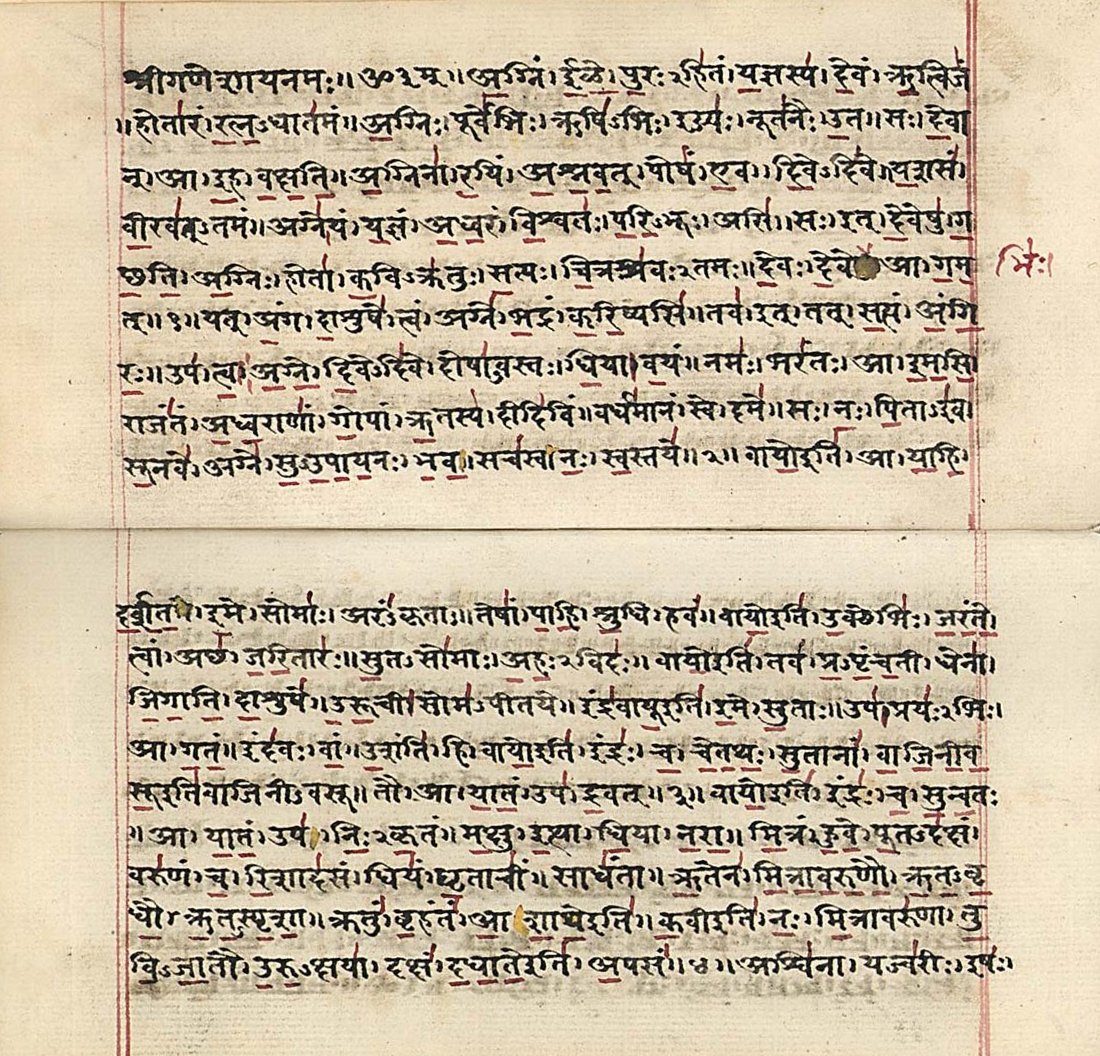
Ṛgveda 3.3.1 is especially instructive. The text contains dharmāṇi sanatā, commonly rendered along the lines of "enduring/everlasting laws or duties." This is important early evidence that dharma and endurance were associated already in Vedic poetry. It is not, however, the same thing as the later proper-name expression Sanātana Dharma for an entire religion: dharmāṇi is plural here, and the verse concerns enduring laws or norms rather than the name of a religion.
The age of the Vedas must likewise be distinguished from a theological claim about their eternity. Some contemporary religious presentations place Vedic composition deep in the fourth millennium BCE. Mainstream philological scholarship instead treats the Ṛgveda as the oldest Sanskrit text, composed principally in the latter half of the second millennium BCE; because it was transmitted orally for a very long period, exact dating of individual hymns remains difficult. The eternity of the Veda as a religious claim and the historical dating of the transmitted text are different questions.
The same pattern occurs in the Mahābhārata. When a teaching, royal obligation, or rule is called sanātana dharma, the adjective "eternal" marks the enduring force of that particular norm. Peter Heehs's genealogical study therefore separates two things often merged together: ancient uses of eternal dharma language and the modern use of Sanātana Dharma as a collective proper name for Hinduism.
This distinction is not an attack on religious self-designation. Communities are entitled to use the name that best expresses their identity. Historical inquiry asks a different question: when and how did a name begin to perform a particular function? "A modern name for a much older tradition" is a coherent answer, not a contradiction.
Dharma is not one single immutable command
If sanātana means eternal, one might expect a single unchanging list of rules. Classical literature is more complex. It recognizes svadharma, a duty tied to one's position; rājadharma, the dharma of kings; āpaddharma, dharma under emergency conditions; and various common or general virtues. Sources of dharma were also plural: Veda, smṛti, and normative practice or ācāra.
This creates an internal tension between universal and contextual norms. Some texts describe virtues meant to apply broadly—non-harm, truth, non-stealing, purity, self-restraint, compassion, or patience. Others assign duties by social location, life stage, occupation, or circumstance. In historical sources, Sanātana Dharma is therefore not one tablet of commandments but a family of arguments about what sustains a rightly ordered life.
Eight foundational principles? The tradition has no single canonical list of eight
Modern presentations sometimes claim that Sanātana Dharma has exactly eight foundational principles. A review of classical sources does not support one standardized ancient list. Manusmṛti 10.63, for example, gives five common principles—non-injury, truthfulness, non-stealing, purity, and restraint of the senses. Manusmṛti 6.92 lists ten characteristics of dharma. Other Dharmaśāstra and Purāṇic sources supply still other lists.
That does not make a modern eight-value list useless. It may be a helpful teaching synthesis. But it should be labelled accordingly: a modern synthesis from older motifs, not a single ancient canon universally acknowledged by all Hindu traditions. This boundary matters historically because otherwise plurality is silently standardized in the act of explaining it.
Contemporary presentations illustrate this point well. Dharma Central, for example, does not offer a list of eight but 25 practical Dharmic values, including nonviolence, truthfulness, meditation, reverence for nature, health, and "organic living." Many of these values have older parallels, but the list as a list is plainly a modern arrangement. It is best cited as the program of a particular teacher or institution, not as an immutable enumeration prescribed by one ancient text.
Is dharma natural order? Partly—but ṛta is not simply another word for dharma
The Vedic term ṛta is more directly associated with cosmic order, right course, and truth. Later dharma absorbed and transformed aspects of this concern with sustaining order, but the history is not a simple replacement of one word by another. Hiltebeitel even warns against projecting the classical meaning of dharma as "cosmic order" backward into the earliest Ṛgveda.
Comparison with Natural Law is therefore meaningful only at a particular level. Both discourses can posit an order that is not merely the arbitrary command of a present ruler, and both can connect right action to something larger than personal preference. But their historical genealogies, metaphysics, sources of authority, and social uses differ. Dharma can include ritual, caste- and life-stage-specific, legal, and religious obligations that the European philosophical category "natural law" does not automatically contain.
What does the modern translation “Eternal Natural Way” mean?
Contemporary internal interpretations of the tradition often go one step further. Dharma Central, for example, translates Sanātana Dharma as the "Eternal Natural Way" and describes dharma as a universal metaphysical order grounded in the Divine and built into the structure of reality itself. As an emic, or internal theological, interpretation, this matters: it tells us what the term means to some living practitioners and should not be flattened into a sterile dictionary label such as "religion" or "duty."
Etymology by itself, however, does not prove that metaphysical system. The root dhṛ and classical uses of dharma for sustaining order or the nature of a thing give such an interpretation genuine conceptual support; they do not establish that all pre-Christian civilizations possessed one identical Dharma under different names, nor that dharma must mean "God's natural law" in every historical source. The article therefore keeps both levels in view: the internal claim of an eternal universal order and the historical question of when particular expressions and meanings actually appear in the sources.
Is Sanātana Dharma a religion or a way of life? A false choice between two boxes
Many practitioners reasonably object that Sanātana Dharma is more than "religion" understood narrowly as Sunday worship, private belief, or membership in one church. In lived form it can involve family ritual, pilgrimage, philosophy, yoga, ethics, food norms, festivals, temple worship, ascetic paths, law, and social order. The phrase "way of life" therefore captures something real.
But the opposite conclusion is too strong as well. Saying "this is not religion, only a way of life" can erase exactly the elements that comparative religious studies legitimately examine: gods and goddesses, ritual, sacred places, revealed or authoritative texts, cosmology, liberation, bhakti, priestly authority, and community. A better formulation is: religion is a useful category, but it does not exhaust the semantic field of dharma.
When did Sanātana Dharma become a name for Hinduism?
Here the historical picture is clearest. Heehs finds that older Sanskrit literature uses the phrase often, but not as the general proper name of all Indian beliefs and practices. That usage becomes established in the late colonial period, when conservative, reformist, and universalist Hindu actors debated what counted as "true" tradition and how it should be presented amid Christian missions, British rule, and the emerging category of world religions.
John Zavos shows that Sanātanist orthodoxy was not simply fossilized resistance to modernity. It was itself part of a modernization process: it built a wider pan-Hindu identity and sought a common framework that could unite diverse communities. A revealing document of this standardization is Sanâtana Dharma: An Elementary Text Book of Hindu Religion and Ethics, prepared for the Central Hindu College at the beginning of the twentieth century. Its title already shows the new function: not merely "eternal dharma" of one rule, but a systematic name for religion and ethics.
The claim 'the British invented Hinduism' is too simple as well
If the general use of Sanātana Dharma as a name is modern, one might infer that Hinduism itself is only a colonial invention. That conclusion is also too sharp. Colonial administration, census categories, Orientalist scholarship, and missionary controversies unquestionably helped standardize and institutionalize the notion of one religion called "Hinduism." Yet Indian actors were not passive, and precolonial thinkers had already spent centuries finding ways to place Vedānta, Sāṃkhya, Yoga, Vaiṣṇava, Śaiva, Śākta, and other traditions within broader fields of relation.
Andrew Nicholson therefore traces processes of unification into the late medieval and early modern periods. David Lorenzen and Brian Pennington likewise reject a model in which the British created from nothing a religion that previously had no shared identity at all. Co-construction and standardization is a better description: older traditions and identities acquired new boundaries, institutions, textbooks, and common names in the colonial encounter.
Universal ethics and social order are not always the same thing
Modern accounts of Sanātana Dharma often emphasize universal values: truth, nonviolence, compassion, self-restraint, generosity. There are genuine classical precedents for this. At the same time, historical Dharmaśāstra corpora also include varṇa-āśrama-dharma, rules for social classes and stages of life, gendered and household duties, purity regulations, and other hierarchical norms.
The phrase "eternal dharma" has therefore not carried one single political or social content across history. Some modern thinkers used it to defend inherited social arrangements; others used it for universalist spirituality, reform, or ethics applying to all humanity. Research on colonial Bengal highlights exactly this tension: organizations could present Sanātana Dharma as traditional social order while also calling it a "universal Dharma for all mankind."
When the term becomes political, that does not erase its religious use
In modern India and the diaspora, Sanātana Dharma can function as sincere religious self-designation, an ecumenical pan-Hindu framework, a traditionalist stance, a philosophical claim about universal dharma, or a political identity slogan. None of these uses automatically becomes the only "real" one simply because it employs an old Sanskrit expression.
Methodologically, two opposite mistakes should be avoided. The first is to label every mention of Sanātana Dharma as nationalist politics. The second is to ignore political usage because the phrase is religiously sacred. Meaning depends on context, speaker, institution, and purpose. The age of the words does not grant a contemporary political claim automatic historical or moral immunity.
The fairest answer: eternal way as a traditional claim, historically changing name
If we ask a practitioner what Sanātana Dharma means, it is entirely legitimate to hear: an eternal order, truth, or path that does not depend on human invention. That is an emic claim about the tradition's own nature. If we ask a historian when the phrase became a general name for Hinduism, it is equally legitimate to hear: primarily in the late nineteenth century. These statements answer different questions and therefore do not automatically contradict each other.
For comparative ethics, a third level is especially useful. Sanātana Dharma contains a rich vocabulary of universal virtues, duties, order, and responsibility that can be compared with Natural Law, yoga, Buddhist dhamma, or the ethical teachings of Jesus. But comparison must distinguish similarity from identity and parallel from historical transmission. That is the boundary required for the comparisons that follow.
A practical test is simple. When someone uses the phrase Sanātana Dharma, ask: Are they speaking of an eternal ethical norm? A specific dharma in a classical text? Hinduism as a whole? A personal spiritual path? A traditionalist institution? Or a political identity? Only then do we know what the claim actually means. One ancient expression can carry all of these meanings—but not all at once.
Sources and further reading
- Peter Heehs, ‘A Brief History of the Eternal Religion: A Genealogy of Sanātana Dharma,’ International Journal of Hindu Studies 29 (2025), 1–32 — detailed genealogy distinguishing ancient phrase from late-colonial proper-name usage
- Alf Hiltebeitel, ‘Dharma,’ Oxford Bibliographies in Hinduism — semantic range and historical contexts of dharma
- Patrick Olivelle & Donald R. Davis (eds.), The Oxford History of Hinduism: Hindu Law: A New History of Dharmaśāstra (2017) — historical development and contextual plurality of dharma
- Patrick Olivelle, ‘Epistemology of Law: dharmapramāṇa’ — Veda, smṛti and ācāra as sources of dharma; historical anchoring in custom
- Arvind Sharma, ‘Dharma,’ Classical Hindu Thought: An Introduction — dharma as sustaining order and relation to ṛta
- St Andrews Encyclopaedia of Theology, ‘Law and Religion in Brahmanism: the Dharmaśāstra’ — breadth of dharma and distinction/relationship with ṛta
- Manusmṛti 4.138 — eṣa dharmaḥ sanātanaḥ attached to a specific norm of speech
- Mahābhārata 3.152.9 — eṣa dharmaḥ sanātanaḥ used for a specific enduring rule/duty
- Manusmṛti 10.63 — five common dharmic norms: ahiṃsā, satya, asteya, śauca, indriyanigraha
- Manusmṛti 6.92 — ten characteristics of dharma, demonstrating variation in ethical lists
- Donald R. Davis Jr., ‘Dharma: Hindu’ (2021) — contextual classical dharma and nineteenth-century universal/eternal reformulations
- Torkel Brekke, ‘Introduction: Modernity and Hinduism,’ The Oxford History of Hinduism: Modern Hinduism (2019) — modern standardization and debate over the category Hinduism
- John Zavos, ‘Defending Hindu Tradition: Sanatana Dharma as a Symbol of Orthodoxy in Colonial India,’ Religion 31.2 (2001), 109–123 — Sanātana Dharma and modern pan-Hindu orthodoxy
- Vasudha Dalmia, ‘Whither Pluralities and Differences? Arya Dharma and Hinduism at the Turn of the Twentieth Century’ (2019) — Sanatana Dharma textbook and modern subsumption of plurality
- Central Hindu College, Sanâtana Dharma: An Elementary Text Book of Hindu Religion and Ethics (early 20th c.) — primary document of modern systematic self-presentation
- Andrew J. Nicholson, Unifying Hinduism: Philosophy and Identity in Indian Intellectual History — precolonial processes of philosophical unification
- David N. Lorenzen, ‘Who Invented Hinduism?’ Comparative Studies in Society and History 41.4 — critique of a purely colonial-invention model
- Brian K. Pennington, Was Hinduism Invented? (2005) — colonial encounter as co-construction involving Indian agency and prior identities
- Julian Strube, ‘(Anti-)Colonialism, religion and science in Bengal from the perspective of global religious history’ — conflicting universalist, traditionalist and nationalist uses of sanātana dharma
- Audrey Truschke, ‘Hindu: A History,’ Comparative Studies in Society and History (2023) — long history of Hindu terminology and nineteenth-century Sanātana Dharma self-designation
- Alexander Rocklin, ‘Standardizing Sanatana Dharma,’ The Regulation of Religion and the Making of Hinduism in Colonial Trinidad (2019) — diaspora, recognition and competing definitions of orthodox Hindu identity
- Sri Dharma Pravartaka Acharya, “The Meaning of Sanatana Dharma,” Dharma Central (contemporary emic/theological presentation) — used as evidence for a living interpretation of Sanātana Dharma, not for historical dating
- Ṛgveda 3.3.1, metrically restored Sanskrit text, University of Texas Linguistics Research Center — primary text containing dharmāṇi sanatā
- Arvind Sharma, “Dharma,” Modern Hindu Thought: An Introduction (Oxford University Press, 2005) — dhṛ “to uphold,” sustaining order, and inherent nature of a thing
- Stephanie W. Jamison and Joel P. Brereton, The Rigveda: A Guide (Oxford University Press, 2020) — Ṛgveda as the oldest Sanskrit text, dating and oral-transmission cautions