How Do Sacred Texts Form? Oral Tradition, Redaction and Canon
Sacred texts often form through oral tradition, writing, redaction, manuscript variation, translation and canonization. What does that history demonstrate — and what does it not?
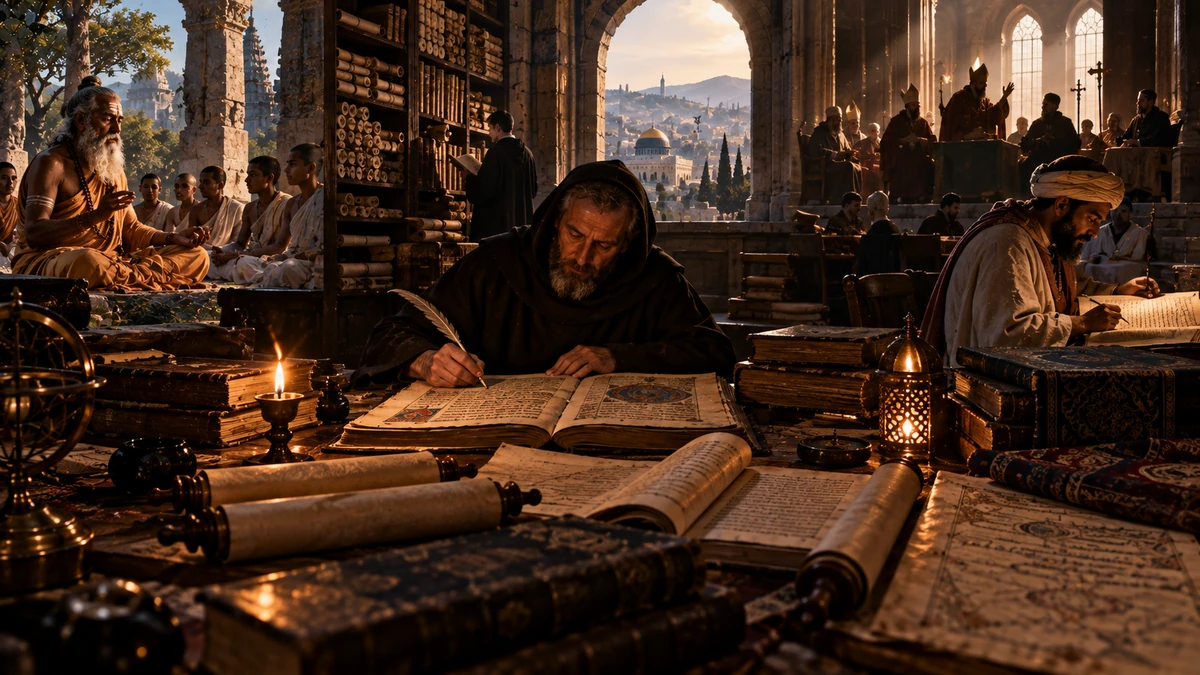
Sacred texts are often read as though they once appeared in exactly the form we hold today: one author, one act of writing, one finished text, followed by centuries of unchanged copying. For some works the history is relatively direct. For many of the world's most influential sacred corpora, it is not. Long oral transmission may precede writing; multiple manuscript forms may follow it; individual works may undergo composition and redaction; and collections may pass through long processes in which communities decide which writings carry enough authority to become canonical.
That historical fact is not automatically an argument against faith. A believer may understand inspiration as operating through memory, community, writers and editors; a historian can investigate the same processes without ruling on whether revelation was at work. These are different questions. It is a mistake to infer from redaction that 'therefore everything was invented,' just as it is a mistake to infer from sacred status that the history of a text may not be examined.
this article therefore does not ask which sacred book is true. It asks something more basic: how speech, memory, song, preaching, law, letters or narrative collections become texts; how texts become manuscript traditions; how traditions become canons; and how translation, institutions and transmission technologies change the way a community knows a text.
Under a Natural Law standard, the key issue is also authority over meaning. No institution acquires a moral right to coerce simply by claiming to speak for the sacred. But criticism of institutions does not license us to falsify textual history. If we want to judge what was added, omitted, translated or canonized, we first need to know what the manuscripts and historical sources actually show.
Oral tradition is not a corrupted written text
A literate culture can treat oral tradition as an imperfect memory of a missing document. That is too narrow. Oral traditions have their own techniques: rhythm, formula, repetition, melody, specialized memory-bearers, public recitation and communal correction. UNESCO's documentation of Vedic chanting describes highly elaborate recitation methods designed to preserve sounds, accents and sequence. This is a strong reminder that 'oral' does not automatically mean 'unreliable.'
The opposite romanticization is also wrong. UNESCO's broader work on oral traditions notes that performance often combines reproduction, improvisation and creation and can vary by performer and context. Different oral cultures therefore display different degrees of controlled stability. There is no single formula by which the word 'oral' tells us how much content changed.
For sacred texts this matters because orality can preserve material while also shaping it. Repetition, parallelism, fixed phrases and structured scenes are not necessarily evidence of late invention; they may also be traces of the medium in which material was transmitted.
The move into writing is not one moment
When a tradition begins to be written down, speech does not disappear overnight. Written and oral modes can coexist for centuries. In South Asia, Vedic traditions continued to rely above all on recitation even when manuscripts existed. Early Buddhist teaching was initially transmitted primarily orally; specialized reciters continued to preserve texts after writing was adopted. In the case of the Qur'an, early recitation and written recording were likewise intertwined rather than two entirely separate phases.
For that reason, a 'first writing' is not necessarily the same thing as the 'origin of the text.' It may mark the first recording of an older poem, the stabilization of several performances into one form, or the standardization of material already circulating in variant recitations. Material media — clay, papyrus, parchment, palm leaf, paper or print — then affect what can be copied, at what cost, by whom, and how large a collection can practically be.
A sacred text is therefore often the result of a long media process rather than a date on the title page of a lost 'original.'
Composition and redaction: editing is not automatically deception
Historical-critical methods distinguish sources, forms of tradition, composition and redaction. A redactor is not necessarily someone who 'forges' an earlier text. An editor may combine materials, arrange them, add transitions, explanations or emphases, and thereby create a new literary whole. In prophetic books, historical narratives and other corpora, scholars therefore study layers, repetitions, tensions, shifts in vocabulary and editorial links.
This work must be treated cautiously. A reconstruction of layers is a model, not a time machine. Some redactional hypotheses have strong support; others remain disputed. The word 'redaction' by itself does not tell us who the editor was, when the work occurred, or why a change was made.
THY-REALITY therefore uses a simple rule: an editorial trace is evidence of an editorial trace. It is not by itself evidence of conspiracy, but neither should it be erased because a later community declared the text sacred.
A manuscript is not the same thing as an abstract 'text'
Before print, every copy had to be physically reproduced by someone. That creates spelling differences, omitted or duplicated lines, reordered words, corrections and sometimes deliberate clarifications. Textual criticism compares surviving witnesses — manuscripts, translations, quotations and fragments — in order to reconstruct the history of transmission. Its task is not to prove or disprove theology but to understand how a text was actually transmitted.
The Dead Sea Scrolls are an especially useful case. The Israel Antiquities Authority notes that many biblical manuscripts closely resemble the later Masoretic Text while others preserve differences. The Great Isaiah Scroll is broadly close to the traditional text but contains thousands of orthographic and other variants, corrections and variant readings. This does not mean that we have a 'different religion'; it means that the textual history is older and more layered than a single medieval codex.
The methodological consequence matters: a variant is not automatically a 'corrupt version.' Sometimes one witness is later, another earlier, and sometimes different manuscripts preserve parallel literary editions of the same work.

When does authoritative become canonical?
A community can treat a work as sacred or authoritative before it possesses a final list of all sacred books. It is therefore useful to distinguish the authority of an individual work from a closed canon. Modern studies of the Jewish canon warn against projecting the later final Tanakh back into every Second Temple Jewish community; there were collections of authoritative writings, but their precise status was not everywhere identical.
Early Christianity shows a similarly processual history. The Gospels and Pauline letters acquired wide authority early, while some other writings remained disputed longer. The criteria were not merely 'who has power': perceived apostolic connection, consistency with a community's rule of faith, antiquity, liturgical use and widespread reception all mattered. Institutional power played a role, but the canon did not emerge from one vote on one day.
Canon is therefore better understood as a history of stabilizing authority than as a moment when someone randomly selected winners from a pile of equivalent books.
Nicaea did not choose the books of the New Testament
A popular story claims that Emperor Constantine had the books of the Bible selected at the Council of Nicaea in 325 and suppressed the rest. There is no good historical basis for that claim. The surviving Nicene canons concern church discipline, episcopal jurisdiction and related matters; they do not contain a list of the twenty-seven New Testament books. The history of the Christian canon shows collection and debate both before and after Nicaea.
That does not mean empire and ecclesiastical power were irrelevant to later Christian standardization. Constantine's political transformation dramatically altered the relation between church and state, and the commissioning of biblical codices materially aided the circulation of standard collections. But 'political influence existed' is not the same claim as 'Nicaea voted the Bible into existence.' If we criticize power, we should criticize what it actually did.
Translation is already interpretation
A sacred text never crosses a language without decisions. A word may carry several senses; grammar does not always reproduce the same emphasis; cultural concepts may lack perfect equivalents. Translators therefore choose. The Septuagint — early Greek versions of Hebrew scriptures — became enormously important in the Jewish diaspora and early Christianity and influenced how older texts were quoted and understood. In Latin, the Vulgate later became a new textual infrastructure of authority for Western Christianity.
A comparable dynamic appears in Buddhism: translation into Chinese, Tibetan and other languages did not merely copy one universal canon but helped create different canonical and commentarial traditions. When a community uses a translation for centuries, that translation itself becomes part of memory, liturgy and theology.
The question 'what does the original say?' is therefore not always simple. We first have to ask which manuscript, which literary edition, which linguistic stratum and which period we are calling the original.
Different traditions do not follow the same textual model
Comparison quickly shows that one scheme does not fit every tradition. Vedic authority is unusually tied to exact oral recitation and sacred sound. Buddhist canons developed as multiple linguistic and school corpora whose contents are not identical. Jewish and Christian biblical corpora have complex histories of manuscripts, translations and canons. The Qur'an is strongly bound to recitation from the beginning, while early manuscript evidence also points to a very early written standardization of its consonantal skeleton.
Those differences matter more than the convenient formula that 'all religions moved from oral myth to a book in the same way.' They did not. The comparative method established in “Religion and Ritual: How to Compare the Sacred Without Reduction” therefore remains in force: similar form does not demonstrate the same process, common origin or identical theology.
Institutions can preserve a text — and control access to it
A canon requires people who copy, teach, read, comment on and preserve it. Monasteries, schools, temples, synagogues, churches, courts, caliphates, universities, libraries and printing houses can therefore be crucial guardians of cultural memory. Without institutions, many texts would have disappeared. The same infrastructure, however, also creates power: who authorizes a translation, who may teach, which commentary is accepted, which book is copied and which remains marginal.
Natural-Law criticism must be symmetrical here. It is not fair to call every canon censorship; communities necessarily classify what they regard as normative. The line is crossed when authority protects its interpretation through coercion, forbids honest examination, punishes questions or treats institutional power as evidence that a claim is true.
As “Religion and Ritual: How to Compare the Sacred Without Reduction” established, the sacredness of a claim and the legitimacy of the institution administering it are separate questions.
Reading a sacred text without naivety or cynicism
A good method begins by asking several questions at once. What does the text mean within its tradition? What are the earliest surviving manuscripts? Do we have evidence of earlier oral or written layers? What variants exist? Who shaped the collection? When did a work become broadly authoritative, and when do we first have evidence of a closed canon? What roles were played by translation, liturgy, commentary and political institutions?
Then comes an even more important boundary: the history of formation does not by itself decide metaphysics. Evidence that a text was edited does not demonstrate that God could not have acted through editors. A claim of revelation, in turn, does not erase a variant manuscript, a later addition or a human decision about canon. One level of the question must not swallow the other.
The mature approach to sacred texts is therefore neither blind untouchability nor an automatic suspicion of fraud. It is a willingness to examine the entire chain of transmission and to distinguish where we have a document, where a reconstruction, where a tradition and where faith. Truth does not require us to make history simpler than it was.
Sources and further reading
- UNESCO Intangible Cultural Heritage — Oral traditions and expressions: oral transmission combines memory, performance, continuity and, in many traditions, variation by performer and context.
- UNESCO — Tradition of Vedic chanting: complex oral recitation techniques preserve sound, accent and sequence across generations.
- Oxford Bibliographies in Hinduism — Vedic Oral Tradition: Vedic authority, recitation, śruti and the continuing primacy of sacred sound.
- The Oxford History of the Book — South Asia: long coexistence of oral transmission, manuscript culture and print across South Asian religious traditions.
- Oxford Bibliographies in Buddhism — Oral and Literate Traditions: early Buddhist oral transmission, bhāṇakas and later writing of the Pāli canon.
- Oxford Research Encyclopedia of Religion — Canon and Commentary in the Earliest Buddhist Manuscripts: transition from oral to written transmission and early Buddhist canonization.
- UNESCO Memory of the World — Gilgit Manuscript: early Buddhist manuscripts preserve both canonical and non-canonical works and illuminate textual development.
- Oxford Handbook of Biblical Studies — Form, Source, and Redaction Criticism: definitions and methodological limits of source, form and redaction criticism.
- Oxford Handbook of the Historical Books of the Hebrew Bible — The Role of Orality and Textuality: interaction of oral-compositional style and scribal culture.
- Oxford Handbook of Textual Criticism of the Bible — Introduction: canon formation, textual criticism, book history and manuscript traditions.
- Oxford Handbook of Textual Criticism of the Bible — Beyond “Textual” and “Literary” Criticism: composition and transmission may overlap in ancient Jewish texts.
- Israel Antiquities Authority — Dead Sea Scrolls Introduction: biblical manuscripts show both strong continuity and meaningful textual differences.
- Israel Museum Digital Dead Sea Scrolls — Versions and Translations of Isaiah: concurrent textual versions and more than 2,600 variants in the Great Isaiah Scroll relative to the later Masoretic tradition.
- Israel Antiquities Authority — Scrolls Content: oldest known copies of biblical works and evidence for multiple manuscripts of the same compositions.
- Timothy H. Lim, The Formation of the Jewish Canon — Yale/Oxford: plurality of authoritative scripture collections in ancient Judaism and gradual canon formation.
- James C. VanderKam — The Formation of the Jewish Canon, Oxford Handbook of Textual Criticism of the Bible: distinctions between authoritative books and demonstrable closed canon.
- Donald Senior — The Formation of the Canon and the Creation of the “New Testament”: gradual canon process and criteria including apostolic association, rule of faith and reception.
- Cambridge History of the Bible — The New Testament Canon: the canon resulted from a long, gradual process rather than one single selection event.
- Cambridge Companion to the Council of Nicaea — The Twenty Canons: surviving Nicene canons concern ecclesiastical discipline and jurisdiction, not a list of New Testament books.
- Oxford Handbook of the Septuagint: history, manuscript transmission, translation and the Septuagint’s authority in Jewish and Christian reception.
- Library of Congress — Codex Amiatinus: earliest surviving complete Latin Vulgate Bible and evidence for copying, textual preservation and later revision.
- Cambridge Companion to the Qur’an — From Palm Leaves to the Internet: early Qur’anic recitation, memorization, writing and traditional accounts of codification.
- Marijn van Putten, Bulletin of SOAS — “The Grace of God” as evidence for a written Uthmanic archetype: shared orthographic features in early Qur’an manuscripts support an early written archetype.
- Oxford Research Encyclopedia of Religion — Transmission of Buddhist Media and Texts: oral, manuscript, printing and translation media shaped Buddhist textual traditions.
- Oxford History of the Buddhist Canon: multiple Buddhist canons, oral transmission and later written stabilization in different schools.