Transmission and Loss of Knowledge
Knowledge does not survive simply because it was once discovered. It needs records, people, languages, copies, institutions and conditions in which it can be understood and transmitted.
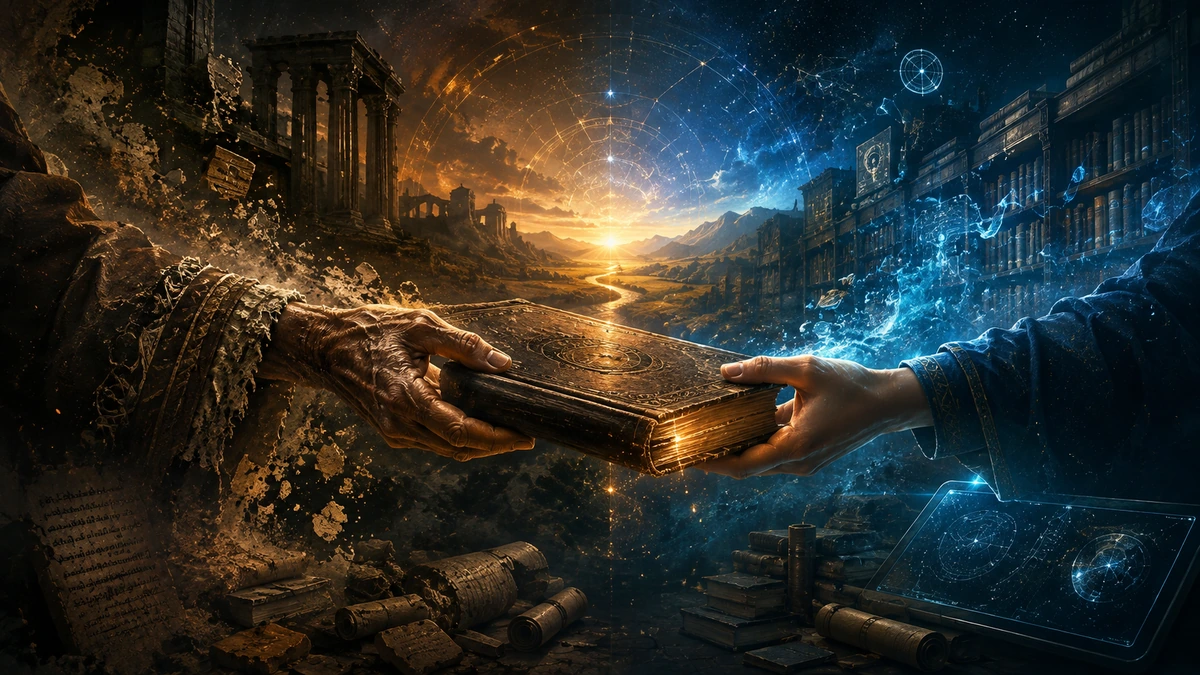
We often speak about past knowledge as if it were a simple object: a civilization discovers something, the knowledge exists, and later people can simply take it from a shelf. History shows something much more fragile.
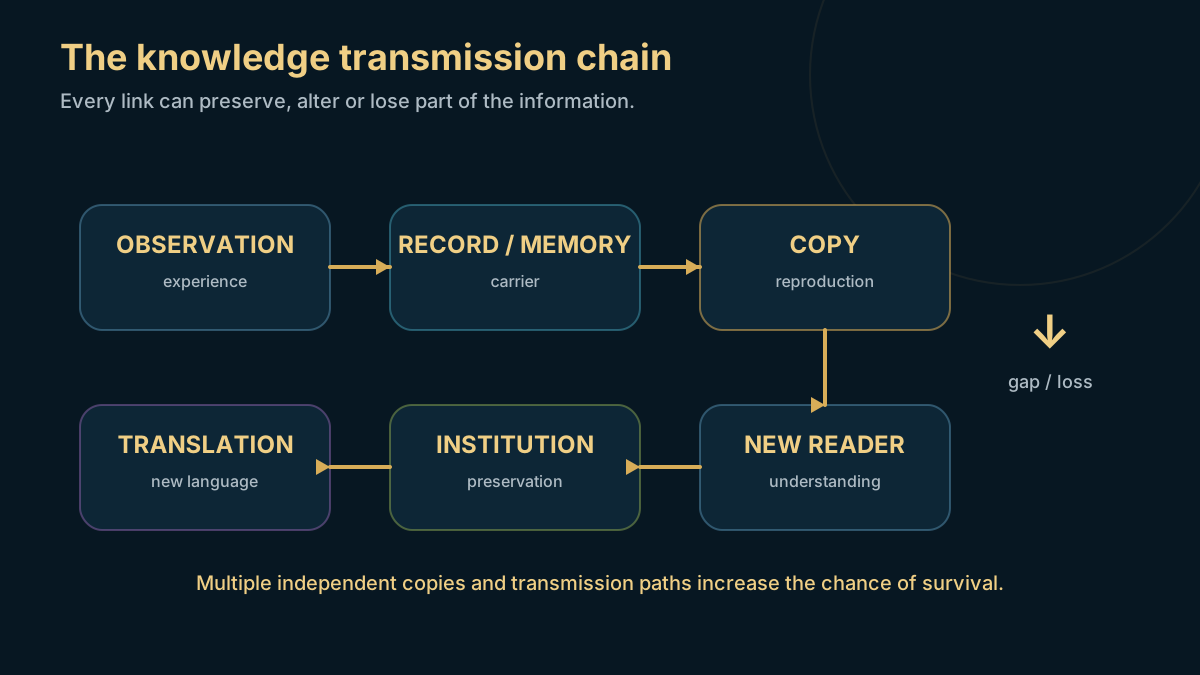
For an idea to survive centuries, it must pass through a chain of material and social conditions. Someone must observe, remember or record it. Someone must know the language. A text must be copied, translated or otherwise preserved. A community or institution must make room for it. A later reader must still be able to understand what the record means.
If one link disappears, an entire work may be lost. If the chain continues, knowledge still does not travel unchanged: it is translated, corrected, commented upon and integrated into new intellectual worlds.
The history of knowledge is not only a history of discovery. It is a history of transmission, selection, preservation, loss and rediscovery.
Knowledge needs a carrier
Oral tradition can preserve enormous amounts of cultural and practical knowledge, but it depends on living communities, languages and practices of transmission. Writing removes some vulnerabilities while creating others: paper, papyrus, parchment, clay and digital media have different lifetimes and access conditions.
UNESCO created the Memory of the World Programme precisely because documentary heritage can disappear. Its logic is simple: a document does not become permanent merely because it is important.
A discovery becomes heritage only when there is a chain capable of carrying it forward.
Copying was once a technology of survival
Before print, the survival of texts was closely tied to manual copying. Every new copy increased the chance of preservation while also creating opportunities for error, editorial change and selection.
That is why asking “how old is this work?” is not enough. We also need to ask which manuscripts survive, how many copies exist, how they differ and by which routes they reached us.
A work that was influential in antiquity may now be known only through fragments or quotations. Another may survive in many copies because later communities repeatedly chose to reproduce it.
Greek-to-Arabic transmission was not passive storage
The history of Greek philosophy and science in Arabic is a strong example of why transmission is not merely the movement of books. The Stanford Encyclopedia of Philosophy describes a multi-century Syriac background and translation circles in which Greek works were translated, interpreted and integrated into new philosophical contexts.
A useful methodological detail is that the popular picture of one institution—the House of Wisdom—as a single centralized translation factory oversimplifies a more distributed process. Modern scholarship distinguishes the court library from the broader translation movement.
Knowledge crossing cultures is not a suitcase. People must translate it—and translation is already intellectual work.
The Archimedes Palimpsest: a text can be lost while still physically present
The Archimedes Palimpsest is one of the clearest examples. According to the Walters Art Museum, a tenth-century scribe copied Archimedes in Greek. In the thirteenth century the parchment was reused: the original writing was erased, the leaves were reshaped, and a prayer book was made from them.
Centuries later, conservators and scholars used modern imaging methods to recover parts of the erased text.
The story is almost a perfect symbol of knowledge fragility. The work was both lost and materially present. Recovering it required technology, funding, specialists and the physical survival of the manuscript.
Sometimes knowledge disappears not because nobody ever possessed it, but because the next generation can no longer access its carrier.

Al-Sufi shows the other side: copying and correction
The Library of Congress provides a digitized later manuscript of al-Sufi’s Book of the Constellations of the Fixed Stars. The tenth-century work discussed Ptolemy’s 48 constellations while adding criticism, corrections, Arabic star names and illustrations. The later copy we can inspect today is itself evidence of a transmission chain.
The example shows that transmission is not only loss. It can also involve improvement, supplementation and new use. Knowledge survives because later communities care enough not only to preserve it but to work with it.
What survives is not a representative sample of the past
Surviving documents are not a random sample of everything that once existed. Material, climate, fire, war, religious and political choices, the value assigned to a text, and the habits of libraries and collectors all affect what reaches a modern researcher. Stone and clay survive differently from papyrus; a repeatedly copied work has a different chance of survival from a local manual that no one continues to reproduce.
This survival bias has two opposite implications. We should not assume that only what survived was important in the past. At the same time, a gap in the archive does not license us to invent the missing content. An incomplete archive justifies caution, not unlimited reconstruction.
The history of knowledge is therefore also a history of carriers and institutions. When we ask what people knew, we also need to ask who wrote, who copied, who preserved, and which forms of knowledge were transmitted mainly through speech or practice.
Lost knowledge is not permission for unlimited imagination
Once we recognize how much has been lost, a temptation appears: gaps can be filled with claims that the past knew almost anything. Logically, the opposite is true. Missing evidence gives us less ability to know, not more.
A lost book may have contained an extraordinary idea. It may also have contained errors, repetition or something ordinary. Without the content, we cannot know.
Serious research therefore separates established knowledge, plausible reconstruction, and open possibility where evidence remains insufficient.
A gap in the archive is a reason for caution, not an empty space into which we can insert any preferred story.
How to test a story about “lost knowledge”
- What exactly is claimed to have been lost: a text, technique, language, institution, or oral tradition?
- Which direct or indirect sources show that the knowledge existed?
- Do we have quotations, copies, translations, material remains, or contemporary references?
- Where does the transmission chain break?
- Does a later source preserve older content, or reinterpret it?
- What can be reconstructed with high confidence and what remains speculation?
- Does a new discovery change the model, or simply show that the past was more complex than assumed?
These questions leave room for surprise without abandoning evidential standards.
Preserving knowledge is an action of the present
No civilization inherits the whole past. It receives a selection: some by chance, some because of climate and materials, some because of political or religious power, and some because collectors, scholars and institutions chose to preserve it.
Digitization has expanded access but has not removed the problem. Files still require formats, servers, migration, metadata and organizations that maintain them.
The question “what did our predecessors know?” is inseparable from another question: “what are we able to preserve, understand and transmit honestly?”
Digitization reduces some older risks but does not eliminate the preservation problem. File formats become obsolete, servers disappear, access rights change, and vast amounts of material can become practically invisible without metadata and curation. A digital archive still requires a carrier, maintenance, and decisions about what will be described well enough to be found later.
Programs such as UNESCO Memory of the World are therefore not merely warehouses for the past. They recognize that the survival of documentary heritage depends on technical, institutional, and political decisions made in the present.
Sources and further reading
- UNESCO. Memory of the World: About the Programme. Source
- Stanford Encyclopedia of Philosophy. Greek Sources in Arabic and Islamic Philosophy. Source
- The Walters Art Museum. Lost and Found: The Secrets of Archimedes. Source
- Library of Congress. Al-Sufi’s Book of the Constellations of the Fixed Stars. Source
- UNESCO Intangible Cultural Heritage. Oral traditions and expressions. Source
- UNESCO. Memory of the World International Register — manuscripts. Source