Myths as Cultural Maps
A myth is not reliable history merely because it is old, and it is not worthless merely because it is not a literal report. It can function as a map of values, relationships and a community’s way of understanding the world.
The word “myth” has two very different meanings today. In everyday speech it often means something false: “that is only a myth.” In the study of religion, folklore and culture, myth names a kind of narrative through which communities speak about origins, world order, gods, ancestors, rules, dangers and meaning.
This distinction should not be abused in the opposite direction. A story can carry deep symbolic or cultural meaning without being a literal historical report. Its age alone is not evidence for a physical or archaeological claim.
But if we discard a myth simply because it is not a modern chronicle, we lose another kind of information: how a community organized the world, which values it emphasized, and which relationships it preserved in memory.
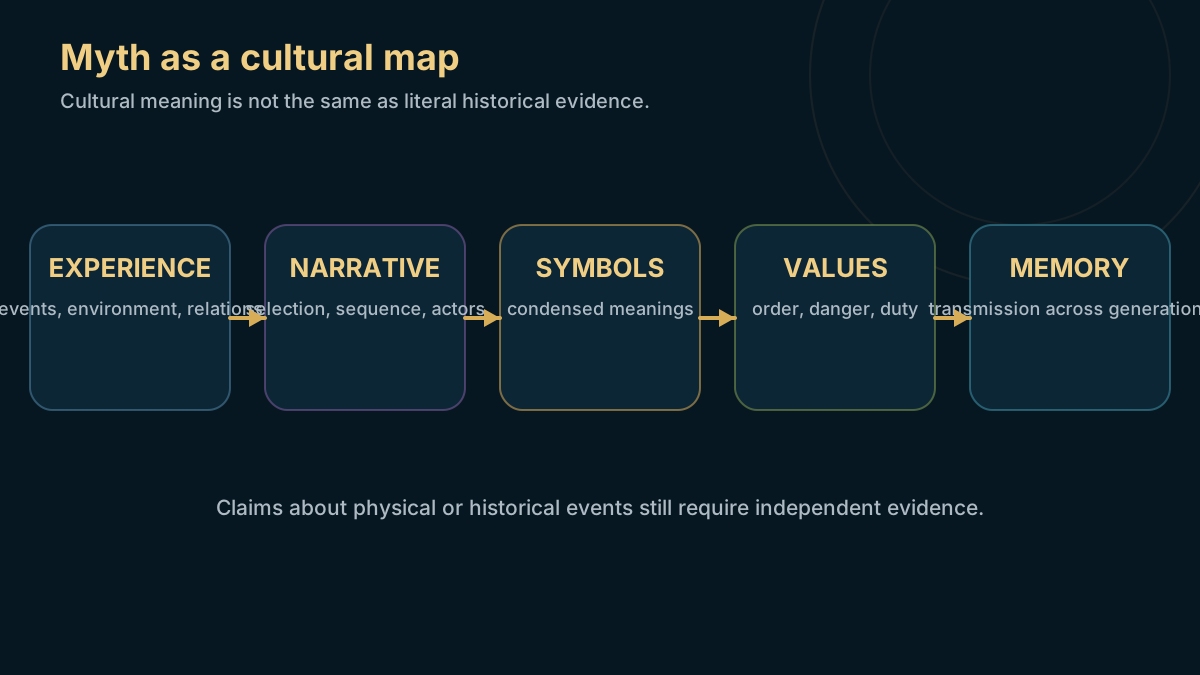
A myth can be read as a cultural map: not as the territory itself, but as an organized way in which a community selects, connects and emphasizes parts of its reality.
Narrative is a way of organizing information
UNESCO explicitly includes myths, legends, epic songs and other narrative forms within oral traditions and emphasizes their role in transmitting knowledge, social values and collective memory.
This helps explain why a story is not merely decoration around “real” information. Narrative selects sequence, actors, causes, dangers and consequences. It produces a structure that can be remembered and transmitted.
Research on cultural transmission likewise shows that stories do not survive randomly: content, the prestige of transmitters and other transmission biases affect which narratives persist.
What travels through a story is not only data. A way of organizing data into meaning travels with it.
Transmission does not preserve every element equally. Experimental and modeling work on cultural transmission suggests that both content and the prestige or perceived value of a source can shape which narratives spread. The popularity of one version of a myth is therefore not simple evidence that it is the oldest or most “original”; it can also reflect what was easier to remember, whom people trusted, or which version institutions amplified.
Myth can carry values without being literal history
A story in which a deity punishes a broken oath can organize ideas about the importance of promises even when we have no reason to treat the event as a historical record. A cosmic battle can structure ideas about order and chaos without describing a measurable astronomical event.
This resembles a map. A map is useful not because it is a photograph of everything, but because it makes selected relationships visible.
Maps have limits. We cannot infer geology, astronomy or chronology directly from the moral structure of a myth. Those claims require independent evidence.
Myths are also spaces of collective memory
UNESCO describes oral traditions as important carriers of collective memory. That does not mean every detail remains unchanged for centuries. Oral transmission is a living process in which stories adapt to language, audience and context.
A myth can therefore be old and new at the same time. A narrative core may persist while characters, emphasis or interpretation change.
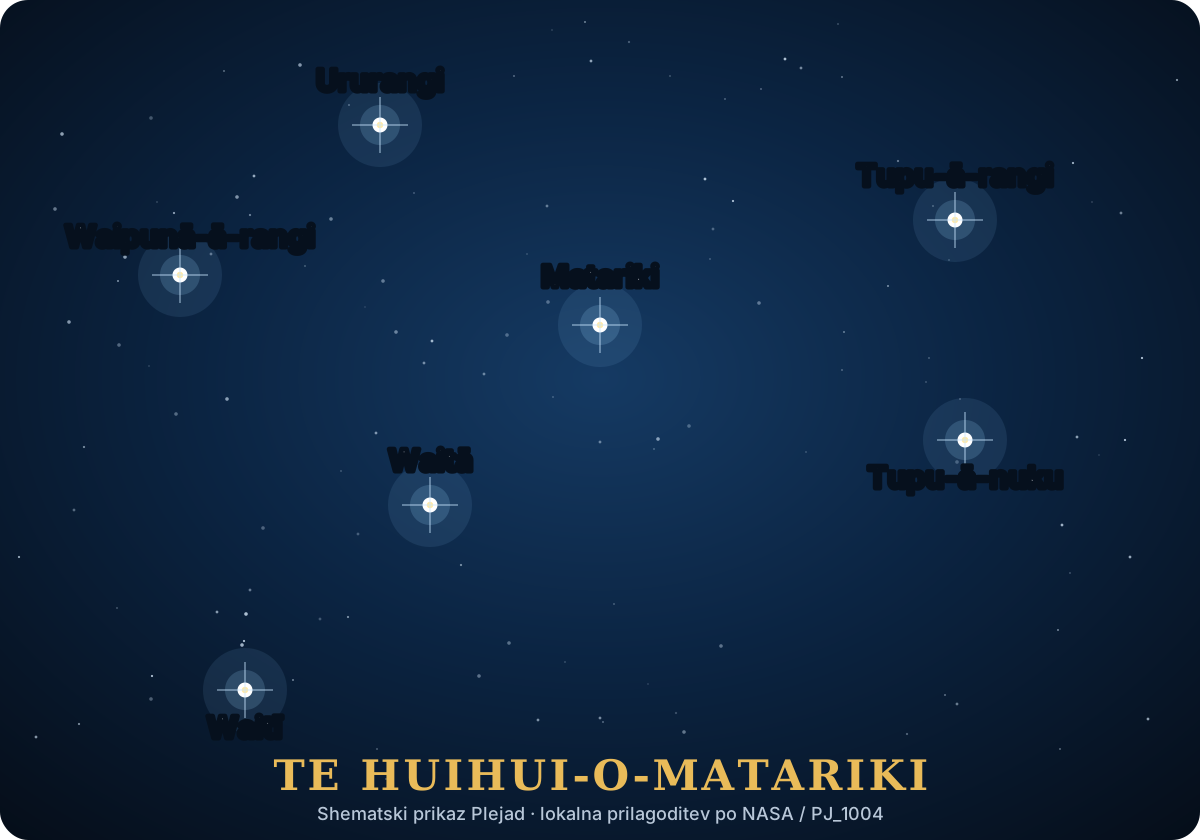
Living traditions around Matariki also show that one broad tradition can contain multiple versions. Te Papa presents several legends rather than one universal “Māori story.”
Variation is not necessarily a damaged copy of an original. In living tradition, variation can be part of how the tradition exists.

A tradition does not necessarily have one single version
When we speak of “a Māori myth,” “a Greek myth,” or “a Native American myth,” the singular can already create a false unity. Oral traditions live in communities, families, places, and performances. A version recorded by an ethnographer or published by a museum can be well documented without being the only version that ever existed.
UNESCO’s treatment of intangible cultural heritage emphasizes the living character of oral traditions and their transmission from generation to generation. Change is therefore not automatically a “corruption of the original.” Variation can itself be evidence that a narrative still functions as a living cultural practice.
For the researcher, differences between versions are data. We can ask what remains stable, what changes, who tells the story, to whom, in what ritual or social context, and when the version was recorded.
Sky myths are a particularly clear example of cultural maps
The physical sky is shared, but the figures and stories projected onto it are not identical. The IAU’s work in cultural astronomy explicitly studies different ways cultures use sky images and natural cycles.
A star pattern can be a group of relatives in one tradition, an object in another, and part of a calendar in a third. None of these stories changes the physical distance between stars. They do change how a community sees, remembers and uses the sky.
Here myth and map almost literally meet: story tells people which points to connect and why the connection matters.
Myth should not become a shortcut to sensational history
Ancient narratives invite overreach. A similarity between two myths can quickly be declared proof of a lost global civilization, a literal catastrophe, or hidden technology.
Oral traditions can sometimes preserve memories of environmental events or historical change. But demonstrating such a connection requires comparison with archaeology, geology, linguistics, dating and historical context. Motif similarity by itself is not enough.
The opposite mistake is to dismiss all myths as arbitrary fantasy. Cultural significance does not require literal historical truth in order to be real as a fact about the community that preserved the story.
The opposite mistake is to assume that myth has no historical value because it is not a chronicle. A narrative can preserve place names, social relationships, seasonal practices, or memories of important events. But any such historical core has to be tested against independent evidence. Myth can guide a question; by itself it rarely completes the proof.
How to read myth as a cultural map
- Identify which version of the myth you are reading and from which period and community it comes.
- Separate the narrative from later interpretations added by scholars or popular culture.
- Ask which relationships the story organizes: human–nature, family–community, order–chaos, life–death, authority–responsibility.
- Examine how the story is used—in ritual, calendar, education, identity, entertainment or political legitimacy.
- If using the myth to infer a historical or natural event, seek independent evidence.
- Compare versions without assuming they must share a single lost origin.
This approach lets myth remain rich without turning it into proof for whatever we already want to believe.
A cultural map is not worthless because it is not the territory
Myths can be beautiful, violent, wise, contradictory, political or spiritual. Their value is not identical in every context, and we do not need to agree with their norms.
But as historical documents of cultural orientation they are exceptionally important. They reveal categories, dangers, models of human place in the world, and values that communities chose to transmit.
A myth is not a scientific theory and need not be a historical chronicle. It can still be one of the most concentrated maps of how a community understood its world.
Sources and further reading
- UNESCO Intangible Cultural Heritage. Oral traditions and expressions. Source
- UNESCO Intangible Cultural Heritage. Knowledge and practices concerning nature and the universe. Source
- Stubbersfield et al. (2021). Prestige and content biases together shape the cultural transmission of narratives. Evolutionary Human Sciences. Source
- International Astronomical Union. Commission C5 Cultural Astronomy — Scientific Objectives. Source
- Museum of New Zealand Te Papa Tongarewa. The legend of Matariki and the six sisters. Source
- UNESCO. Hezhen Yimakan storytelling. Source