Comparing Civilizations: How to Compare Without Oversimplifying
Comparison can reveal patterns invisible within a single history. It can also create a false ladder of progress when unlike institutions, periods or sources are treated as if they were equivalent.

When two societies are placed side by side, a tempting question appears immediately: which was more advanced, freer, more scientific, more moral or more successful? Such questions are attractive, but they often hide a methodological problem: the terms used for measurement may not mean the same thing in both cases.
Comparison is nevertheless one of history’s most powerful tools. Marc Bloch defended it as a way to make similarities and differences analytically visible, while modern comparative-historical analysis emphasizes systematic, contextualized comparison of cases and processes unfolding over time.
The solution is not to abandon comparison. It is to define what is being compared, at what time, by which criteria and from which sources.
A good comparison does not ask only “who was better?” It asks: “what is genuinely comparable here—and what is not?”
Comparison Is Not a Ladder of Civilizations
A civilization is not a competitor on one universal scale. A society may be highly developed in one form of organization and very different in another. A city with sophisticated administration may lack the political representation of a modern state; a community with rich oral knowledge may leave no large written archive; technical excellence in one domain does not automatically imply a “higher” level in every other domain.
When many dimensions are compressed into a single word—progress—we lose information. Comparative method becomes more useful when a large judgment is broken into smaller questions: how was taxation organized, who decided, how was knowledge transmitted, how did trade operate, what was the demographic setting, and how were disputes resolved?
What Exactly Are We Comparing?
We may compare states, cities, empires, religious communities, economic systems or historical processes. These units are not interchangeable. “The Roman Empire” and “a modern state” are not comparable in every property simply because both govern territory.
Comparison becomes clearer when the unit is defined functionally. Instead of “compare two civilizations,” ask how two societies organized irrigation, long-term storage of knowledge, or political legitimacy.
The unit of comparison must be concrete enough that evidence can actually be gathered for it. If we compare “Egypt” and “China,” we still do not know whether we mean state administration, agriculture, family organization, military mobilization, or centuries of cultural history. A large label can conceal ten different research units.
Good comparison therefore often begins less dramatically: two tax institutions, two forms of political succession, two cities in comparable periods, or two systems for preserving knowledge. Only after several bounded comparisons can we cautiously assemble a broader picture.
One of the central traps is conceptual equivalence. Terms such as state, slavery, citizenship, temple, science or market can cover very different institutional practices.
Giving two societies the same label does not prove that the institution worked in the same way. Rules, roles, rights, obligations and actual practice must be examined before comparison becomes meaningful.
Comparability is not the same as identity. Two institutions can be comparable precisely because they perform a related function even though they use different legal categories or rituals. The important point is to define the comparison rule in advance and not change it after seeing the result.
If we compare political participation, for example, we should not count only formal voting in one case while including informal consultative institutions in another unless we explicitly justify that difference. Otherwise the category is being fitted to the result rather than used to measure it.
HRAF emphasizes that cultures change over time, so comparisons need temporal anchors. Comparing Old Kingdom Egypt with Classical Greece and then speaking as though two timeless “civilizations” had been compared would hide centuries of internal change.
The same is true within one society. An institution present in the year 500 may not be the same institution in the year 1000. Time is not merely the background of the data; it is part of the data.
Comparison can be cross-sectional or processual. A cross-sectional comparison asks how two systems worked at a particular moment; a processual comparison asks how they arrived at similar or different outcomes through time. The latter is often harder, but it can reveal mechanisms of change that a snapshot hides. The same outcome can emerge through very different paths.

Civilizations Are Not Single Actors
The word “civilization” can make a society sound as though it had one will, one goal, and one character. Large historical settings were actually composed of cities, regions, classes, genders, occupations, religious communities, and political factions that could conflict with one another. Statements such as “Rome wanted” or “Egypt believed” are therefore often shorthand that needs to be unpacked.
Comparative analysis becomes more precise when it identifies who produced an action or a source. A royal inscription can express an ideal of power rather than the everyday experience of a farmer; a legal text shows a norm rather than necessarily a practice; an elite philosophical work is not the average view of an entire population. Different sources may describe different levels of the same society.
If we select only famous empires, we may conclude that complex society almost inevitably produces centralized states. If we select only societies with preserved archives, we may exaggerate the importance of writing because writing systems are precisely what leave large bodies of evidence.
Comparative research therefore pays attention to sampling. HRAF explicitly notes that representative sampling and temporal focus should follow from the research question. This does not eliminate bias, but it makes its sources more visible.
Selecting cases by their outcome is especially dangerous. If we look only for societies that collapsed after high inequality, we can assemble a persuasive sequence of stories without checking highly unequal societies that did not collapse in the same period, or societies that collapsed for quite different reasons.
A negative case is not an obstacle to theory; it is a test. A case in which the expected relationship is absent forces us to specify more precisely the conditions under which an explanation is supposed to work.
Unequal Archives Create Unequal Comparisons
Two societies may have been equally complex historically while one left thousands of administrative documents and the other mostly archaeological remains or later testimony. If we treat the quantity of surviving writing as the quantity of former knowledge or organization, we are mainly measuring the fortune of the archive.
We therefore need to evaluate not only source quality but source comparability. If one society gives us tax registers and another only monumental inscriptions, we cannot compare everyday administration with equal confidence. Sometimes the most honest result of a comparison is: the evidence for this dimension is not symmetrical.
Similarity and Difference as Evidence
Two societies may develop similar solutions because of contact, shared inheritance or independent responses to similar problems. Terraced agriculture, monumental architecture or calendrical observation does not by itself reveal a pathway of transmission.
Claims of historical influence require additional traces: chronology, geographical possibility of contact, linguistic borrowing, material objects, documented routes or other independent evidence.
There are at least three basic explanations for similarity: historical transmission, independent responses to similar problems, or some combination of the two. Monumental construction can spread through contact, but it can also arise because different political elites face recurring problems of organizing labor and displaying legitimacy.
Form is therefore only the beginning of the question. Stronger evidence for transmission appears when similarities accumulate in details, occur in the correct chronological order, and are connected by a plausible route of contact. Without those links it is safer to speak of analogy than origin.
Comparison succeeds not only when it finds a universal pattern. Skocpol and Somers also emphasized contrast-oriented comparative history: difference can help explain what is distinctive about a case.
If two societies faced similar pressures and responded differently, the difference may be the most informative result. The question then becomes not “which one failed?” but “which conditions directed the paths apart?”
Causal Comparison Must Allow Our Own Explanation to Fail
Comparative history becomes especially powerful when it is used to test explanations. If we claim that an institutional condition caused an outcome, we should look for cases in which the condition exists without the outcome and the outcome exists without the condition. Such cases help distinguish necessary, sufficient, and merely accompanying factors.
Skocpol and Somers showed that comparison can serve different logics: testing macro-causal hypotheses, demonstrating contrasts, or understanding parallel historical trajectories. These logics are not interchangeable. An article that claims a cause requires a stricter test than one that mainly shows how institutions differed.
It is therefore important to say at the start what kind of claim is being supported. “These cases are similar” is descriptive. “The similarity arose through transmission” is historical-genealogical. “This institution caused this outcome” is a causal claim with the heaviest evidential burden.
A Practical Protocol for Comparing Civilizations
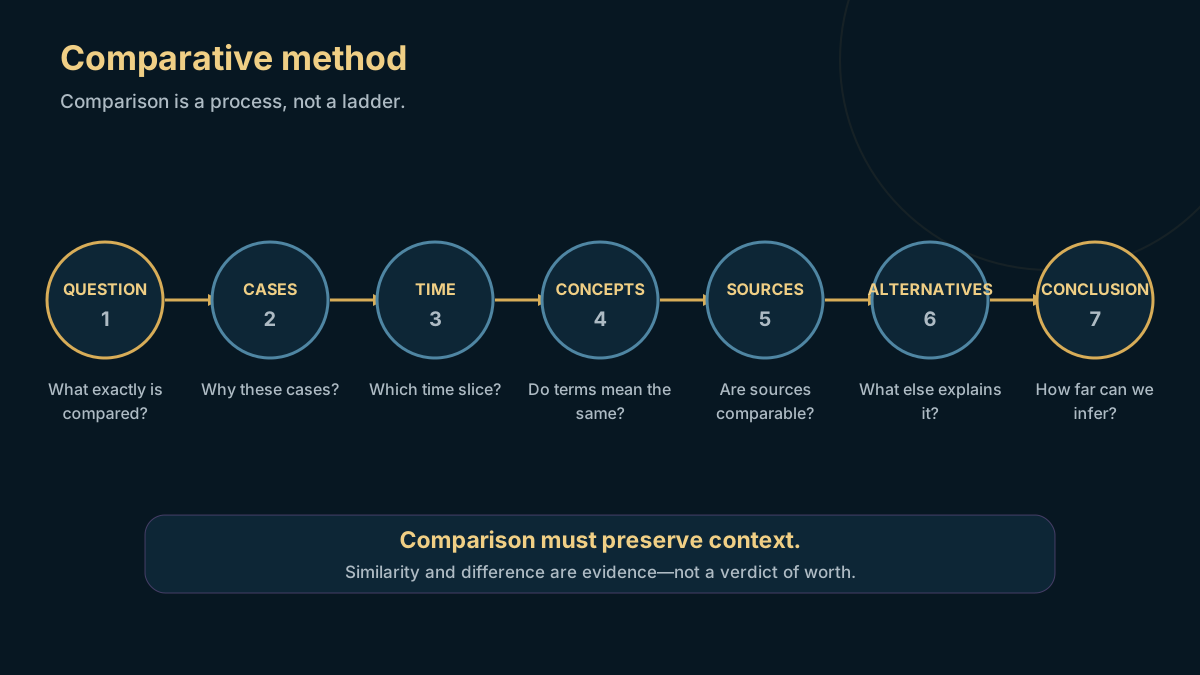
- Ask a concrete question rather than building a general ladder of “progress.”
- Define the unit of comparison and time frame.
- Check whether the same terms refer to genuinely comparable practices.
- Use sources of comparable quality and record where documentation is uneven.
- Separate similarity from evidence of historical transmission.
- Test alternative explanations and cases that do not fit the pattern.
- Limit the conclusion to what the evidence actually supports.
- Before concluding, look for at least one case that does not fit the explanation.
- State whether the conclusion is descriptive, genealogical, or causal.
- Explain which dimensions cannot be compared reliably because the evidence or measurement is unequal.
Comparative history does not require perfectly identical cases. It requires differences to be defined clearly enough that we know what the conclusion means.
Comparison Is a Tool for Better Questions
Large civilizational comparisons can be useful when they begin analysis rather than replace it. Good comparison forces us to define categories, examine temporal context and acknowledge uneven sources.
Its greatest value is therefore not always an answer. Often it is the transformation of a question that initially looked simple into one that is genuinely precise.
Comparison is powerful when it reveals the structure of a question—and dangerous when it becomes a value ladder.
Sources and further reading
- Skocpol, T., & Somers, M. (1980). The Uses of Comparative History in Macrosocial Inquiry. Comparative Studies in Society and History, 22(2), 174–197. DOI: 10.1017/S0010417500009282. Source
- Mahoney, J., & Rueschemeyer, D. (eds.). (2003). Comparative Historical Analysis in the Social Sciences. Cambridge University Press. Source
- Human Relations Area Files. Basic Guide to Cross-Cultural Research. Source
- Human Relations Area Files. Cross-cultural research overview. Source
- Bloch, M. Toward a Comparative History of European Societies. Lietuvos istorijos studijos 39 (2017 reprint). DOI: 10.15388/LIS.2017.39.10767. Source
- Lange, M. (2012). Comparative-Historical Methods. SAGE. Source