Star Lore: When the Sky Becomes Story
Stars are physical objects; star lore is a cultural system connecting the sky with memory, seasons, direction, kinship and story.
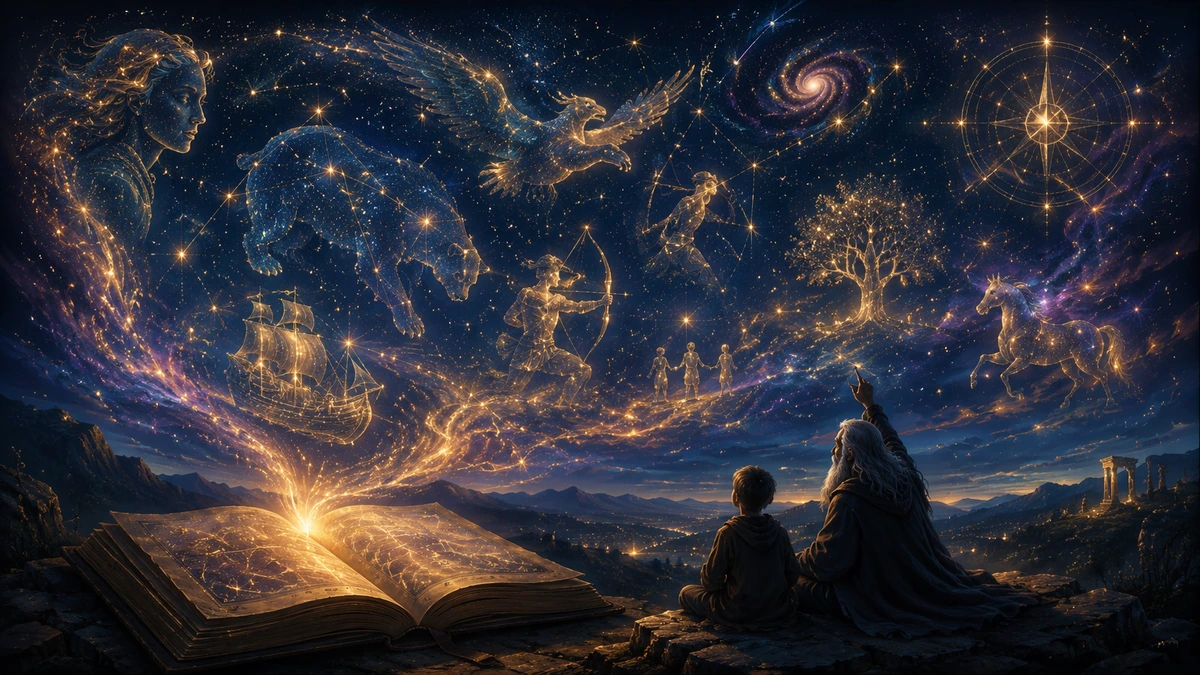
An astronom can measure a star’s position, brightness, spectrum, motion and distance. Human beings have also used the sky in another way: as a space of stories, names, kinship relations, seasonal signs, direction and memory.
We can call this broader cultural layer star lore. It is not one universal collection of myths and not a hidden dictionary in which every people assigns the same meaning to the same star. Cultural astronomy shows substantial diversity in how communities connect the physical sky with life on Earth.
Star lore therefore requires two levels at once. Stars are not created by stories. But stories can shape which stars people connect, remember and use as part of a cultural system.
Star lore is not an alternative physics of stars. It is part of the history of human relationships with the sky.
The sky is stable enough to become shared memory
On human time scales, patterns of bright stars change slowly. Multiple generations can therefore recognize similar celestial landmarks. This relative stability is one reason the sky could become a cultural archive.
The IAU’s cultural astronomy framework notes that people used movements of the Sun, Moon and stars for timekeeping, seasonal change, planting, harvesting and other practices. Story and practical use were not always separated as sharply as they are in modern categories.
When the same celestial event returns year after year, it can become observation, seasonal marker and story at the same time.
Story helps select which points in the sky matter
The sky contains far more stars than any one cultural figure includes. Story performs selection: it tells people which stars belong together, how they relate and what should be remembered.
This resembles a mnemonic system. An abstract sequence of points is harder to preserve than a figure, name or story with relationships among its parts.
But the mnemonic analogy does not mean every myth originated only to remember astronomy. Narratives can have religious, social, moral and identity functions at the same time.
Matariki shows how sky, season and narrative can intertwine
Matariki is a Māori name for the Pleiades star cluster and part of a broader New Year cultural complex. Te Papa presents multiple stories concerning Matariki and its stars and emphasizes variation among traditions.
Some contemporary presentations connect individual stars with different domains of environment, memory and hopes for the coming year. These should not be presented as one unchanged system shared by all Māori, but as documented traditions with internal diversity.
Astronomically, the Pleiades are an open star cluster. Culturally, the same physical object can become a seasonal marker, a narrative focus and a node of community memory.
Physical object and cultural meaning are not competitors. They answer different questions.

Star lore can also connect with orientation
In many maritime and terrestrial traditions, knowledge of the rising and setting of stars is connected with orientation. The Hawaiian star compass used in the modern revival of Polynesian navigation organizes directions using celestial and other natural cues.
Again, precision matters. Story, star name and navigational practice are not automatically the same thing. A particular tradition may connect them in a specific way that should not be generalized to all cultures.
That is why local sources are more valuable than a universal table of star symbols.
Dark constellations show that even the idea of a “star pattern” is not universal
Australian Aboriginal traditions of the Emu in the Sky are important because the figure is formed largely from dark regions of the Milky Way, including the Coalsack area, rather than primarily by connecting bright stars.
This expands the very idea of what a celestial figure can be. If we looked only for lines between bright stars, we would miss an important type of sky knowledge.
Research also emphasizes that details vary among language and cultural groups. “Australian Aboriginal astronomy” is not one homogeneous tradition.
Lakota traditions show that star lore is more than a list of constellations
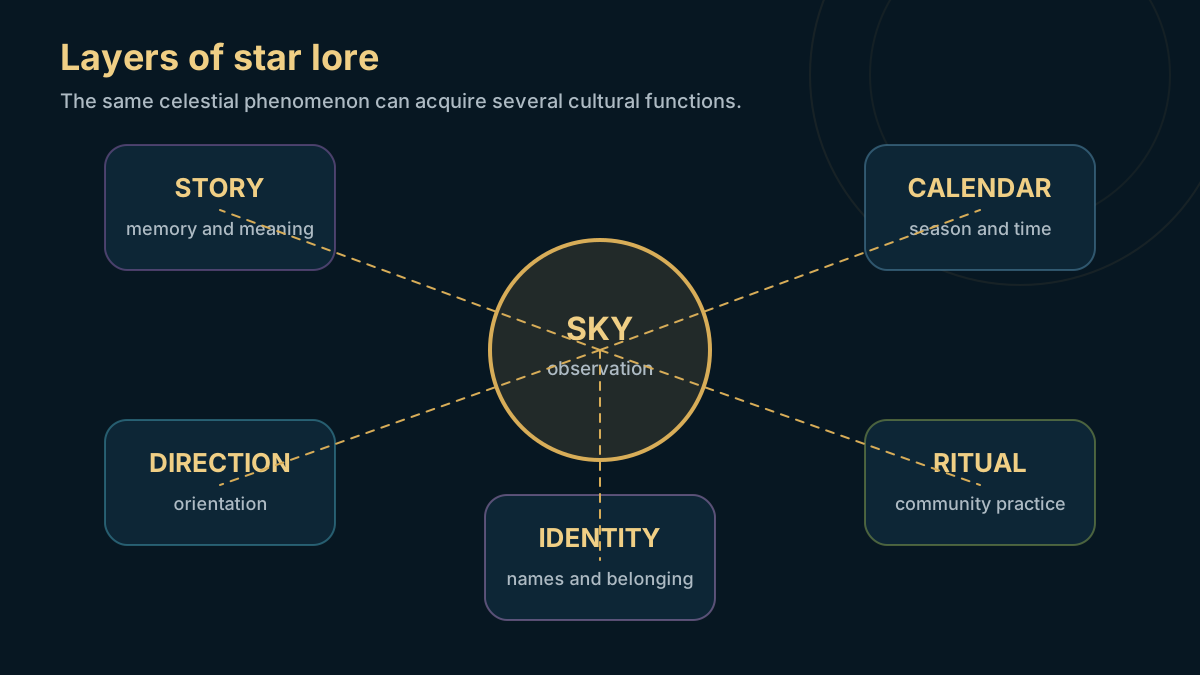
Another useful example comes from research on Lakota ethnoastronomy. The Smithsonian catalog record for Mark Hollabaugh’s The Spirit and the Sky describes a system in which names for stars and constellations connect with timekeeping, the Sun and Moon, meteors, the aurora, and broader cultural practices and beliefs. This matters because it shows that “star lore” need not be a separate collection of stories about figures in the sky.
The Smithsonian National Museum of the American Indian made a similar point in the exhibition Our Universes, presenting several Indigenous cosmologies through one solar year and emphasizing how celestial bodies help structure calendars of ceremonies and celebrations. In such examples the sky is simultaneously a temporal, ritual, practical, and narrative space.
Precision still matters. The labels “Lakota” or “Native astronomy” do not imply one unchanged version shared by every community and period. The value of the example lies in documenting a particular cultural system, not in reconstructing a universal Indigenous sky.
Such examples reveal another methodological issue: when oral knowledge is written into a book or museum catalog, it is necessarily moved into a different form. Recording can preserve knowledge and make comparison possible, but it can also remove voice, place, season, the relationship between teller and audience, and other elements that were part of the original context.
It is therefore useful to distinguish documenting content from documenting practice. The question “which star is this?” may be only the first step. The next questions are “when is it spoken about, who uses the knowledge, and what is done with it?”
Star lore is not evidence for a universal hidden code
When similar motifs appear—a hunter, serpent, bird or seven sisters—it is tempting to declare them evidence of one secret system or a single lost origin. Sometimes historical connections may exist; sometimes shared human experience matters; sometimes similarities arise independently.
Historical transmission requires more than motif similarity: linguistic, archaeological, documentary or other evidence of contact is needed.
This caution does not make comparison less interesting. It allows difference to remain as important as similarity.
Comparing Matariki, the celestial emu, Lakota star knowledge, and navigational traditions therefore reveals a shared human activity—connecting the sky with life—not one shared interpretation. Similar functions can emerge from common observation of cycles, from historical transmission, or from local development.
How to study star lore
- Separate the physical celestial object from the cultural figure or story.
- Identify the community, period and source of the version being discussed.
- Ask whether the tradition is living, historically documented, or reconstructed from later sources.
- Identify its functions: calendrical, navigational, ritual, educational, social—or several at once.
- Compare traditions without assuming similarity must imply common origin.
- When a narrative makes a natural-science claim, evaluate that claim with the appropriate scientific method as well.
This approach can take both cultures and astronomy seriously.
The sky is shared; relationships with it are part of human history
Star lore bridges astronomy and the humanities. On one side is the measurable sky. On the other are names, stories, calendars, rituals and memory.
If we see only stories, we may forget that they concern a real sky. If we see only physics, we may miss millennia of human practice through which the sky became part of social life.
The stars are older than our stories. But stories about stars are part of the history of how human beings found their place beneath them.
Sources and further reading
- International Astronomical Union. Commission C5 Cultural Astronomy — Scientific Objectives. Source
- Museum of New Zealand Te Papa Tongarewa. The legend of Matariki and the six sisters. Source
- Museum of New Zealand Te Papa Tongarewa. What and who is Matariki? Source
- UNESCO Intangible Cultural Heritage. Oral traditions and expressions. Source
- Fuller, R. S. et al. (2014). The Emu Sky Knowledge of the Kamilaroi and Euahlayi Peoples. Source
- NASA Science. Messier 45 (The Pleiades). Source
- Polynesian Voyaging Society / Hōkūleʻa. The Star Compass. Source
- Hollabaugh, M. (2017). The Spirit and the Sky: Lakota Visions of the Cosmos. University of Nebraska Press / American Indian Studies Research Institute. Smithsonian Libraries and Archives catalog record. Source
- Smithsonian National Museum of the American Indian. Our Universes: Traditional Knowledge Shapes Our World. Source