Astrological and Astro-Theological Symbolism: What a Symbol Can—and Cannot—Prove
Zodiacs, planets and solar motifs appear in very different religious and cultural settings. Their presence is historical evidence; claims about their meaning require context and independent support.

A zodiac wheel in a temple, an image of the Sun in a religious space or a planetary name in a myth can quickly trigger a sweeping interpretation. Yet several steps lie between observing a symbol and establishing what it meant.
The history of astrology shows that celestial signs belonged to scholarly, political, religious and divinatory systems in different periods. Francesca Rochberg describes Mesopotamian celestial divination as part of a scribal tradition of systematic sign-reading, while Tamsyn Barton traces astrology from Mesopotamia into the Greco-Roman world.
That does not mean every zodiac proves the same belief, or that every religious image of the Sun is a hidden astrological code. Symbols travel between cultures and can change function.
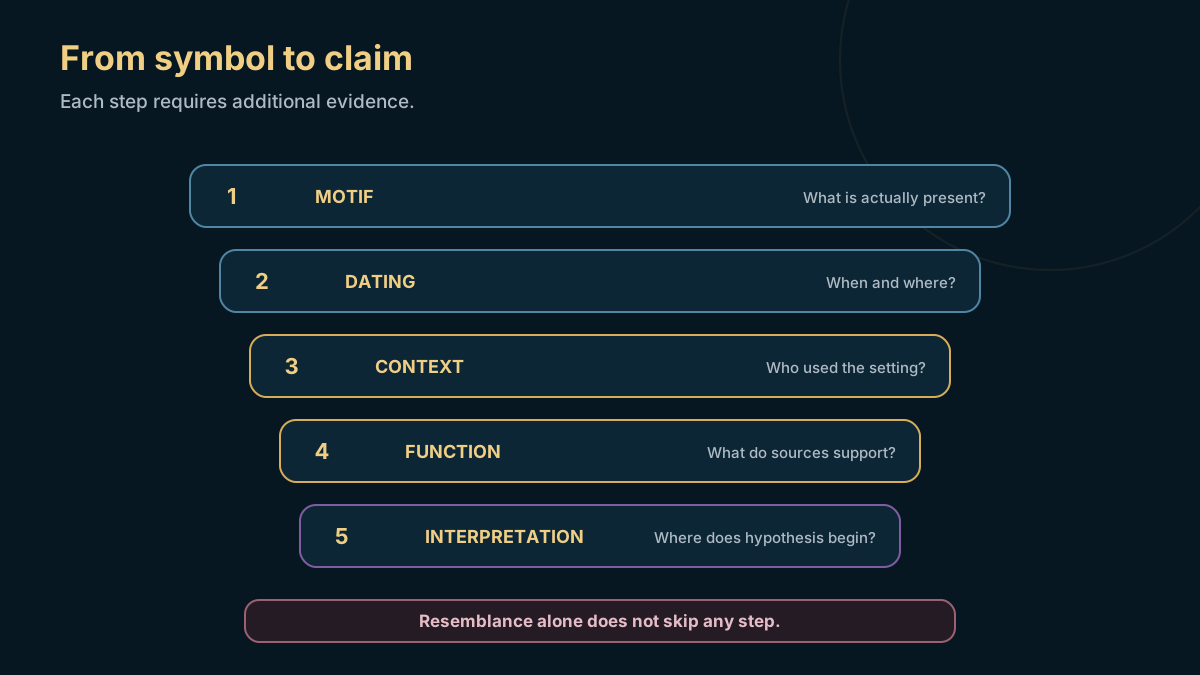
Document the symbol first. Interpret its meaning only after establishing time, place and context.
Astrology and the Zodiac Are Historical Systems
Mesopotamian celestial divination, Hellenistic horoscopes, Roman astrology and later European or Islamic astrological traditions are not one unchanged doctrine. They share concepts and pathways of transmission, but differ in techniques, institutions and interpretations of the sky.
It is therefore more accurate to speak of histories of astrological practice than of a single “ancient astrology” that meant the same thing everywhere.
Even within one broad historical region, the object of interpretation can change. Mesopotamian celestial omens often concerned king and state, while Hellenistic horoscopy centered an individual birth. When a later author adopts a planetary name or zodiacal sign, that does not mean the entire earlier theory was adopted with it.
The history of an idea is therefore not a list of symbols that look alike. It is a history of techniques, texts, institutions, and users who give a symbol a function.
The twelve-part zodiac can belong to an astrological system, but its image can also represent the annual cycle, seasons, celestial order or the prestige of learned knowledge. Function depends on context.
This is where the distinction between motif and interpretation becomes essential. We may see twelve signs; their presence alone does not tell us how the users of a space understood them.
Dendera and the Importance of Cultural Context
The Dendera Zodiac, now in the Louvre, is a relief ceiling from the Temple of Hathor and is dated to around 50 BCE. The Louvre describes zodiacal signs, decans and constellations; another official account also notes the twelve zodiacal constellations, five planets known at the time and depictions of eclipses.
This is an important example of celestial iconography in an Egyptian religious space of the Hellenistic period. It proves that this visual language was present. It does not prove that the whole of Egyptian religion can be reduced to the zodiac.
Late Antique synagogues in Palestine offer a striking example. Beth Alpha has a central mosaic panel with Helios, the zodiac cycle and four seasons. An Oxford overview dates it to the sixth century and describes it within a multi-panel Jewish sacred program.
Interpretation of the motif remains a scholarly question. That distinction matters: the zodiac’s presence is archaeological fact; its exact theological meaning cannot be read from the form alone. Hachlili and other scholars compare multiple synagogue zodiacs to reconstruct the wider iconographic context.

Three Routes to Similarity: Shared Sky, Transmission, and Independent Analogy
When two cultures use a similar celestial motif, at least three explanations remain open. The first is a shared object of observation: the Sun, Moon, Pleiades, or seasonal cycle are visible to many societies and can generate similar categories without direct contact. The second is historical transmission: people, texts, and objects move, carrying symbols with them. The third is independent analogy, in which a similar social or cognitive problem produces a similar form.
These possibilities can overlap. Zodiacal imagery moved historically between cultural settings, but receiving communities integrated it into their own religious and calendrical systems. Evidence that a form was transmitted is therefore not yet evidence that its meaning was transmitted unchanged.
Methodologically, the safest approach is to begin with the least ambitious claim that the evidence supports. If we can establish a shared motif, we say shared motif. If we can establish a route of transmission, we add transmission. Only when sources support interpretation do we claim shared meaning.
Astro-Theological Interpretation and Chronology
The term astro-theological symbolism is useful when analyzing links between celestial motifs and religious narratives, rituals or theological ideas. It should remain a descriptive, testable category rather than a universal key.
A strong claim that a myth is “really” only a disguised astronomical phenomenon needs more than resemblance. Historical texts, iconography, chronology, cultural context and ideally independent evidence are required to show that people themselves understood such a connection.
A claim of influence has to respect time. A younger object cannot be the direct source of an older one, and a late literary explanation does not necessarily prove that the same interpretation existed centuries earlier. Dating is therefore not a technical footnote; it is part of the argument.
When a similar motif appears in two settings, we look for the earliest secure examples, possible routes of contact, and intermediate forms. Sometimes the transfer is well documented; at other times we have only a possible connection. Scholarly discipline includes leaving the arrow between two points unfinished when the evidence is not strong enough.
The silence of sources also matters. The absence of a textual explanation does not prove that no meaning existed, but it limits how precisely we can reconstruct it. Iconography can be strong evidence for the presence of a motif without becoming an automatic transcript of what viewers thought.
How Strong Is the Evidence?
In iconography it is useful to distinguish at least three levels. The first is descriptive: what is actually depicted? The second is conventional: does the motif normally carry a recognizable meaning in the same cultural setting? The third is programmatic: what does the motif mean in this particular building, tomb, coin, or manuscript together with the surrounding elements?
The mistake is to jump directly from the first level to the third. A figure of Helios can identify a solar motif; its position in a synagogue mosaic requires interpretation of the whole program, inscriptions, dating, and local Jewish context. The same symbol in a temple, coin, and private horoscope can serve three different functions.
Comparative iconography therefore gains strength from a series of objects rather than one striking example. If a motif recurs in several well-dated contexts and its accompanying elements vary in patterned ways, we can better separate what is stable in the symbol from what is locally interpreted.
- The motif is genuinely present and correctly identified.
- The object or text is reliably dated and located.
- The local cultural and religious context is known.
- Textual, comparative or archaeological evidence supports a specific function.
- Only then should a broader interpretation be assessed, with a clear boundary between evidence and hypothesis.
- Check chronological direction and plausible routes of transmission.
- Separate demonstrated meaning from later or modern interpretation.
What Would Count Against Our Interpretation?
A good astro-theological hypothesis must be able to fail. If every sun, circle, group of twelve, cross, or sevenfold pattern automatically confirms the same system, the method will almost always find what it is looking for. Human cultures contain so many symbols that accidental matches are not rare.
Before analysis it is therefore useful to state what we would expect if the proposed connection were real: a particular chronology, several linked motifs, textual evidence, a geographic route, or a specific function. We should also examine cases in which the motif ought to appear under the theory but does not.
Historical interpretation does not have to become a laboratory experiment. It does need a sufficiently clear distinction between evidence and interpretation that a new discovery could weaken the hypothesis rather than only strengthen it.
Resemblance Is Not Enough for a Universal Hidden Code
The Sun, Moon, seven classical wandering lights, four seasons and twelve-part divisions are powerful motifs partly because cultures share the same sky and partly because ideas travelled historically. Similarities are therefore not surprising.
But a shared sky does not guarantee a shared theology. Sometimes transmission can be demonstrated, sometimes local reinterpretation, and sometimes only formal resemblance.
A universal interpretation faces an additional problem: it often selects similarities while discarding differences. If a theory claims that twelve zodiacal signs explain a religious system, it must also account for major elements of that system that do not fit the zodiacal scheme. An explanation that always counts a match as evidence and a mismatch as irrelevant cannot seriously fail—and is therefore a poor test.
Symbolism Becomes Historical Evidence When Read with Discipline
Astrological and astro-theological symbolism is valuable because it shows how people connected sky, time, fate, authority and religious ideas. Precisely because symbols can carry multiple meanings, they require more context, not less.
The most interesting interpretation is not necessarily the most spectacular one. The strongest interpretation is the one for which we can show a path from object to meaning.
A symbol proves that the symbol was there. Everything beyond that must be demonstrated separately.
Sources and further reading
- Rochberg, F. (2004). The Heavenly Writing: Divination, Horoscopy, and Astronomy in Mesopotamian Culture. Cambridge University Press. Source
- Rochberg, F. Personal Celestial Divination: The Babylonian Horoscopes. In The Heavenly Writing. Cambridge University Press. Source
- Barton, T. (1994). Ancient Astrology. Routledge. Source
- Musée du Louvre. Zodiaque de Dendéra, E 13482. Source
- Ancient Synagogues in Palestine: An Overview — Beth Alpha. British Academy / Oxford Academic. Source
- Hachlili, R. (2002). The Zodiac in Ancient Jewish Synagogal Art: A Review. Jewish Studies Quarterly, 9(3), 219–258. JSTOR 40753310. Source
- International Astronomical Union. Commission C5 Cultural Astronomy — Scientific Objectives. Source