How Stars Become a Constellation
A constellation is not a three-dimensional group of stars. Explore sky projection, real stellar distances, proper motion, and the difference between constellations and asterisms.
When we look at a clear night sky, we see bright points against a dark background. Some are brighter, others barely visible. If we observe them long enough, we begin to recognize shapes among them: an arc, a cross, a triangle, the letter W, a belt of three stars, or an outline that we can associate with an animal, a person, or an object.
But there are no lines drawn through space between those stars.
No star knows that it is part of Orion's Belt. No star belongs to Ursa Major because it forms a three-dimensional bear with the other stars. The pattern appears only from a particular observing position — from Earth — when we see three-dimensional space projected onto an apparently two-dimensional sky.
That is why constellations are such a useful example of the subject we opened in the article “One Reality, Many Maps”: reality is one, yet human beings organize it into a map that helps us orient ourselves.
A constellation is not a three-dimensional object waiting to be found among the stars. It is a pattern, or a region of the sky, that arises from how we see and name the stellar distribution from Earth.
When we look at the sky, we barely see depth
If we stand in a forest, we can usually estimate fairly quickly which tree is closer and which is farther away. Stereoscopic vision, changes in perspective, overlapping objects, apparent size, and many other cues help us.
Stars are different.
The distances are so great that with the naked eye we have almost no direct sense of their depth. We therefore experience the stars as if they were arranged across a vast celestial dome around us. That picture does not mean that they really lie on a single spherical surface. It is a convenient way of describing their directions in the sky.
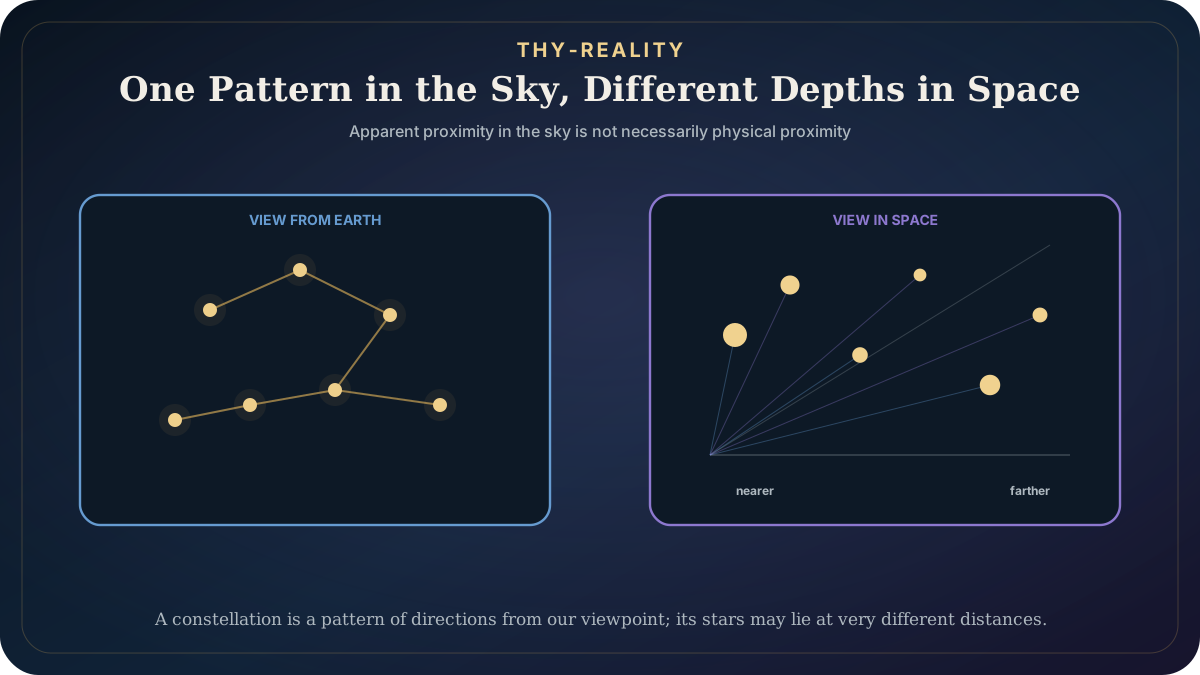
When two stars appear close together, this mainly tells us something about the angular directions in which we see them from Earth. It does not necessarily mean that they are close together in three-dimensional space.
Imagine two lights. One is ten metres away from us, the other a hundred metres away. If they are almost in the same direction, they may look very close to each other. If we moved far enough sideways, it would become obvious that they are not next to each other at all.
The same thing happens with stars, only on an incomparably larger scale.
Stars in the same constellation are not necessarily neighbours
NASA explicitly points out in its explanations of constellations that stars which appear close together in the same pattern can actually be separated by enormous distances and may have no physical connection with one another.
Orion is an excellent example.
Its belt appears to us as an almost straight row of three bright stars. From our direction, they look like a remarkably orderly group. But when their arrangement is viewed in three dimensions, the picture stretches out in depth. NASA visualizations of Orion show that the familiar two-dimensional figure quickly breaks apart when the observing position begins to move around the stars.
This does not mean that stars appearing within the same constellation can never be physically related. Some may belong to the same star cluster or wider stellar association. But membership in a constellation pattern is not, by itself, evidence of physical connection.
When we speak about a traditional stellar pattern, membership in it first means that we see the stars from Earth in particular directions on the sky, not that they form a mutually gravitationally connected group.
That is an important distinction. If we say “the stars in Orion,” we may be referring to stars that from Earth appear in the direction of that constellation. It does not follow that they form one physical group in the Galaxy.
Closeness in the sky is not the same as closeness in space.
The pattern depends on where we observe from
We can make a simple thought experiment.
Imagine several small lights suspended at different distances in a large dark room. We stand on one marked spot on the floor. From that position, some of the lights appear to line up and form a recognizable triangle.
If we move a few metres sideways, the triangle changes. If we could move far enough away, the original figure might disappear entirely.
The same applies to stellar constellations. NASA's three-dimensional visualization of Orion shows exactly this: the familiar outline exists because of our current viewpoint from the neighbourhood of the Sun. From a sufficiently different place in the Galaxy, the same stars would be arranged differently.
This reveals something important about the idea of a pattern.
A pattern is not necessarily imaginary in the sense that nothing is there. The positions of the bright points we observe are real observational data. But the way we connect them into a figure depends on projection, the selection of stars, and the observer's position.
A constellation is therefore connected both with an objective sky and with the human way of organizing that sky.
Why constellations still seem permanent
If stars occupy different places in space and also move, why do Orion, Cassiopeia, or the Big Dipper look almost the same from year to year? Because stars are extremely far away. Their motion through the Galaxy is real, but for most stars the change in position on our sky is very small on the timescale of a human life. Astronomers call this angular change in position proper motion.
Using data from the Gaia mission, the European Space Agency explains that constellations appear fixed, but over millennia the different proper motions of individual stars will change their shapes. Gaia measures the positions, distances, and motions of enormous numbers of stars, giving us a three-dimensional view of the stellar neighbourhood that we do not have with the naked eye.
On a short timescale, then, a stellar pattern is stable enough to serve as an orientation map. On a long timescale, even this map is not unchanging. The constellations we know today are not eternal geometric figures of the universe. They are our present view of a dynamic Galaxy.
In modern astronomy, a constellation is more than a line drawing
When we use the word “constellation” today, we can mean two somewhat different things. In everyday speech, we usually imagine a recognizable pattern of bright stars — something like connecting the dots.
In modern astronomy, however, official constellations have a more precise function. The sky is divided into 88 named regions so that every position in the sky can be assigned to one of them. A constellation is therefore not limited to the few bright stars used to draw its traditional figure. Its region also contains fainter stars, galaxies, nebulae, and other objects that lie in the same direction on the sky.
This is similar to countries on a map. If we mark Ljubljana, Maribor, and Koper on a map of Slovenia, those three points are not Slovenia. They are only some recognizable places within a larger defined area. Likewise, a few bright stars forming a recognizable outline are not the whole modern astronomical constellation.
How astronomy arrived at today's 88 regions and how their boundaries became standardized will be discussed separately in the final article of this first series. For now, only the distinction matters: the traditional figure is a pattern; the official constellation is a defined region of the sky.

A constellation and an asterism are not quite the same thing
Here we encounter another term: asterism. An asterism is a recognizable pattern of stars used for orientation or for identifying the sky, but it is not necessarily one of the 88 official constellations.
The Big Dipper is a familiar example. Many people casually treat it as a constellation, but in modern astronomical usage it is an asterism within the larger constellation Ursa Major. The Summer Triangle is a different kind of example: its three bright stars belong to three different official constellations.
This distinction shows that human pattern recognition and the astronomical division of the sky are not the same systematic level. The first helps us recognize a shape quickly. The second gives us a standardized way to name regions of the sky.
Both are useful, but for somewhat different purposes.
Human beings do not see only stars — they also see meaning
When we connect points of starlight, we do not automatically obtain only one possible figure. Different observers can assign different shapes to the same arrangement. Boundaries between a “head,” an “arm,” a “tail,” or a “weapon” do not exist as bright lines in the sky. We add them.
That is why cultures around the world recognized different animals, heroes, objects, and stories in the same sky. IAU astroEDU educational material notes that throughout history people assigned different names and stories to stellar patterns and used them to recognize the sky, navigate, and identify the approach of seasons.
This does not mean that everything in the sky is arbitrary. Bright stars have particular apparent positions. Some geometric arrangements stand out more strongly than others because of brightness and spacing. But those positions do not dictate one necessary story.
This opens the next question in the first publication phase: If we all look at the same sky, why did different cultures not see the same world in it? The article “The Same Sky, Different Worlds” continues that question.
How to think accurately about a constellation
The next time we look at a familiar constellation, we can keep several levels in mind at once. The first level is observation: there are bright points in the sky with particular apparent positions and brightnesses.
The second is projection: from Earth, we see their three-dimensional distribution as directions on an apparent celestial surface. The third is pattern: we connect some of the points into a recognizable figure. The fourth is cultural meaning: we give the figure a name and attach a story, symbol, or practical meaning to it.
The fifth is astronomical standardization: modern astronomy also uses the constellation name for a defined region of the sky, not only for a traditional line figure. None of these levels needs to be discarded. The problem begins only when we mix them up.
If we mistake projection for physical proximity, we get a false picture of space. If we mistake a cultural pattern for a figure literally drawn by nature, we forget the role of the observer. If we mistake the traditional outline for an official astronomical boundary, we confuse two different meanings of the same word.
Understanding constellations is therefore a small exercise in precision.
Stars are physical objects. Their distances and motions are physical facts. A constellation is the way we organize those stars, from a particular observing position, into a useful map of the sky.
That does not diminish the value of constellations. Quite the opposite. It shows how human beings transformed an enormous number of bright points into a system that could help them find direction, follow time, tell stories, and eventually map the sky more precisely.
When we understand how stars become a constellation, we begin to look at the same night sky in two ways at once: as real three-dimensional space and as a human map drawn across its apparent surface.
Sources and further reading
- NASA Space Place. What Are Constellations? NASA/JPL-Caltech. Source
- NASA Goddard Space Flight Center, StarChild. What are constellations? Source
- NASA Science. The True Shape of Orion. Hubble visualization. Source
- NASA Science. Discovering the Universe Through the Constellation Orion. 2026. Source
- European Space Agency. Proper motion. Gaia mission. Source
- European Space Agency. The future of the Orion constellation. Gaia mission. Source
- NASA Science. Skywatching FAQ — Stars and Constellations. Source
- International Astronomical Union / astroEDU. What is a Constellation? Source