Cycles of Time and Cosmologies: Between Astronomical Rhythm and Cultural Models of the World
Day, lunation, year and precession are measurable cycles. Calendar rounds and cosmological recurrences are ways societies organize, interpret and embed rhythms within larger models of the world.
We experience time as flow, yet we measure it through recurrence. Day returns, the Moon passes through phases, seasons recur, and calendars begin new rounds. Repetition is what allows duration to be organized.
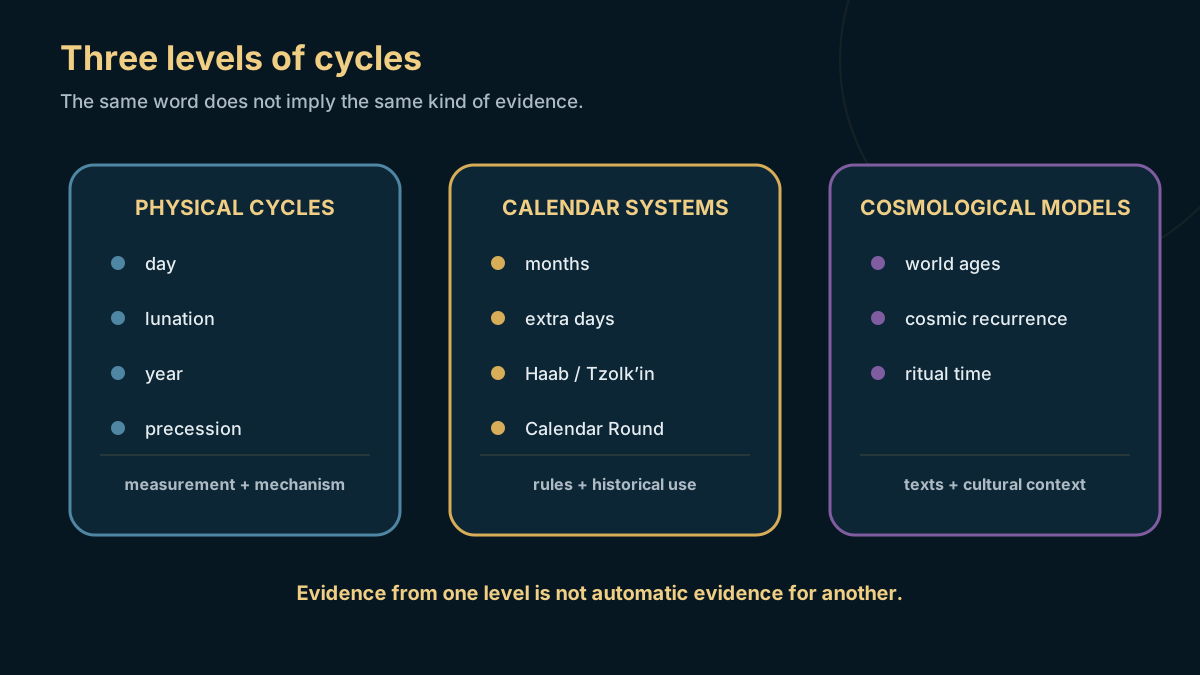
But not all “cycles of time” are the same kind of thing. Some are physical: Earth’s rotation, lunar motion, Earth’s orbit around the Sun or axial precession. Others are calendar systems that translate these rhythms into social time. Still others are cosmological ideas about worlds recurring.
When these levels are mixed, symbolic cosmology can be mistaken for astronomical measurement—or the reverse. When they are separated, it becomes clearer why cyclical language appears so widely.
Recurrence can be a measured phenomenon, a calendrical convention or a cosmological idea. First identify the level being discussed.
First: Physical Cycles
The most direct cycles come from measurable motions. Earth’s rotation structures the day; Earth–Moon motion produces the rhythm of lunar phases; Earth’s orbit around the Sun together with axial tilt organizes the year and seasons.
On longer time scales, the geometry of Earth’s motion also changes. NASA divides Milankovitch cycles into orbital eccentricity, axial tilt and precession. These variations affect the distribution of incoming solar radiation over tens to hundreds of thousands of years.
When the Sky Becomes a Calendar
Calendars must translate natural rhythms that do not divide neatly into one another into usable social schemes. The astronomical year is not a whole number of days; a lunation does not fit perfectly into the solar year. Calendars therefore use rules, additional days, leap corrections or multiple interlocking cycles.
A calendar is therefore a map of time. It tracks real rhythms while organizing them within a conventional structure a community can use.
A lunar month and a solar year are not integer multiples of one another. A lunisolar calendar therefore needs a way to insert an occasional month and bring lunar months back into alignment with the seasons. One of the best-known historical approximations is the nineteen-year cycle associated with the Athenian astronomer Meton in the fifth century BCE.
Diodorus Siculus reports that Meton publicly presented a nineteen-year cycle. Later calendrical descriptions explain it as 19 solar years approximately aligned with 235 lunar months, with an additional month inserted in seven of the years. It is an unusually clear example of a calendar as a mathematical model of two real rhythms that do not fit together perfectly.
Historical caution still matters: the fact that the cycle is known as Metonic does not mean it was simply and completely adopted as the Athenian civil calendar. Scholarship notes that practical calendrical use was more complicated. A mathematical approximation and its social implementation are separate questions.
The Metropolitan Museum describes the Egyptian civil calendar as twelve 30-day months plus five additional days. New Year was probably originally connected with the heliacal rising of Sopdet, or Sirius.
Because the civil calendar counted 365 days while the astronomical year is longer, it drifted across centuries relative to the seasons and Sirius. This is a clear example of the difference between a natural cycle and a human system for counting it.
The Smithsonian’s Living Maya Time project describes the Haab as a 365-day cycle and the Tzolk’in as a 260-day cycle. Their combination in the Calendar Round repeats after 18,980 days, or 52 Haab years.
The Long Count additionally allowed events to be dated across longer periods. It is therefore misleading to speak of “the Maya calendar” as one circular dial. Several systems served different functions.

Corrections, Approximations, and Mismatches
Because natural rhythms are not perfectly commensurable, a good calendrical system includes a correction mechanism. The leap day in the modern Gregorian calendar or an intercalary month in a lunisolar system is not an admission that the calendar “does not work.” It is the mechanism that keeps the model sufficiently close to the phenomenon it measures.
This matters more broadly for models. A model that can be corrected can be more useful than an elegant system that never adjusts to observations. Cycles should therefore be judged not only by the beauty of a numerical ratio but by predictive accuracy and by how cumulative drift is handled.
When two cycles nearly coincide after a certain number of repetitions, it is tempting to speak of a perfect return. But a small difference accumulates across many cycles. This is why historical astronomers improved calendrical approximations and why modern astronomy states a period together with precision and a reference system.
Nineteen years and 235 lunations form an excellent approximation, not a mathematical identity. The same applies to long orbital rhythms: their characteristic periods are not clocks that return the entire planetary system to an identical state after an exact number of years. Several periods vary and overlap at once.
This detail matters for cultural interpretation. If a text speaks of a “great year,” numerical resemblance alone does not prove that it describes exactly the same physical cycle calculated by a modern model.
Astronomical Cycles Are Not a Timetable of History
Precession changes the orientation of Earth’s axis over roughly 26,000 years. Milankovitch cycles influence long-term climate. But the existence of a long natural cycle does not mean every cultural idea of a “great age” is a direct measurement of the same phenomenon.
Linking a cultural cycle to an astronomical mechanism requires historical evidence that the mechanism was observed, calculated or actually connected to that temporal model within the tradition.
Cyclical language is attractive in history as well: we speak about the rise and fall of empires, generational cycles, or recurring crises. Such patterns can be analytically useful, but they do not have the same status as an orbital period. Social events are not bodies moving on a stable trajectory; institutions, technology, decisions, environments, and contingencies all intervene.
A similar interval between historical events is therefore not yet a cycle. A serious claim needs a repeatable mechanism, a clear method of measurement, and enough cases to distinguish a prediction from a pattern identified only after the fact.
Cosmological Cycles Are a Different Kind of Claim
Stoic cosmology, for example, included repeating world cycles in which the cosmos passes through periods of order and cosmic conflagration. The Stanford Encyclopedia of Philosophy also notes disagreement among ancient sources about the details of recurrence.
This is not an astronomical cycle in the same sense as precession or orbit. It is a philosophical model of the whole. It may use the language of nature, but it should be evaluated as a historical-philosophical idea.
A calendrical cycle solves a practical problem of counting: when will a combination of phases or dates recur closely enough? A cosmological cycle can instead address the origin, destruction, and renewal of a world. Even when both use numbers and repetition, their evidential burdens are not the same.
We can therefore study Stoic world cycles, Indian cosmologies, or other concepts of great ages historically without having to validate them as astronomically measured periods. The first question is what the source itself claims: an observation, a calendrical rule, a philosophical metaphysics, a ritual period, or some combination of these levels.
This distinction prevents two opposite errors: reducing ancient cosmology to “bad astronomy,” or turning every symbolic great age into a hidden modern scientific measurement.
Why Cyclical Thinking Is So Common
Cycles are cognitively and practically powerful because they combine change with predictability. A season returns but never within exactly the same circumstances. Calendars permit preparation, ritual preserves communal memory, and cosmology can add meaning to recurrence.
Cycles therefore do not prove one universal ancient cosmology. They are an expected response from beings living on a planet with strong daily, lunar and seasonal rhythms.
How to Evaluate Claims About Cycles
- Identify whether the claim concerns a measured physical phenomenon, a calendrical rule or a cosmological model.
- For astronomy, check period, mechanism and measurement.
- For calendars, check the rules of the system and its historical use.
- For cosmology, seek primary sources or high-quality historical scholarship.
- Similar cycle lengths alone do not prove historical connection.
- Separate modern reconstruction from what can be demonstrated in original sources.
A Cycle Tells Us What Returns—Not Necessarily What It Means
Astronomy can tell us with great precision how an axis changes orientation or how long an orbital variation takes. A calendar tells us how a community counts rhythms. Cosmology asks what recurrence means within a larger model of the world.
All three levels are worth studying. The problem begins only when evidence at one level is used automatically as evidence for another.
A cycle is a pattern of recurrence. Its meaning is an additional question.
Sources and further reading
- NASA Science. Milankovitch (Orbital) Cycles and Their Role in Earth’s Climate. Source
- The Metropolitan Museum of Art. Telling Time in Ancient Egypt. Source
- Smithsonian National Museum of the American Indian. Living Maya Time — The Calendar System. Source
- Smithsonian National Museum of the American Indian. Living Maya Time — Sun, Corn, and the Calendar. Source
- Stanford Encyclopedia of Philosophy. Stoicism — Cosmic Cycle and Conflagration. Source
- International Astronomical Union. Commission C5 Cultural Astronomy — Scientific Objectives. Source
- IAU astroEDU. Navigation in the Ancient Mediterranean and Beyond. Source
- Diodorus Siculus. Library, Book XII, 36.2–3: Meton and the nineteen-year cycle. Perseus Digital Library. Source
- Leverington, D. (2003). Babylon to Voyager and Beyond: A History of Planetary Astronomy. Cambridge University Press — discussion of the 19-year / 235-lunation calendrical relation. Source