Cause and Effect: Actions Have Consequences
What we do can change the world around us and our future options, but consequences are not a cosmic system of rewards and punishments. Responsibility requires distinguishing cause, risk, foreseeability, and circumstance.

Every decision changes something. If we speak, the sentence has been spoken. If we sign a document, an obligation may arise. If we hit someone, injury may follow. If we fail to act when we could have acted, that omission may also influence what happens next. In this basic sense, human action never occurs in an empty space: it enters a world that already contains other people, physical regularities, institutions, history, and circumstances we do not control.
But the modest statement “actions have consequences” can quickly be transformed into a much stronger claim: “everyone always receives exactly what their actions deserve.” Those are not the same proposition.
Causation means that events influence other events. It does not mean that the world is an automatic moral judge.
Causation is not the same as moral blame
A cause is not the same as moral guilt If lightning starts a fire, we can speak about a cause. Lightning is not therefore morally guilty. If a small child accidentally knocks over a glass and breaks a phone, the child's action may be part of the causal chain, but we do not judge that case as we would an adult who deliberately destroys the phone.
Causation and moral responsibility answer different questions. Contemporary philosophy of moral responsibility does not look only at causal contribution. It also considers the agent's capacities, degree of control, knowledge, and the way the conduct issued from the person's agency. “What caused the result?” is therefore not the same question as “whom may we fairly blame for it?”
Causation is more complicated than it looks Everyday language favors the simple form: A caused B. Real outcomes often depend on several conditions. A traffic accident may involve speed, visibility, road conditions, fatigue, vehicle condition, and the behavior of another road user. Social outcomes may involve far larger networks of interacting factors.
There is no single uncontested simple philosophical definition of cause. Contemporary approaches use, among other things, counterfactual dependence, probability, mechanisms, processes, models, and interventions. Cause and Effect: Actions Have Consequences does not need to solve the metaphysics of causation. The practical boundary is enough: when an outcome follows an action, we do not yet know automatically how much that action contributed or which other conditions were necessary.
“After this” does not mean “because of this” A occurs, then B occurs, and we are tempted to say that A caused B. Sometimes it did. Temporal order by itself is not enough. If I wear a red shirt in the morning and rain begins in the evening, the sequence does not show that my shirt caused the rain.
For serious causal questions we therefore need alternative explanations, additional evidence and, when possible, intervention-based or other methods that help distinguish mere association from causal influence. Modern causal models formalize precisely these kinds of questions about what would happen under different interventions or conditions.
Types of consequences and their time horizon
Consequences can be intended or unintended When we act, we usually seek some result. We send a message to inform someone, introduce a rule to solve a problem, or adopt a technology to make work easier. Yet purposeful action can also produce outcomes we did not intend.
Robert K. Merton's 1936 article The Unanticipated Consequences of Purposive Social Action is a classic treatment of unintended results of purposeful social action. It supplies an important correction to a simple moral story: a good intention does not guarantee a good outcome, and a bad outcome does not by itself prove a bad intention.
One decision can produce several consequences at once Imagine a company removes a service to reduce costs. The direct consequence may be lower expenditure. At the same time the decision may create longer waits, additional work for another team, dissatisfied users, or new costs elsewhere.
The same decision can benefit one person and harm another, produce a short-term benefit with a long-term cost, or generate several positive and negative effects at once. The statement “that had a good consequence” often needs a second question: good for whom, when, and in what respect?
Short-term and long-term consequences may diverge Many choices only become intelligible over time. A lie may prevent an uncomfortable conversation today, yet damage trust when it is discovered. A company may save money for years by postponing maintenance until the system eventually fails.
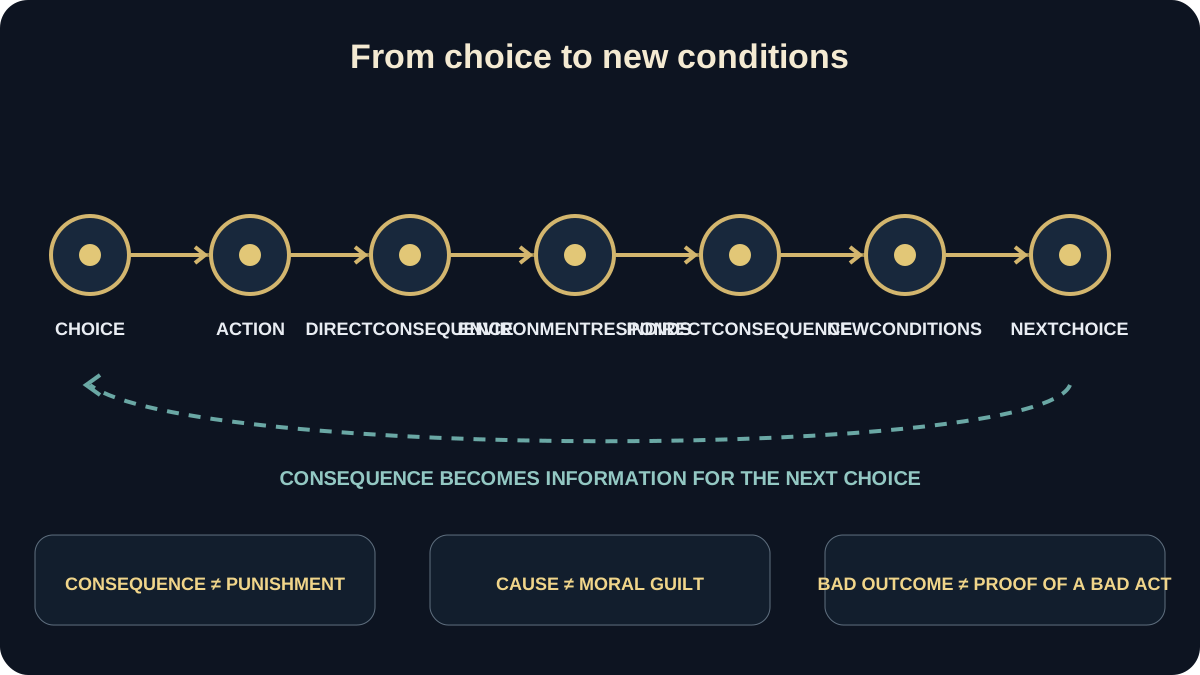
A more realistic pattern is often: action → immediate consequence → responses by others → new conditions → further consequences. The world contains feedback loops and adapting agents, so consequences cannot always be represented by one straight chain.
Consequences can change our future options A person who spends all available money may have chosen freely, yet have fewer options tomorrow. A person who trains a skill for years may acquire options that were not previously available.
An action can therefore alter not only an outcome but also the space of later choices. This is one reason cause and effect matter for freedom and responsibility: today's actions can expand or narrow tomorrow's real possibilities.
Control, risk, and foreseeability
But the outcome is not always under our control Imagine two drivers who make the same dangerous mistake and briefly look at a phone. No pedestrian steps in front of the first driver. A pedestrian appears in front of the second, and a tragedy occurs. Their conduct is similar, but the outcomes diverge because of a circumstance neither fully controlled.
Philosophers discuss this family of problems under the heading of moral luck: in ordinary moral practice, our judgments sometimes vary with outcomes and circumstances that are not fully controlled by the agent. The problem arises from the tension between a principle of control and our actual judgments about results.
The final outcome is often a mixture of our choice, other people's actions, circumstances, and luck.
Risk matters even when we are lucky This does not mean that responsibility attaches only to harms that actually occur. Extremely dangerous driving creates a serious risk even if good fortune prevents a crash. A fortunate result does not transform reckless behavior into safe behavior.
We therefore need to distinguish the actual outcome from the risk created by the action. A person may have acted irresponsibly even when lucky circumstances prevented disaster. Conversely, a bad outcome does not automatically prove that the original decision was unreasonable if it was carefully made on the evidence then available and involved a proportionate risk.
Foreseeability matters more than clairvoyance Responsibility does not require knowing the future. No one can foresee every consequence. The more useful question is what could reasonably have been expected from the information available at the time.
A highly unusual outcome that could not reasonably have been anticipated is different from a case in which an obvious risk was ignored. It is therefore useful to distinguish unforeseen from unforeseeable. Sometimes we fail to anticipate an outcome not because anticipation was impossible but because we did not want to look closely enough.
Omissions, punishment, suffering, and good intentions
Omissions can have consequences too Cause and effect usually makes us think of actions, but failures to act may also matter. A valve is not closed, a hazard is not reported, a system is not maintained, or a person with a special duty and a real ability to intervene does nothing.
This does not make us responsible for every problem in the world we failed to prevent. Does Authority Remove Personal Responsibility? already constrained responsibility for omissions by knowledge, role, effective control, and realistic capacity to act. When those conditions are present, however, an omission can be an important part of causal and moral analysis.
A consequence is not a punishment Here we need a clear methodological boundary. A person lies, later loses a job, and someone says, “natural law punished him.” But how do we know? The job loss may have resulted from the lie, an economic downturn, an unrelated restructuring, or something that would have happened anyway. The lie may never be discovered at all.
The world is not arranged so that every pleasant or unpleasant outcome transparently reveals the moral quality of earlier conduct. A consequence is the result of processes; a punishment is a moral or legal interpretation of a result. They are not the same thing.
Suffering is not proof of guilt If every bad consequence proved previous wrongdoing, we could slide into a cruel conclusion: a person suffers, therefore the person somehow caused or deserved the suffering. But people become ill, suffer accidents, are harmed by others, are born into war, and lose people they love without any moral guilt that explains those outcomes.
THY-REALITY therefore does not use cause and effect as a version of victim-blaming or as a claim that victims “create” their own misfortune. Such a conclusion would be an added moral story, not an established causal finding.
A good action does not guarantee a good outcome A person can do something morally admirable and suffer because of it. Someone may defend an innocent person and lose status, tell the truth and become a target, or try to rescue another person and be injured in the attempt.
We therefore need to separate whether the action was morally right from whether it produced a pleasant outcome for the person who acted. Consequentialist theories connect moral rightness closely to consequences, but consequentialism is one family of moral theories, and its variants disagree about which consequences matter and whether the relevant unit is the act, a rule, or a broader practice.
From causation to evaluation and feedback
Causation supplies information; values supply direction The sentence “if we do X, the probability of Y increases” can be an empirical claim. The sentence “therefore we must not do X” adds a normative step. Why is Y morally relevant? Which values are threatened? Are there competing goods? Does the action prevent a greater harm?
Natural Law Is Not a Matter of Belief already distinguished descriptive and normative claims. A description of what happens does not become a complete moral theory without additional value premises. Consequences are essential information, but they are not automatically the whole of ethics.
Yet morality cannot simply ignore consequences The previous limitation does not make consequences irrelevant. If we know that an action will seriously harm someone, that is morally important information. If two comparable options are available and one foreseeably causes substantially less unjustified harm, any serious moral account must at least address that difference.
Cause and Effect: Actions Have Consequences therefore defends a modest thesis: responsible choice should take consequences into account, but consequences alone do not automatically generate a complete moral rule.
Consequences as feedback There is a highly practical form of cause-and-effect reasoning that does not require cosmic metaphysics. We act, observe what happens, compare the result with what we expected, revise our model, and make a different choice next time.
CHOICE → ACTION → CONSEQUENCE → INFORMATION → NEW CHOICE
In this sense consequences are not punishments. They are information about how well our model of the world worked. If a policy repeatedly produces an unwanted effect, that is a reason to examine the policy. If a communication style repeatedly generates the same conflict, we can examine our contribution to the process. Repetition is a signal, but it still does not replace causal analysis.
Seven kinds of consequences worth checking
- Direct consequences — what is the action most likely to produce immediately?
- Indirect consequences — what may happen because other people respond to my action?
- Short-term consequences — what do I gain or lose today?
- Long-term consequences — what may change over months or years?
- Consequences for others — who else bears the result of my choice?
- Risks — what may not occur but is sufficiently probable and serious that I should consider it?
- Irreversible consequences — what will be very difficult or impossible to repair if my judgment is wrong?
These questions cannot predict the future. They do make it harder to behave as though consequences did not exist.
Uncertainty of outcomes and the limits of control
Future consequences also have degrees of certainty Fact, Interpretation, Hypothesis, and Speculation Are Not the Same distinguished fact, interpretation, hypothesis, and speculation. The same discipline is needed when talking about future effects. “If I do X, Y will certainly happen” is much stronger than “X slightly increases the probability of Y” or “Y has often followed X in similar circumstances.”
Without that distinction, consequences become a rhetorical weapon. Almost any decision can be portrayed as the beginning of a catastrophic chain. The strength of our language should therefore track the strength of our evidence even when the subject is the future.
We can choose an action, not order an outcome I can choose to tell the truth, but I cannot dictate another person's response. I can choose to drive carefully, but I cannot guarantee I will never be involved in an accident. I can choose to help, but I cannot guarantee that the help will succeed.
Our actions are inputs into a causal network, not a complete control panel for the world. We cannot reasonably be expected to be omniscient. We can reasonably be expected to consider sufficiently foreseeable consequences in important choices and to revise our behavior when better information becomes available.
Natural law without a cosmic accountant
Natural law without a cosmic accountant Within a natural-law inquiry, we can retain the core claim that actions have real consequences and that ignoring those consequences does not make them disappear. We do not need to add the stronger proposition that the universe automatically settles every moral account. That claim would require a very different kind of evidence.
A more research-disciplined framework is this: human beings live in a world that is not determined by their wishes; actions alter that world; some consequences are predictable enough to inform choice, while others remain uncertain. Some outcomes are tightly connected to our choices, while others emerge from multiple causes and circumstances beyond our control.
Natural law becomes an interesting research question when we ask which consequences of action are real and stable enough to shape responsibility — not when every fortune or misfortune is declared a cosmic verdict.
Consequences as a limit on wishful thinking A person may wish an action had no consequence, deny the consequence, or rationalize it away. If a causal relationship exists, belief alone does not erase it. In that sense cause and effect connects directly with THY-REALITY's basic question: what remains true even when we would prefer otherwise?
The answer is not that every outcome is just, every consequence deserved, or every misfortune proof of an earlier mistake. The answer is more modest and more useful:
To act is to intervene in the world. Responsibility begins when we try to understand what our action actually does in that world.
Natural Law and the Question of Freedom connected freedom with consequences, Freedom Without Responsibility Is Not Freedom with responsibility, and Follow an Order or Follow Your Conscience?–Does Authority Remove Personal Responsibility? showed that orders and systems do not automatically erase personal judgment. Cause and Effect: Actions Have Consequences adds the foundation beneath all of them: our actions are not detached from the world that follows them, but consequences must be studied carefully rather than converted into mythology.
Sources and further reading
- Stanford Encyclopedia of Philosophy. Moral Responsibility. Substantive revision 2024. Source
- Stanford Encyclopedia of Philosophy. Causal Models. Source
- Stanford Encyclopedia of Philosophy. The Metaphysics of Causation. Source
- Stanford Encyclopedia of Philosophy. Moral Luck. Substantive revision 2025. Source
- Stanford Encyclopedia of Philosophy. Consequentialism. Source
- Stanford Encyclopedia of Philosophy. Rule Consequentialism. Source
- Merton, R. K. (1936). The Unanticipated Consequences of Purposive Social Action. American Sociological Review, 1(6), 894–904. DOI: 10.2307/2084615. Source
- Hume, D. (1739–1740). A Treatise of Human Nature, Book III, Part I, Section I. Source