Is Buddhism a Single Teaching?
When someone says “Buddhism,” they may mean very different things: Theravāda in Sri Lanka or Thailand, Zen in Japan, Pure Land in China, Tibetan Buddhism, vipassanā, Mahāyāna philosophy of emptiness, recitation of Amitābha’s name, tantric visualizations, monastic discipline, meditation, ritual, or philosophy.
When someone says “Buddhism,” they may mean very different things: Theravāda in Sri Lanka or Thailand, Zen in Japan, Pure Land in China, Tibetan Buddhism, vipassanā, Mahāyāna philosophy of emptiness, recitation of Amitābha’s name, tantric visualizations, monastic discipline, meditation, ritual, or philosophy. At first glance it seems almost incredible that all of this bears the same name. So does a single Buddhism actually exist? The answer is both yes and no. Buddhism is not one unchanging doctrine, but neither is it a random collection of unrelated religions. Its history is the history of a shared core, different paths, and centuries of reinterpretation.
A shared early core
If we compare the oldest surviving Buddhist discourses in the Pāli Nikāyas and parallel Āgamas, the same foundational ideas recur again and again: dukkha, suffering or unsatisfactoriness; its arising; the possibility of its cessation; and the path leading to that cessation; impermanence; non-self; dependent arising; karma and rebirth; ethical training; meditation; and liberation, or nirvāṇa. The Four Noble Truths and the Noble Eightfold Path are among the most recognizable structures of this old core. The Stanford Encyclopedia of Philosophy describes them as a standard framework for the Buddha’s basic teaching: the problem of suffering, its origin, the possibility of cessation, and the path that leads to it. Different traditions would later interpret these concepts differently, but they did not begin from completely unrelated starting points.
They also share the fundamental problem of saṃsāra. In almost all major historical forms of Buddhism, ordinary existence is not fully free: beings are caught in a cycle of birth, death, and rebirth associated with ignorance, attachment, craving, and karma. The goal of the path is in some way to transcend this condition. Differences arise mainly in what exactly that transcendence means. For early traditions the central term is nirvāṇa; in Mahāyāna, the same problem continues through new interpretations of nirvāṇa, emptiness, buddha-nature, and the relationship between saṃsāra and nirvāṇa. The underlying problem is related, but the philosophical solutions are not always the same.
A similar continuity appears in practice. Across Buddhist traditions, three great areas recur: ethical conduct, training or concentration of the mind, and wisdom. In early Buddhism they form part of the Eightfold Path; Mahāyāna may organize them differently, for example through the six pāramitās: generosity, ethical discipline, patience, perseverance, meditative stability, and wisdom. The structure is not identical, but the basic functions are similar enough that we can speak of historical continuity.
Arahant and bodhisattva
One important difference concerns the question of who is to become awakened. In the Theravāda tradition, the classical ideal is the arahant — a person who attains liberation and is no longer reborn in saṃsāra. The path to buddhahood also exists here, but it is regarded as the exceptionally long and demanding career of an individual who will one day become a fully awakened Buddha. In Mahāyāna, by contrast, the bodhisattva becomes the central ideal. The practitioner aims at complete buddhahood for the benefit of all beings. The Stanford Encyclopedia of Philosophy identifies this difference in the goal as one of the major historical and doctrinal distinctions between Theravāda and Mahāyāna, while also noting that the bodhisattva ideal is not wholly foreign to older traditions.
This difference must be formulated carefully. It is not correct to say that Theravāda does not know the bodhisattva and that Mahāyāna simply invented the figure. More precisely, Mahāyāna transforms the bodhisattva path from the special career of a future Buddha into a normative ideal for its practitioners. The principal difference lies in the status of that path and in Mahāyāna’s decision to place it at the center of practice.
Even the great traditions are not uniform
“Theravāda” itself does not mean one single practice. Today it links Sri Lanka, Thailand, Myanmar, Laos, Cambodia, and many modern international communities. Among them are different monastic lineages, meditation traditions, rituals, and interpretations. In some settings the study of Abhidhamma is central; elsewhere forest monasticism or vipassanā dominates; elsewhere ritual, merit-making, protective chanting, and relic veneration are prominent. Theravāda is therefore a historical tradition with internal diversity, not a single method.
This is even more obvious with Mahāyāna, which is not one school, one philosophy, or one organization. Under this label we find Madhyamaka, which emphasizes emptiness and the absence of intrinsic nature in phenomena; Yogācāra, which develops complex analyses of consciousness and experience; Tiantai, which systematizes different Buddhist teachings as different modes of instruction; Huayan, which develops a vision of the radical interpenetration of phenomena; Chan or Zen, which strongly emphasizes direct practice and meditative experience; and Pure Land traditions, which foreground Amitābha and birth in Sukhāvatī. All of these movements are called Mahāyāna even though their practices, philosophies, and religious imaginations differ greatly. The Stanford overview of Tiantai, for example, shows how even a single Mahāyāna tradition systematizes different teachings as different ways of understanding the Four Noble Truths and emptiness.
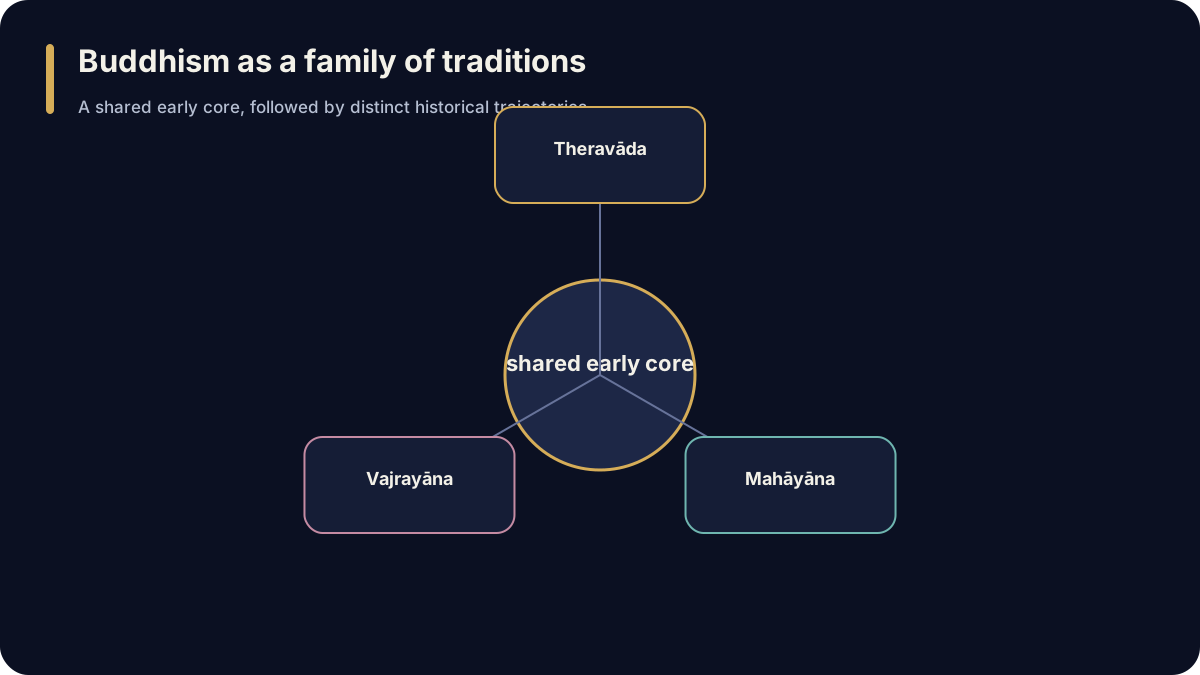
Vajrayāna can historically and doctrinally be understood as a development within the broader Mahāyāna world. It retains the bodhisattva goal of awakening for the benefit of all beings, while adding distinctive tantric means: mantras, maṇḍalas, visualizations, rituals, initiations, identification with meditational deities, and complex yogic practices. The Stanford Encyclopedia of Philosophy therefore describes Vajrayāna as a tradition that shares the Mahāyāna goal but employs distinctive tantric methods. This example shows clearly how a goal can remain connected to an older tradition while the technology of the path changes dramatically.
What, then, is shared?
We cannot locate the common core in every individual detail. Teachings about Amitābha do not occur in every Buddhist tradition, nor do tantric maṇḍalas, tathāgatagarbha, Theravāda Abhidhamma, or Zen kōans. If we required every Buddhist to believe exactly the same things, we would quickly discover that “Buddhism” hardly existed at all. But if we look at broader historical structures, a clear family resemblance emerges: there is a problem of suffering and unfreedom; its causes are connected with ignorance, attachment, and karmic action; the ordinary way of understanding self and world is problematic; ethical conduct is part of the path; the mind can be trained; wisdom transforms the experience of reality; and liberation or awakening is possible.
The precise interpretation of these claims can differ greatly. Non-self provides a good example. In early Buddhism, anattā or anātman is a key mode of analyzing human experience: the body is not a permanent self, nor are feelings, perceptions, mental formations, or consciousness. Mahāyāna literature does not abandon this problem but extends it. Prajñāpāramitā and Madhyamaka ask not only whether a permanent self can be found, but whether any phenomenon possesses an independent intrinsic nature. This leads to śūnyatā — emptiness. It can be understood as a development of the older question, but anattā and śūnyatā are not simple synonyms.
Even greater tension appears in teachings on tathāgatagarbha, or buddha-nature. If Buddhism teaches that there is no permanent self, what does it mean to say that beings possess “buddha-nature”? Some interpretations stress that buddha-nature is not an enduring individual self, while others use such positive language that at first sight it can sound almost contrary to the early doctrine of non-self. Examples like these show why we cannot compile ten Buddhist dogmas and claim that all Buddhists understand them in the same way.
The Buddha himself is not understood identically everywhere either. In the early discourses, Gautama Buddha is the awakened teacher who discovers the path to liberation and reveals it to others. In later Mahāyāna cosmology, the idea of buddhahood expands: innumerable buddhas appear, among them Amitābha, Akṣobhya, and Vairocana; there are buddha-fields, bodhisattvas who act through countless lifetimes, and teachings about different “bodies of the Buddha.” The development is substantial, yet it still revolves around the older question: what does it mean to be fully awakened?
One goal, very different practices
Imagine three Buddhist practitioners. One sits and observes the breath, another recites Amitābha’s name, and a third visualizes a tantric deity and recites a mantra. Outwardly they can look as if they are practicing three entirely different religions. Yet their traditions may explain all three practices as means of transforming the mind, overcoming ignorance, reducing attachment, and moving toward awakening. The general function is related; the technology of the path is very different.
The differences also emerged because Buddhism did not develop in a vacuum. It spread through India, Sri Lanka, Central Asia, China, Tibet, Korea, Japan, Southeast Asia, and many other regions. Each culture had its own language, philosophical traditions, rituals, political structures, and religious ideas. When Buddhism enters a new environment, it is not transferred like a frozen file: it is translated, interpreted, adapted, brought into debate with other ideas, expressed through new terminology, and embodied in new institutions. The history of Buddhism is therefore not only a history of preservation but also a history of transformation.
It is important not to push diversity too late in the historical story. The early Buddhist schools already differed over philosophical, disciplinary, and textual questions. Comparisons of Pāli and Chinese versions of early discourses show much in common, but also real differences in structure and in some doctrinal emphases. Buddhist diversity is therefore not a late accident; it has been part of its history almost from the beginning.
Is there an “original Buddhism”?
That depends on what we mean. If we are looking for one perfectly preserved book containing exactly everything the historical Buddha taught, we do not have it. But if we are looking for the oldest shared layers of teaching, comparison of the Nikāyas, Āgamas, Vinayas, and other early sources can tell us a great deal. The very differences between early versions allow researchers to reconstruct older common material. It is therefore better to speak of early Buddhism or early Buddhist teachings than of a perfectly reconstructed and frozen “original religion.”
The equation Theravāda = Buddhism before Mahāyāna is also not quite correct. Theravāda is today the only surviving non-Mahāyāna tradition descended from the early school world, but it was not the only one in ancient India; several early Buddhist schools existed, and an influential traditional classification speaks of eighteen. Theravāda is thus one surviving branch of a much more ramified older world, as the Āgamas of vanished schools also demonstrate.
It would be equally misleading to describe Mahāyāna as the sudden appearance of an entirely “new Buddhism.” Early Mahāyāna communities did not necessarily live in completely separate monasteries or reject older practices. Some scholarly interpretations suggest that early Mahāyāna developed within broader Buddhist communities, with the choice of the bodhisattva path as one important distinguishing feature. Philosophical and ritual differences grew much larger later, but the beginning need not be understood as the overnight creation of an entirely new religion.
A family of traditions
Perhaps the most useful comparison is a family. Members of a family are not identical, do not have the same face or character, and need not live in the same country. They may even disagree fiercely about their own history, yet kinship remains recognizable. Buddhism is similar. Theravāda, Zen, Pure Land, Tibetan Buddhism, Madhyamaka, Tiantai, and Vajrayāna do not always speak the same language, use the same texts, perform the same rituals, or interpret nirvāṇa, buddhahood, or emptiness in exactly the same way. But their histories, concepts, institutions, and practices are genealogically connected. It is therefore more precise to speak of Buddhist traditions within the broader historical phenomenon we call Buddhism.
The safest way to describe their broad family traits is to point to the problem of ignorance, attachment, and unfreedom; the impermanence and conditioned nature of human experience; the consequences of actions; the problematic character of ordinary understandings of the self; the importance of ethical conduct; the possibility of training and transforming the mind; the essential role of wisdom or right seeing; and the possibility of liberation or awakening. When we try to explain each of these claims in very precise terms, the schools begin to diverge — and that is precisely why the sutras are so interesting, because in them we can observe when particular ideas were shared and when they began to develop in different directions.
Buddhism, then, is not a single teaching in the sense of one unchanging doctrine. There is no Buddhist catechism that all Buddhists have understood in the same way for 2,500 years. But neither are these completely unrelated religions that history happened to gather under one name. There is a recognizable genealogy, a set of shared problems, a common historical origin, a shared vocabulary, related practices, and centuries of debate about how all of this should be understood correctly. Perhaps the most honest answer is this: Buddhism is not one single teaching, but a long family of teachings that continually converse with a shared past.
Once this orientation is clear, we can leave the map and open the first great text of early Buddhism: the Dhammacakkappavattana Sutta — the discourse that tradition presents as the Buddha’s first teaching after awakening.
Sources and literature
Primary texts and reference editions
- SuttaCentral — early Buddhist texts, translations, and parallels; for Pāli texts, Bhikkhu Sujato as the principal digital reference translation.
- 84000: Translating the Words of the Buddha — a reference digital corpus for published Tibetan canonical Mahāyāna translations.
Research and verification literature
- Siderits, Mark. “Buddha.” The Stanford Encyclopedia of Philosophy, Summer 2026 ed., edited by Edward N. Zalta and Uri Nodelman.
- Goodman, Charles, and Aaron Schultz. “Ethics in Indian Buddhism.” The Stanford Encyclopedia of Philosophy, Spring 2024 ed., edited by Edward N. Zalta and Uri Nodelman.
- Ziporyn, Brook. “Tiantai Buddhism.” The Stanford Encyclopedia of Philosophy, Summer 2026 ed., edited by Edward N. Zalta and Uri Nodelman.
Note: verification sources are part of the editorial apparatus. Where the original edition used during reconstruction was not preserved, a standard reference edition is not presented as though it were the presumed original source of the article.