Searching for the Ox: Ten Images of the Zen Path
The Ten Oxherding Pictures trace a Zen path from restlessness and searching through discipline and direct insight to emptiness and return among people. What do we know about Kuoan's series, and why does the final image end in the marketplace?
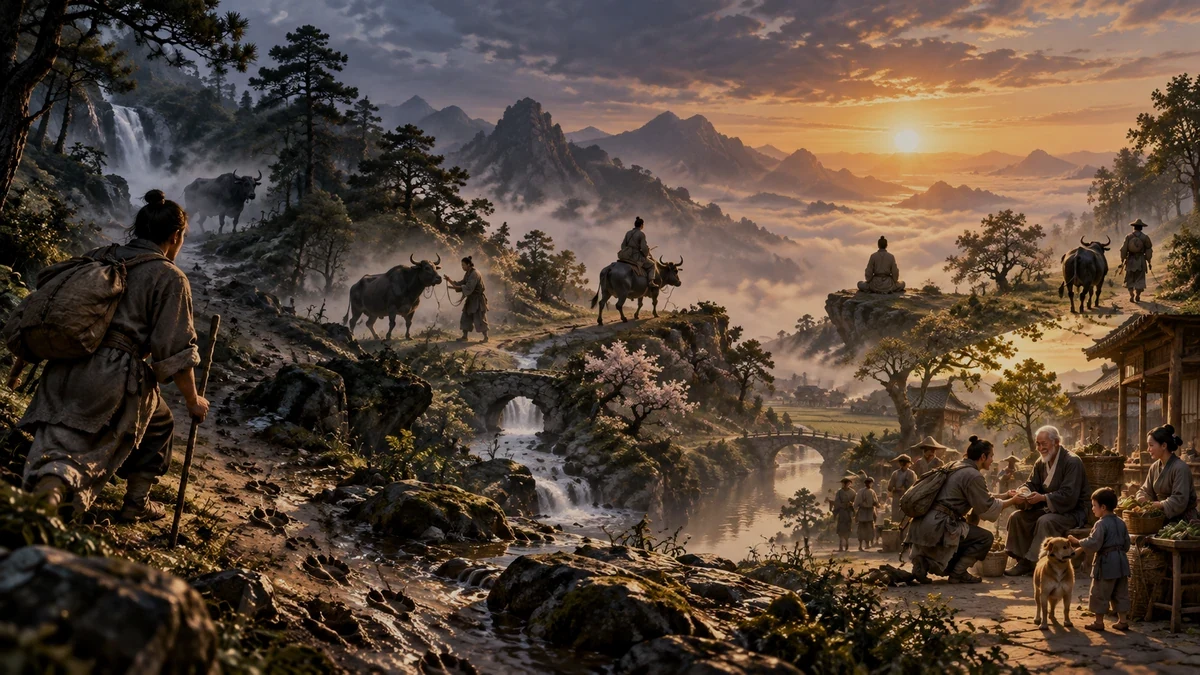
The Ten Oxherding Pictures are among the best-known visual maps in the Chan or Zen tradition. In the first image a person searches for a lost ox; in the last, he returns among ordinary people without special marks of holiness. Between those moments unfolds a story of seeking, discipline, direct insight, letting go of attachment to attainment, and returning to ordinary life.
The best-known version is attributed to the twelfth-century Chinese master Kuoan Shiyuan (Japanese: Kakuan Shien), but it was not the first. Other series existed, including Puming's. The ten pictures are therefore better understood not as the single canonical ladder of Zen practice but as an extraordinarily influential pedagogical metaphor that has been repainted, translated, and commented upon for centuries.
In many later commentaries the ox is interpreted as one's true nature, Buddha-nature, or the untamed mind, while the herder is the person who seeks, practices, and gradually discovers that what is being sought was never truly separate from the seeker. Yet the symbol is not an equation with only one permitted meaning; different teachers emphasize discipline, directness, emptiness, naturalness, or compassionate activity.
The cycle's greatest power lies in its final images. If the path ended with the empty circle, one could imagine that the goal were escape from the world. Kuoan's version continues: after emptiness, trees, water, and the path return, and finally the marketplace appears. Insight is tested in life. Wisdom that cannot survive relationships, work, discomfort, and encounters with other people has not completed its journey.
From Chinese Chan to Japanese Zen: where the ten pictures come from
Oxherding series emerged in the medieval Chinese Buddhist world of the Song dynasty. Encyclopedic and historical accounts stress that there was no single original collection: at least the early Puming and Kuoan versions are known, alongside other shorter or differently structured series. Through later Japanese Zen, Kuoan's version became the most widespread and is now usually what people mean by “the Ten Oxherding Pictures.”
Kuoan's scenes are accompanied by prose introductions and verses. Different visual realizations survive; a famous series is attributed to the fifteenth-century Japanese monk-painter Tenshō Shūbun and is said to follow older models that are now lost. In the seventeenth century, Karasumaru Mitsuhiro reworked the theme in the elegant handscroll Ten Oxherding Songs. The tradition was therefore not a frozen illustration but a living teaching form repeatedly reimagined by later generations.
Historically, it is safer to say that Kuoan did not “invent enlightenment in ten stages.” He adapted and transformed an existing animal-taming metaphor to show something difficult to state directly. The pictures are not a report of ten measurable neurological states and are not a psychological diagnostic instrument. They are Chan/Zen didactic poetry in visual form.
What the ox, the herder, and the ten scenes mean
A common modern interpretation says that the ox represents true nature or Buddha-nature, while the herder represents the ordinary self seeking it. Other commentaries emphasize the mind, its untamed habits, or reality itself as always already present. Kuoan's images are powerful precisely because they can carry several meanings at once: a person searches for something that seems lost and gradually discovers that the deepest problem lay in how life was being seen and lived.
| Image | Traditional title | Central idea |
|---|---|---|
| 1 | Searching for the Ox | restlessness and the beginning of inquiry |
| 2 | Seeing the Traces | teachings and first signposts |
| 3 | Seeing the Ox | a first direct glimpse |
| 4 | Catching the Ox | insight is not yet a stable habit |
| 5 | Herding the Ox | discipline and reshaping habits |
| 6 | Riding the Ox Home | practice becomes natural |
| 7 | The Ox Forgotten | the sought object is no longer needed |
| 8 | Ox and Herder Forgotten | the identity of attainment also falls away |
| 9 | Returning to the Source | the world is again simple, just as it is |
| 10 | Entering the Marketplace | wisdom is expressed among people |
The sequence is useful as a map, but it should not be converted into spiritual rank. Contemporary Zen teachers often caution that practice can move forward, backward, or through several images at once. A person may be peacefully “riding home” in one area of life while searching for footprints in another. The pictures describe patterns of experience more than administrative levels of advancement.

Searching, tracks, and the first glimpse: when the question becomes real
The first image is restlessness. The herder looks for the ox among grasses and mountains without knowing exactly where it is. Zen commentaries often read this as the moment when ordinary solutions no longer satisfy: something feels missing, yet the search is still directed outward. Simply recognizing confusion is already the beginning of the path. Until a person sees the problem, there is little reason to practice.
In the second image, footprints appear. They may stand for teachings, texts, a teacher, personal experience, or a rational recognition that another way of seeing is possible. But the track is not the ox. Knowledge about Zen is not the same as direct experience. The distinction is easy to recognize today: one may read many books about equanimity without changing one's response in a real conflict.
The third image is the first sight of the ox. What was previously only an idea becomes immediate. In classical Zen language this can be understood as a first glimpse into one's nature. Yet the sequence has only begun: seeing the ox does not mean consistently living from that insight. The cycle thus resists the dangerous idea that one powerful meditative or mystical experience automatically completes the path.
Catching and taming: why insight does not instantly change a person
In the fourth image the herder catches the ox, but the animal resists. Old habits, impulses, and automatic reactions have not vanished simply because they were clearly seen once. Here the metaphor becomes strikingly practical: understanding and behavior are not the same thing. A person may know very well what is harmful and still repeat it.
The fifth image therefore concerns taming. In traditional commentaries, rope, whip, and careful tending symbolize discipline. The point is not violence against oneself but repeated returning: noticing that the mind has wandered and bringing it back; noticing an old reaction without automatically feeding it; examining speech and conduct. Over time, external effort becomes less necessary because a different mode of responding is becoming established.
Modern psychology can offer interesting parallels here—habit formation, attentional training, emotion regulation, and learning through repetition—but those parallels are not scientific proof of the entire Zen metaphysical framework. The picture makes an experientially recognizable point: insight without repeated practice can remain only a beautiful moment.
Riding home: when discipline no longer feels like coercion
The sixth image changes the mood. The herder rides the ox home, often while playing a flute. Tension has eased. This does not mean that the person has become passive or incapable of error; it means the relationship between herder and ox has changed. What was struggle becomes cooperation. Practice begins to function more naturally and with less inner friction.
The transition matters outside explicitly religious language as well. At first, every discipline requires conscious effort: a new stance has to be deliberately recalled. With prolonged practice it becomes part of one's way of life. Zen adds another warning, however: identification with discipline can create a new ego—“I am the calm one, the spiritual one, the enlightened one.” Two more radical images therefore follow.
In Mitsuhiro's handscroll from around 1634 and in many later versions, this playfulness is an important part of the story. Maturation is not portrayed only as increasing seriousness. When less energy is spent fighting oneself, more room appears for ease, responsiveness, and spontaneity.
Forgetting the ox and forgetting the self: why the empty circle is not the final stop
The seventh image says: the ox is forgotten, the herder remains. If the ox stood for something that had to be found, then after returning home there is no longer a need to keep the object of the search constantly in view. The path is no longer “me here, truth over there.” Yet a subtle identity remains: I am the one who realized.
The eighth image removes even that. Ox and herder disappear into an empty circle. In Mahayana and Zen contexts this image is often associated with emptiness and the dissolution of rigid subject-object division. Emptiness here does not mean nihilism or the claim that nothing exists. It points toward loosening the idea that things exist as fully independent, self-sufficient entities—and toward giving up spiritual attainment as a new possession of the ego.
Some earlier series ended roughly at this point. Kuoan's version continues. This is its crucial editorial turn: even emptiness can become a new cave if one settles into it as a special state and never returns to life. The ninth and tenth images therefore reopen the world.

Returning to the source and the marketplace: enlightenment returns to the ordinary
The ninth image shows nature again: tree, flowers, water, landscape. The dramatic hunt is gone. Things are simply what they are. Later commentaries describe this as returning to the source or to naturalness. It is striking that the most concrete world reappears after the most abstract image, the empty circle. One need not flee forms in order to understand emptiness; forms return, but they are no longer held in the same way.
The tenth image is even more earthly: entering the marketplace with open or helping hands. The herder meets people, merchants, innkeepers, children, and the noise of the world. In many Zen commentaries this is the image of compassion and activity. The person does not retreat into solitude to protect a state of consciousness but returns among people without needing to display spirituality.
Here the cycle becomes ethically interesting. The final criterion is not an unusual vision, a special title, or the ability to describe emptiness. The question is what happens when one returns to relationship, work, conflict, responsibility, and ordinary imperfection. If wisdom is real, it must become a way of presence and action.
Using the ten pictures today—without romanticizing them or measuring spiritual ego
The ten pictures can now be read religiously, philosophically, or as a psychological metaphor. A useful question is: where do I recognize myself right now? Am I merely searching? Collecting tracks and theories? Have I seen something directly but not learned to live it? Am I struggling with old habits? Or have I turned practice into a new identity that must be defended? Questions like these can turn the pictures from decoration into a mirror.
Two boundaries matter. First, the series is not an empirically validated scale of personality development, so it makes little sense to classify a person as “stage seven” or “stage three” as if using a psychometric test. Second, spiritual language must not become an excuse for evading ordinary responsibility. Someone who speaks about nonduality while humiliating others, manipulating them, or escaping the consequences of their actions contradicts the logic of the final image.
The healthiest use of the cycle may therefore be circular. Again and again we get lost, find a trace, see something, lose balance, and learn. The final picture is not a diploma but a direction: return among people with less need to prove yourself and more capacity to help. If the ox always represented what is deepest and most real, the path is not the construction of a new self. It is the gradual dropping of what prevents clearer, simpler, and more humane living.
The ten pictures are not a map for escaping the world. The path is completed only when a person returns to the marketplace—among other people—and insight becomes visible in the way life is lived.
Sources and further reading
- Steven Heine, “Oxherding Pictures,” Encyclopedia of Buddhism: historical overview of Puming and Kuoan versions and the significance of the final return to the world.
- John M. Koller, “Ox-Herding: Stages of Zen Practice,” Columbia University ExEAS: historical framing, symbolism and stage-by-stage teaching commentary.
- Kuoan Shiyuan / John Daido Loori and Kazuaki Tanahashi translation, “The Ten Oxherding Pictures,” via Terebess: translated introductions and verses.
- Kuoan Shiyuan / Stanley Lombardo translation, “The Ox-Herding Poems,” in Zen Sourcebook, via Terebess: sequence and stage titles.
- Urs App translation and introduction, “The Ten Oxherding Pictures,” with Japanese woodcuts of 1689: historical transmission and stage sequence.
- D. T. Suzuki, *Manual of Zen Buddhism*: influential English presentation of the Ten Oxherding Pictures.
- Yamada Mumon, *Lectures on the Ten Oxherding Pictures*, trans. Victor Sōgen Hori, University of Hawai‘i Press, 2004 — bibliographic record.
- Myokyo-ni, *Gentling the Bull: The Ten Bull Pictures — A Spiritual Journey*: Rinzai Zen commentary and historical context.
- Bret W. Davis, *Zen Pathways: An Introduction to the Philosophy and Practice of Zen Buddhism*: modern scholarly introduction including the oxherding pictures.
- Yong Zhi, “Human Actions Illustrated in Zen’s Ox-Herding Pictures,” *Humanities* 1(3), 2012: philosophical analysis of action and enlightenment in the sequence.
- Ruben Habito, “The Zen Oxherding Pictures: Overview,” Maria Kannon Zen Center: contemporary Zen interpretation and caution against treating the sequence as strictly linear.
- The Metropolitan Museum of Art, *Ten Oxherding Songs*, Karasumaru Mitsuhiro, ca. 1634: public-domain historical handscroll and curatorial description.
- Wikimedia Commons, Tenshō Shūbun, “Looking for the Ox,” 15th century: public-domain image and provenance information.
- Wikimedia Commons / The Metropolitan Museum of Art, Karasumaru Mitsuhiro *Ten Oxherding Songs* image: CC0/public-domain dedication and object metadata.
- Sara Granovetter, “Wild Otherness Within: A Jungian and Zen Approach to the Untamed Self in the Ten Oxherding Pictures,” *International Journal of Transpersonal Studies* 42(2): example of a modern psychological interpretation explicitly distinct from classical exegesis.
- Buddha Mind Monastery, “The Ten Oxherding Poems”: contemporary Chan presentation of Kuoan’s verses and stages.