The Seven Essene Mirrors: Origins of the Teaching, Relationships as Mirrors and a Modern Spiritual Interpretation
From the historical Essenes and the Qumran manuscripts to Gregg Braden: where the Seven Mirrors teaching comes from, what each mirror means, and where the spiritual metaphor meets modern relationship psychology.
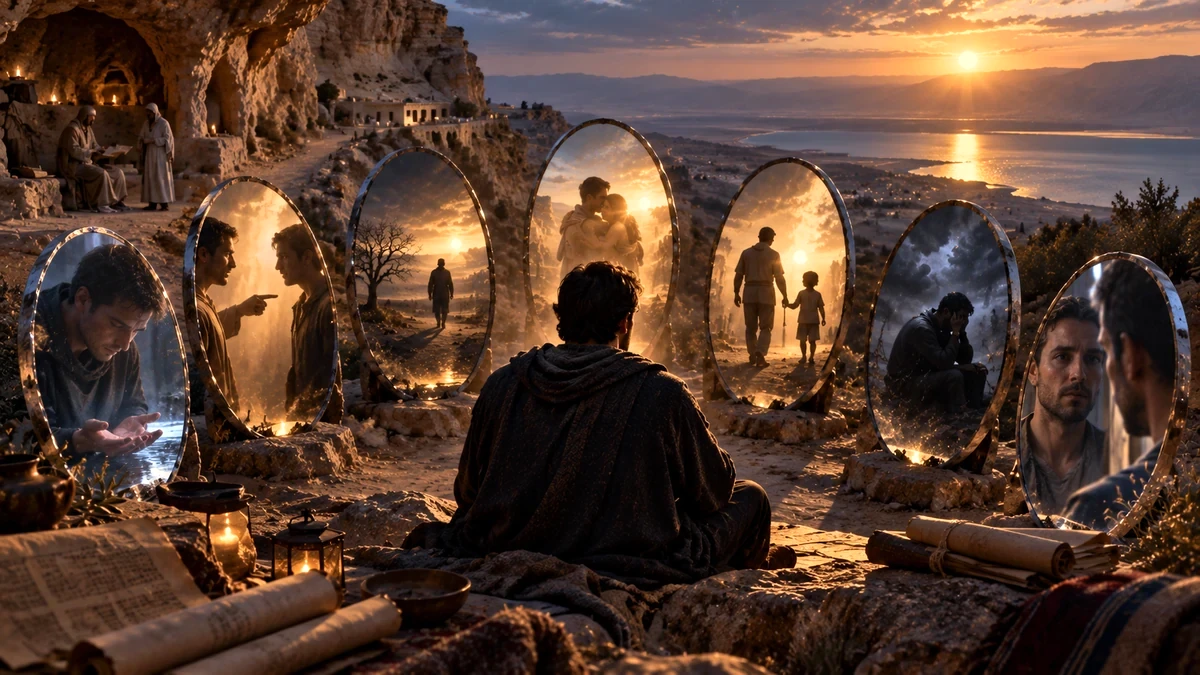
The teaching of the Seven Essene Mirrors is compelling because it turns the ordinary question “why does this keep happening to me with other people?” into “what might this relationship be showing me about myself?” In its modern form, the seven mirrors cover present behaviour, judgment, lost parts of the self, repeated attachments, the parental relationship, trials in a “dark night,” and one’s own self-perception.
But the name of the teaching immediately raises a historical question. The Essenes were a real Jewish group of the Second Temple period, described by Josephus, Philo of Alexandria and Pliny the Elder. The Qumran manuscripts contain community regulations, the teaching of the two spirits, hymns, legal materials and apocalyptic expectations. The connection between Qumran and the Essenes is influential and widely accepted, though not completely uncontested.
The provenance review reveals an important boundary: in the ancient sources and major Qumran rules examined here, a seven-part system of relationship mirrors in the form now circulated under that name cannot be located. The earliest clearly traceable modern publication of the system in this audit is Gregg Braden’s 1997 book Walking Between the Worlds: The Science of Compassion, explicitly described as exploring the seven “Essene Mirrors of Relationship.”
That does not make the framework useless. It means that historical origin and practical value are different questions. The Seven Mirrors can be read as a modern spiritual map for self-reflection, and each claim can then be compared with psychology of projection, attachment, attribution, recurring relationship loops and self-compassion.
Who the Essenes were and what we actually know about them
Josephus describes the Essenes as one of the important Jewish “philosophical” groups of his time. Philo of Alexandria portrays a substantial community devoted to piety, common life, simplicity and discipline. Pliny places Essenes near the western shore of the Dead Sea. These authors write as outsiders and their accounts do not agree in every detail, but together they establish that the Essenes themselves are not a modern invention.
After the discovery of the Dead Sea Scrolls in 1947, identification of the Qumran community with the Essenes became highly influential. The Community Rule (1QS) describes admission, discipline, communal life, hierarchy and a teaching about the “spirit of truth” and the “spirit of injustice.” The Israel Antiquities Authority now cautions that the older equation “all Qumran scrolls = one Essene sect” is too simple: the corpus reflects related and evolving communities, and the word “Essene” itself does not occur in the sectarian scrolls.
The historical core is solid: Essenes existed, and the Qumran manuscripts reveal a related ascetic, disciplined and dualistic religious environment. The claim that those manuscripts preserve exactly the modern list of seven mirrors requires separate evidence.
So where does the Seven Mirrors system come from?
The modern trail is much clearer. Bibliographic records for Gregg Braden’s Walking Between the Worlds: The Science of Compassion from 1997 describe it as a book exploring the “7 Essene Mirrors of Relationship.” Later recordings, interviews and workshops repeat the same seven-part map: the mirror of the moment, what is judged, what has been lost or given away, the “most forgotten love,” father/mother, the quest into darkness and self-perception.
In the Community Rule, summaries of other sectarian writings and the classical descriptions of Josephus, Philo and Pliny examined for this article, no such seven-part list appears. That matters more than whether individual ancient themes look similar. Qumran’s teaching about two spirits can resemble later language of light and darkness, for example, but thematic resemblance is not evidence that the sixth mirror historically descended from it.
The most defensible label is therefore a modern Braden synthesis attributed to Essene wisdom. He may have drawn on multiple translations, apocryphal materials and interpretive traditions; without a specific ancient manuscript, column and line, the source of each mirror cannot be verified as an ancient Essene teaching.
Provenance gate: “ancient” is not the same as “inspired by antiquity.” The system has a clearly documented modern history from 1997 onward; its ancient attribution in the present seven-part form remains unverified.

The first and second mirrors: what I express and what I judge
The first mirror — the mirror of the moment — proposes that we may encounter in others a reflection of what we ourselves are expressing now. If we enter a relationship tense, defensive or distrustful, our tone and behaviour can alter the other person’s response and return a similar tension to us. As an absolute metaphysical law this is false: an angry person in front of us does not have to be a reflection of our anger. As a self-review question it is useful: what did I bring into this interaction?
The second mirror — the mirror of what is judged — focuses on strong emotional charge around particular behaviour in others. Modern psychology recognizes projection, in which one’s own characteristics or impulses are attributed to another person, but not every judgment is projection. We can accurately identify lying, aggression or manipulation. The useful version of the second mirror is therefore not “everything you condemn is you,” but “why is this particular behaviour so charged for me, and are my past experiences altering how I interpret it?”
This is where the spiritual metaphor meets research on relationship attributions: the same event can be interpreted very differently by different people, and those interpretations influence the next response. A mirror is best treated as a hypothesis to test, not a verdict about oneself or another person.

The third and fourth mirrors: what was lost and what life became organized around
The third mirror is described in the modern system as the mirror of what was lost, given away or taken away. Braden links it with unusually strong attraction to a person who embodies something we miss in ourselves: spontaneity, courage, tenderness, creativity or freedom. Instead of concluding “this person must complete me,” the mirror asks a different question: am I recognizing in them a part of myself that I once learned to suppress?
That idea has psychological relatives in developmental models of self and relationship. People build internal expectations from early relationships about what can be expected from oneself and from others; later experiences can reinforce or revise those models. There is no evidence that the universe magnetically sends us people carrying our missing traits, but there is strong evidence that our needs, expectations and learned relational patterns are carried into new relationships.
The fourth mirror — the “most forgotten love” — is interpreted somewhat differently in later summaries, but usually concerns an attachment, habit or compulsion around which a person gradually reorganizes life at the expense of something more deeply valued. Its practical value is not a mystical diagnosis but an inventory: what receives so much of my energy that I am losing something that was actually more important to me?
The fifth and sixth mirrors: parents, the image of the divine and the journey through darkness
The fifth mirror — father/mother — suggests in Braden’s account that relationships with parents may shape deep expectations about authority, acceptance, love and even the divine. Modern psychology does not need the metaphysical step to recognize the core idea: attachment theory describes internal working models of self and others that develop from early relational experience and influence later expectations in close relationships.
But the mirror must not become a deterministic formula. A difficult relationship with one’s father does not necessarily imply a difficult relationship with God, a partner or every authority figure; a good childhood relationship likewise does not guarantee secure attachment in all situations. Internal models are malleable and can change through new relationships, experience and therapy.
The sixth mirror — the “quest into darkness” — describes periods in which a person encounters major fears, losses or a crisis of identity. The nearest ancient parallel is Qumran’s teaching of the two spirits of light and injustice, but a genealogy between the two is unproven. As a modern metaphor, the sixth mirror is intelligible: crisis can expose the strategies by which we maintained a sense of safety. The safeguard matters, however: suffering is not evidence of spiritual progress, and no dangerous situation needs to be maintained in order to “complete a lesson.”
The seventh mirror: by what standard do I judge myself?
The seventh mirror — self-perception — asks what standard a person uses to evaluate body, success, intelligence, relationships, spirituality and personal worth. If the reference point is always external, the target can keep moving: someone else is more attractive, wealthier, calmer, more enlightened or more successful. The mirror therefore invites examination of the standard itself, not merely the score.
Here a strong connection can be made with modern research on self-compassion. Meta-analyses find a moderate-to-strong association between self-compassion and psychological well-being. That does not mean every form of self-acceptance is therapeutic or that goals no longer matter. It does mean that how people relate to their own failures and shortcomings is a measurable part of well-being.
Braden’s closing emphasis on compassion can therefore be read without requiring an historically unverified Essene label. A person can see patterns, accept responsibility and still refuse to turn the mirrors into another system of self-punishment. The most mature mirror is not the one that says “everything is my fault,” but the one that allows a more accurate view of oneself.
What modern psychology supports — and what it does not
Psychology supports several mechanisms that can make mirror language useful. Projection is a recognized concept for attributing one’s own material to others. Internal working models of attachment influence expectations of close relationships. Attributional biases can shape interpretations of a partner’s behaviour, and a relationship can become a feedback loop in which one person’s response changes the other person’s next response.
Those findings do not establish the stronger claim that every person we meet cosmically reflects our inner state or that consciousness alone “manifests” the events that happen to us. Other people have their own motives, history and responsibility; chance exists; social and material conditions are real. When someone abuses, deceives or humiliates another person, there is no need to assume that the harmed person created that behaviour through an inner state.
The safest and most testable use of the Seven Mirrors is therefore reflective rather than causal. A mirror can help ask what a situation activates in me, which needs or fears it exposes, and what I can change in my own response. It does not determine what caused another person’s behaviour and does not remove that person’s responsibility.
How to use the Seven Mirrors without turning them into dogma
A practical method is deliberately slow. First describe the event without interpretation: what was actually said or done. Then ask which mirror might offer a useful hypothesis: did I bring similar behaviour myself; what am I judging strongly; what do I miss; what pattern am I organizing my life around; what did I learn about love and authority; which fear has opened; by what standard am I judging myself?
The next step is reality testing. What other evidence supports my interpretation? What might a neutral observer say? Am I accepting responsibility for my part, or am I also taking on responsibility that belongs to the other person? This turns a mystical mirror into a structured exercise in metacognition.
This is also where the teaching can remain valuable after a strict provenance review. The seven points do not need to be proven as a verbatim transcript of a lost Essene school for the questions to help with self-knowledge. What matters is that usefulness is not confused with historical authenticity, and no mirror is used to deny facts, excuse harm or impose automatic blame.
The most useful formulation is simple: a relationship may show me something about myself, but it is not necessarily only about me. The mirror is an invitation to investigate, not a verdict.
Sources and further reading
- Braden, Gregg — Walking Between the Worlds: The Science of Compassion (1997), Google Books bibliographic record; description explicitly identifies the 7 Essene Mirrors of Relationship
- Open Library — Walking Between the Worlds: The Science of Compassion, 1st U.S. edition, 1997, 211 pages
- Israel Antiquities Authority, Leon Levy Dead Sea Scrolls Digital Library — Scrolls Content; sectarian texts, Community Rule and current caution about a single-group attribution
- Library of Congress — The Qumran Community / Community Rule exhibit
- Cambridge University Press — Michael A. Knibb, The Community Rule, in The Qumran Community
- Cambridge History of Judaism — The Essenes, classical sources and Qumran relationship
- Flavius Josephus — The Wars of the Jews, Book II, Perseus Digital Library
- Center for Online Judaic Studies — Philo, Every Good Man Is Free XII, 75–87: Description of the Essenes
- Library of Congress — Scrolls from the Dead Sea bibliography and Pliny on the Essenes
- APA Dictionary of Psychology — projection
- Simpson, J. A., & Rholes, W. S. (2017). Adult Attachment, Stress, and Romantic Relationships. Current Opinion in Psychology, 13, 19–24.
- Eilert, D. W., & Buchheim, A. (2023). Attachment-Related Differences in Emotion Regulation in Adults: A Systematic Review.
- Li, D., Carnelley, K. B., & Rowe, A. C. (2023). Insecure Attachment Orientation and Negative Attribution Bias: A Meta-Analysis.
- Zessin, U., Dickhäuser, O., & Garbade, S. (2015). The Relationship Between Self-Compassion and Well-Being: A Meta-Analysis.
- Wikimedia Commons / Library of Congress — Qumran Cave 4, Matson Collection, no known restrictions / public domain
- Wikimedia Commons — Dead Sea Scroll fragment from Wadi Qumran Cave IV, photograph by Daderot, CC0