Relationships as a Mirror of Consciousness
Relationships do not reveal a hidden “true personality,” but they can expose our interpretations, fears, attachment patterns, emotion-regulation strategies and repeated responses.

When people say that a relationship is a “mirror,” the metaphor can easily become mystical or moralistic: every partner supposedly shows us only our own interior, so anything that hurts us must really be our problem. That is too simple.
Other people have real behaviour, motives, limits, and responsibility. If someone lies, manipulates, or humiliates, we do not need to call that a projection by the observer.
But the mirror metaphor has a useful, testable core: relationships create situations in which our internal models become unusually visible. How do we interpret silence? What do we expect during conflict? What do we do when we fear rejection? Whom do we blame? How quickly can we identify our own contribution?
A relationship is not a perfect mirror of the truth about us. It is an unusually sensitive environment in which our patterns often become visible faster than they do in abstract reflection.
We do not enter relationships empty
Attachment theory proposes internal working models of self and others: expectations about whether closeness will be safe, whether others will be available, and whether we ourselves are worthy of response. These models are not perfect copies of childhood and are not fixed destiny, but they can shape what we notice and how we respond under stress.
Two people may therefore interpret the same behaviour differently. A few hours without a message can be neutral for one person, evidence of abandonment for another, and uncomfortable pressure for a third who wants more distance.
The event can be the same while the meaning constructed around it is very different.
Attributions: explanations change responses
Research on relationship attributions shows that the way we explain a partner’s behaviour is not a harmless footnote after the event. It is associated with conflict behaviour and relationship quality.
If I explain lateness as “they do not respect me and will always be like this,” I will probably respond differently than if I explain it as “something unexpected happened today.” The first explanation can, of course, be accurate in some relationships. The point is that explanation is not identical to observation.
A meta-analysis links insecure attachment with more negative attribution bias, although effects vary and the evidence does not justify simplistic diagnosis of individuals.
The question is not “Is my explanation negative?” It is “How much evidence do I have that it is the best explanation?”
It is therefore useful to treat an attribution as a hypothesis rather than a verdict. “They are deliberately ignoring me” and “they are overwhelmed” are different explanations of the same observed behavior. Either can be correct in a particular case; neither is contained in the bare fact that there was no reply for two hours.
A meta-analysis by Li, Carnelley, and Rowe found medium-sized associations between insecure attachment and negative attribution bias across 41 samples. This is a group-level statistical result, not a diagnostic rule for an individual. Its practical value is the warning that interpretation can systematically tilt the response that comes next.
Emotion regulation becomes interpersonal
In close relationships, emotion regulation is not only individual. A partner’s tone, proximity, responsiveness, or withdrawal can intensify or calm our state. Research on attachment and dyadic regulation suggests that partner responses can sometimes reduce or amplify characteristic insecurity-related reactions.
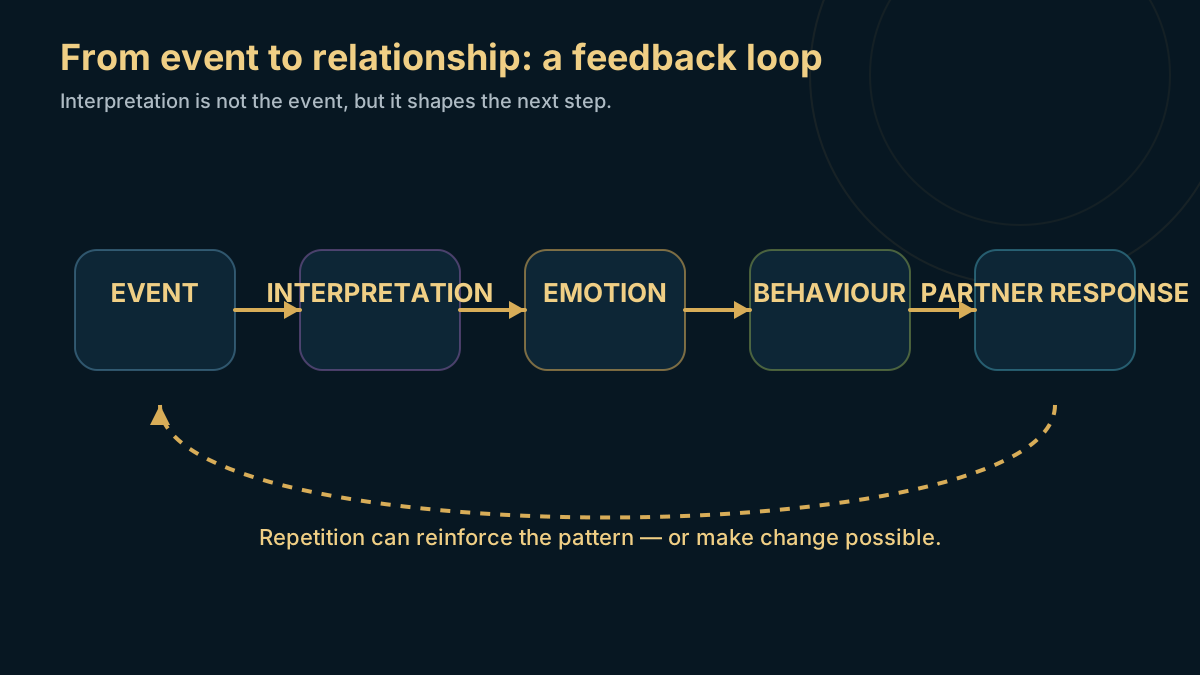
A relationship is therefore not merely a stage on which two fixed personalities perform. It is a feedback loop. My response affects you, your response affects me, and repetition can create a stable pattern.
Sometimes two people are not simply “a bad match” as fixed personalities; together they have built a bad loop.
Feedback loops can become self-confirming
Imagine someone who fears that a partner is insufficiently present. Because of that fear they repeatedly check, demand reassurance, and interpret delays as signs of withdrawal. The partner begins to pull back under the pressure. That withdrawal then confirms the first person’s expectation: “I knew they were leaving.”
The reverse loop is equally possible: one person withdraws during tension because they expect criticism; the other experiences withdrawal as rejection and increases pressure; the first withdraws even further.
This does not tell us who is right in every concrete conflict. It shows why repeated problems must be examined as sequences rather than only as isolated final events.
A loop can change through one small but different response
A feedback loop is not destiny. If one partner changes one link in the sequence, they can also change the information received by the other. Instead of checking repeatedly, someone might name the fear directly; instead of disappearing, someone might say that they need twenty minutes and will return to the conversation. Such a change does not guarantee success, but it creates new information to which the relationship can respond.
Research on dyadic regulation suggests that a partner’s behavior can amplify or buffer characteristic responses associated with attachment insecurity. Longitudinal research on early marriage likewise shows that attributions, behavior, and relationship quality are linked through reciprocal processes over time. This supports a more dynamic picture: a pattern has a history, but that history continues through new interactions.
Repair therefore does not mean simply “think more positively.” Sometimes the problem is a mistaken interpretation, sometimes genuinely harmful behavior, and often some interaction between the two. A good review separates the event, the explanation, and the response.
A mirror is not a verdict
The mirror metaphor becomes dangerous when it is used to assign blame. A person subjected to disrespect is not responsible for that behaviour merely because they have patterns of their own. Likewise, being strongly triggered does not automatically mean the other person has done nothing wrong.
A more useful distinction asks two questions at once: what did the other person actually do, and what did I add through interpretation, expectation, or automatic response? Both levels can matter.
Self-reflection without distinction can become self-blame. Distinction without self-reflection can become endless blame of others.
Six questions for examining a recurring relationship pattern
- What concretely happened before I began interpreting motives?
- What explanation did I automatically assign to the event?
- What emotion and bodily reaction followed from that explanation?
- What did I then do, and how did that affect the other person?
- How did their response affect me in return, and does this loop recur?
- Which part of the pattern can I examine or change without taking responsibility for the other person’s choices?
This does not require becoming a detached observer of one’s own life. It requires enough distance to create a small space for verification between event and explanation.
Relationships can expose patterns and also change them
If relationships activate old models, it does not follow that they can only repeat them. Research on responsiveness and dyadic regulation suggests that more secure and responsive interaction can support different experiences and more constructive responses over time.
This is one of the more hopeful findings in relationship science. Our patterns have histories, but they are not necessarily destinies.
The relationship-as-mirror metaphor is most useful when it does not tell us “who we really are,” but shows which pattern is happening now—and where a different response may still be possible.
The most useful meaning of the mirror metaphor is therefore provisional: a relationship shows us something that can then be tested. The mirror does not define our identity, and it does not declare the other person innocent. It makes a pattern visible enough that a different next step becomes possible.
Sources and further reading
- Simpson, J. A., & Rholes, W. S. (2017). Adult Attachment, Stress, and Romantic Relationships. Current Opinion in Psychology, 13, 19–24. Source
- Eilert, D. W., & Buchheim, A. (2023). Attachment-Related Differences in Emotion Regulation in Adults: A Systematic Review. Source
- Li, D., Carnelley, K. B., & Rowe, A. C. (2023). Insecure Attachment Orientation in Adults and Children and Negative Attribution Bias: A Meta-Analysis. Personality and Social Psychology Bulletin, 49(12), 1679–1694. DOI: 10.1177/01461672221117690. Source
- Durtschi, J. A., Fincham, F. D., Cui, M., & Lorenz, F. O. (2011). Dyadic Processes in Early Marriage: Attributions, Behavior, and Marital Quality. Family Relations, 60(4), 421–434. DOI: 10.1111/j.1741-3729.2011.00655.x. Source
- Reis, H. T., Clark, M. S., & Holmes, J. G. (2004). Perceived Partner Responsiveness as an Organizing Construct in the Study of Intimacy and Closeness. Source
- Overall, N. C., & Simpson, J. A. (2015). Attachment and Dyadic Regulation Processes. Current Opinion in Psychology, 1, 61–66. Source
- Lathren, C. R., Rao, S. S., Park, J., & Bluth, K. (2021). Self-Compassion and Current Close Interpersonal Relationships: A Scoping Literature Review. Source
- Bradbury, T. N., & Fincham, F. D. (1990). Attributions in Marriage: Review and Critique. Psychological Bulletin, 107(1), 3–33. DOI: 10.1037/0033-2909.107.1.3. Source
- Simpson, J. A., & Overall, N. C. (2014). Partner Buffering of Attachment Insecurity. Current Directions in Psychological Science, 23(1), 54–59. DOI: 10.1177/0963721413510933. Source