Love Without Self-Destruction
Closeness does not require losing yourself. How can we distinguish care, attachment and compromise from a relationship in which our needs, boundaries and judgment slowly disappear?

Love is often described as going beyond the self: being willing to listen, help, compromise, and sometimes place another person’s good before our immediate comfort. But it does not follow that a good relationship should require the erasure of our own judgment, needs, or dignity.
A person can genuinely love someone and at the same time become less and less able to say what they need, what they do not want, where they disagree, or what hurts them. From the outside this can look like extraordinary devotion. From the inside, closeness may turn into fear of loss, constant adjustment, and the feeling that peace is possible only if one person disappears from the equation.
It is therefore useful to distinguish love from self-destruction—not to turn relationships into cold calculations of benefit, but because the capacity for closeness and the capacity to remain a person are two parts of the same problem.
Closeness is healthiest when a relationship can grow without requiring either person to stop being a subject of their own life.
Love and autonomy are not opposites
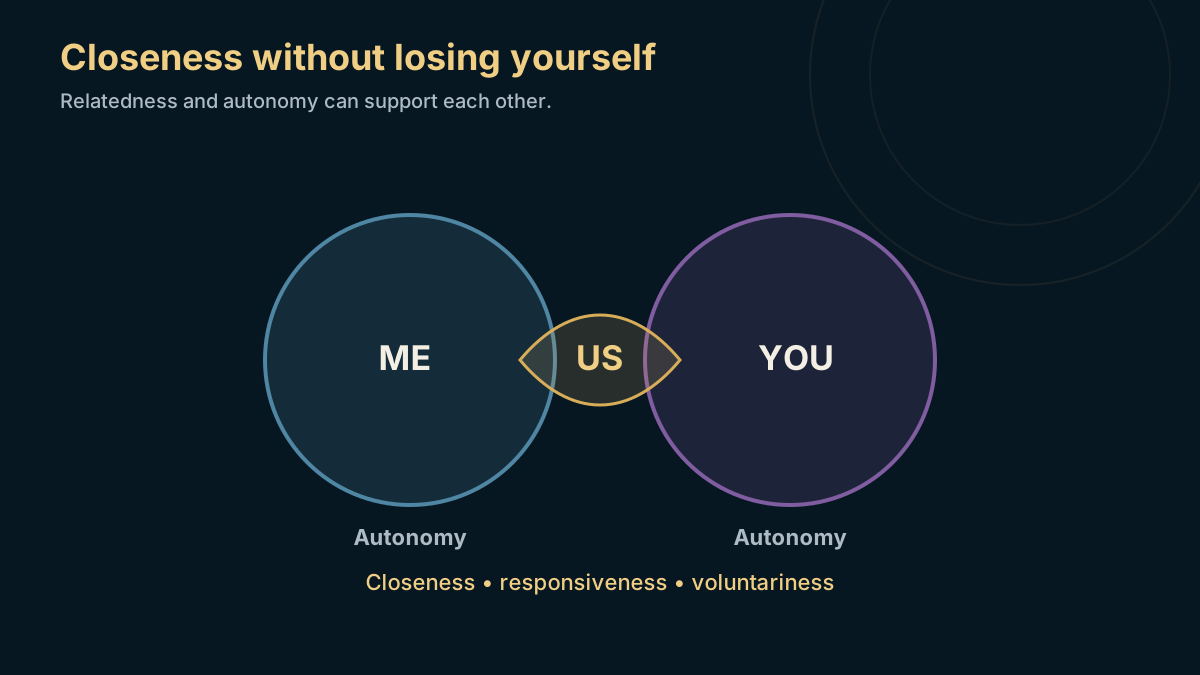
Relationship psychology often examines closeness together with autonomy. Autonomy does not mean isolation or the principle “I need nobody.” It means, more basically, being able to act for reasons one can recognize as one’s own and not having to abandon one’s judgment merely to preserve connection.
Relational accounts of autonomy add that independence does not develop in a vacuum. Good relationships can help people become more capable of deciding, speaking, and taking responsibility; damaging relationships can narrow that capacity.
This corrects two extremes: the idea that love means complete fusion and the idea that real independence means needing no one. Relationship research supports a more complex picture in which relatedness and autonomy can support each other.
The aim is not to choose between “me” and “us.” A mature relationship must make room for both.
Attachment can make closeness secure or fearful
Attachment theory describes ways in which people seek safety, closeness, and a partner’s response in intimate relationships. Research on adult attachment shows that insecure orientations are often associated with characteristic emotion-regulation strategies: some people intensify reassurance seeking when they fear loss, while others deactivate emotion or distance themselves.
These are not permanent personality labels, and one reaction is not enough to classify a person. They are useful models for understanding why the same situation can evoke very different responses.
Self-erasure can begin when fear becomes stronger than judgment: “If I say no, I will be abandoned.” “If I say what I think, everything will end.” “If my partner is upset, I must fix it even if I have to deny myself.”
Fear of loss can explain accommodation. It does not turn every accommodation into love.
Caring for another person is not the same as abandoning yourself
Every relationship requires adjustment. People share time, space, money, obligations, families, and emotional energy. That is why “always put yourself first” is no more useful than “if you love, you must sacrifice yourself.”
A better question concerns the pattern over time. Do both people adapt? Can both express needs? Can each tolerate the other’s disappointment without having to erase it immediately? Are compromises voluntary, or maintained by fear, punishment, silence, or humiliation?
A scoping review of self-compassion in close relationships found mostly positive associations with secure attachment, constructive relationship functioning, and repair after conflict, while also noting that much of the evidence is correlational. The point is modest but important: care for the self need not compete with care for another person.
Staying in contact with your dignity and limits does not make you less able to love. It can make love less dependent on hidden resentment and fear.
Care in a healthy relationship does not have to be symmetrical every day. Illness, parenting, job loss, or another crisis can temporarily mean that one person carries more of the burden. The problem is not every asymmetry; it is a pattern in which one person continually adapts while the other begins to treat that adaptation as an entitlement.
The useful question is therefore not only “how much am I giving?” but also “can I still freely say no, can I express a different need, and is my inner world still visible in this relationship?” Love can include giving up a particular preference. It does not require giving up one’s capacity for judgment.
Responsiveness: being seen, not possessed
A major concept in modern relationship science is perceived partner responsiveness: the sense that another person understands, values, and responds to important parts of who we are. Longitudinal research links greater perceived responsiveness with better well-being and relationship functioning.
Responsiveness is not total agreement. A partner can understand us and still think we are wrong. They can respect a need and still set a limit of their own. They can support us without becoming responsible for regulating every emotion we experience.
This is one difference between closeness and possession. In closeness, the other person remains a person we try to understand. In possession, they become a function: someone who must supply safety, calm, status, or self-worth.
“I understand you” is not the same as “I will do everything you ask.” And “no” is not automatically evidence that love is absent.
When compromise becomes disappearance
A single compromise tells us little. The pattern matters. The warning sign is not that we sometimes give up a preference, but that we are systematically not allowed to have preferences that inconvenience the other person.
- I am always the one who must justify a need for rest, time, or friends.
- My “no” is answered with punishment, humiliation, or prolonged retaliation.
- Peace is possible only if I accept blame even for things I did not do.
- The relationship gradually requires me to abandon people, activities, or values that were an important part of my life.
- I increasingly make decisions mainly to prevent my partner’s reaction.
This is not a diagnostic checklist. It is a way to notice relationship structure. Any single event may require context; a repeated asymmetry deserves closer attention.
A useful test is to distinguish a cost we knowingly choose from a cost we feel pressured to pretend is not a cost at all. In the first case we remain the author of our decision. In the second, our own need can gradually become something we no longer permit ourselves even to notice.
Research on autonomy in close relationships matters precisely because it suggests that a sense of self-direction is not the enemy of connection. Closeness can be stronger when a partner supports the sense that a choice remains ours, rather than making belonging depend on surrendering our own will.
Seven questions for closeness without losing yourself
- Can I honestly say what I think even when I know my partner will dislike it?
- Does my “no” remain an allowed answer, or does it become a moral offence?
- Do both of us adapt, or does one person systematically become smaller?
- Can we distinguish a partner’s emotion from my duty to make that emotion disappear?
- Can I keep important relationships, interests, and values that do not belong to the couple?
- Do mistakes lead to repair, or to permanent debt and punishment?
- Would I accept the same standard of love, freedom, and responsibility if our roles were reversed?
No relationship will answer every question perfectly all the time. Direction matters: does the relationship enlarge both people’s capacity for honest connection and responsible choice, or reduce it?
Love does not require disappearance
Love without self-destruction is not risk-free or emotionally sterile. Closeness can hurt precisely because another person matters. It may require patience, changed habits, forgiveness, and acceptance of limits.
But giving up comfort for a relationship is different from giving up the status of being a person.
A good relationship cannot guarantee that we never suffer. It can preserve a space in which both people remain able to speak, choose, set limits, acknowledge mistakes, and take responsibility.
Love does not become deeper when one person disappears. It becomes deeper when two real people can meet without requiring either one to stop existing as an “I.”
Sources and further reading
- Eilert, D. W., & Buchheim, A. (2023). Attachment-Related Differences in Emotion Regulation in Adults: A Systematic Review. Brain Sciences, 13(6), 884. Source
- Lathren, C. R., Rao, S. S., Park, J., & Bluth, K. (2021). Self-Compassion and Current Close Interpersonal Relationships: A Scoping Literature Review. Mindfulness, 12, 1078–1093. Source
- Reis, H. T., Clark, M. S., & Holmes, J. G. (2004). Perceived Partner Responsiveness as an Organizing Construct in the Study of Intimacy and Closeness. Source
- Selcuk, E., Gunaydin, G., Ong, A. D., & Almeida, D. M. (2016). Does Partner Responsiveness Predict Hedonic and Eudaimonic Well-Being? A 10-Year Longitudinal Study. Journal of Marriage and Family, 78, 311–325. Source
- Don, B. P., & Hammond, M. D. (2017). Social Support in Intimate Relationships: The Role of Relationship Autonomy. Source
- Stanford Encyclopedia of Philosophy. Feminist Perspectives on Autonomy. Source
- Simpson, J. A., & Rholes, W. S. (2017). Adult Attachment, Stress, and Romantic Relationships. Current Opinion in Psychology, 13, 19–24. Source