Boundaries and Mutual Responsibility
A boundary is neither a wall nor an order issued to another person. It clarifies what I can choose, what I will not accept, and which consequences I am prepared to take responsibility for.

The word “boundary” has become so common in relationship language that it can mean almost anything. Sometimes it refers to a clear decision about one’s own participation. Sometimes it becomes a way of controlling another person: “My boundary is that you are not allowed to see that friend.” At other times it serves as a more respectable label for punishment or unexplained withdrawal.
THY-REALITY therefore begins with a distinction. A boundary is not a magic word that automatically makes a demand legitimate. It becomes meaningful only when we are clear about who controls which action and who is responsible for which choice.
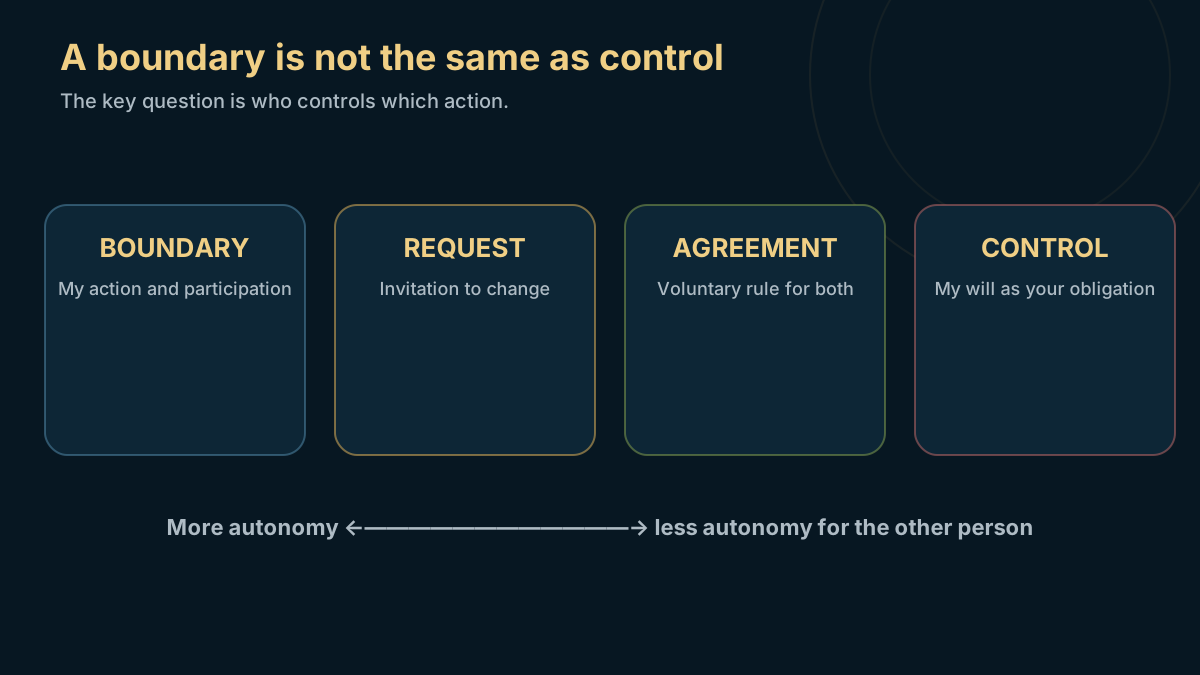
A boundary mainly concerns my participation: what I will do, what I will not do, and what I will do if a situation continues. Control attempts to turn my will into another person’s obligation.
A boundary is not a wall
Autonomy is the capacity to make decisions about one’s own life, but relational accounts emphasize that this capacity develops and operates within relationships. Healthy boundaries therefore do not mean the absence of relationship. They mean that relationship does not erase the distinction between two people.
A wall tries to prevent all influence. A boundary permits influence, conversation, and negotiation while preserving a point at which a person still decides about their own action.
A wall says, “Do not come near me.” A boundary may say, “We can talk, but I will not remain in the conversation if humiliation continues.”
A boundary and a demand are not the same
We can legitimately express wishes and requests in a relationship: ask for changed behaviour, a shared agreement, more time, or a different way of communicating. The problem begins when we rename a wish as a “boundary” in order to bypass the question of whether the demand is justified.
“I would like you to tell me if you will be late” is a request and a proposal for coordination. “My boundary is that you are never allowed to be late” claims control over an action that remains under the other person’s control.
A genuine boundary might follow: “If unexplained lateness keeps happening, I will stop making plans that leave me completely dependent on your timing.” That concerns one’s own participation.
Mutuality: my autonomy meets yours
Relationships are distinctive because there is more than one will. Each person has needs, limits, and a right to decide. A boundary is therefore not a test of whether the other person will obey. They may respect the boundary by accepting its consequence: “I understand that you do not want to stay in a relationship under those conditions; I am still not changing my choice.”
That can be painful, but it is conceptually cleaner than treating boundaries as duties imposed on others.
Research on autonomous motivation and autonomy support in close relationships links autonomy-supportive interaction with more constructive support-seeking, well-being, and relationship quality. This does not mean every conflict can be resolved. It means coercion is not the only mechanism by which relationships influence behaviour.
Mutual responsibility means: my choice is mine, your choice is yours, and the consequences of our interaction often belong to both of us.
This applies even in domains where closeness is especially intense. A multi-method study of perceived partner sexual autonomy support found associations with need fulfillment and with sexual and relationship satisfaction. Such findings do not prescribe how every relationship should work, but they support a narrower and important point: feeling free to choose without pressure is compatible with intimacy and may support it.
Mutuality is therefore more than an exchange of favors. It is a structure in which both people can express wishes, refusals, and proposals without treating the mere possibility of a different answer as betrayal.
Boundary, ultimatum, control, and punishment
In practice these forms can look similar, so purpose and structure matter.
- Boundary: defines my own action or participation.
- Request: invites change while leaving the other person able to refuse.
- Agreement: both people voluntarily accept a rule.
- Ultimatum: reduces the options to two and carries substantial pressure; it may sometimes be justified, but it is not automatically a “healthy boundary.”
- Control: attempts to subordinate another person’s decisions to our will.
- Punishment: deliberately imposes discomfort in order to force or discipline.
The same behaviour can resemble different categories depending on context. The key question is not which word we used, but who controls what and what kind of pressure is being applied.
Responsibility does not mean taking responsibility for everything
Mutual responsibility is not total responsibility for another person’s emotional state. If we communicate an unpleasant truth respectfully, their disappointment is real, but it does not follow that we are obliged to eliminate every unpleasant emotion.
Conversely, “your emotions are your responsibility” cannot excuse deliberate humiliation, threats, or manipulation. Our conduct remains part of the causal and moral context.
A useful framework is the one already used in the article on freedom and responsibility: control, knowledge, foreseeability, and causal contribution. Boundaries are not an escape from responsibility; good boundaries make responsibility clearer.
Power and dependence can change what a “free choice” means
Formally, we may say that both people have a choice, but relationships are not always relationships of equal power. Financial dependence, fear of losing housing, social isolation, responsibility for children, or a large difference in status can make the price of saying “no” much higher for one person.
When evaluating a boundary, it is therefore useful to ask whether the consequence is proportionate and whether the other person has meaningful room to decide. “If you shout at me, I will end the conversation” is structurally different from “if you disagree with me, I will cut off your access to money.” Both contain a condition, but the second uses dependence as leverage.
Relational approaches to autonomy emphasize precisely this point: self-direction is not only an inner property of an individual; social and relational conditions can support or constrain it. A good boundary protects one’s own participation without exploiting another person’s vulnerability.
A practical boundary formula
- Describe the concrete behaviour or situation without diagnosing the person.
- Explain why it matters to you.
- State what you are requesting or proposing.
- State what you will do if the situation does not change.
- Check that the consequence is genuinely under your control and that you are prepared to carry it out.
- Allow the other person to decide, even when you dislike their decision.
- Recheck whether the boundary is proportionate and whether you would accept the same standard with roles reversed.
A clear boundary does not need a threat we will never carry out. It needs a decision for which we are prepared to take responsibility.
Boundaries also do not have to be eternal. New information, changed circumstances, or a better agreement can legitimately change our decision. Consistency does not mean never revising a boundary; it means explaining the revision and taking responsibility for it, rather than changing the rule only when doing so benefits us.
Boundaries allow two people to remain two people
Without boundaries, closeness can become fusion and responsibility becomes unclear. Without responsibility, boundaries can become a slogan for ignoring everyone else.
We therefore need both: a right to personal judgment and a responsibility to justify our conduct where it significantly affects another person.
A boundary is not the end of relationship. It is the line at which it becomes visible that a relationship is made of two free and responsible people.
Sources and further reading
- Stanford Encyclopedia of Philosophy. Autonomy in Moral and Political Philosophy. Source
- Stanford Encyclopedia of Philosophy. Feminist Perspectives on Autonomy. Source
- Don, B. P., & Hammond, M. D. (2017). Social Support in Intimate Relationships: The Role of Relationship Autonomy. Source
- Reis, H. T., & Gable, S. L. (2015). Responsiveness. Current Opinion in Psychology, 1, 67–71. Source
- Selcuk et al. (2016). Partner Responsiveness and Wellbeing: A 10-Year Longitudinal Study. Source
- Shoikhedbrod, A., Harasymchuk, C., Impett, E. A., & Muise, A. (2026). When a Partner Supports Your Sexual Autonomy: Perceived Partner Sexual Autonomy Support, Need Fulfillment, and Satisfaction in Romantic Relationships. Personality and Social Psychology Bulletin, 52(2), 381–399. DOI: 10.1177/01461672241279099. Epub 2024-09-30. Source