Big Brother’s Coming!: The Genealogy of a 1989 Newspaper Clipping
A clipping attributed to 1989 describes implanted microchips, a master computer, tracking, and vaccination. What can be authenticated, what was already technologically possible, and which functions later emerged through very different systems?
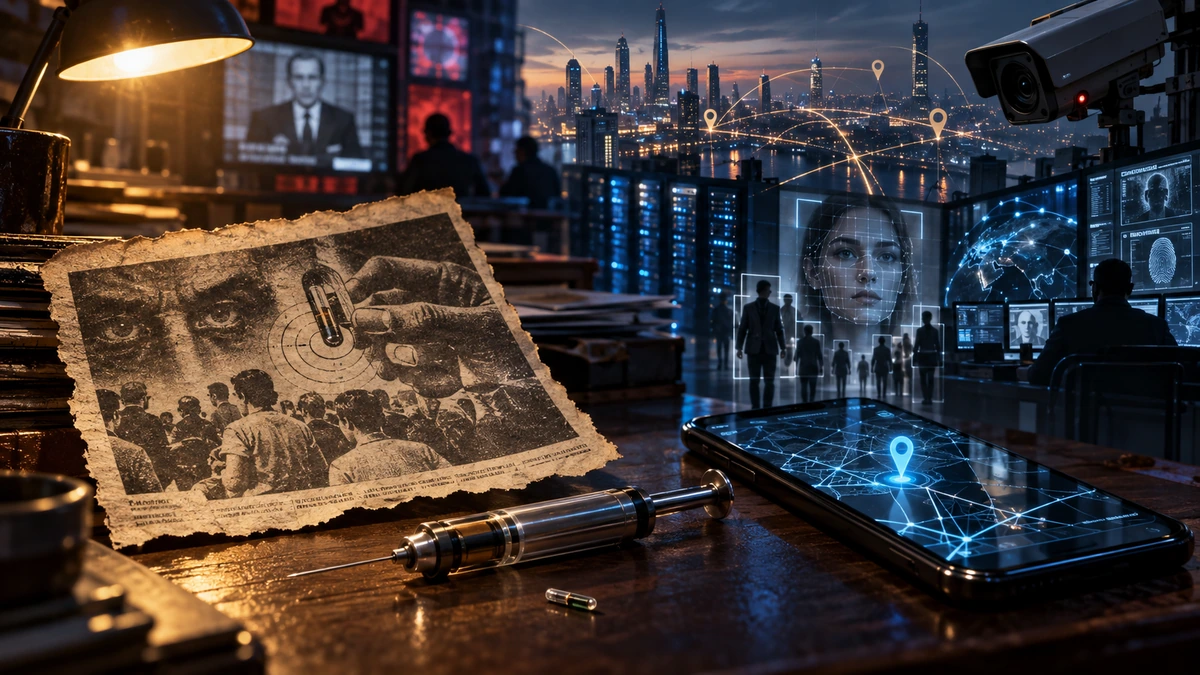
For years a black-and-white clipping has circulated online under the large headline “BIG BROTHER’S COMING!”, with a subheadline about a secret plan to tag every man, woman and child. The text speaks of microchips, a government computer, tracking people, and even the possibility that transmitters could be inserted unnoticed through a vaccination programme. Because several parts of that picture seem less technologically fantastic today than they did in 1989, the clipping has become an evidentiary object in debates about surveillance.
But a source like this requires four separate questions: is the clipping itself authentic; is the claimed publication and date authentic; are the claims inside the article true; and do later technological similarities prove continuity? These are not the same thing. A genuine old newspaper story can contain false claims; a misattributed clipping can still describe real technology; and later resemblance does not by itself prove that an alleged secret plan existed.
The earliest object we can directly verify in the open web corpus is the reproduction of the clipping on page 444 of William Cooper’s *Behold a Pale Horse* (1991). From there its genealogy can be traced: the alleged 1989 publication, its inclusion in Cooper’s book, its online revival around 2009, and present-day comparisons with RFID, digital identity, smartphones, and biometrics.
The question is therefore not “Did the newspaper predict everything?” A more useful question is: what can be established about the clipping, what technology already existed in 1989, which parts of the described architecture later became real, and which crucial part — covert mass chipping through vaccination — still lacks a verifiable chain of evidence?
Start with the clipping itself: what can actually be verified?
Page 444 of Cooper’s book reproduces a newspaper-style clipping headed “BIG BROTHER’S COMING!”, with the subheadline “Revealed: Secret plan to tag every man, woman and child” and the byline Joe Frick. It also shows a hand holding an injector-like device and a caption saying tiny transmitters could be injected into humans. Because Cooper’s book appeared in 1991, one point is highly secure: the printed clipping existed no later than 1991.
The publication and date are harder. Online reproductions from 2009 onward almost uniformly identify it as The Sun, 1 August 1989, but the scan in Cooper’s book does not visibly preserve a masthead, page number, or full publication imprint. In the open corpus reviewed here, we did not locate an independently digitised complete 1 August 1989 issue of The Sun that would close the attribution question.
The most precise provenance statement is therefore: the clipping is authentically reproduced in a 1991 source; attribution to the American tabloid The Sun and the date 1 August 1989 is probable and long repeated, but not independently archival-confirmed in this audit by the original full issue. That is more useful than a binary “real/fake” label because it identifies exactly where the evidence chain is strong and where it remains incomplete.
The Sun was not an ordinary newspaper source
If the attribution is correct, the nature of The Sun of Boca Raton matters. It was a U.S. supermarket tabloid published by Globe International, part of a media environment known for mixing sensationalism, extraordinary claims, and entertainment fiction. A federal court record from the early 1990s directly confirms that Globe published the Sun and that it ran a fictional story about a pregnant 101-year-old newspaper carrier alongside the photograph of a real 96-year-old woman.
That does not prove Frick’s article was fabricated. It establishes a crucial methodological point: publication in the Sun is not, by itself, strong verification of anonymous national-security claims. Such a story needs outside support — a document, a named agency, a verifiable official, a patent, a contract, an archival record, or another independent trail.
The clipping supplies no such primary document. Its central source is a man named Davis Milerand, described as a critic of government intervention who allegedly received leaked information from insiders. Exact-name searches find him almost entirely in later reproductions of the same clipping; we found no independent biography, official role, or archive confirming his alleged sources. The claim of a specific secret Bush-administration programme is therefore unverified second-hand testimony, not a documented fact.
But the technology was not science fiction in 1989
The most interesting part of the story is that the basic idea of an injectable identification chip did not require secret technology in 1989. A patent family for a syringe-implantable identification transponder claims priority from February 1986 and was publicly published in 1987. It describes a passive transponder small enough to be implanted by syringe for animal identification.
The timing is even more striking: on 14 April 1989, only months before the clipping’s alleged date, UPI reported on International Infopet, a system in which a microchip carrying a ten-digit code was implanted beneath an animal’s skin; a scanner read the code and a database linked it to the owner. That same month, The Scientist described laboratory-animal microchip transponders inserted with a needle.
A completely ordinary genealogy is therefore possible: the writer could have taken publicly available animal-identification technology and extrapolated it into a dystopian human-surveillance scenario. This does not prove that is what happened, but it shows that the technological skeleton of the story did not require a classified leak.
What did the clipping actually predict?
The text bundles together several distinct predictions. First, a microchip implanted in humans. Second, a unique identity linked to a central database. Third, the ability to track a person at any moment. Fourth, use of the system for missing persons, criminals, and spies. Fifth — and strongest — the claim that implants could be covertly inserted through a nationwide vaccination programme.
These claims do not carry the same evidentiary burden. An identification implant is an engineering problem. A central database is an information-systems problem. Continuous tracking requires communications infrastructure and power. Covert mass insertion through vaccination would additionally be a medical, logistical, supply-chain, legal, and institutional programme that should generate many other traces.
Each claim must therefore be tested separately. If one later becomes technologically real, that does not automatically transfer credibility to the others.
2004: the human RFID implant becomes a regulated medical product
Fifteen years after the alleged article, the FDA on 12 October 2004 granted classification for the VeriChip Health Information Microtransponder system. The FDA database describes it as an implantable radio-frequency transponder for patient identification and access to health information. This is a direct documented point at which the scenario of a “chip under human skin” moved from speculation into a regulated product.
But VeriChip’s architecture is much more limited than the clipping implies. The transponder is passive: it has no GPS and does not continuously broadcast. A nearby reader energises it, and it primarily stores a unique identification number. Personal information sits in an external database reached through that identifier. This difference is revealing: the clipping says “everything about you” could be in the chip; the real architecture is more efficient — the chip carries the key while the data lives elsewhere.
Similar implants were later used voluntarily for building access, computer login, purchases, or rail tickets. Reuters reported in 2017 on a U.S. company offering voluntary RFID implants to staff, and Swedish railway operator SJ trialled implant-based ticket verification the same year. This confirms technological capability, not a compulsory mass programme.

Tracking arrived by another route: the phone became the transmitter
The clipping’s greatest irony is that near-continuous tracking did not require putting a chip under most people’s skin. A smartphone inherently communicates with cell towers, satellite navigation, Wi‑Fi networks, apps, and location-service providers. In Carpenter v. United States (2018), the U.S. Supreme Court described the government obtaining 12,898 location points from one phone across 127 days — an average of 101 per day.
In 2026, Chatrie v. United States brought geofence warrants before the Supreme Court: investigators did not begin with a suspect’s name, but with a geographic area and compelled Google to reveal devices that had been there during a specified time. The Court described Location History as recording the location of participating users’ phones roughly every two minutes.
Functionally, this reverses the clipping’s image. The article imagines a physical implant allowing the state to “track anyone down at any moment.” Modern infrastructure has achieved much of that capability through devices people voluntarily carry because they are useful. This does not mean surveillance is universal or that one government has a single map of everyone; it means the technical barrier to mass location history has fallen dramatically.
The “master computer” became a network of identity systems
The idea of one literal “master computer” did not materialise either. Instead, large state and commercial systems are linked through identifiers, interfaces, and verification requests. The clearest example is India’s Aadhaar: in 2026, official UIDAI figures showed more than 1.44 billion Aadhaar enrolments, while its Central Identities Data Repository (CIDR) supports identity verification using demographic or biometric information.
In travel, electronic passports became a global standard. ICAO reports more than one billion ePassports in circulation; the chip stores biographical information and a digital facial image, with additional biometrics possible. The EU Entry/Exit System, fully operational from April 2026, records document data, the date and place of entry or exit, facial images, and fingerprints for covered third-country nationals.
The European Digital Identity Wallet adds another layer. EU law creates a digital identity framework for accessing public and private services, while the Commission stresses user control and voluntary use. The critical question is therefore not whether every such system is automatically “Big Brother,” but how identity concentration, interoperability, data linkage, and the legal boundaries of secondary use evolve.
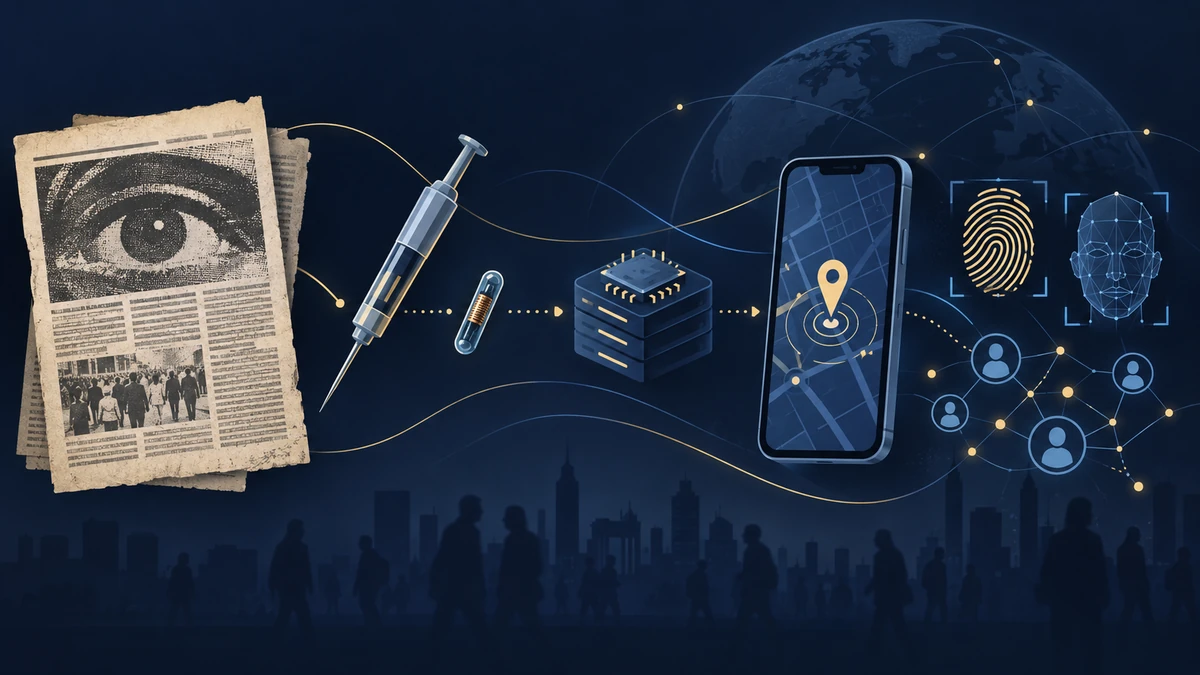
Vaccination and a hidden implant: the strongest claim remains the least substantiated
The most quoted part of the clipping suggests that transmitters could be inserted unnoticed through a nationwide vaccination programme, with doctors perhaps not even knowing what they were injecting. This is the line that drove renewed circulation after 2009 — first around H1N1 and later around COVID-19.
The audit yields two conclusions at once. First, implanting an electronic transponder by needle was technically demonstrated before 1989, so injection as an insertion method was not fantasy. Second, across the patent, regulatory, judicial, medical, and archival sources reviewed here, we found no documented chain confirming a specific secret Bush-administration programme to covertly chip the population through vaccination.
That boundary matters. Technical possibility is not evidence of deployment. Conversely, lack of public admission is not logical proof that a secret programme could never exist; but a historical article cannot fill an absent evidentiary link with certainty. A claim of an actual mass operation would require more: devices, procurement contracts, logistics, internal documents, verifiable whistleblowers, forensic samples, or another independent corroborating trail.
What was “prophetic” — and what was not?
If read as a technological forecast, several elements are surprisingly close to later reality: subcutaneous identification transponders for humans did exist; a unique ID can link to an external database; implants can be used for access and payments; states operate enormous biometric identity systems; phones allow detailed reconstruction of movement; and law enforcement can obtain location data under legal processes.
Other elements did not unfold as described. VeriChip does not contain “everything about a person” and is not a long-range tracking transmitter. Mass location tracking developed primarily through mobile devices and platforms, not implanted RFID. There is no documented proof that the entire U.S. population — or any other national population — was covertly chipped through vaccination. And instead of one government master computer, there is a plural ecosystem of public and private databases.
“Prophetic” is therefore too broad. A more precise description is: the clipping combined genuinely emerging technology with a dystopian surveillance architecture at an unusually early date; several functions of that architecture later became real, often through different technical routes. That is historically interesting without requiring a claim of a secret plan.
Evidence matrix: the clipping versus documented reality
| Claim | What the sources support | Where the evidence stops |
|---|---|---|
| The clipping is proven to date from 1989 | A reproduction is directly verifiable in Cooper’s 1991 book; later circulation gives 1 Aug 1989 | This audit did not locate the complete original issue with masthead and date |
| The Sun proves a secret programme | If attribution is correct, the article appeared in a known U.S. tabloid | The Sun also published fictional sensational stories; a secret programme requires independent evidence |
| Injectable microchips were impossible in 1989 | Patents and commercial animal systems using injectable transponders existed before August 1989 | That proves technical possibility, not a secret human programme |
| Human implants later became real | The FDA classified VeriChip for patient identification in 2004 | Passive RFID is not GPS and cannot continuously track a person at long range |
| The chip can contain everything about a person | Real systems use an identifier linked to an external database | The personal record is generally not physically stored in the implant |
| Government can track people through digital infrastructure | Carpenter and Chatrie document law-enforcement use of mass phone-location data | Access is legally constrained and there is no single universal system covering everyone |
| Central biometric identity systems exist | Aadhaar, ePassports, and EES are large documented systems | Their purpose, legal basis, and scope differ from a covert implant programme |
| Vaccines were used for covert mass chipping | Needle implantation of a transponder is technically possible | No independent evidentiary chain for an actual mass vaccination-chipping programme was found in the reviewed corpus |
The matrix reveals an unusual combination: the story’s technical skeleton was far more realistic than is sometimes assumed, while its political skeleton — a specific secret Bush-administration operation to chip the entire population through vaccination — remains independently uncorroborated in the reviewed corpus. That distinction allows the clipping to be taken seriously as a historical object without automatically treating it as a leaked government plan.
Why the clipping matters even without a proven conspiracy
The historical value of the clipping does not depend on someday finding an NSA-stamped document that validates Milerand’s story. It is already valuable because it captures a transition point: microchip identification was becoming practical, computer databases were expanding, and Orwell’s language of “Big Brother” offered a cultural framework for interpreting the new infrastructure.
Three decades later, the central dilemma has shifted. The greatest surveillance capability may not be a device secretly inserted into us, but an ecosystem of devices and services we adopt voluntarily: phones, biometrics, digital identity, electronic payments, automated border systems, and data brokers. Any one system may be useful, lawful, and voluntary; their combination raises a different question — how complete a picture of a person can emerge through data linkage.
The most productive question is therefore not whether Joe Frick was a “prophet.” It is: if the functional outcome of near-comprehensive identification and location profiling can be achieved without a secret implant, were surveillance debates too focused on the chip under the skin and not focused enough on the data architecture around us?
Sources and further reading
- William Cooper, Behold a Pale Horse (1991), p. 444 — earliest directly verifiable reproduction in the open corpus of the “BIG BROTHER’S COMING!” clipping.
- Bibliotecapleyades / archived 2009 circulation — attributes clipping to Joe Frick, The Sun, 1 Aug 1989; useful for tracing online genealogy, not as independent verification.
- End-Times Deception (18 Nov 2009) — early online repost tying the clipping to Cooper p. 444 and The Sun; secondary provenance node.
- Peoples Bank & Trust Co. v. Globe International Publishing, 978 F.2d 1065 (8th Cir. 1992) — judicial record concerning Sun and its publication of a fictional sensational story.
- UPI, 18 Oct 1993 — identifies Globe International as publisher of the Sun of Boca Raton and describes the court dispute over a fictional story.
- WO1987004900A1 — Syringe-implantable identification transponder; priority 25 Feb 1986, publication 27 Aug 1987.
- UPI, “New Products on the Market,” 14 Apr 1989 — Infopet implanted microchip, 10-digit code, scanner and database for pet identification.
- The Scientist, 17 Apr 1989 — laboratory-animal microchip transponder implanted by needle and read by scanner.
- FDA De Novo DEN040007 — VeriChip Health Information Microtransponder, decision 12 Oct 2004.
- FDA Product Classification NRV — implantable radiofrequency transponder stores a unique ID and is activated by an external reader; ID links to database information.
- FDA guidance (2004) — Implantable Radiofrequency Transponder System for Patient Identification and Health Information.
- SEC filing reproducing FDA clearance letter for VeriChip, 12 Oct 2004.
- BMJ (2004), “FDA approves implantable chip to access medical records” — medical reporting on VeriChip clearance and privacy concerns.
- Reuters, 2017 — Wisconsin company offered optional RFID microchip implants for access, computer login and purchases; short read range noted.
- SJ (Sweden), 22 May 2017 — trial of microchip implants as train tickets.
- U.S. Supreme Court, Carpenter v. United States (2018) — government obtained 12,898 cell-site location points over 127 days.
- U.S. Supreme Court, Chatrie v. United States (2026) — geofence warrants and Google Location History as location-surveillance infrastructure.
- UIDAI Aadhaar Dashboard (2026) — 144.66 crore Aadhaar enrolments, large-scale national digital identity infrastructure.
- UIDAI — Aadhaar Authentication — demographic/biometric data checked against Central Identities Data Repository (CIDR).
- UIDAI — Protection of the Individual — states what data is collected and explicitly denies transaction profiling in UIDAI’s own system.
- ICAO — ePassport Basics — more than 140 issuers and over one billion ePassports; chips carry biographical and security data.
- ICAO — ePassport validation — explains chip authentication and limits of the PKD validation exchange.
- U.S. State Department (2005/2006) — U.S. electronic passports integrate facial biometrics and contactless chip technology.
- Council of the EU — Entry/Exit System — biometric border database, fully operational from 10 Apr 2026; records entries, exits, fingerprints and facial image for covered travellers.
- European Commission — European Digital Identity Regulation entered into force in 2024; wallet offered as a mobile app and described as voluntary.
- European Commission — implementing regulations for European Digital Identity Wallets, 2024.
- EUR-Lex, Regulation (EU) 2024/1183 — legal framework for European Digital Identity Wallets.
- Council of the EU — Eurodac modernisation (operational 2026) — expanded biometric and identity data in migration/asylum infrastructure.