Psychological Operations: How Information Becomes a Weapon
Psychological operations target not territory first, but human perception and behaviour. How do states turn information into an operational tool — and where does influence become manipulation that violates free judgement?
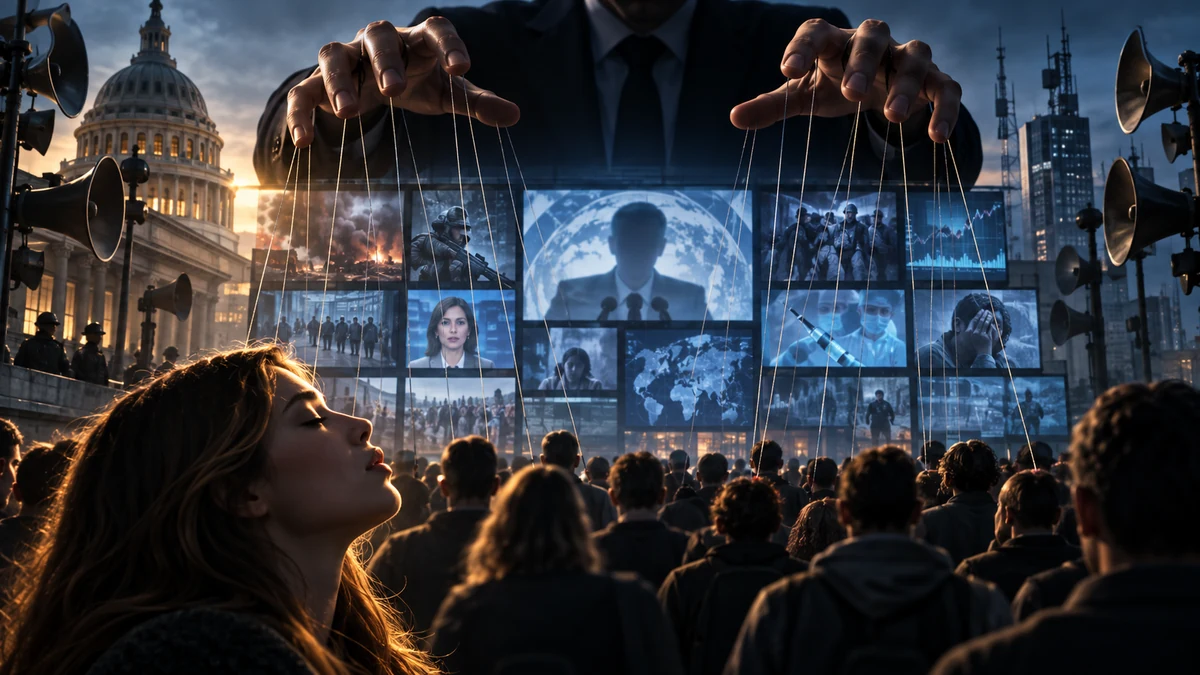
A psychological operation begins where information is no longer merely content that another person is expected to understand, but a means for producing a behavioural effect. Military doctrine says this quite directly: the aim is to influence the perceptions, attitudes, motives, reasoning and ultimately the behaviour of a selected target audience. Words, images, rumours, symbols, video, actions and even silence can become part of an operation when they are planned for their psychological effect.
This does not mean that every attempt at persuasion is a psychological operation. A parent, teacher, journalist, physician or political candidate may try to persuade someone without conducting PSYOPS. What matters is organised intent, a defined target population, a measurable desired effect and a connection to a political or military objective. Yet this is precisely why the field is morally dangerous: a person can cease to be an interlocutor and become a 'target audience' — a variable whose behaviour is to be moved.
Modern states describe these methods through sterile vocabularies of influence, information support, strategic communications and the cognitive environment. Euphemism does not change the underlying act. If an institution deliberately searches for people's fears, vulnerabilities, identities and information habits in order to push them, without their awareness, toward behaviour useful to the sponsor, we are no longer speaking only about informing. We are speaking about management of perception.
This article therefore asks not only whether psychological operations work, but what their logic does to the idea of free judgement. Natural law, as THY-REALITY uses it as a normative question about truth, freedom, harm and responsibility, does not permit the easy excuse that a method becomes acceptable merely because it is effective, lawful or performed in the name of the state.
What are psychological operations?
NATO describes psychological operations as planned activities directed at approved target audiences in order to influence perceptions, attitudes and behaviour in support of political and military objectives. U.S. military doctrine uses closely related language: military information support operations convey selected information and indicators to foreign audiences in order to influence emotions, motives, objective reasoning and ultimately behaviour. The desired result is not merely that somebody 'knows something', but that they act, refrain from acting or begin to perceive the situation differently.
PSYOPS therefore cannot be reduced to propaganda leaflets. Leaflets, radio and loudspeakers are historical delivery methods. Today the same function can be performed through social media, video, influencers, memes, selectively released data, false personas, true stories stripped of context, or actions on the ground designed to create a specific impression. NATO itself notes that almost every military action or inaction can have psychological effects and that commanders must consider those effects.
The official definition already breaks the comfortable idea that information is merely a neutral description of reality. In operational logic, information can function as a form of coercive power without physical contact: it can alter a decision, morale, willingness to resist, confidence in leadership or relations between groups. That is why military documents place it among capabilities used to produce effects on an adversary.
Persuasion, propaganda, disinformation and deception are not the same thing
Serious analysis requires distinctions. Public communication may be openly persuasive, but the source is known and the audience usually knows who is speaking. Propaganda is a broader term for systematic messaging organised around a political or institutional objective. Disinformation is the intentional spread of false or misleading information. Military deception is a separate discipline aimed primarily at misleading adversary decision-makers about one's own intentions, capabilities or actions.
A psychological operation may use truth, half-truth, selective facts, emotional framing or, in some historical and covert forms, false attribution. The old distinction among 'white', 'grey' and 'black' propaganda mainly concerns the visibility of the source: white propaganda identifies its origin, grey leaves it uncertain, and black propaganda is deliberately attributed to someone else. This matters because the moral problem is not limited to outright falsehood. A true fact can also be used manipulatively when context is deliberately removed or timing is chosen to exploit fear and ignorance.
Here the limits of bureaucratic terminology become obvious. In 2010 the U.S. Department of Defense replaced the term PSYOP with MISO, partly because PSYOP was considered too menacing; U.S. units later returned to the name Psychological Operations. The name changed, but the function did not: the objective remained behavioural influence. A euphemism can reduce public discomfort, but it cannot morally cleanse a method.
The target audience: when a person becomes an operational problem
Target-audience analysis is at the centre of psychological operations. Military planners ask not only what people think, but which needs, fears, identities, social relationships, authorities, information channels and vulnerabilities can help move their behaviour. U.S. military sources openly discuss susceptibility, vulnerability, accessibility and measures used to track behavioural change.
Technically this is understandable: persuasion requires some understanding of motives. But the boundary moves quickly. When a system's task is to locate a human weakness so that it can be operationally exploited, the person is no longer treated as an equal rational subject. The person becomes an object of behavioural engineering. The difference between argument and manipulation lies precisely in whether an appeal respects a person's capacity for free judgement or attempts to bypass it.
This is the central problem from the perspective of Natural Law. Human rationality and free will are not defects in a system to be circumvented when they become politically inconvenient. If authority deliberately uses confusion, hidden attribution, fear or psychological vulnerability instead of evidence in order to obtain compliance, the question is no longer merely whether the operation succeeded. The question is whether a human being was treated as a person or as a means.
From leaflets to covert propaganda
Psychological warfare was not invented by social media. The U.S. Army traces its institutional PSYOP tradition to the First World War. During the Second World War, governments used radio broadcasts, rumours, forged publications and leaflets. Britain's Political Warfare Executive also conducted 'black propaganda', in which messages were designed to appear as if they originated inside the enemy's own environment. Imperial War Museums notes that such operations aimed to encourage desertion, distrust and internal division.
After the war, psychological warfare moved into permanent Cold War structures. In December 1947, U.S. NSC 4-A authorised the CIA to conduct covert psychological operations abroad. In 1948, NSC 10/2 broadened covert operations to include propaganda, subversion and support for selected political forces while requiring that U.S. Government responsibility not be evident and could be plausibly disclaimed. This is not a theory about hidden history; it is part of the later-declassified official record of U.S. foreign policy.
In Vietnam, U.S. units conducted extensive psychological operations through leaflets, loudspeakers, radio and television broadcasts, safe-conduct passes and other materials. The techniques varied, but the logic remained: influence morale, the perception of risk and individual decisions. History therefore shows that states did not begin treating information as a weapon in the digital age. The digital age primarily increased reach, speed, measurability and targeting precision.

The greatest moral danger is not always a lie
An obvious lie is easy to condemn. Manipulation built from true facts is harder to detect. An operator can select only the data that produces the desired emotional reaction; foreground one victim and hide another; present a lawful fact without its surrounding circumstances; or time a message for a moment of panic. Every individual piece may be factually correct while the overall picture pushes a person toward a conclusion the sponsor could not obtain through open and fair argument.
The claim that 'our psychological operations tell the truth' therefore does not resolve the issue. The truth of an individual sentence does not make an entire operation honest. If the speaker's identity is concealed, purpose withheld, context deliberately impoverished or the audience selected because of its vulnerability, the distinction between informing and manipulation remains real.
Natural law supplies a stricter test than mere positive legality: does an act respect truth, free judgement and human dignity? War may create difficult exceptions — deceiving an armed adversary about a military manoeuvre is not identical to long-term psychological shaping of a civilian population. But the label 'national security' cannot by itself convert every manipulation into a moral act.
When the boundary between foreign and domestic audiences collapses
Classical doctrine often stresses that PSYOPS are directed at foreign target audiences. That boundary has always mattered politically as well: a state that secretly shapes the will of its own citizens intervenes directly in the conditions of democratic decision-making. Digital networks weakened the geographic boundary. A message released for a foreign audience can reach domestic populations within minutes through platforms, news coverage and reposting.
A U.S. Information Operations Roadmap from 2003 acknowledged this problem explicitly: information intended for foreign audiences, including PSYOP, was increasingly consumed by the American public, while media could replay such messages to much larger audiences. That is a crucial warning. In a networked world, 'this was not intended for you' is no longer an adequate safeguard.
A democratic system therefore cannot rely on an administrative label attached to a target group. If the same state demands informed consent from citizens while developing capabilities to shape perception invisibly, there must be a clear legal, institutional and technical separation. Otherwise citizens may formally remain sovereign while the information environment in which they form their will becomes an object of state management. No terminology removes that contradiction.
The digital environment: influence becomes individualized and measurable
Social media gave psychological operations three qualities a leaflet never possessed: near-instant global reach, detailed audience data and continuous feedback on response. A message can be tested, adjusted, retargeted and linked to behavioural data. U.S. military professional literature already discusses 'psychological targeting' that adapts content to needs, wants, susceptibility, psychographics and past online behaviour.
Here the logic of warfare approaches commercial advertising technology. The same platform that helps a seller find a buyer can help a political or military actor find a frightened, angry, isolated or distrustful person. The difference lies not in the infrastructure but in the purpose, data, concealment and consequences.
NATO discussions of cognitive warfare describe a convergence of psychological, information and cyber capabilities and the potential exploitation of human vulnerabilities. The field is not yet a single settled doctrine and the term 'cognitive warfare' is used in different ways. But the direction is clear: contemporary conflict contests not only territory and communication channels, but the interpretation of events inside the human mind. That is precisely why moral oversight should become stronger, not weaker.
Not every defence against propaganda is another propaganda campaign
Criticising psychological operations does not mean that a state must remain passive in the face of foreign manipulation. If an adversary distributes forged documents, fabricated video or coordinated disinformation, a government can legitimately expose the origin, publish evidence, correct false claims and teach citizens how to verify sources. NATO's current approach to information threats explicitly describes defence against intentional, harmful and coordinated manipulation.
Defence, however, must not become a pretext for a monopoly on truth. The Council of Europe warns that propaganda and psychological manipulation can damage the free formation of opinion, while also warning that states must not build countermeasures that become tools for silencing critics and opposition. This is an essential double boundary: a society must defend itself against organised manipulation and against authorities that label all dissent as hostile disinformation.
The healthiest defence is therefore usually more truth, more verifiability, transparent attribution, independent media and the ability of citizens to compare sources. A system that trusts citizens only when they accept the official account does not build resilience. It builds dependence on authority.
What should a democracy be allowed to do?
Positive law already sets some limits. The International Covenant on Civil and Political Rights protects the right to hold opinions without interference and freedom of expression while requiring prohibition of propaganda for war and certain forms of incitement to hatred. The U.S. Operational Law Handbook identifies free speech, privacy, attribution, domestic-audience restrictions and international law among the legal issues surrounding MISO. But law is a floor, not a complete moral theory.
At minimum, a democratic system should follow this principle: the farther the state moves away from open, verifiable communication and the more it relies on concealed sources, psychological profiling, false identity, fear or vulnerability, the stronger the legal basis, oversight and eventual public accountability should be. The threshold must be substantially higher when a state's own citizens may be affected.
Natural law draws an even stricter boundary. The state has no moral title to treat a person as property of an information system. Human consciousness is not public infrastructure and free will is not an enemy communications channel. Defence against violence can justify some secrecy and military deception. It cannot justify the general principle that invisible behavioural shaping is permissible merely because government possesses the technology, budget and legal authority to perform it.
Information becomes a weapon when the person becomes the target
Psychological operations reveal an uncomfortable truth about modern power: physical coercion is not the only way to direct human behaviour. If you can change the frame through which a person understands the world, you can sometimes change what that person does without an order, prohibition or weapon. That is precisely why these methods attract states. Effects can be large, costs comparatively low and responsibility difficult to see.
Effectiveness, however, is not moral permission. A system that speaks about human rights, free choice and democratic consent cannot avoid contradiction if it simultaneously treats the human psyche as an operational space that may be covertly shaped whenever a strategic objective requires it. If we call the same procedure 'strategic communication' when performed by our side and 'manipulation' when performed by an adversary, we have replaced a moral standard with a flag.
A more honest boundary is simple: truth can be defended with evidence; lies can be exposed; danger can be explained; people can be persuaded openly. But when an institution needs concealed attribution, psychological vulnerability or control of context in order to make a person behave differently, the burden of justification must fall on the institution, not the target. A democracy that fails to understand this can preserve elections and statutes while slowly losing what those mechanisms were supposed to protect: free human judgement.
Sources and further reading
- NATO — AJP-10.1 Allied Joint Doctrine for Information Operations / psychological operations: PsyOps are directed at approved target audiences to influence understanding, will and behaviour in support of political and military objectives.
- NATO — C3 Taxonomy Baseline: psychological effects are expected from military actions and PSYOPS processes seek measurable behavioural change in a target audience.
- U.S. Department of Defense / Joint Staff — Military Information Support Operations: MISO develop and convey messages and actions to influence selected foreign groups, attitudes and behaviours.
- U.S. Army — FM 3-13 Inform and Influence Activities: MISO are described as the commander's primary capability to inform and influence foreign populations and to induce or reinforce behaviour favourable to military objectives.
- U.S. Army JAG Corps — Operational Law Handbook, Information Operations: definition of MISO and legal issues including free speech, privacy, attribution, domestic audiences and international law.
- U.S. Army — 100 years of subterfuge: institutional history of Army psychological operations since 1918 and continuity of the behavioural-influence mission.
- U.S. Army Military Review — What's in a Name?: history of the 2010 PSYOP-to-MISO terminology change and later return to PSYOP terminology.
- U.S. Army Military Review — AI Integration for Scenario Development: target audience assessment includes susceptibility, vulnerability, accessibility and measures of behavioural change.
- U.S. Army Military Review — Cyber Considerations / persuasive technology: discusses psychological targeting based on vulnerabilities, susceptibilities, psychographics and prior online behaviour.
- NATO — Mind Games: historical discussion distinguishing PSYOPS, public diplomacy, public information, deception and covert action and warning about blurred terminology.
- NATO — Approach to Counter Information Threats: current definitions of hostile information activities, propaganda, disinformation and information manipulation.
- NATO Science & Technology Organization — Cognitive Warfare: discussion of convergence among PsyOps, InfoOps and cyber capabilities and the exploitation of human vulnerabilities.
- U.S. Department of Defense — Information Operations Roadmap (2003): acknowledges that foreign-targeted information and PSYOP can be replayed to and consumed by domestic audiences.
- U.S. Department of State, Office of the Historian — NSC 4-A, Psychological Operations (1947): authorization for CIA covert psychological operations abroad.
- U.S. Department of State, Office of the Historian — NSC 10/2 draft/history (1948): covert operations included propaganda and subversion under conditions of concealed U.S. responsibility / plausible denial.
- U.S. Department of State, Office of the Historian — intelligence establishment introduction: distinction among overt information, covert propaganda and psychological warfare in the early Cold War.
- Imperial War Museums — Sefton Delmer / Political Warfare Executive: British black propaganda aimed at desertion, distrust and dissent in Nazi Germany.
- U.S. Army Center of Military History — Department of the Army Historical Summary FY 1969: Vietnam PSYOP used loudspeakers, leaflets, safe-conduct passes, radio and television broadcasts.
- U.S. GAO — Information Environment: Opportunities and Threats to DOD's National Security Mission (2022): modern information operations exploit globally connected digital and social-media environments.
- Council of Europe — Information Disorder: framework distinguishing misinformation, disinformation and mal-information and discussing manipulation of social divisions.
- Parliamentary Assembly of the Council of Europe — Resolution 2567 (2024), Propaganda and freedom of information in Europe: propaganda and psychological manipulation can impair free opinion and informed democratic participation.
- Council of Europe — Report Doc. 16034 (2024): warns both about state-backed propaganda and about countermeasures that could be used to silence critics and opposition.
- OHCHR — International Covenant on Civil and Political Rights, Articles 19 and 20: freedom of opinion/expression and requirement to prohibit propaganda for war and certain incitement to hatred.