Cymatics: When Sound Becomes Pattern
Sand, liquid, and sound can produce striking geometric patterns. What does the physics actually show — and what is added only by later interpretation?
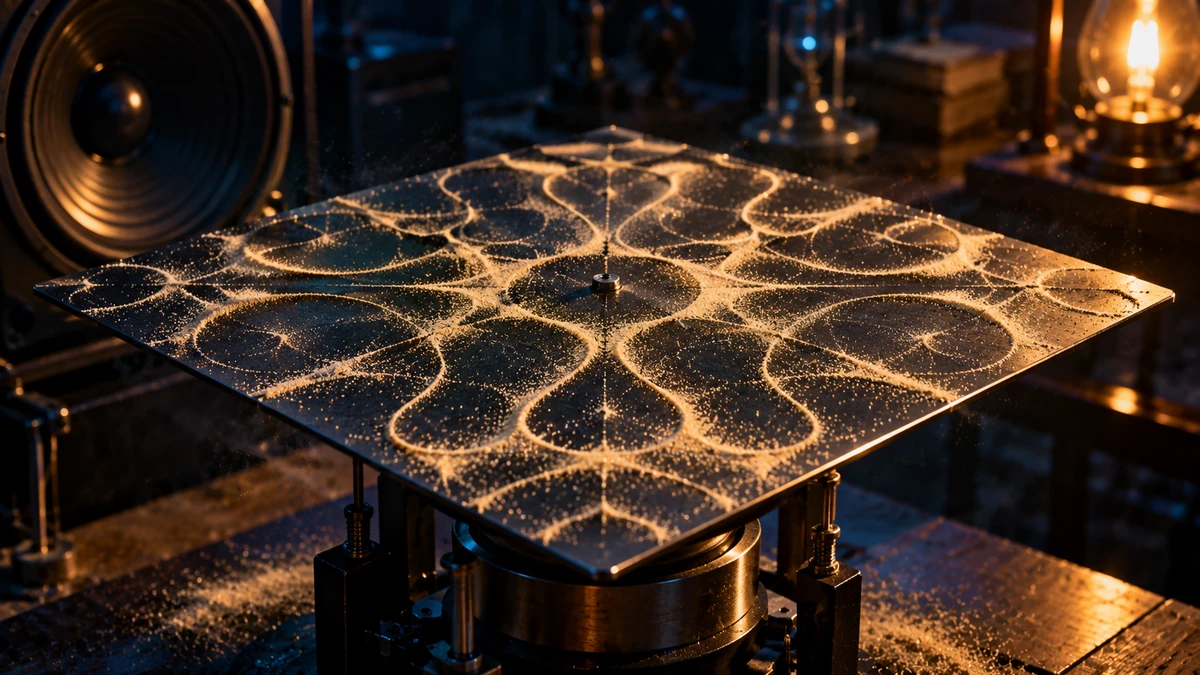
Sprinkle fine sand on a metal plate and excite it with sound, and apparent chaos can rearrange within moments into lines, circles, stars, and rosettes. The images are so striking that it is difficult to watch them without feeling that sound is revealing some hidden geometry of nature. That visual power is why cymatics has become a major meeting point between physics, art, and modern esotericism. [1][4]
But an image does not explain itself. The physical phenomenon is remarkable without any additional claim: vibrating plates possess normal modes, liquids develop parametric waves, and acoustic fields can move particles and even levitate small objects. The key question is where this well-measured physics ends and where interpretations about sacred geometry, healing tones, and universal frequency codes begin. [7][9][11][13]
What Does Cymatics Actually Mean?
Cymatics is the modern name for methods that make the effects of vibration visible. The best-known example is a metal plate sprinkled with sand: when the plate is driven at one of its resonant modes, grains are displaced from strongly moving regions and collect along lines where displacement is very small. A geometric pattern appears that can be photographed, reproduced, and mathematically related to the plate’s mode of vibration. [1][7][8]
One common confusion should be removed at the outset. Cymatics does not reveal “sound itself” as a hidden symbol. It reveals the response of a particular physical system to mechanical excitation: a plate, membrane, liquid, granular layer, or other material. Sound or vibration is part of the cause, but the final image emerges from the interaction of frequency, geometry, material properties, boundary conditions, and the way the system is driven. [7][8]
Before Jenny: Hooke and Chladni
The story does not begin in the 1960s. Robert Hooke described an experiment to the Royal Society in 1680 in which he bowed a plate covered with fine material and observed the resulting nodal patterns. A century later, Ernst Chladni systematically developed the method and published his investigations in 1787, which is why such patterns are now known as Chladni figures. [2][6]
Chladni’s contribution was not merely a collection of beautiful pictures. He showed that different resonant modes of the same plate produce different stable networks of nodal lines. This visualisation became an important step in experimental acoustics: the invisible motion of an elastic body could be made visible with sand. The Smithsonian therefore describes Chladni plates as an early way of displaying the vibrational modes of mechanical surfaces directly. [1]
Why Does the Sand Form Lines?
When a plate resonates, it does not move equally everywhere. Some regions oscillate strongly, while between them lie nodal lines where displacement is very small or, in the idealised model, zero. Grains on the strongly moving regions bounce and migrate until they accumulate in quieter areas. The bright sand lines therefore do not mark lines of maximum energy; they usually trace regions of minimum plate motion. [1][8]
This is essential for interpreting the images correctly. The pattern is not drawn from outside, and the plate does not “know” a flower, star, or mandala. The geometry emerges as a solution to a vibration problem: the plate’s shape and thickness, its mounting, elastic properties, and the driving frequency determine which mode can be strongly excited. Modern research on Chladni plates measures and models these modes with much greater precision, but the basic principle remains the same. [7]
A Frequency Does Not Have One Universal Shape
Social-media comparisons often show pairs of images labelled “432 Hz,” “440 Hz,” “528 Hz,” or other numbers, as though every frequency in nature possessed one unique geometric image. The physics of Chladni plates does not support that interpretation. A pattern belongs to a resonant mode of a particular system, not to an abstract frequency number detached from the apparatus. Changing the plate shape, thickness, material, or mounting changes both the natural frequencies and the nodal lines. [7][8]
The same numerical frequency can therefore produce different images in two different devices, while visually similar patterns can occur at different frequencies in different systems. This does not make frequency irrelevant — the chosen frequency determines which mode may be excited — but photographs without a complete description of the apparatus are not sufficient evidence for the supposed “natural geometry” of a specific frequency. This boundary will matter again when examining 432 versus 440 Hz. [7][8]

Faraday Waves: When the Pattern Forms in a Liquid
In 1831 Michael Faraday systematically studied not only particles on vibrating plates but also forms assumed by liquids in contact with vibrating surfaces. Today the term Faraday waves refers to parametrically excited surface waves: if a container of liquid is oscillated vertically with sufficient strength under suitable conditions, the flat surface becomes unstable and develops ordered wave patterns. [3][9]
Those patterns may appear as stripes, squares, hexagonal lattices, or more complex states, depending on driving frequency, amplitude, viscosity, depth, and other parameters. This is why liquid “cymatic” imagery looks different from sand on a plate: the mechanisms are not identical, even though both belong to the wider physics of driven waves, resonance, and pattern formation under constraints. [9]
Hans Jenny and the Birth of the Word “Cymatics”
The Swiss physician and researcher Hans Jenny published the first volume of Kymatik / Cymatics: The Structure and Dynamics of Waves and Vibrations in 1967. He derived the name from the Greek kyma, wave, and used it for a broader phenomenological study of periodic effects. His experiments included powders, pastes, liquids, membranes, and devices that allowed him to vary frequency systematically and document the resulting forms. [4][5]
It is noteworthy that Jenny’s introduction stressed empirical observation and warned against premature analogical interpretation of the images. Later popular culture often extended the word “cymatics” far beyond that experimental use — toward sacred geometry, healing frequencies, and cosmic analogies. Historically it is therefore useful to separate Jenny’s documentation of wave phenomena from the meanings later attached to his photographs. [4][5]

Why Do the Patterns Resemble Flowers, Mandalas, and Geometry?
The human eye is exceptionally quick to recognise symmetry. Because many plates and containers themselves have circular, square, or otherwise regular geometry, their normal modes often possess mirror, radial, or rotational symmetries. When fine particles trace the nodal lines, the result may resemble a flower, star, rosette, or mandala. [7][8]
That resemblance is real at the level of form, but it does not by itself establish a historical or metaphysical connection. To argue that a sacred rosette was derived from a cymatic experiment would require historical evidence of transmission; to argue that the same pattern reveals a “fundamental code of creation” would require a physical theory and predictions beyond visual similarity. Symmetry can be a shared result of mathematics and system constraints rather than evidence of a shared secret origin. [7]
From a Beautiful Demonstration to Modern Technology
Cymatic phenomena are not interesting only as demonstrations. Modern acoustics uses standing waves, acoustic radiation forces, and controlled vibrational modes to move particles, droplets, micro-objects, and in some systems even cells. Researchers have shown that the motion of multiple objects on a Chladni plate can be controlled by tailoring vibration, while the broader field of acoustofluidics uses ultrasound to sort, collect, and position particles in fluids. [10][11]
Acoustic levitation goes further: a sufficiently strong and properly shaped sound or ultrasonic field can produce a force that suspends a small object or droplet without direct mechanical contact. This is real physics, but it is not the same as an ordinary tabletop salt-and-speaker demonstration. It requires controlled pressure fields, geometry, and often ultrasonic frequencies. [11][12]
Do “Healing Frequencies” Follow from This?
Because vibration visibly moves matter, the temptation is understandable: if sound organises sand and liquids, perhaps particular frequencies can also “organise” the human body. But that inference skips several levels. Biological tissue is not a thin metal plate, and an organism is not a dish of water. The effect of sound on the body depends on intensity, duration, frequency, coupling, tissue, and physiological mechanism. The existence of Chladni figures therefore does not prove a therapeutic effect for any particular frequency. [12][13]
This does not mean every therapeutic effect of vibration is impossible. Vibroacoustic therapy is genuinely being studied, but a review of the pain literature found highly heterogeneous protocols and evidence too sparse to identify reliable beneficial parameters; the authors called for better randomised trials. The safest conclusion is therefore twofold: the mechanical effects of sound are real, while clinical claims must be demonstrated separately for each application. [13]
What Does Cymatics Really Show?
Cymatics demonstrates something striking that needs no mystification: matter under periodic excitation can organise into stable, mathematically describable patterns. Chladni lines reveal the normal modes of an elastic plate, Faraday waves reveal instabilities and patterns on a liquid surface, and modern acoustics can use related principles to manipulate particles. [1][3][9][11]
That is precisely why the phenomenon does not need an additional legend to be remarkable. The real question is not whether “sound creates geometry” — under particular conditions it clearly helps to do so — but which geometry, in which system, through which mechanism, and with which measurable consequences. Preserving that distinction lets cymatics remain a genuine bridge between sound, mathematics, and visible form without turning a beautiful pattern into evidence for a claim that the experiment itself does not contain. [7][9]
Sources and further reading
- Museum overview of Chladni plates, nodal lines, sand accumulation, and the experiment’s historical role in acoustics. Source
- Historical source for Hooke’s 1680 experiment and its relationship to Chladni’s later work. Source
- Primary historical source for Faraday’s investigations of acoustic figures, particles, and liquids on vibrating surfaces. Source
- Bibliographic primary source for Jenny’s 1967 work and the introduction of the term cymatics. Source
- Jenny’s contemporary description of his research programme and the term’s derivation from Greek kyma. Source
- Historical review of Hooke’s and Chladni’s acoustic figures and their wider influence on visual science. Source
- Modern physical study of resonant modes in Chladni plates and the role of geometry and frequency in nodal patterns. Source
- Physics teaching source for the relationship between plate geometry, resonant frequency, and nodal-pattern shape. Source
- Experimental survey of Faraday waves showing stripes, squares, hexagons, and other patterns dependent on forcing and fluid parameters. Source
- Demonstrates that object motion on a vibrating Chladni plate can be statistically modelled and controlled. Source
- Review of acoustic radiation forces, standing waves, acoustofluidics, and micro/nanoparticle manipulation. Source
- Modern experimental source for acoustic levitation in a controlled standing-wave field. Source
- Review of clinical vibroacoustic-therapy research; evidence is heterogeneous and too sparse to identify reliable beneficial parameters. Source