The mystery of Gregorian chant: neumes, space, resonance, and more than a millennium of living sound
Gregorian chant is neither a single ancient melody nor a hidden frequency system, but a centuries-long tradition of Latin liturgical song. This article follows its formation, neumes, eight modes, Guido of Arezzo, and the acoustics of sacred space.
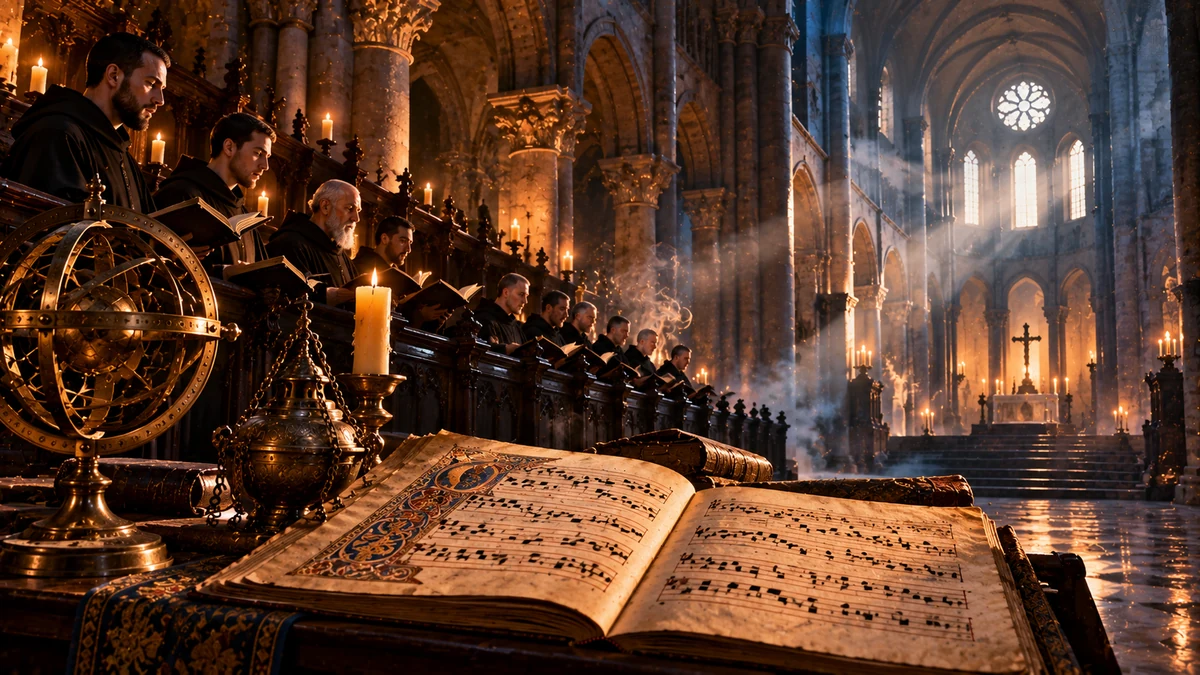
Gregorian chant can sound as though it comes from a single, very distant world: monophonic Latin voices, slowly breathing melody, stone space, and notation that looks almost like a secret script to modern eyes. Yet that sense of unity conceals a long history. The repertory now called Gregorian chant grew from older Western liturgical traditions and became decisively consolidated in the early medieval Frankish-Roman world. [1][2]
Its “mystery” therefore need not lie in one hidden code. Much of its power comes from the interaction of text, memory, melody, architecture, and communal breathing. Some features — the history of neumes, the eight modal categories, or the effects of reverberation — can be documented quite precisely. Other modern claims, especially those assigning specific healing frequencies to medieval chant, are not information preserved by the medieval notation itself. [3][4][5]
Chant as liturgical speech, not a concert composition
Gregorian chant is above all the monophonic song of the Roman liturgy. Its purpose was not concert presentation but the shaping of Mass and the Office: text was spoken through melody. David Hiley notes that it is the earliest Western musical repertory preserved on such a large scale; thousands of chants survive in sources whose notation becomes tangible in the ninth century. [1]
Rhythm, phrasing, and melodic elaboration therefore vary greatly. Some passages remain close to heightened recitation, while others unfold long melismas on a single syllable. The common denominator is the close relationship between liturgical text and melody rather than instrumental accompaniment or modern metric periodicity. [1]
Why it is called “Gregorian” — and what Gregory the Great has to do with it
The name links the chant with Pope Gregory I the Great (590–604), but modern historiography does not treat the entire repertory as his personal composition. In the Carolingian period Gregory became an authoritative symbol of Roman liturgical tradition; later imagery famously shows him receiving chant from the Holy Spirit in the form of a dove. [2][7]
Solesmes’ historical account points out that several Western Christian regions had already developed local repertories — Roman, Beneventan, Ambrosian, Hispanic, and Gallican. In the eighth century, Frankish adoption of the Roman liturgy initiated a process in which Roman and Gallican elements contributed to a new shared repertory. [2]
Carolingian standardization: when local song became a common language
In the mid-eighth century Frankish rulers adopted the Roman liturgy and promoted it across their realm. This was not simply the copying of a single Roman book: melodies were transmitted largely by memory, while local singers learned, adapted, and systematized them. In this setting emerged the tradition historians often describe as the Roman-Frankish or Carolingian core of Gregorian chant. [2][7]
Association with Gregory gave this repertory special authority, while imperial and ecclesiastical reform created a practical need to teach a vast body of music across many places. From that need grew modal theory, experiments in notation, and eventually increasingly precise musical writing. [3][7]
Neumes: writing memory, gesture, and melodic movement
The earliest neumes did not function like modern notes on a staff. Placed above the text, they mainly helped singers recall previously learned melodic motion, accent, and phrasing. Cambridge’s history of chant notation emphasizes that early neumes did not initially specify exact pitch; they remained closely tied to oral memory and performance practice. [3]
This explains why a manuscript without a living tradition does not work like a modern sound recording. Notation preserves important relationships but not every detail of performance. Modern reconstruction therefore draws on comparisons among manuscripts, theory, liturgical context, and later forms of notation. [1][3]

Guido of Arezzo: lines, intervals, and a revolution in teaching song
Around the year 1000, the Benedictine teacher Guido of Arezzo developed methods that gave singers much firmer orientation in pitch. The Library of Congress describes his decisive step: placing neumes on lines, creating the foundation from which the Western musical staff developed. [4]
Guido is also associated with solmization using the syllables ut–re–mi–fa–sol–la, drawn from the opening syllables of the lines of Ut queant laxis. The syllables identify relative positions within an interval system; they are not a medieval list of absolute frequencies in hertz. This distinction matters when considering later claims about “solfeggio frequencies.” [4]
Eight modes: a logic different from major and minor
Medieval theorists classified the repertory into eight modal categories. The system was in use by the early Carolingian period and gave singers and teachers a way to understand the final, range, and characteristic formulas of a chant. [3][7]
These modes are not best equated with the modern major-minor system. They organize melody through a different logic in which the final, reciting centers, range, and characteristic melodic gestures matter. To modern listeners this can produce a sense of antiquity or suspension, though to medieval singers it belonged to a practical musical language. [3]
Modality was also a practical aid to memory: classifying a chant helped singers anticipate characteristic cadences, reciting tones, and related melodic formulas. Theory therefore did not stand outside performance; it helped organize an enormous repertory. [3][7]
Stone, vault, and echo: when architecture becomes part of the sound
Church space strongly changes how chant is heard. Acoustic studies show that longer reverberation can increase a sense of spaciousness and fusion in monophonic singing, while excessive reverberation reduces textual intelligibility. A reconstruction of the acoustics of the great church at Cluny found exactly this dual effect: chant was clear and powerful in the choir area, while very long reverberation blurred the signal elsewhere. [5]
Studies of historic churches therefore do not point to one “miracle” acoustic parameter. Volume, singer and listener position, early decay time, clarity, and the frequency distribution of reverberation all matter. Auralization research suggests that certain reverberant conditions are particularly compatible with slow, melodically clear vocal music such as chant. [5][6]

What about 432 Hz, 528 Hz, and “ancient solfeggio frequencies”?
Modern sound culture often connects Gregorian chant with specific absolute frequencies such as 432 or 528 Hz. Medieval manuscripts do not record that kind of information. Early neumes first preserved melodic direction and shape, while later systems encoded intervals and pitch relationships; practical starting pitch could be adapted to vocal range and local practice. [3][4]
Historically, we can therefore discuss modal relationships, melodic formulas, solmization, and architectural acoustics, but we cannot read one universal modern hertz value directly from the neumes. This does not diminish the subjective value of listening at a chosen tuning; it simply distinguishes modern sound practice from what the medieval source itself preserves. [3][4]
So where is the real “mystery” of Gregorian chant?
Once the need for a single hidden code is set aside, something more interesting remains: a musical system that survived for more than a millennium through memory, ritual, manuscripts, architecture, and community. Modern performance is not a perfect copy of the ninth century — Hiley explicitly notes that there is no unbroken chain of performance practice — yet the surviving written network allows reconstruction of a musical world far older than that available for most Western repertories. [1]
In the nineteenth century the monks of Solesmes began systematically comparing medieval manuscripts and rebuilding chant practice from those sources. Their work demonstrated that an “ancient” tradition had not remained unchanged but had to be reread through evidence. Gregorian chant is therefore simultaneously history, living liturgy, and acoustic experience — its mystery lies above all in how long it has changed while remaining recognizable. [2]
Listening also has a bodily, communal dimension. Singers share breathing pace, phrase endings, and the resonance of the same room; monophony therefore does not mean acoustic simplicity. Small differences between voices merge within a long reverberant field while the Latin text remains a rhythmic anchor. The interaction of voice, breath, and space can itself create a sense of depth without requiring one hidden frequency to explain the experience. [1][5][6]
Sources and further reading
- Overview of the function, history, and preservation of the Gregorian repertory. Source
- Overview of regional chant traditions, Frankish-Roman formation, and later restoration at Solesmes. Source
- Neumes, modal theory, and the development of more precise melodic notation. Source
- Guido of Arezzo, staff lines, and the development of Western musical notation. Source
- Acoustic reconstruction of Cluny and the effect of reverberation on the perception of Gregorian chant. Source
- Church-acoustic parameters, reverberation, clarity, and auralization of historical vocal environments. Source
- Carolingian dissemination of chant, association with Gregory I, earliest notation, and the eight modes. Source
- Provenance and licensing information for Gregorian-chant manuscript visuals. Source