The Astrotheological Origins — S. Grey: Mithraism, Judaism, Christianity, and celestial symbolism
S. Grey reads the Mithraic mysteries, Judaism, and Christianity through the zodiac, Sun, planets, and calendrical cycles; the article places his astrotheological interpretation alongside archaeological, iconographic, and historical sources.
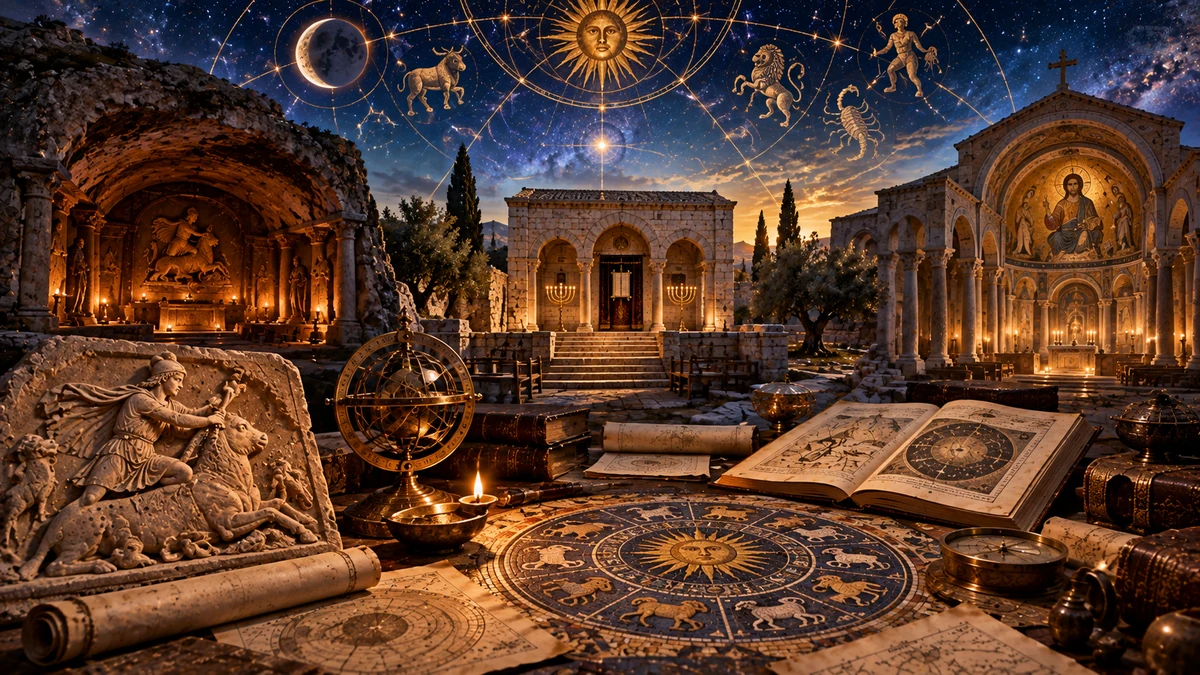
In the short 2012 book The Astrotheological Origins of the Mithraic Mysteries, Judaism and Christianity, S. Grey proposes that an important part of the religious language of the ancient Mediterranean and Near East can be understood through the sky. His central thesis is that constellations, the zodiac, the Sun, Moon, planets, and annual cycles were not merely practical tools for measuring time; they also became symbolic material from which different traditions constructed stories about order, death, rebirth, and salvation. The book applies this framework especially to the Mithraic mysteries, Judaism, and Christianity. [1]
Such a comparison brings together several levels that are useful to keep distinct. Archaeology and texts clearly show that astronomical and zodiacal imagery mattered in some Mithraic sanctuaries, Jewish calendrical traditions, and late-antique religious art. A second question concerns how those symbols should be interpreted, and a third asks whether similarities between traditions demonstrate direct historical transmission. Grey often reads these levels as parts of a shared astrotheological inheritance; this article presents his interpretation alongside specialist historical context. [2][4][5][6]
Astrotheology as a way of reading religion
Grey begins from a straightforward astronomical fact: the zodiac is the belt of constellations along the ecliptic through which the Sun, Moon, and planets appear to move. In premodern societies, observing this region was directly connected with calendars, seasons, agriculture, navigation, and religious festivals. The book uses the term “astrotheology” for a broader process in which celestial order becomes a language of myth and theology. [1]
For Grey, similarities among gods, heroes, groups of twelve, solar journeys, and seasonal cycles are therefore not incidental details but traces of an older astral symbolic system. His approach is comparative: he looks for a pattern recurring across cultures. Specialist historiography more often separates astronomy, astrology, calendars, iconography, and direct religious influence, so a shared motif does not necessarily represent the same kind of historical connection in every case. [1][5][6][7]
The Mithraic mysteries and the cosmos in the cave
The strongest body of astronomical-astrological material in the book concerns Roman Mithraism. Mithraea were often shaped as caves or cave-like spaces, and Porphyry describes them as images of the cosmos. Specialist literature points to the Sun and Moon, the zodiac, seven planets, the four directions or winds, and planetary associations of individual initiation grades. Astral symbolism in this cult is therefore not merely a modern invention but a documented part of its symbolic world. [2][4]
This allows Grey to treat Mithraism as an especially clear example of a religion in which a salvific journey is mirrored in celestial architecture. The interpretive question is less whether the heavens were present than what each astral element meant to participants in the mysteries and how uniform that meaning was across different sanctuaries. [2][4]
The tauroctony: bull, scorpion, and stars
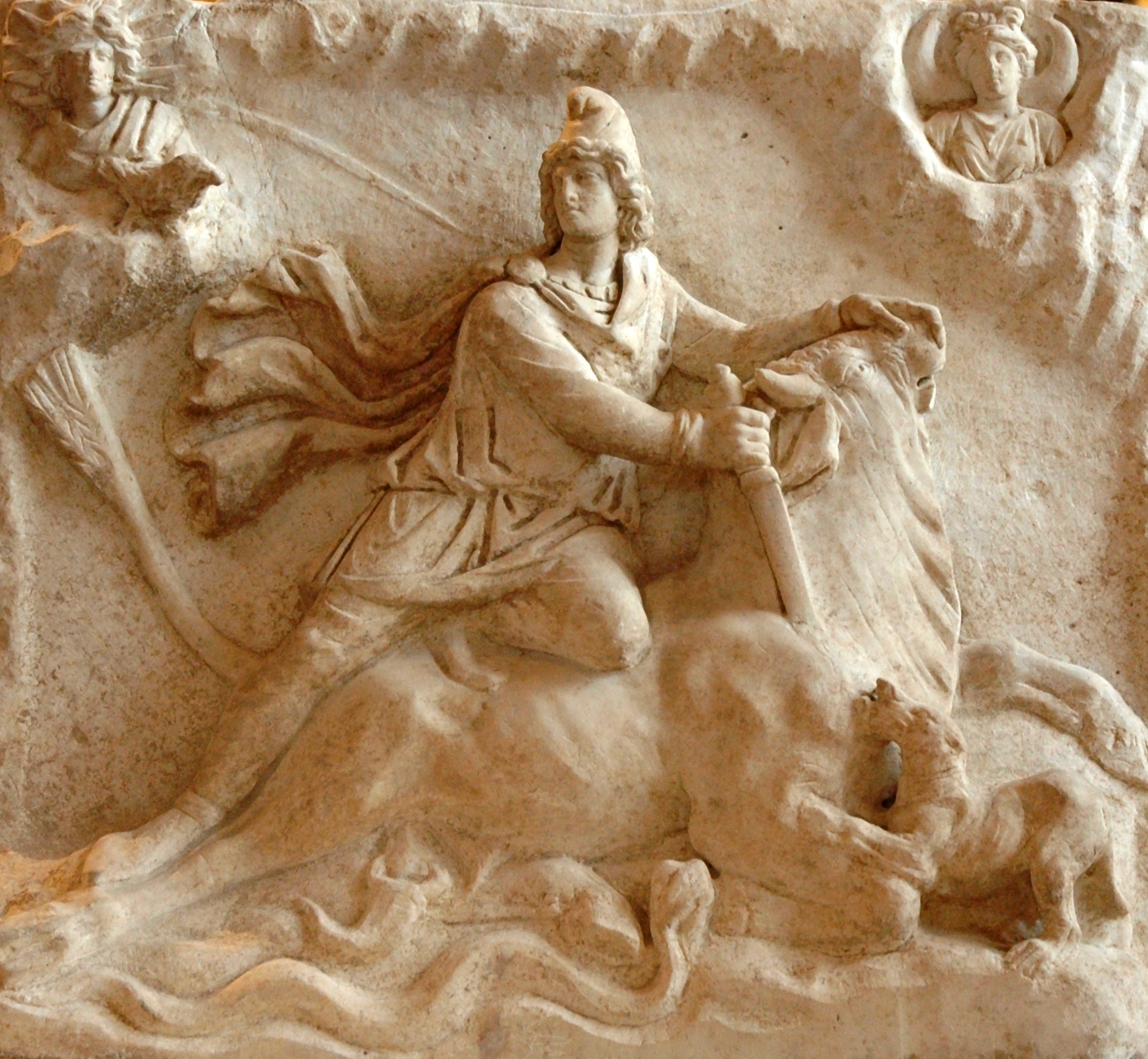
The central Mithraic image shows Mithras killing the bull, commonly accompanied by a dog, serpent, scorpion, raven, and the Sun and Moon. There is a long scholarly tradition connecting these figures with constellations: Taurus, Scorpius, Hydra or the Serpent, Canis Major or Minor, and other parts of the celestial map. Roger Beck treats the astral “language” of the tauroctony as an important part of its symbolic system. [2]
David Ulansey proposed a more specific interpretation in which the scene encodes a change in celestial coordinates associated with the precession of the equinoxes, with Mithras representing a power beyond the zodiacal sphere itself. Grey draws on such astronomical interpretations in constructing his wider astrotheological picture. Ulansey’s reconstruction has been influential, but it is one among several interpretations of the tauroctony; the presence of astral symbolism is more widely accepted than any single key to the whole image. [2][3]
Judaism: calendar, sky, and zodiac
Grey’s next major layer is Judaism. Here it is important to distinguish the prohibition on worshipping celestial bodies from the fact that the sky, Moon, and Sun were indispensable for timekeeping, calendars, and festivals. Second Temple Judaism contained different calendrical systems; the Qumran manuscripts include 364-day schemes, lunar phenomena, and material connected with Babylonian zodiacal traditions. [6]
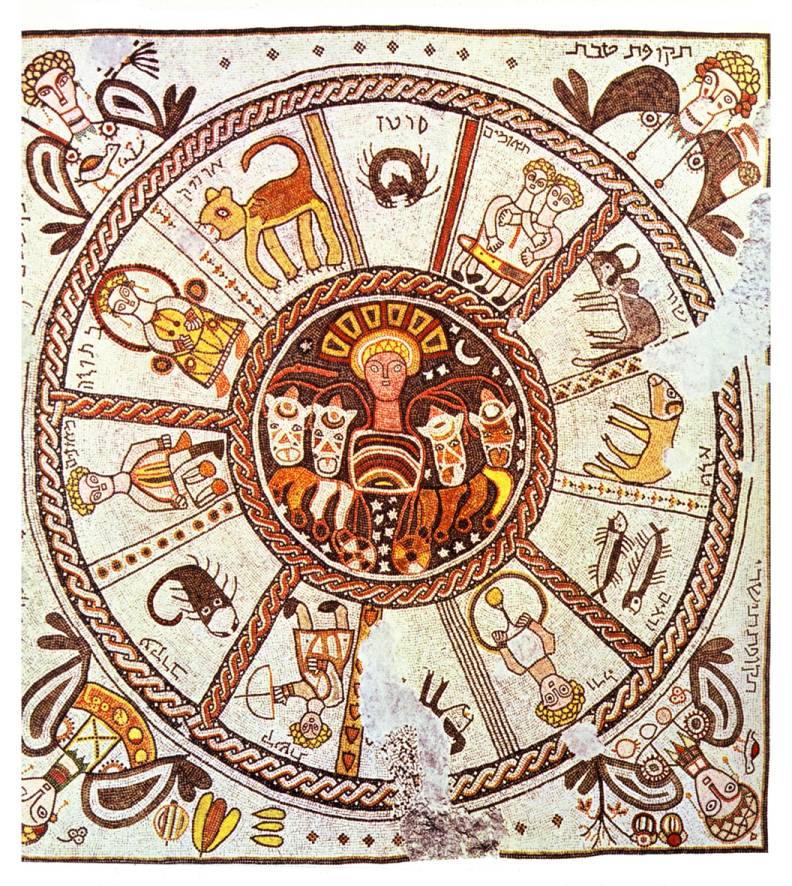
Late-antique synagogues further show that zodiac imagery was not automatically excluded from Jewish space. Mosaics at Beth Alpha, Hammat Tiberias, Sepphoris, and elsewhere include the zodiacal circle, seasons, and a central solar image embedded within Jewish liturgical and artistic settings. Historians interpret these motifs in different ways—as calendrical order, divine sovereignty over the cosmos, participation in Greco-Roman visual culture, or combinations of these meanings. [5]
From astral presence to an astrotheological reading of Judaism
Grey goes beyond the observation that Jewish culture knew the zodiac and sophisticated calendrical systems. He reads biblical and later motifs as transformed celestial stories and searches for connections among groups of twelve, signs, solar cycles, and religious structures. [1]
Historical sources confirm sustained engagement with calendars, celestial cycles, and, in some periods, zodiacal imagery. How much of this material should be understood as foundational theology and how much as calendrical, symbolic, or cultural adaptation is an additional interpretive question. The distinction matters because the same zodiacal motif can serve different functions in a pagan temple, a synagogue, or later religious art. [5][6]
Christianity and the language of light
The third part of Grey’s comparison is Christianity. Early Christian texts and art frequently use the language of light, east, dawn, and the Sun, while the late Roman environment already possessed strong solar symbolism, including the cult of Sol Invictus. Research on early Christian iconography also shows that Christians did not develop their visual language in isolation; many Greco-Roman motifs were adapted and given new meanings. [7][8]
Grey reads these contacts as part of a deeper astrotheological continuity and looks for transformed solar and zodiacal patterns in Christian motifs. Historical context confirms that such symbols were available and that cultural languages overlapped. The further claim that a particular Christian narrative is fundamentally a coded astronomical story is a stronger interpretation than the fact that Christianity used light, solar metaphors, or elements of a shared late-antique iconographic vocabulary. [1][7][8]
25 December, the Sun, and the question of origins
The date of Christmas is one of the best-known places where Christian and solar calendrical language meet. In the later Roman world, 25 December is associated with the winter-solstice season and the celebration of the unconquered Sun, while the Roman Christian calendar records Christ’s birth on that date in the fourth century. [7][8]
The relationship between those dates is not explained by a single universally accepted account. Paul Bradshaw summarizes two major lines of interpretation: a “history of religions” hypothesis in which the Christian feast developed in relation to existing solar festivals, and a “calculation” hypothesis deriving the date from Christian chronological ideas about the conception and death of Jesus. Grey emphasizes solar continuity; the history of the feast allows for more than one route by which 25 December acquired Christian meaning. [8]
Twelve, the zodiac, and the problem of similarity
An important part of astrotheological reading rests on numerical and structural similarities: twelve zodiac signs, twelve months, twelve tribes of Israel, and twelve apostles. Grey incorporates such parallels into his argument that religious systems preserve an older celestial matrix. [1]
The similarities are real as comparative data, but by themselves they do not identify the historical route by which a particular motif arose. Twelve was strongly associated with calendars and the zodiac in the ancient world, while a new tradition could adopt an older numerical form, transform it, or assign it an entirely different meaning. For each proposed connection it is therefore useful to ask about the date of the source, cultural contact, and the function of the symbol within its own setting. [5][6][7]
The book as a map of a shared sky
The Astrotheological Origins is most easily understood as a comparative map drawing attention to how often sky, zodiac, planets, seasons, light, and cycles of time recur in religious history. In Mithraism the cosmic layer is built directly into architecture and iconography; in Judaism it appears in calendrical traditions and late-antique synagogue art; in Christianity it appears in the language of light, solar metaphors, calendars, and the reworking of a wider Roman visual culture. [2][4][5][6][7][8]
Grey connects these phenomena into a broad narrative of shared astrotheological origins. Specialist sources allow the individual parts of that narrative to be placed at different levels of certainty: some astral features are directly documented, their precise religious meanings are interpreted, and direct genealogies between entire religious systems are broader historical hypotheses. This distinction does not require a single final verdict; it lets the reader see both the extent of the actual celestial material and the way Grey connects it. [1][2][5][8]
In that sense the book opens a useful question even beyond its own thesis: how deeply was ancient religious life intertwined with observation of the sky? Archaeology, calendrical manuscripts, and iconography show that the answer was often “very deeply.” How much this implies about common origins of specific beliefs remains a question to be addressed case by case within each historical setting. [2][4][5][6]
Sources and further reading
- Bibliographic record, summary, and the book’s central thesis that Mithraism, Judaism, and Christianity preserved significant astral and zodiacal layers. Source 1 Source 2
- Specialist treatment of Mithraic astral language, zodiacal structures, the tauroctony, and the symbolism of Cautes and Cautopates. Source 1 Source 2
- Influential astronomical interpretation of the tauroctony and its relation to constellations, the celestial equator, and precession. Source 1 Source 2
- Overview of Mithraic cosmology: the mithraeum as an image of the cosmos, seven planets, twelve zodiac signs, Sun and Moon, and planetary initiation grades. Source 1 Source 2
- Art-historical context for zodiac motifs in late-antique synagogues and their place within the broader Greco-Roman visual culture. Source 1 Source 2
- Survey of 364-day calendars, astronomical cycles, and their importance for Jewish religious life in the Second Temple period. Source 1 Source 2
- Overview of astrology in Greek and Roman culture, imperial solar cult, Sol Invictus, and the transmission of solar iconography into late-antique Christianity. Source 1 Source 2
- Context for early Christian dating of Christmas and debates over 25 December, together with a broader survey of the adaptation of Greco-Roman visual motifs in early Christianity. Source 1 Source 2