Music of the Spheres: from Pythagoras to Kepler
From the ratios 2:1, 3:2, and 4:3 to Kepler’s planetary harmonies, the music of the spheres linked music, mathematics, and cosmology for centuries. This article follows the idea from the Pythagorean tradition through Plato and Boethius to Harmonices Mundi.
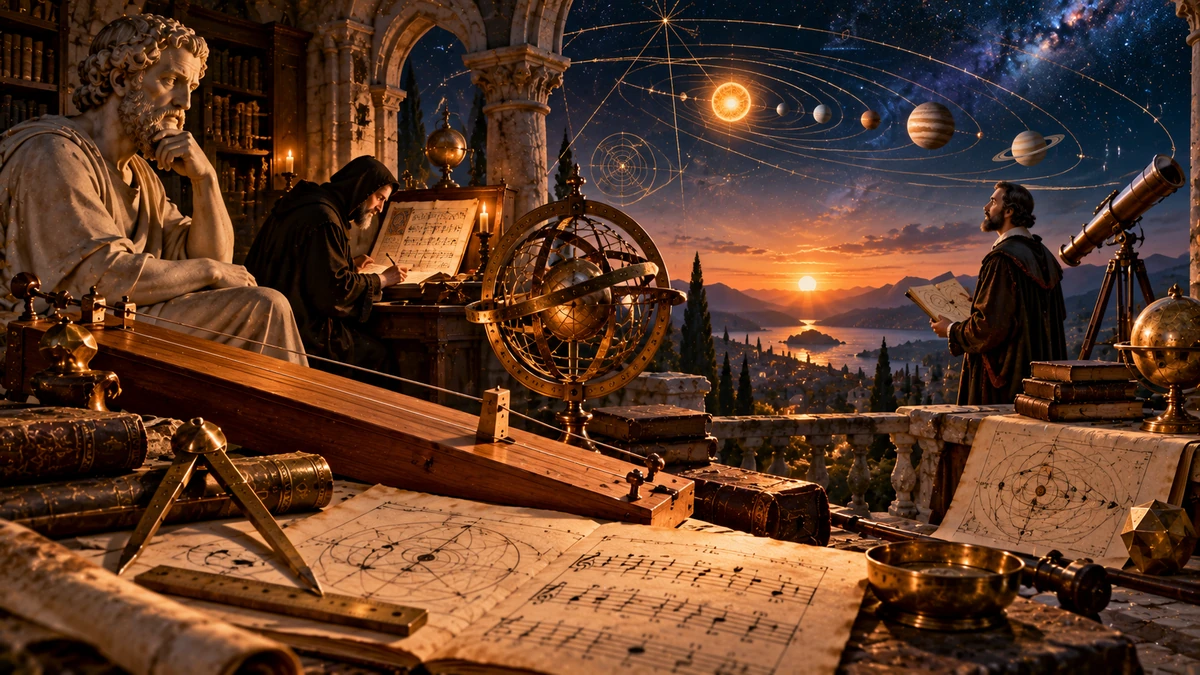
When we hear the phrase music of the spheres today, it is easy to imagine the planets as a gigantic orchestra producing tones as they move. The history of the idea is more interesting. In the ancient Pythagorean tradition, musical harmony first demonstrated that qualities of sound could be expressed through numerical ratios: the octave as 2:1, the fifth as 3:2, and the fourth as 4:3. From this emerged a broader idea that the order of the cosmos might likewise rest on mathematical harmony. [1][2]
Over the next two millennia the meaning changed. Plato connected celestial circles with harmony and the image of Sirens; Boethius transmitted the concept of musica mundana, the music of the world, to the Middle Ages; and in 1619 Johannes Kepler tried in Harmonices Mundi to identify musical ratios in the measured motions of the planets. The crucial distinction is that the history of the “music of the spheres” is not one continuous theory of a secret cosmic sound, but a long history of the idea that number, proportion, music, and cosmos are connected. [2][5][7]
When an interval becomes a number
The core of Pythagorean musical mathematics can be demonstrated with a very simple experiment on a string. With material and tension held constant, halving the vibrating length produces a pitch an octave higher; the ratios 3:2 and 4:3 correspond to the fifth and fourth. This connection between an audible interval and whole-number ratios was enormously important in Greek harmonics because it offered an early example of a natural phenomenon that could be described mathematically. [1][2]
Later tradition credited the discovery directly to Pythagoras and attached it to the famous story of hammers in a blacksmith’s shop. Modern historians of ancient science are more cautious: the method described in the hammer-weight story would not physically produce the claimed intervals. Better evidence exists for early Pythagorean analysis of ratios in Hippasus, Philolaus, and Archytas. We can therefore speak of a Pythagorean tradition of musical ratios without assigning every later legend to the historical Pythagoras. [1]
From musical harmony to cosmic harmony
Once it could be shown that consonant intervals follow simple ratios, a larger philosophical question arose: might the same kind of order be present elsewhere in nature? Philolaus understood harmony as a principle joining unlike components of the world, while number was crucial to knowing things. In later Pythagorean tradition, musical ratios were therefore connected with the arrangement and motion of celestial bodies. [1]
Here emerges what later came to be called the “harmony of the spheres.” Yet the phrase can mislead if interpreted too literally. In different periods it meant different things: an actual celestial sound, the mathematical structure of the universe, metaphysical concord, or a theological image of creation. The common thread is not a single acoustic theory but the conviction that harmony perceived in music can serve as a model for understanding a wider cosmic order. [2]
Plato: the World-Soul and eight Sirens
Plato incorporated mathematical harmony into two highly influential images. In the Timaeus, the World-Soul is constructed through numerical proportions, while celestial circles move with mutually ordered speeds. Harmony is built into the geometrical and psychic structure of the cosmos itself: the universe is not merely a collection of bodies but an ordered whole whose motions are expressed through ratios. [4]
In the Myth of Er at the end of the Republic, the image becomes more explicitly musical. One Siren sits on each of the eight circular rims of the Spindle of Necessity and each gives a single note; all eight together form one harmony. This is not an astronomical report in the modern sense, but a philosophical myth in which cosmic order, fate, time, and music are gathered into one image. [3]
Do the planets literally sound? Aristotle’s objection
Already in antiquity the idea of literal celestial sound was not accepted without objection. In On the Heavens, Aristotle argues against the Pythagorean claim that the motion of immense heavenly bodies produces a harmony that we fail to notice only because it is always present. His objection is physical: bodies of such magnitude should generate an overwhelmingly powerful sound with observable effects, which we do not experience. [2]
This dispute matters because it shows that the “music of the spheres” was never simply one unquestioned ancient dogma. At least two readings existed early on: the cosmos as a literally sounding system and the cosmos as a mathematically harmonious system, with music serving as an analogy for ordered ratios. Later history would move between these two poles. [2]
Boethius and the three musics of the Middle Ages
Around the turn of the sixth century, Boethius transmitted ancient musical philosophy into the Latin Middle Ages through De institutione musica. His influential division distinguishes musica mundana, the harmony of the cosmos; musica humana, the concord of the human body and soul; and musica instrumentalis, actually sounding vocal or instrumental music. To a modern reader it is striking that audible music occupies only one part of this much broader mathematical concept of musica. [2][6]
Boethius’s classification became foundational for medieval music theory. Music stood beside arithmetic, geometry, and astronomy in the quadrivium, the fourfold path of mathematical sciences. Questions about the music of the spheres therefore belonged not merely to aesthetics or worship but to the study of world structure, number, and proportion. [1][6]

Musica mundana: heavens, elements, and seasons
In medieval interpretation, musica mundana did not mean only planets playing a scale. Boethian world-music encompassed celestial motion, the concord of the elements, and the ordered succession of the seasons. This allowed the ancient Pythagorean idea to enter a Christian image of creation: a mathematically ordered world could be understood as a sign of divine wisdom. [5]
Medieval authors discussed celestial harmony in different ways. Some retained images of heavenly tones; others incorporated the idea more abstractly into natural philosophy and astronomy. The Middle Ages did not merely repeat a single ancient formula: the older idea was repeatedly adapted to new cosmologies, theological frameworks, and learned debates. [5][6]
Kepler: when old harmony meets new measurements
Johannes Kepler was one of the last major thinkers for whom the Pythagorean ideal of harmony and emerging modern astronomy remained tightly intertwined. In his early work he searched for a geometrical plan of the planetary system in the regular solids. Yet his work with Tycho Brahe’s precise observations forced him to abandon the ancient demand for perfect circular orbits and accept ellipses. [1][8]
This shift did not mean that he abandoned cosmic harmony. On the contrary, in Harmonices Mundi (1619) he tried to show that musical ratios could be found in the ranges of the planets’ angular velocities between their fastest and slowest motion. Harmony thus became something to be reconciled with observation, not merely deduced from inherited authority. [1][7]
Harmonices Mundi: planetary scales heard by reason
Kepler assigned each planet a range comparable to a musical interval. On a famous page of Harmonices Mundi, Saturn, Jupiter, Mars, Earth, Venus, and Mercury appear beside small musical staves. These ranges come from comparing their extreme velocities, not from measuring actual sound in space. [7]
That distinction is essential. Kepler does not require air to carry planetary notes to the human ear. His celestial music is a harmony apprehended by reason through mathematical ratios of motion. In this sense his theory stands between older metaphysics and newer mathematical astronomy: the musical language remains, but its material consists of measurements and orbital calculation. [1][7]

Kepler’s third law appears in a book about harmony
The most striking historical connection is that Kepler published what we now call his third law of planetary motion in Harmonices Mundi: the square of a planet’s orbital period is proportional to the cube of the semi-major axis of its orbit. This is a precise mathematical relationship between time and orbital size, not a musical metaphor. [8]
It would therefore be too simple to dismiss Kepler’s music of the spheres as merely a mystical residue, just as it would be wrong to treat the third law as proof that the ancient idea of literally sounding planets was correct. In Kepler the two layers are historically connected: the search for harmony directed his attention toward ratios, but the result had to survive comparison with precise astronomical data. [7][8]
What remains of the music of the spheres today?
Modern astronomy does not require a theory that planets emit audible tones in the Pythagorean sense as they orbit. Yet the central intuition that nature can be understood through mathematical relationships became one of the foundations of physical science. In this broad sense, the history of the music of the spheres is a history of movement from symbolic analogy between music and cosmos toward increasingly precise mathematical descriptions of motion. [1][8]
Its enduring appeal comes from this double character. On one side are real musical proportions—2:1, 3:2, 4:3—and real equations of orbital motion. On the other lies the philosophical question of whether mathematical order in the world should itself be called “harmony.” Pythagoreans, Plato, Boethius, and Kepler answered that question in different languages. Those differences are precisely why the music of the spheres matters as a history of an idea, rather than as one unchanged secret doctrine. [1][2][5][7]
Sources and further reading
- Pythagorean musical ratios, Philolaus, Archytas, the later Pythagoras legend, and Kepler’s Pythagorean cosmology. Source
- Harmony of the spheres, musical ratios, Aristotle’s criticism, and Boethius’s musica mundana/humana/instrumentalis division. Source
- Myth of Er: the Spindle of Necessity, eight circular rims, and eight Sirens whose notes form a single harmony. Source
- Numerical proportions of the World-Soul, circles, and the harmonic structure of Plato’s cosmos. Source
- Boethian musica mundana, medieval harmony of the spheres, and connections with elements, seasons, and celestial motions. Source
- Medieval reception of Boethius, the three kinds of music, and music as a mathematical discipline of the quadrivium. Source
- Kepler’s planetary musical ranges in Harmonices Mundi and their connection to fastest and slowest orbital motions. Source
- Kepler’s three laws, elliptical orbits, equal areas, and the third law published in 1619 in Harmonices Mundi. Source