The Antikythera Mechanism: an ancient computer of the heavens
The Antikythera Mechanism is a Hellenistic bronze-geared device that linked calendars, the motions of the Sun and Moon, lunar phases, eclipses, and probably the planets. Its fragments reveal a remarkable level of ancient mechanics while leaving important questions open.
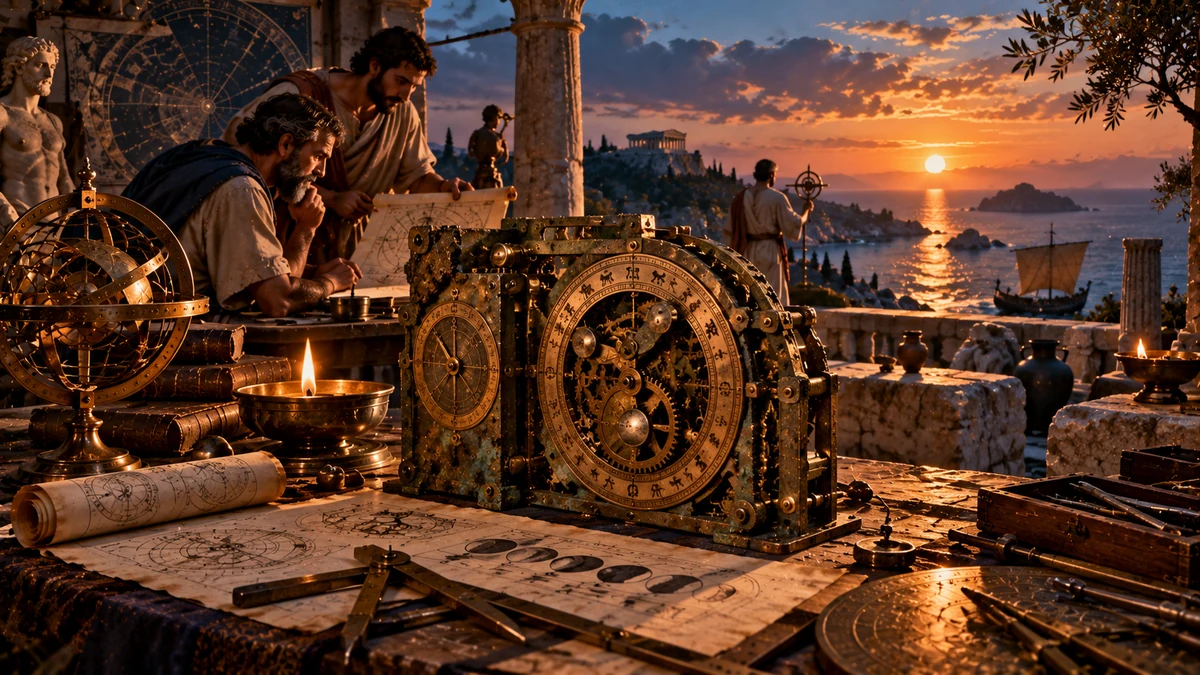
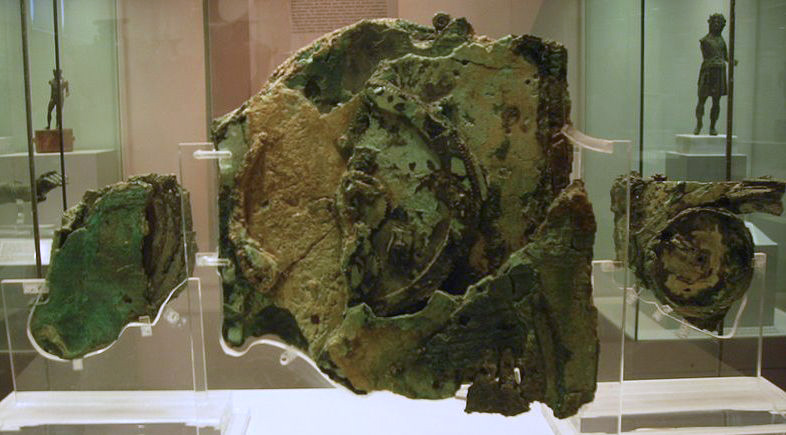
When sponge divers from Symi discovered a Roman shipwreck near the small Greek island of Antikythera in 1900, the most unusual object among its statues, vessels, and cargo was not immediately recognized. In 1902, gear teeth were noticed inside a corroded bronze fragment. We now know it as the Antikythera Mechanism: a hand-driven Hellenistic device whose bronze gearing linked calendars, the motions of the Sun and Moon, lunar phases, and eclipse cycles. The National Archaeological Museum in Athens broadly dates its manufacture to about 150–100 BCE, while the ship sank around 70 BCE. [1]
The phrase “ancient computer” is useful if treated as a modern analogy. The device did not run a program in the contemporary sense; instead, it mechanically transformed astronomical periods into the movement of pointers and dials. X-ray computed tomography has revealed at least thirty surviving gears, intricate transmissions, and inscriptions that function in part like an instruction manual. Because only about a third of the original machine survives, however, a substantial part of its front display still has to be reconstructed. [2][4][8]
From shipwreck to mechanism: an object revealed slowly
The wreck was found by sponge divers from Symi in 1900–1901, and the first objects were raised under the supervision of the Greek archaeological service and navy. The mechanism’s bronze remains initially looked like corroded lumps among a rich cargo. In 1902, politician and former education minister Spyridon Stais drew attention to a gear inside one fragment, beginning more than a century of attempts to understand the device. [1]
Progress was not linear. Early researchers compared it with an astrolabe, and later scholars proposed different arrangements of gears and dials. Derek de Solla Price played a major role in establishing the idea of an astronomical mechanical calculator in the twentieth century, though later work revised parts of his reconstruction. A major turning point came after 2005, when three-dimensional X-ray tomography, advanced surface imaging, and digital processing exposed hidden gearing and inscriptions inside the fragments. [1][2]
How bronze gears turn the sky into motion
The underlying principle is simple: two gears with different numbers of teeth rotate at different rates. Link many such pairs together and a mechanical system can approximate ratios between astronomical periods. The Antikythera Mechanism developed this principle into an exceptionally dense transmission system in which a single hand-driven input moved several indicators at once. The machine therefore did more than count time; it encoded relationships between the solar year, lunar months, and longer repeating cycles in metal. [2][8]
This is why researchers often describe it as the oldest known analogue computer. Here “computer” means that by turning the mechanism a user could obtain a mechanically calculated position or calendrical result for a selected date. It was not a general-purpose machine: its functions were fixed by the geometry of its gearing. That specialization is precisely what reveals the high level of precision mechanics achieved by Hellenistic craftspeople. [2]
The front: Sun, Moon, zodiac, and lunar phase
Surviving evidence indicates that the front carried calendar and zodiac rings together with pointers for the Sun and Moon. A small spherical Moon model also displayed lunar phase. More remarkable is the mechanism for lunar irregularity: an eccentric pin-and-slot arrangement changes the pointer’s speed so that it approximates the Moon’s anomaly, associated with the non-uniform apparent motion produced by its orbit. Researchers have related this mechanical model to Greek astronomical theory known from the period of Hipparchus. [2]
Here the difference between a simple calendar and an astronomical model becomes clear. The machine did not merely count uniform days; it tried to reproduce the observed non-uniform motion of a celestial body mechanically. This does not imply a modern physical explanation involving gravity or orbital ellipses. It shows instead that a geometrical-kinematic theory could be translated into gears and indicators. [2]
The Metonic cycle: 19 years and 235 lunar months
The upper spiral dial on the back followed the Metonic cycle: 19 solar years are approximately equal to 235 synodic lunar months. In the ancient world this relationship was crucial for reconciling lunar months with the seasonal solar year. The mechanism distributed those 235 months across five turns of a spiral, allowing a particular month to be located within the nineteen-year cycle. [3]
The deciphered month names surprised researchers because they belong to a calendar tradition of Corinthian origin. A smaller dial in the same region did not represent the 76-year Callippic cycle, as once thought, but a four-year cycle of Panhellenic games. The mechanism thus placed celestial periods and the social-religious rhythms of the Greek world on the same object. [3]
The Saros: predicting eclipse possibilities
The lower rear spiral was based on the 223-lunar-month Saros cycle, roughly eighteen years, after which the geometry of the Sun, Earth, and Moon repeats closely enough for related eclipse series to occur. Glyphs on particular months marked possibilities for solar or lunar eclipses, approximate times, and some descriptive characteristics. [3][6]
The mechanism therefore did not “predict” an eclipse in the same sense as modern numerical astronomy for an arbitrary location on Earth. It used a periodic arithmetic scheme to infer when similar geometry could recur. A smaller Exeligmos dial supplied a correction to the time of day after three Saros cycles. The details of this scheme continue to generate debate about how the designers organized and described individual eclipse possibilities. [3][6]
The inscriptions: an almost-lost instruction manual
The mechanism was not simply a box of gears. Its metal plates were densely covered with Greek inscriptions of astronomical and calendrical content. Some text describes displays on the front, some explains cycles on the back, and parts function like instructions. This matters because reconstructions are not based solely on the surviving geometry of the gears; the text also tells researchers what the user was supposed to see. [8]
Corrosion and fragmentation hid much of this evidence for decades. After 2005, three-dimensional X-ray tomography allowed researchers to read letters trapped inside the internal layers of fragments, substantially increasing the amount of recoverable text. The inscriptions are one of the main reasons we can now discuss calendars, planets, eclipses, and displays far more precisely than researchers could in the first decades after discovery. [1][2][8]
Five planets: what is inscribed and what is reconstructed
The greatest unresolved puzzle concerns the front cosmological display. The inscriptions mention Mercury, Venus, Mars, Jupiter, and Saturn, all five naked-eye planets known to Greek astronomers. This is strong evidence that a planetary component belonged to the design. Yet most of the front gearing is missing, so its exact mechanical arrangement does not survive directly. [2][4]
In 2021 a University College London team published a comprehensive model of the front “Cosmos,” using concentric rings and compact gear trains to display all five planets together with the Sun, Moon, and lunar nodes. The model was designed to fit the inscriptions, surviving periods, and physical constraints of the machine. Because the original gears are missing, it remains a reconstruction model, not a photograph of the lost mechanism; its importance lies in demonstrating a mechanically feasible solution consistent with the surviving evidence. [4]

Where and when was it made? Calendars give clues, not a signature
No maker’s signature survives. The National Archaeological Museum broadly places manufacture around 150–100 BCE, while analysis of the cycles indicates that some computational epochs were set near 205 BCE. That does not require the physical object itself to have been built in 205 BCE; an earlier astronomical or calendrical epoch could have served as a mathematical reference for a later maker. [1][5]
The Corinthian month names raised the possibility of a connection with northwestern Greece or Syracuse in Sicily. Because Syracuse was the city of Archimedes, an association with his tradition of planetaria is especially attractive. Researchers have treated that connection as a historically interesting possibility, not as proof that Archimedes himself—or a directly identifiable workshop of his—built the Antikythera Mechanism. [3][5]
What 2024 added: even the number of holes remains researchable
Research did not end with the major reconstructions of 2006 or 2021. In 2024 Graham Woan and Joseph Bayley used Bayesian statistics and methods related to gravitational-wave analysis to estimate the original number of evenly spaced holes in a damaged calendar ring. Their analysis gave the highest probability to roughly 354 or 355 holes, closer to a lunar year than to a 365-day Egyptian calendar. [7]
This is a useful example of how work on the mechanism proceeds. A new model can significantly revise the interpretation of one component without making the entire previous picture obsolete. Because the device is fragmentary, reconstructions evolve with new imaging, new readings of inscriptions, and new mathematical tests. Claiming that the Antikythera Mechanism is now “fully solved” would therefore be as misleading as claiming that almost nothing about it is known. [4][7]
Lost supertechnology, or an extraordinary summit of Hellenistic craft?
The Antikythera Mechanism is so advanced compared with most surviving mechanical objects from antiquity that it often becomes a starting point for stories about a lost civilization or technology of unknown origin. The object itself already tells an extraordinary story without requiring that additional assumption. Its astronomy uses cycles known from Greek and Babylonian traditions; its inscriptions are Greek; its calendars and games belong to the Hellenistic cultural world; and its gearing realizes mathematical relationships with remarkable craftsmanship. [2][3][4]
The genuinely open historical question is: how many comparable devices once existed, and why did they not survive? Bronze was valuable and routinely recycled, while delicate gearing preserves poorly on land. The Antikythera Mechanism survived precisely because it sank and remained on the seabed. It can therefore be understood as a rare window into a technical tradition that may have been broader than a single object—how much broader, however, cannot yet be established securely. [1][2]
Sources and further reading
- Timeline of manufacture, shipwreck, and discovery; development of research from early observations to modern X-ray tomography. Source
- X-ray tomography, gears, lunar and solar displays, lunar anomaly, eclipses, and planetary indications in the inscriptions. Source
- Metonic cycle, 235 lunar months, Corinthian month names, Panhellenic games, Saros, and Exeligmos. Source
- Modern reconstruction model of the front Cosmos with all five visible planets and distinction between surviving evidence and reconstructed mechanics. Source
- Dating of calendrical and eclipse epochs near 205 BCE and distinction between computational epoch and manufacture date. Source
- Details of the Saros dial, eclipse glyphs, times, and the mathematical eclipse-prediction scheme. Source
- Statistical analysis of the calendar ring and the result that it most likely contained about 354–355 holes. Source
- Greek astronomical and calendrical inscriptions on the front and back plates and their role in reconstructing the device’s functions. Source