The Golden Ratio: mathematics, art, nature, and the idea of perfect proportion
The golden ratio φ is a precisely defined irrational proportion with genuine connections to the pentagon, the Fibonacci sequence, and phyllotaxis. Its cultural history is broader: from Pacioli’s divine proportion and Le Corbusier’s Modulor to disputed attributions involving the Parthenon, artworks, and human beauty.
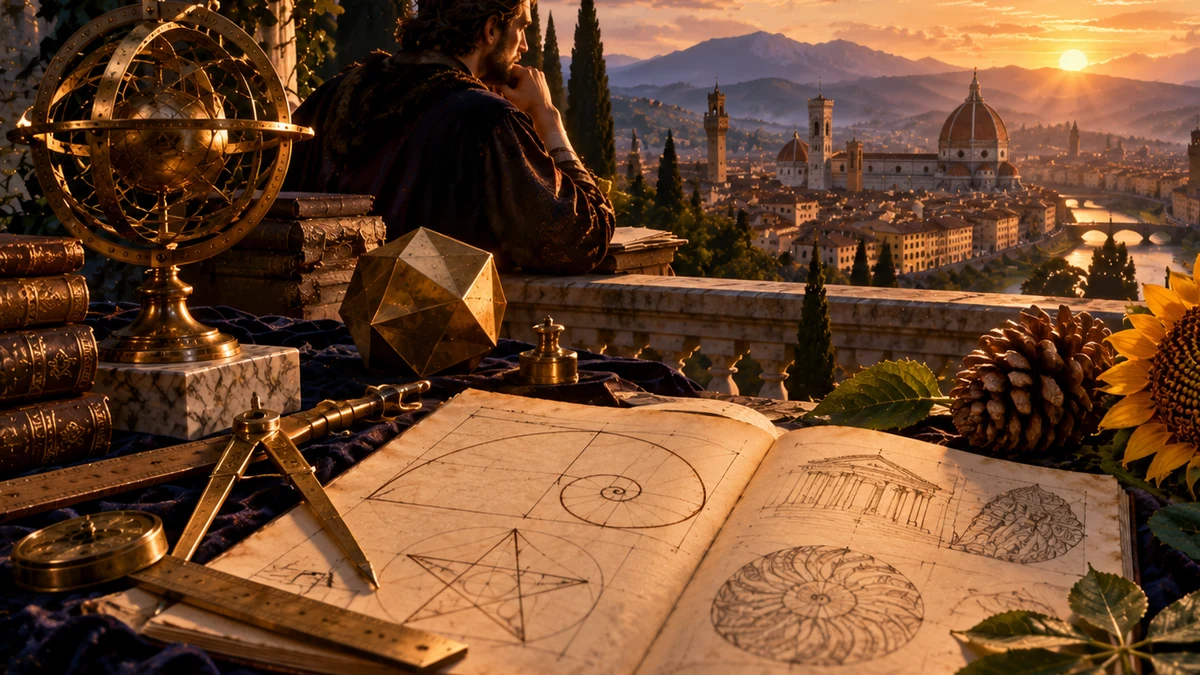
The golden ratio is one of those mathematical proportions that long ago crossed the boundary between geometry and culture. If a line segment is divided into a longer part a and a shorter part b so that (a + b) / a = a / b, the resulting number is φ = (1 + √5) / 2 ≈ 1.6180339887…. The ratio has a striking self-similar property: φ² = φ + 1 and 1/φ = φ − 1. It appears in the regular pentagon, in constructions of certain regular solids, and in the mathematical relationship with the Fibonacci sequence. [1]
Yet the history of the golden ratio has two layers. The first is strictly mathematical and well documented; the second is the cultural history of the idea that the same ratio reveals a universal key to beauty, the human body, architecture, and nature. This article considers both layers without collapsing them into one another: where we have Euclidean geometry, Pacioli’s Divina proportione, Le Corbusier’s Modulor, or measured patterns of phyllotaxis, we can be quite specific; with the Parthenon, faces, and supposed “hidden codes” in artworks, we need to ask what is documented and what belongs to later interpretation. [1][4][5][6]
A ratio that repeats itself
The mathematical distinction of φ is not simply that it is approximately 1.618, but the equation that defines it. If the whole is to the larger part as the larger part is to the smaller, the resulting ratio reappears after the appropriate part is removed or added. From φ = 1 + 1/φ follows the quadratic equation φ² − φ − 1 = 0, whose positive solution is (1 + √5)/2. It is irrational, so no ordinary fraction represents it exactly. [1]
This algebraic property explains much of the geometry that has seemed almost magical through the centuries. Remove a square from a golden rectangle and the remaining smaller rectangle has the same proportion; in a regular pentagon, diagonals and sides are linked by the same φ; related proportions enter constructions of the dodecahedron and icosahedron. The mathematical elegance is therefore not a later metaphor: it follows from concrete symmetries, similarity, and a quadratic equation. [1]
Euclid knew the ratio, not the phrase “golden section”
The earliest classical systematic treatment normally associated with the golden ratio appears in Euclid’s Elements. Euclid describes a line divided in “extreme and mean ratio” and uses the relation in constructions connected with the regular pentagon and regular solids. The geometry is ancient; the name golden section is not. Historical accounts emphasize that Greek mathematicians did not call it by that modern name. [1][3]
The pentagon is an especially clear example because the golden ratio is not imposed from outside. Draw the diagonals of a regular pentagon and a pentagram appears in which the ratio of diagonal to side is φ; intersections generate smaller similar pentagons and triangles. The same self-similarity later reappears in the algebraic identity. This is one reason the ratio remains mathematically compelling even without any aesthetic or mystical interpretation. [1]

Fibonacci and φ: closely related, not identical
The Fibonacci sequence and the golden ratio are tightly connected, but they are not the same object. Divide consecutive Fibonacci numbers — 2/1, 3/2, 5/3, 8/5, 13/8, and so on — and the quotients approach φ. The larger the terms become, the closer the ratio comes to about 1.618. This relationship can be derived from the recurrence Fₙ₊₁ = Fₙ + Fₙ₋₁ and from Binet’s formula, in which φ appears explicitly. [1]
The same mathematics also produces the golden angle, approximately 137.5°, the smaller of the two angles obtained when a full circle is divided in the golden ratio. In many plants, the angle between successively initiated leaves or other organs lies near this value, while visible spiral families later often have Fibonacci numbers. This is a real biological and mathematical connection, but it does not mean that every spiral in nature is Fibonacci or golden. [6]
Pacioli, Leonardo, and the “divine proportion”
A major Renaissance turning point came with Luca Pacioli. His Divina proportione, completed near the end of the fifteenth century and printed in 1509, presented the ratio not only as a geometric object but as something that could be connected with the order of creation. Pacioli attributed symbolic qualities to it and called it the “divine proportion.” Leonardo da Vinci collaborated on the work, producing the famous drawings of regular and semiregular solids. [2]
That documented connection between Pacioli and Leonardo matters because it is a genuine bridge between mathematics and Renaissance art. It does not, however, establish that Leonardo designed every painting around φ. His illustrations for Pacioli demonstrate knowledge of geometry and collaboration on a specific project; claims about the golden ratio in the Mona Lisa, The Last Supper, or the Vitruvian Man require separate evidence of composition and intention. Proximity to the idea is not itself evidence that the ratio was deliberately embedded in every work. [2]

How the “divine” proportion became “golden”
The modern name is much younger than the mathematics. Histories of mathematical terminology place the expression equivalent to “golden section” in the nineteenth century; Martin Ohm used the German term goldener Schnitt in the second edition of his mathematics textbook in 1835. It is therefore historically misleading to treat the phrase as an ancient name supposedly used by Pythagoreans or Euclid. [3]
The nineteenth century was also when the ratio moved more strongly from geometry into theories of aesthetics. Gustav Fechner used experimental comparisons of rectangles to ask whether people spontaneously preferred the golden proportion. Later experiments produced a mixed picture: some tasks reveal a slight group preference, others do not, and individual differences are substantial. The history of the “golden” name and the idea of aesthetic universality are therefore largely modern developments rather than direct inheritances from Greek sources. [3][7]
The Parthenon, pyramids, and artworks: measuring backward
One of the most widespread claims is that the Parthenon and other major works of antiquity were deliberately designed according to the golden ratio. The difficulty lies in choosing measurements. A photograph or plan can accommodate many rectangles: one may include or exclude steps, rooflines, columns, pediments, or empty space until a proportion near 1.618 appears. Such a procedure does not by itself establish that the ratio was part of the original design. [4]
Patrice Foutakis examined numerous Greek temples, monumental tombs, sarcophagi, and grave stelae and reported that the golden ratio was absent from classical fifth-century BC architecture and only rarely used in later examples. This does not mean Greek mathematicians were unaware of the ratio — Euclidean geometry shows otherwise — but knowledge of a proportion and its use as a universal architectural canon are different historical claims. [1][4]
Le Corbusier: a case where use of the ratio is documented
Modern architecture also gives us cases in which there is no need to infer intention. Between 1943 and 1950 Le Corbusier developed the Modulor, a system of anthropometric proportions for architectural design and construction standardization that explicitly drew on the Fibonacci sequence and the golden section. He later presented it in Le Modulor (1950) and Modulor 2 (1955) and applied it in post-war projects. [5]
The Modulor is therefore a useful contrast with disputed retrospective measurements. Here we have an author, documentation, an articulated system, and known applications. Yet even this example does not prove that φ is an objective formula of beauty. Le Corbusier turned the ratio into a design tool linked to human scale, industrialization, and his own architectural ideals. Whether he actually used it is a historical question; whether the resulting system is aesthetically superior to alternatives is a question of judgment and experience. [5][7]
Nature: real patterns without a universal code
The strongest natural example connected with the golden ratio is phyllotaxis. In many vascular plants, successive leaves or other organs are initiated near the golden angle of roughly 137.5°, and mature structures often display spiral families numbered 5, 8, 13, 21, 34, and other Fibonacci terms. Modern models examine how such patterns emerge from spatial, developmental, and energetic constraints at the growing tip. [6]
That documented phenomenon is often extended into a much stronger popular claim: that nautilus shells, galaxies, hurricanes, waves, horns, and nearly every organic curve are exact manifestations of φ. Logarithmic spirals can have many different growth factors, so spiral form alone does not determine the golden ratio. Plants themselves also show other phyllotactic arrangements and variations. The golden ratio is interesting in nature precisely because it can be measured in particular systems, not because it must be hidden inside every curved form. [6][8]
Beauty and the human body: an attractive hypothesis, not a single formula
The idea that the golden ratio must be a universal measure of beauty is intuitively attractive: one number would unite geometry, art, and the human face. Experimental research on aesthetic preference gives a more varied picture. One recent study found a slight overall preference for the golden ratio across some kinds of stimuli but not for simple geometric figures; the authors themselves emphasize the long history of conflicting findings and the importance of stimulus type and methodology. [7]
Research on facial and bodily proportions similarly has not produced convincing evidence for a single golden ratio as a universal standard of attractiveness or as a clinical rule for reconstructive and aesthetic surgery. This does not mean proportion is irrelevant to beauty; it means complex biological and cultural judgments do not necessarily collapse into one constant. The golden ratio therefore remains a powerful aesthetic motif and a useful design proportion rather than an experimentally established universal equation of beauty. [7][8]
What remains when mathematics is separated from legend
Once we stop requiring φ to explain everything, the golden ratio becomes no less interesting — arguably the opposite. What remains is a precisely defined irrational number with elegant self-similarity, the geometry of pentagons and regular solids, a remarkable relationship with the Fibonacci sequence, and an important role in some natural growth patterns. There is also a rich cultural history in which Pacioli, Leonardo, theorists of art, and Le Corbusier repeatedly interpreted the proportion in new ways. [1][2][5][6]
The most useful distinction is simple: finding a ratio is not the same as proving deliberate use, and deliberate use is not the same as proving universal beauty. When we have an author’s text, a plan, a mathematical construction, or a repeatable measurement, we can speak of a documented connection. When the ratio appears only after selecting rectangles or landmarks retrospectively, we have an interesting interpretation that should be presented as such. That distinction allows the golden ratio to remain both mathematically beautiful and historically intelligible. [4][7][8]
Sources and further reading
- Euclid’s extreme-and-mean division, the pentagon, regular solids, the history of the ratio, and its relationship to the Fibonacci sequence. Source
- Pacioli’s Divina proportione, collaboration with Leonardo da Vinci, and the Renaissance mathematical-artistic context. Source
- Terminological history: ancient mathematics did not use the phrase golden section; the German goldener Schnitt is documented in the nineteenth century. Source
- Measurement study of Greek architecture and assessment of the claim that the golden ratio was a universal canon of classical Greek buildings. Source
- Documented development of the Modulor between 1943 and 1950, its use of the Fibonacci sequence and golden section, and architectural applications. Source
- The golden angle of about 137.5°, Fibonacci phyllotactic sequences, and a biological model for their emergence. Source
- Experimental evidence on aesthetic preference for the golden ratio and review of conflicting findings in earlier research. Source
- Review of claims about the golden ratio in human proportions, facial beauty, nature, and popular historical attributions. Source