Binaural Beats: Sound, Brain Rhythms and Altered States of Attention
From Dove’s acoustic experiments to EEG and clinical research: how binaural beats arise, what entrainment measurements actually show, and which effects on anxiety, pain, memory, attention and sleep are supported by evidence.
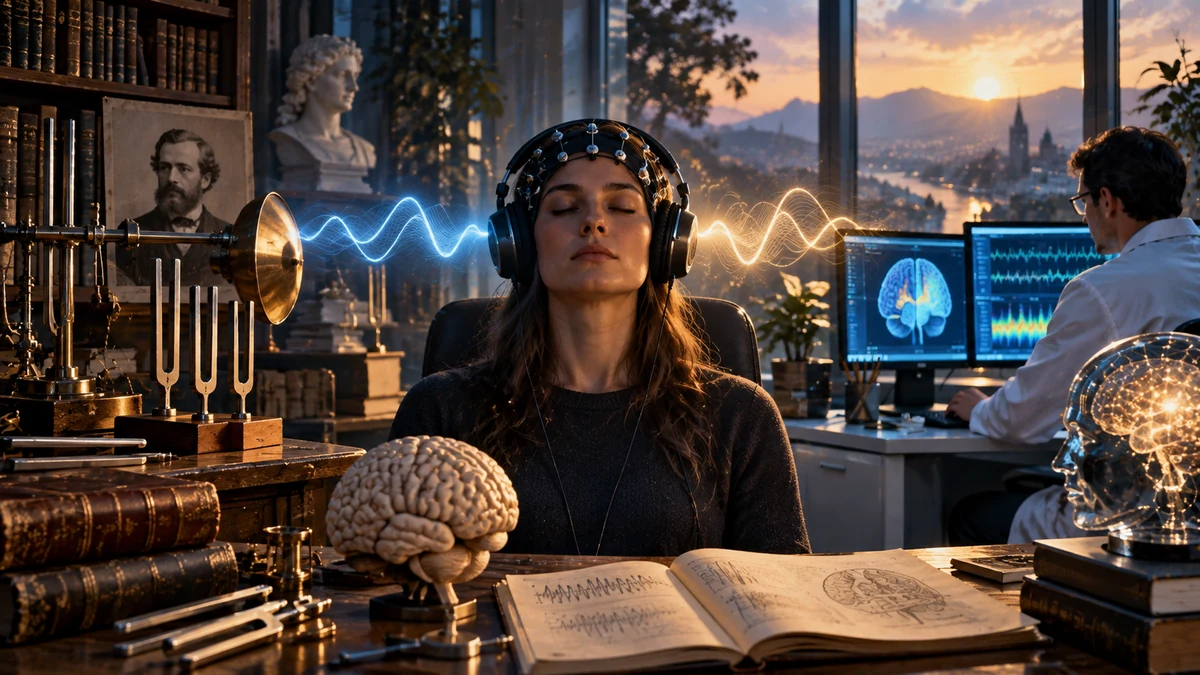
Binaural beats are a useful example of a topic in which two things can be true at once: the perceptual phenomenon is physiologically real and measurable, while many claims built around it extend well beyond what research can currently establish with confidence. If two nearby pure tones are delivered separately to the left and right ears — for example 200 and 210 Hz — a listener may perceive a slow fluctuation of roughly 10 Hz even though neither channel contains a physical 10-Hz tone. The additional rhythm emerges from the way the auditory system combines information from the two ears.
That is what makes binaural beats interesting. They are not a mystical sound hidden inside the recording but a perceptual product of the nervous system. The harder question follows: can that periodic percept also influence wider brain dynamics, attention, anxiety, pain or sleep? Laboratory and clinical studies report some effects often enough that dismissing the subject as pure imagination is not justified. At the same time, results are not consistent enough to treat binaural stimulation as a universal switch for an alpha, theta or gamma mental state.
This article therefore separates four layers of evidence: the binaural beat percept, which is well established; neural responses to the beat, measurable under some conditions; behavioral and clinical effects, where meta-analyses are promising but heterogeneous; and stronger altered-consciousness claims, for which evidence is substantially weaker. That separation matters more than whether one approaches the subject as an enthusiast or a skeptic.
The history also predates the internet and the modern wellness industry. Heinrich Wilhelm Dove described the phenomenon in the nineteenth century; Gerald Oster brought it into modern psychoacoustics and neurophysiology in 1973. We now have EEG studies, randomized clinical trials and several systematic reviews. The resulting picture is neither miracle nor zero: effects depend on beat frequency, carrier frequency, exposure time, task, control condition and individual differences. That is exactly why the subject remains scientifically interesting.
What a binaural beat actually is — and why each channel must receive its own signal
A binaural beat arises during dichotic listening: one frequency is delivered only to the left ear and another only to the right. If the frequencies are sufficiently close and lie in a suitable range, the nervous system can perceive a slow periodic fluctuation related to their difference. With 200 Hz on the left and 210 Hz on the right, the target difference is 10 Hz. Crucially, in a true binaural stimulus there is no physical 10-Hz sound wave in space or in either individual audio channel. This distinguishes it from a monaural beat, where the two tones are physically summed before playback and an actual amplitude modulation is already present in the signal.
That also explains the practical need for stereo headphones or another method that keeps the channels well separated. If both tones reach both ears as an already mixed signal, the listener mainly hears an ordinary acoustic beat rather than the same binaural phenomenon. Binaural beats are most readily perceived with relatively low carrier frequencies and small interaural differences. Popular maps then associate the difference frequency with EEG bands — delta, theta, alpha, beta or gamma. Those labels can be useful experimentally, but the name of an EEG band does not mean that the whole brain automatically adopts the psychological state that popular culture assigns to that band.
From Dove to Oster: 1839, 1973 and the return of the phenomenon to the laboratory
The historical starting point is usually associated with the Prussian physicist and meteorologist Heinrich Wilhelm Dove. Around 1839 he was working on acoustic interference and effects produced when the ears receive different tones. During the same century, sirens, tuning forks and resonators made frequency control precise enough for such phenomena to be compared systematically. The Smithsonian’s history of acoustic sirens explicitly connects Dove’s multi-tone instruments with research on binaural beats and interference. That matters historically: the phenomenon is not an invention of late self-help culture but part of classical experimental acoustics.
The modern turning point was Gerald Oster’s Auditory Beats in the Brain, published in Scientific American in 1973. Oster distinguished monaural from binaural beats and argued that binaural perception could provide a window into central auditory processing. Later EEG methods and computer-generated tones made it possible to ask a question the nineteenth century could not test well: not merely whether a beat is heard, but whether measurable neural activity appears at the beat frequency and whether that response has behavioral consequences. This is where the modern history of brainwave-entrainment claims begins — and where much stricter experimental controls become essential.

What happens in the auditory system: perceiving a difference is not the same as a sound in the air
Each ear first converts its own carrier tone into neural activity. Information from the two sides then meets at binaural stages of the brainstem and continues through the midbrain toward auditory cortex. Because timing and phase differences help the brain determine where sounds come from, the auditory system is fundamentally sensitive to differences between the ears. Binaural beats exploit that architecture. When the tones are sufficiently similar, a central temporal pattern can emerge that listeners experience as a fluctuation in loudness or apparent position. It is a neuroacoustic construction, not a third external tone.
EEG can detect frequency-following responses and auditory steady-state responses to periodic auditory stimulation. A 2020 experiment by Orozco Perez and colleagues found subcortical responses to the carrier tones and a cortical response at the beat frequency for both binaural and monaural stimulation. Yet the monaural beat entrained cortex more strongly, and the binaural condition did not alter self-reported mood in that experiment. This is almost an ideal example of careful interpretation: neural following of a rhythm is real, but by itself it does not prove a special psychological effect.

The entrainment hypothesis: when the brain follows a rhythm and when it does not
The best-known mechanism proposes brainwave entrainment: periodic auditory stimulation is said to synchronize brain oscillations with the frequency of the perceived beat. The idea is physiologically plausible in a limited sense because nervous systems do show phase locking and steady-state responses to rhythmic input. The problem begins when that fact is expanded into the claim that the whole brain has entered a uniform theta, alpha or gamma state — and that meditation, creativity or heightened intelligence must therefore follow.
A 2023 systematic review of EEG research included fourteen studies: five reported findings consistent with the entrainment hypothesis, eight reported contradictory findings and one reported mixed findings. The authors emphasized major differences in protocols, frequencies, EEG analyses and control conditions. The most honest model is therefore two-step: (1) the auditory system can generate and neurally follow the beat structure; (2) broader changes can follow in some circumstances, but they are neither automatic nor identical across people. EEG bands are statistical descriptions of oscillatory activity, not switches with a single psychological function.
Anxiety and perioperative stress: this is where the applied signal is strongest
The most persuasive applied findings come from settings where acute anxiety can be measured clearly before or during a medical procedure. Randomized studies in general anesthesia, dentistry and cataract surgery have repeatedly reported lower subjective anxiety or more favorable physiological measures. One especially informative control study in cataract surgery was published in 2016: both music containing binaural beats and ordinary music reduced anxiety compared with silence, while the main anxiety outcome did not differ significantly between the two music groups. This illustrates why a good trial must separate the effects of sound, music, expectation and the binaural component itself.
A more recent perioperative meta-analysis pooled fifteen randomized trials. Compared with blank-audio controls, it found reductions in anxiety and pain; some advantages also appeared against non-binaural audio. However, heterogeneity for anxiety was extremely high, meaning results varied substantially between studies. Even more informative is a 2026 randomized trial in 72 patients: thirty minutes of 1-Hz binaural sound before anesthesia was associated with a lower remimazolam requirement and faster loss of responsiveness, while EEG spectral analysis showed no significant between-group difference. A clinical effect can therefore be present without confirming the simple story of global brainwave entrainment.
Pain, attention and memory: effects exist, but they are not universal
A 2019 meta-analysis of 22 studies and 35 effect sizes covering memory, attention, anxiety and analgesia found an overall effect of about Hedges g = 0.45, conventionally a medium effect. A review focused specifically on memory and attention analyzed fifteen studies and 31 effects and reported about g = 0.40. Those are serious reasons not to dismiss the hypothesis. Yet the systematic component of the same review found conflicting results, particularly over whether theta or beta stimulation helps specific tasks. One laboratory experiment, for example, found better long-term memory after a 20-Hz beta beat and worse performance after a 5-Hz theta beat compared with white noise — a clear warning that the slogan “theta always improves memory” is false.
Pain shows a similar pattern. A double-blind crossover trial in chronic pain reported lower pain and analgesic use with 5-Hz stimulation, and several acute-procedure studies also report benefit. But a 2024 systematic review of sixteen randomized trials judged the risk of bias high in most studies and the evidence low to very low in quality; the conclusion for chronic pain remained uncertain. A 2026 meta-analysis restricted to theta binaural beats found a moderate pain reduction across four quantitatively pooled trials, but graded that evidence as low certainty. The precise summary is therefore: there is an analgesic signal, while the evidence quality does not yet justify promises of reliable treatment.
Sleep and altered states: intriguing findings, not yet a robust technology of consciousness
Sleep research has produced intriguing newer results, but samples are often very small. A daytime-nap study in twelve healthy participants reported shorter latencies to N2 and N3 sleep with 0.25-Hz beats, yet found no significant neural entrainment at those slow frequencies. A 2026 study of fifteen participants reported improved objective sleep efficiency after two weeks without a matching improvement in subjective sleep quality. Another small study of twenty students reported more N3 and REM sleep and fewer awakenings but no faster sleep onset. These are useful signals for further research, not a final protocol for insomnia.
The same caution applies to the phrase altered states of consciousness. Sound can change attention, relaxation, drowsiness and subjective experience, and rhythmic stimulation has been part of human practice long before electronic tone generators. But that does not establish that a particular frequency difference reliably opens a precisely defined state of consciousness, or that a binaural beat by itself produces an out-of-body experience, vision or other specific phenomenon. Such reports can be studied seriously, but controls must separate expectation, suggestion, music, relaxation, sleep and individual sensitivity. A subjective experience is data; its cause is a separate research question.
What we can claim today with high, medium and low confidence
With high confidence, we can say that the binaural beat percept exists, that it requires separate delivery of nearby frequencies to the two ears, and that the auditory system can show neural responses to the temporal structure of the beat. With moderate confidence, binaural stimulation can be said to have measurable effects on anxiety, pain, memory or attention in at least some people and protocols; the most consistent applied signal currently appears in acute or perioperative anxiety. With lower confidence remain universal frequency recipes, durable cognitive enhancement, treatment of chronic conditions, and precise programming of mental states merely by choosing an EEG-band frequency.
The best philosophy of use is therefore simple: binaural beats need neither mystification nor ridicule. They are a low-cost, non-invasive form of auditory stimulation worth testing at sensible volume, with a clear goal and the understanding that an effect is not guaranteed. For medical conditions they are not a substitute for treatment, and in consciousness research a powerful experience does not prove its explanation. The most interesting lesson is broader: the brain is not a passive receiver of sound. It actively constructs rhythm, meaning and state — but the path from stimulus to experience is not a one-line equation.
Sources and further reading
- Dove, H. W. & Moser, L. (eds.) — Repertorium der Physik, vol. 3: Akustik, theoretische Optik, Meteorologie (Berlin, 1839), digitized bibliographic record
- Smithsonian National Museum of American History — The Acoustic Siren: Dove’s Siren and the nineteenth-century acoustics context
- Oster, G. — Auditory Beats in the Brain, Scientific American 229(4), 1973
- Schwarz, D. W. F. & Taylor, P. — Human auditory steady state responses to binaural and monaural beats, Clinical Neurophysiology 116(3), 2005
- Orozco Perez, H. D., Dumas, G. & Lehmann, A. — Binaural Beats through the Auditory Pathway: From Brainstem to Connectivity Patterns, eNeuro, 2020
- Ingendoh, R. M. et al. — Binaural beats to entrain the brain? Systematic review of brain oscillatory activity, 2023
- García-Argibay, M., Santed, M. A. & Reales, J. M. — Efficacy of binaural auditory beats in cognition, anxiety, and pain perception: a meta-analysis, 2019
- Basu, S. & Banerjee, B. — Potential of binaural beats intervention for improving memory and attention: meta-analysis and systematic review, 2023
- García-Argibay, M., Santed, M. A. & Reales, J. M. — Binaural auditory beats affect long-term memory, Psychological Research, 2019
- Wiwatwongwana, D. et al. — Music with and without binaural beat audio on operative anxiety in cataract surgery: randomized controlled trial, 2016
- Loong, L. J. et al. — Binaural beat audio on operative pain and anxiety in cataract surgery: randomized controlled trial, 2022
- Xiong, J. et al. — Binaural beats for perioperative anxiety and pain: systematic review and meta-analysis, 2025
- Kim, H.-C. et al. — Preoperative binaural beats reduce remimazolam dosage and enhance safety in anesthesia induction: randomized controlled trial, 2026
- Gkolias, V. et al. — Reduced pain and analgesic use after acoustic binaural beats therapy in chronic pain: double-blind randomized crossover trial, 2020
- Shamsi, F., Azadinia, F. & Shaygan, M. — Binaural auditory beats and acute/chronic pain: systematic review, 2024
- Fatima, I. et al. — Efficacy of theta binaural beat therapy on pain, cognition and anxiety in adults: systematic review and meta-analysis of RCTs, 2026
- Binaural beats at 0.25 Hz shorten the latency to slow-wave sleep during daytime naps, 2024
- Sharma, K. & Dhaka, S. — Sleep modulation by binaural beats and its relation to error-aware response inhibition, 2026
- Dabiri, R. et al. — The effect of delta binaural beat on sleep onset and maintenance based on EEG signal analysis, 2026
- Chee, Z. J. et al. — The effects of music and auditory stimulation on autonomic arousal, cognition and attention: systematic review, 2024