DMT: The Molecule, Its Use Around the World, and the Boundary of Neuroscience
DMT is at once an endogenous molecule, an Amazonian plant alkaloid, a religious sacrament, a modern psychedelic, and a research tool for consciousness. How is it used around the world, what can neuroscience measure, and where do open questions begin?
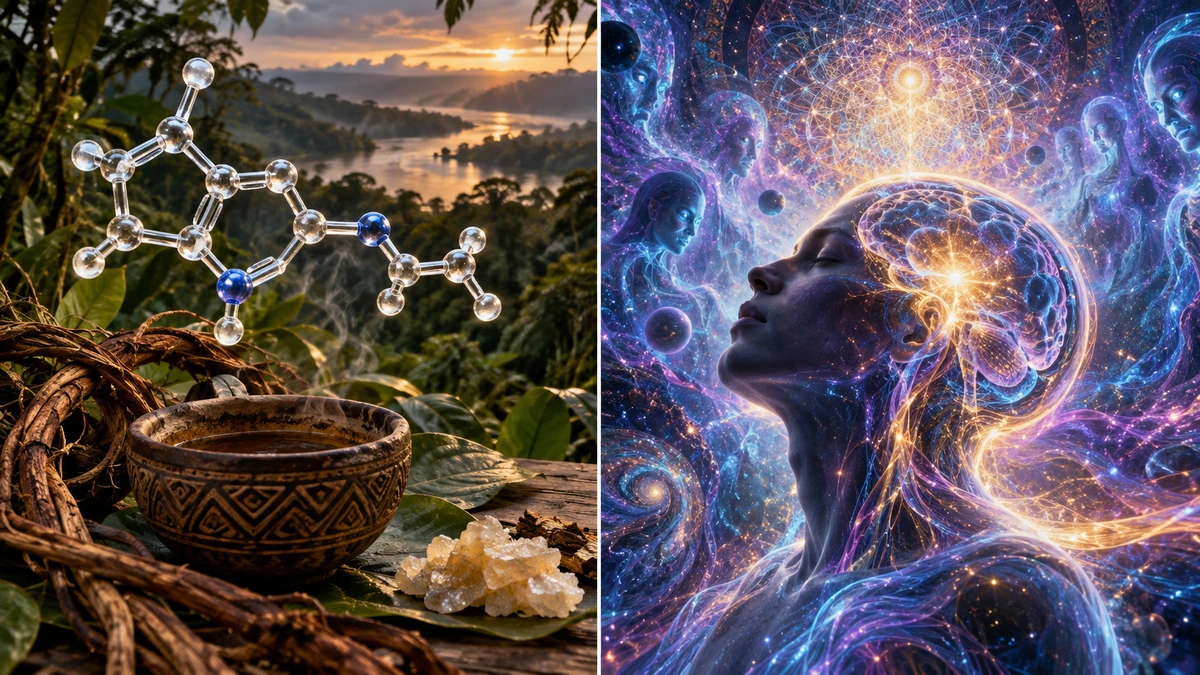
DMT—N,N-dimethyltryptamine—is a small indole molecule with an unusually large cultural range. It occurs in many plants, trace amounts have also been measured in human body fluids, and in Amazonia it is one component of some ayahuasca preparations. In modern laboratories it has become a tool for studying consciousness and a candidate in psychiatric research.
Yet the same acronym is often made to carry very different things: isolated DMT, traditional ayahuasca, synthetic combinations with monoamine-oxidase inhibitors, 5-MeO-DMT, and popular claims about the pineal gland, birth, death, and ‘other dimensions’. Mixing them creates a compelling story but erases history, pharmacology, and evidentiary boundaries.
This article therefore follows DMT from molecule to world: what is chemically and neurobiologically established, how ayahuasca is used in Amazonian traditions, how use has spread into religious, therapeutic, and informal settings across the world, and what modern research can actually say about mystical experience.
The aim is not to declare DMT a medicine, a dangerous poison, or a portal to another reality. It is to separate directly measurable phenomena from cultural interpretation and to leave questions open where measurement cannot yet close them.
DMT is not the same as 5-MeO-DMT—and ayahuasca is not just DMT
N,N-dimethyltryptamine is a classic serotonergic psychedelic in the tryptamine family. It is structurally related to serotonin and acts mainly through serotonin receptors, especially 5-HT2A, although its pharmacology includes other targets. 5-MeO-DMT is a related but distinct molecule with a different receptor profile and different subjective phenomenology; conflating the two is one of the most common errors in popular discussion.
Ayahuasca is pharmacologically more complex still. Traditional Amazonian preparations often combine the Banisteriopsis caapi vine, rich in beta-carbolines, with a DMT-containing plant such as Psychotria viridis or, in some traditions, Diplopterys cabrerana. Composition is not universal; traditions use different recipes, plants, and ritual frameworks.
The ayahuasca experience therefore cannot simply be equated with isolated DMT. Beta-carbolines contribute pharmacologically, the time course is different, and context matters: group, ritual, music, expectation, culture, and personal history.
Why isolated DMT is short-lived while ayahuasca lasts much longer
DMT is rapidly metabolized in the body, especially by monoamine oxidase A (MAO-A). Isolated DMT is therefore very short acting when administered parenterally; a 2025 systematic review of human pharmacokinetics found rapid elimination and substantial inter-individual variability. Controlled intravenous studies can capture almost the complete acute arc of the experience within a relatively short experimental window.
In ayahuasca, beta-carbolines from B. caapi reversibly inhibit MAO-A and allow orally consumed DMT to reach systemic circulation and the brain. This is a striking example of how combining two classes of plant alkaloids can transform the pharmacology of a molecule that would otherwise be rapidly broken down when swallowed.
The mechanism also matters for safety. Ayahuasca is not simply ‘natural DMT’; it combines a psychedelic with biologically active enzyme inhibitors, so medication interactions and individual medical circumstances can matter. Research and many traditional contexts use screening and supervision, whereas informal preparations are not necessarily standardized.
DMT in nature and in humans: what is established about the endogenous molecule
DMT is not a molecule confined to laboratories or a single Amazonian plant. It has been reported in many plant and animal species. In humans, decades of research have detected it in blood, urine, and cerebrospinal fluid, usually in very small amounts, although early studies used widely varying analytical methods.
In 2019, Jimo Borjigin’s group showed that rat brains can synthesize and release DMT and that concentrations in visual cortex increased after experimentally induced cardiac arrest. One important detail: DMT remained present in rats without a pineal gland. In human brain tissue the authors demonstrated INMT enzyme transcripts, not a direct measurement of a large psychoactive burst of DMT in living human brains.
It is therefore justified to say that DMT is endogenous and that biochemical machinery exists for its synthesis. It is not justified to present as established fact the claim that the pineal gland releases a psychedelic dose at birth or death that causes dreams or near-death experiences. That remains a hypothesis, not a measured human phenomenon.
Amazonia: ayahuasca as medicine, ritual, and relationship with the world
The longest cultural history of DMT is not attached to the isolated molecule but to Amazonian plant practices. Ayahuasca and related preparations have many names and roles among communities in present-day Peru, Brazil, Colombia, Ecuador, and the wider Amazon. They are used in healing, divination, ritual, learning, and communal practice, and the Western term ‘psychedelic’ often captures only part of their local significance.
In 2008 Peru declared the knowledge and traditional uses of ayahuasca practiced by Amazonian Indigenous communities to be Cultural Heritage of the Nation. Contemporary Peruvian health and cultural authorities likewise emphasize that this is a living tradition, not merely a chemical preparation.
There is also no single ‘authentic ayahuasca’. Anthropological research describes different local ontologies of healing, different ritual specialists, and different interpretations of visions. Globalization has partly preserved, partly transformed, and partly commercialized these practices.

Brazil: from an Amazonian brew to new religious traditions
During the twentieth century ayahuasca also became incorporated into Brazilian syncretic religious movements, most famously Santo Daime and União do Vegetal (UDV). In these settings the brew is not understood as a recreational drug but as a sacrament used within structured ceremonies that may include prayer, singing, and communal discipline.
Brazil’s Conselho Nacional de Políticas sobre Drogas established principles compatible with religious ayahuasca use through Resolution No. 1/2010. This does not amount to a general legalization of isolated DMT; it is a specific legal and cultural regime for ritual use of the brew.
The case is important to the global DMT story: the same molecule can be a controlled psychotropic substance in one legal document and part of a protected religious practice in another cultural setting. The chemistry is the same; the social meaning is not.
From Amazonia to the world: religion, retreats, and modern use
In recent decades ayahuasca use has spread far beyond Amazonia. The Global Ayahuasca Survey included more than ten thousand participants from over 50 countries, and research describes traditional, religious, neo-shamanic, therapeutic, and commercial retreat settings in North America, Europe, Australia, and elsewhere.
In the United States, the Supreme Court’s 2006 decision in Gonzales v. O Centro Espírita Beneficente União do Vegetal protected a specific religious use of hoasca under the Religious Freedom Restoration Act. The decision did not generally legalize DMT or ayahuasca; it concerned a particular religious claimant and statutory framework.
Internationally, DMT is listed in Schedule I of the 1971 UN Convention on Psychotropic Substances. The INCB has also noted that plants naturally containing such controlled ingredients, and some preparations made from them, are not automatically controlled by that Convention itself. Domestic laws therefore vary considerably, and ayahuasca may have a different legal status from isolated DMT.
Isolated DMT now also circulates outside Amazonian traditions in psychonautic, recreational, spiritual, and research settings. The 2023 Global Psychedelic Survey included psychedelic users from 85 countries and found substantial regional differences in motives, access, and substances used. A separate analysis found that many DMT users expressed a preference for ‘natural’ sources, even though a molecule’s source by itself does not determine purity, safety, or meaning.
It is useful here to distinguish culture from pharmacology. For one person ayahuasca is a sacrament, for another a therapeutic retreat, for another a tourism experience, and for another a laboratory object. These categories can overlap, but they are not identical and carry different ethical and safety standards.
Globalization also raises questions about cultural appropriation, commercialization, retreat safety, and relationships with Indigenous knowledge. Research warns that Western models of ‘treatment’ are not necessarily equivalent to local Amazonian concepts of healing and spiritual relationship.
What people experience: visions, loss of self-boundaries, and ‘presences’
In controlled studies DMT rapidly produces intense changes in perception, bodily experience, time, space, and sense of self. Complex visual scenes, strong emotions, a sense of transition into another environment, and reports of apparent beings or ‘presences’ are common. The experience can feel more real than ordinary waking consciousness, which is one reason DMT attracts both philosophy of mind and religious interpretation.
An Imperial College study in 2018 found substantial overlap between DMT experiences and standardized features of near-death experiences. A more recent qualitative comparison in 2025 narrowed the picture: meaningful overlap exists, but there are also clear differences in content and sequence. DMT can therefore model some aspects of NDE phenomenology without demonstrating that both states share the same causal mechanism.
The same caution applies to reports of ‘entities’. Their recurrence as a subjective motif is scientifically interesting. But whether they are brain-generated constructions, culturally shaped perceptions, or perceptions of something ontologically independent is not settled by the intensity of the experience itself. Empirical science can measure reports and neural correlates; the metaphysical conclusion requires an additional argument.
What happens in the brain: 5-HT2A, network disintegration, and global connectivity
The most robust modern account of DMT’s psychedelic action involves agonism at the 5-HT2A receptor. Simultaneous EEG-fMRI imaging in healthy volunteers in 2023 found reduced integrity within ordinary functional networks, increased global connectivity, and reduced segregation between networks. These changes tracked subjective intensity over time and spatially overlapped with 5-HT2A receptor maps.
This does not mean the brain simply becomes ‘more connected’ in a universally positive sense. Organization becomes less modular and more dynamic, with ordinary network hierarchies temporarily loosened. Such reorganization may help explain the unusual combination of hyper-real imagery, emotional intensity, and weakened boundaries between self and environment.
DMT also binds to other targets, including the sigma-1 receptor, but their contribution to the characteristic psychedelic experience is less clearly established than the role of 5-HT2A. The pharmacology is broader than a single receptor, but the evidence is not equally strong for every proposed mechanism.
From laboratory tool to treatment candidate
Clinical interest in DMT has accelerated partly because its effects are rapid and relatively short. Randomized studies show that intravenous infusion can control the time course sufficiently to measure pharmacokinetics, physiology, EEG, and fMRI within the same experimental window.
In 2026, Nature Medicine published a phase IIa randomized trial of intravenous DMT (SPL026) in adults with moderate-to-severe major depressive disorder. The results support further investigation of a short-acting psychedelic approach, but DMT has not thereby become a standard or generally approved treatment. Clinical programmes use participant selection, medical monitoring, and psychological support.
The ayahuasca evidence base is broader but methodologically mixed: there are clinical, observational, and naturalistic studies with promising signals for depression and some other conditions, alongside selection effects, cultural differences, and limitations of self-report. ‘Promising’ is not the same as ‘established treatment’.
Safety, bodily responses, and psychological risk
DMT and ayahuasca are not pharmacologically inert. Controlled studies record transient changes in blood pressure and heart rate alongside powerful psychological effects. A 2024 systematic review found DMT and ayahuasca generally well tolerated in research and many traditional contexts, while also documenting adverse events and potentially important interactions, especially because ayahuasca contains beta-carboline MAO inhibitors.
The Global Ayahuasca Survey found that acute physical effects are common and post-experience psychological difficulties are not negligible. A powerful experience is not automatically a therapeutic outcome; for some people it can involve fear, disorientation, prolonged distress, or worsening of pre-existing vulnerability. Research studies therefore use health screening and supervision.
This article deliberately does not provide instructions for preparation, dosing, or use of DMT. An informational review can explain pharmacology and history; it cannot turn the literature into an individualized safety assessment for a specific person.
Where knowledge ends: pineal gland, death, consciousness, and the question of ‘what is real’
With DMT, a scientific question quickly becomes a philosophical one. It is established that the molecule can produce radically altered consciousness; it is established that it is synthesized endogenously in animal brains; and humans show biochemical traces and relevant enzymatic machinery. It has not been established that endogenous DMT reaches psychedelic concentrations in humans during dreaming, birth, or death.
A neural correlate also does not by itself decide the ontology of an experience. If fMRI shows which networks reorganize during a vision, it reveals a mechanism associated with perception; it does not logically entail either ‘it is only a hallucination’ or ‘the perceived beings exist independently of the brain’. Both are additional interpretations.
| Layer | What is well documented | What remains open |
|---|---|---|
| Molecule | DMT is a tryptamine, acts mainly through serotonergic receptors, and is rapidly metabolized | The full physiological function of endogenous DMT |
| Endogenous DMT | Trace detection in humans; synthesis and release directly shown in rat brain | Whether human brains release psychedelic quantities and under what conditions |
| Pineal gland | INMT transcripts occur in pineal tissue; rat cortical DMT does not depend on the pineal gland | The popular claim of a large release at birth or death |
| Ayahuasca | Long Amazonian ritual use; DMT + beta-carboline pharmacology is well characterized | How findings generalize across very different cultural contexts |
| Global use | Use has spread across more than 50 countries in religious, retreat, and informal settings | True prevalence and long-term outcomes across populations |
| Brain effects | 5-HT2A involvement, EEG/fMRI changes, reduced network segregation, increased global connectivity | How brain dynamics generate specific visions and the sense of ‘other worlds’ |
| NDE similarity | Controlled studies show partial phenomenological overlap | Whether endogenous DMT plays a substantial causal role in actual near-death experiences |
| Therapy | Active clinical development, including a phase IIa depression trial | For whom, under what conditions, and with what long-term benefit treatment will prove effective |
| Ontology of experience | Subjective reports are measurable and reproducible as phenomena | Whether perceived ‘entities’ or spaces exist independently of the brain |
The most defensible conclusion is therefore double-sided. DMT is a very concrete molecule with measurable pharmacology and, at the same time, a culturally rich phenomenon used from Amazonian ceremonies to contemporary laboratories. Science can increasingly describe what happens to the brain and body. The question of what the experience means and whether its content is exhausted by neurobiology remains an open philosophical and research field.
Perhaps the most interesting question is less sensational than the myth of a ‘spirit molecule’: why can one relatively simple molecule, in different cultures and contexts, open such different yet often extraordinarily convincing models of reality—and what does that reveal about human consciousness itself?
Sources and further reading
- Cameron & Olson, ACS Chemical Neuroscience (2018), ‘Dark Classics in Chemical Neuroscience: N,N-Dimethyltryptamine (DMT)’ — broad review of DMT chemistry, pharmacology, metabolism and history.
- van der Heijden et al., Clinical Pharmacokinetics (2025) — systematic review of human DMT pharmacokinetics; rapid elimination and substantial inter-individual variability.
- Holze et al., Translational Psychiatry (2023) — randomized placebo-controlled intravenous DMT study in healthy participants.
- Timmermann et al., PNAS (2023), ‘Human brain effects of DMT assessed via EEG-fMRI’ — network disintegration, desegregation, global connectivity and 5-HT2A-related effects.
- Timmermann et al., Frontiers in Psychology (2018), ‘DMT Models the Near-Death Experience’ — placebo-controlled comparison of DMT phenomenology with NDE features.
- Michael, Luke & Robinson (2025), ‘An encounter with death’ — qualitative comparison of naturalistic DMT experiences and near-death experiences, highlighting both overlap and differences.
- Barker et al., Drug Testing and Analysis (2012) — critical review of reports of endogenous DMT and related tryptamines in human body fluids.
- Dean et al., Scientific Reports (2019) — DMT biosynthesis and extracellular concentrations in rat brain, including after cardiac arrest and after pinealectomy; INMT transcripts in human brain tissue.
- Barker (2022), Journal of Psychopharmacology, ‘Significance of mammalian DMT: a 60-year-old debate’ — review arguing for possible endogenous physiological roles while emphasizing unresolved questions.
- Ermakova et al. (2024), review of DMT neurobiology and MAO inhibition — current synthesis of DMT, beta-carbolines, ayahuasca pharmacology, and MAO-A-mediated oral activity.
- Riba et al., Drug Testing and Analysis (2012) — metabolism and disposition of DMT and harmala alkaloids after ayahuasca administration.
- Dos Santos & Hallak, CNS Spectrums (2024), ‘Ayahuasca: pharmacology, safety, and therapeutic effects’ — current review of composition, traditional use and clinical evidence.
- Naranjo, Journal of Ethnopharmacology (1979) — ethnographic review of hallucinogenic plant use and Indigenous belief systems in the Ecuadorian Amazon.
- Peru, Ministry of Culture / RDN 836/INC-2008 — traditional knowledge and uses of ayahuasca declared Cultural Heritage of the Nation.
- Peru, Instituto Nacional de Salud — official overview of traditional ayahuasca use in health and Amazonian cultural practice.
- Brazil, Ministério da Justiça / CONAD — official reference to Resolution No. 1/2010 governing procedures compatible with religious ayahuasca use.
- U.S. Supreme Court, Gonzales v. O Centro Espírita Beneficente União do Vegetal (2006) — case-specific protection of sacramental hoasca use under RFRA.
- United Nations Convention on Psychotropic Substances (1971) — DMT listed in Schedule I.
- International Narcotics Control Board — clarification that plants containing internationally controlled psychoactive constituents are not themselves automatically scheduled under the 1971 Convention; ayahuasca discussed as an example.
- Bouso et al., PLOS Global Public Health (2022), Global Ayahuasca Survey — adverse effects data from 10,836 participants in more than 50 countries.
- Perkins et al. / Global Ayahuasca Project (2021), context and setting study — ayahuasca use across more than 40 countries and multiple ritual/non-ritual settings.
- Global Ayahuasca dataset analysis (2024) — associations between naturalistic ayahuasca use and mental-health/wellbeing outcomes across more than 50 countries; cross-sectional limitations apply.
- Lake & Lucas, International Journal of Drug Policy (2024), Global Psychedelic Survey — 6,379 respondents across 85 countries; regional patterns of psychedelic use and access.
- White et al., International Journal of Toxicology (2024) — systematic thematic review of ayahuasca/DMT adverse events, toxicity, and interaction considerations.
- Zeifman et al. / ayahuasca ethics and globalization literature — ethnographic analysis of ethical tensions among globalized ayahuasca shamanisms and integration practices.
- Weiss et al., Nature Medicine (2026) — phase IIa randomized placebo-controlled trial of intravenous DMT (SPL026) for major depressive disorder.
- Dos Santos et al. / European Neuropsychopharmacology (2022), ‘Ayahuasca’s therapeutic potential: what we know—and what not’ — review of promising signals and evidence limitations.
- Fontanilla et al., Science (2009) — DMT as an endogenous sigma-1 receptor ligand; mechanistic relevance remains distinct from the best-established 5-HT2A psychedelic pathway.