Jung, synchronicity and astrology: the psychology of symbols and the limits of interpretation
What did Jung actually claim about astrology and synchronicity — and where does symbolic meaning end and an empirical claim begin?
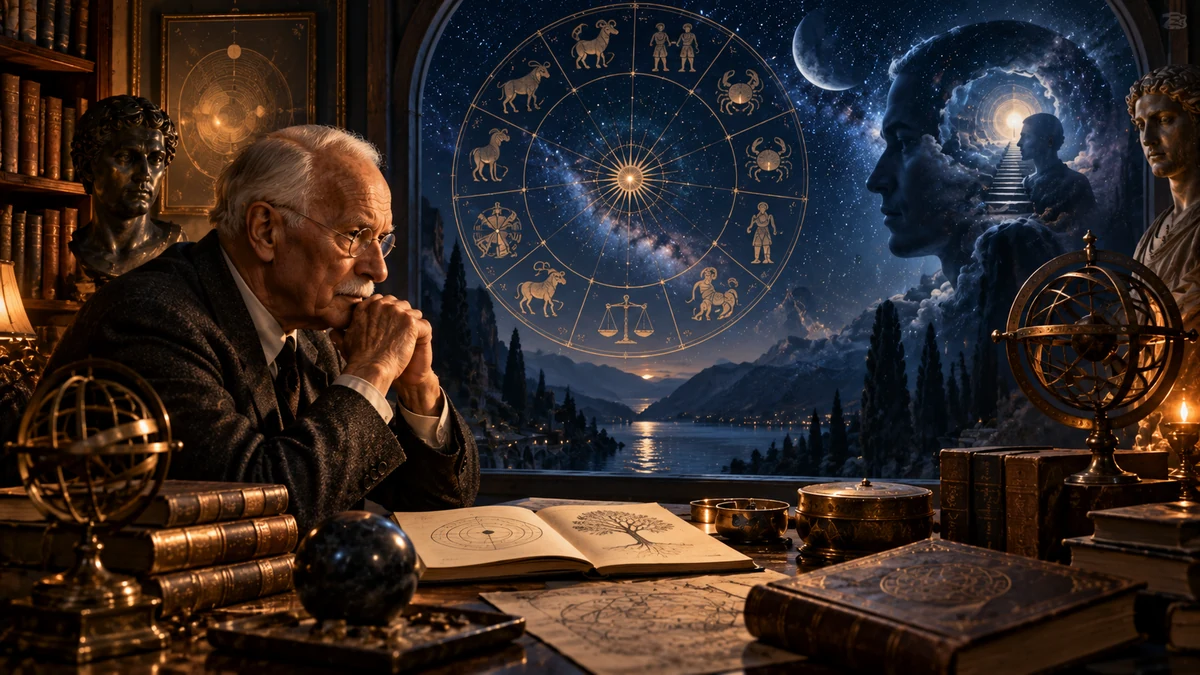
Carl Gustav Jung did not treat astrology as newspaper-style fortune telling. He was interested in it as an old symbolic system, as a historical archive of projections of the human psyche, and as a possible example of the broader problem he called synchronicity: a meaningful coincidence between an inner psychic state and an outer event without a demonstrated classical causal chain.
That does not mean Jung scientifically proved astrology. On the contrary, in his letters he called for statistical testing, and in his famous experiment with married couples the final results did not yield a stable effect beyond expected probability. His conclusion therefore remained philosophically and psychologically open rather than experimentally settled.
This article therefore separates three levels that popular accounts often merge: Jung's actual use of horoscopes and symbols; his theory of archetypes, projection and synchronicity; and the modern empirical question of whether astrological charts measurably predict personality or events.
The most interesting issue is not a choice between blind belief and ridicule. A more productive question is what a symbol allows a person to see that they could not previously articulate — and where interpretation must stop so that subjective meaning is not declared an objectively proven law of the universe.
Jung, astrology and archetypes
Jung was a Swiss psychiatrist and the founder of analytical psychology. He studied astrology for decades as a psychological and symbolic phenomenon, but he did not present himself as a professional astrologer or reduce his psychology to astrological technique.
In a 1947 letter to the Indian astrologer B. V. Raman he wrote that, in difficult diagnostic cases, he sometimes obtained a horoscope because it offered another point of view. This is important historical evidence about his practice, but it is not proof that the method was objectively valid.
The primary source gets the broad direction right: Jung did connect astrology with archetypes, projection, symbols and synchronicity. He also considered whether time might possess a qualitative aspect rather than being only measurable duration.
But formulations such as 'the planet is an archetype' or 'the sky mirrors the inner world' must be marked as Jungian or symbolic interpretations. A historical source can confirm that Jung thought in these terms; it cannot by itself confirm that the metaphor is also a physical law.
Popular astrology often reduces a planet to a single keyword: Saturn is limitation, Venus love, Mars action. Jung's concept of the archetype is more demanding. For him an archetype is not fixed content but a deeper pattern or possibility of forming images that becomes concrete only through symbols, dreams, myths and lived situations.
It is therefore more Jungian to speak of an archetypal field of meanings than of a simple planet-equals-trait table. The same symbol can evoke different, even opposite, meanings across cultures, periods and individuals.
The collective unconscious, projection and the “quality of time”
Alongside the personal unconscious Jung proposed a collective unconscious: a more universal layer of psyche whose contents were thought to appear through archetypal motifs. It is foundational to his system and the framework within which he understood recurring imagery in myth, religion, dreams and alchemy.
This article does not present this as an uncontested empirical fact of contemporary psychology but as Jung's theory. That distinction is essential for historical accuracy: we need to describe what Jung claimed without silently converting his metaphysical assumptions into established science.
Projection was one of Jung's key mechanisms for understanding astrology. Psychic contents can be experienced as though they belong to external objects, people or cosmic images. In that sense the zodiac and planets can function as a screen onto which culture and the individual project inner conflicts, desires and patterns.
This does not make a symbol worthless. Projection can be psychologically informative precisely because it reveals something about the observer. But it does not follow that the external planet must physically cause the psychological content attributed to it.
In his reflections on astrology Jung repeatedly suggested that a particular moment might possess a 'quality' expressed simultaneously in different events. This was his attempt to understand how a birth moment and psychological development might stand in a meaningful relation without positing a simple mechanical influence from the stars.
This is a philosophical hypothesis about the nature of time. The article preserves it as an important part of Jung's thought but does not present it as a measured physical property of time.

Synchronicity: concept, development and the scarab
For Jung, synchronicity is a principle for events connected by meaning even though no ordinary causal chain can be demonstrated between them. His classic formulation links an inner psychic state with an external event experienced as a striking and meaningful parallel.
The word is therefore not merely a synonym for a 'weird coincidence'. For Jung, the meaning connecting both sides was decisive. Yet meaning is difficult to objectify, which creates a methodological problem from the start: how do we distinguish a rare pattern from significance added by the observer after the fact?
The idea took shape for Jung in the late 1920s. In dream seminars in 1928 and 1929 he discussed simultaneous events that he thought could express the same 'time content'. He used the term publicly in 1930 in his memorial address for the sinologist Richard Wilhelm.
The I Ching was an important influence. Jung saw in Chinese divination a model in which the moment is not treated merely as a link in a causal chain but as a totality of simultaneous qualities. That is the historical origin of the idea, not proof of its physical correctness.
Jung's best-known account concerns a patient who was describing a dream of a golden scarab when a scarab-like beetle struck the window. Jung used the event therapeutically and described it as a breakthrough that helped the patient move beyond an excessively rationalistic attitude.
The case is powerful as a clinical anecdote about the effect of meaning. It is not an experiment: there was no preregistered hypothesis, control group or independent measurement of probability. This article therefore separates the therapeutic value of the event from its evidential value for a general law of nature.
Pauli and Jung’s actual relationship with astrology
The physicist Wolfgang Pauli played an important role in the development of Jung's late theory of synchronicity. Their correspondence linked psychological questions with the history of science, symbolism and philosophy of nature. In 1952 Jung's essay on synchronicity and Pauli's essay on Kepler appeared together in Naturerklärung und Psyche.
Popular literature sometimes turns this collaboration into a claim that quantum physics proved Jungian synchronicity. The sources do not justify that move. Pauli was a serious interlocutor in the development of the concept, but resemblance between quantum indeterminacy and Jungian meaningful connection is not itself experimental confirmation of astrology or synchronicity.
The letter of 6 September 1947 is one of the strongest primary sources for Jung's position. He says astrology interests the psychologist as a kind of projected psychological experience and that he sometimes used horoscopes in difficult cases as an additional perspective.
The end of the letter matters just as much: Jung stresses that astrological literature lacks the statistical method needed to establish fundamental claims scientifically. He was therefore both open to symbolic meaning and dissatisfied with the level of evidence.
Jung's often-quoted statement that astrology represents the 'sum of all the psychological knowledge of antiquity' belongs to his historical-symbolic outlook. For him the old astrological language preserved many projections, character types and mythic relations that could be interesting to a psychologist.
The statement does not mean every traditional astrological technique is correct. Still less does it mean antiquity already possessed experimental psychology in the modern sense. It is a claim about a symbolic archive of human thought.
Jung’s astrological experiment and its problem
Jung used astrology as a test case for synchronicity. He asked whether certain relations among Sun, Moon, ascendant, Mars and Venus occurred among married couples more often than chance would suggest.
The initial sample contained 180 married couples; groups of 220 and 83 couples were later added. In total, 483 marriages — 966 birth charts — were examined.
Different batches produced different highest frequencies: one emphasized a Sun-Moon conjunction, another a Moon-Moon conjunction, and another a Moon-ascendant relation. At first glance this was attractive because traditionally important factors happened to stand out.
But mathematical evaluation did not produce a stable statistically significant overall effect. The International Association for Analytical Psychology's summary of Jung's Collected Works explicitly notes that the analyzed figures remained within the limits of probability. This is a central limitation often omitted in popular retellings.
Jung did not simply declare the experiment a failure. He noticed that three successive batches highlighted different symbolically expected relations and linked this to the psychic states of people involved in selecting the material. That move is characteristic of his understanding of synchronicity: statistical repeatability was not supposed to be its essence.
This is also where the major methodological problem appears. If failure to replicate can itself be explained as meaningful within the theory, it becomes harder to specify what result could count against the theory. The article presents this as an open epistemological problem rather than a resolved evidential victory.

Later tests, the Barnum effect and apophenia
Later scientific literature attempted to test natal astrology with more standard blind procedures. The best-known example is Shawn Carlson's double-blind test published in Nature in 1985, which did not confirm the preregistered level of matching between natal charts and personality profiles.
That study was not beyond criticism. Suitbert Ertel later argued that parts of the analysis were problematic and that alternative calculations yielded marginal or weak positive effects. Yet Ertel also explicitly stopped short of saying that astrology had therefore been empirically verified. A fair summary is: the literature is not reducible to one experiment, but robust general validation of natal astrology does not follow from these studies.
In 1949 Bertram Forer showed that people often rate a very general personality description as highly accurate for themselves when they believe it was individually prepared. The phenomenon later became known as the Barnum or Forer effect.
This does not prove that every astrological interpretation is merely a Barnum effect. It does mean that the feeling 'this describes me incredibly well' is weak evidence on its own. Serious testing must remove identity cues, expectations and opportunities for selective confirmation.
Contemporary research on meaningful coincidences studies why people perceive patterns and significance in events that may be objectively unrelated. Some studies associate more frequent coincidence experiences with mood, creative activity, paranormal beliefs or particular cognitive characteristics.
Such associations do not mean every synchronicity is 'just a brain error'. They do show that the perception of meaning has a measurable psychological side. Faced with a striking coincidence, at least two possibilities should remain open: perhaps we have noticed a genuinely unusual pattern, or perhaps our minds are constructing meaning from rare events.
Symbolic and empirical truth and the limit of interpretation
A symbol can be psychologically true without being literally physically causal. A dream can reveal something to a person even though its scene is not a historical fact. Likewise, a birth chart can function as a structured language for association, self-reflection or conversation without thereby proving that planets measurably cause personality traits.
This distinction does not impoverish astrology; it removes the need to overclaim. It allows us to ask whether a symbol is useful without requiring every symbolic correspondence to also be a law of natural science.
Interpretation becomes problematic when it is unfalsifiable: if every possible outcome confirms the same theory, the theory loses the ability to distinguish what it predicts from what would have occurred anyway. Another danger is retrospective selection: from thousands of events we retain the one that fits the symbol and forget the rest.
The article therefore proposes a simple standard: clearly mark when we are discussing Jung's theory, when we are offering a personal or therapeutic symbolic interpretation, when we have a statistical correlation, and when we are making a claim about physical causation. Evidence at one level must not automatically migrate to another.
Astrology as symbolic language: a cautious conclusion
The strongest formulation supported by the historical record is more modest and therefore more useful: Jung regarded astrology as an exceptionally rich symbolic system capable of eliciting associations, projections and archetypal comparisons in an analytic context. Synchronicity offered him a way to think about such connections without simple mechanical causation.
He did not, however, prove that the natal chart objectively measures personality, nor did he show that quantum physics confirms astrology. Separating these levels allows Jung's question about meaning to be taken seriously without forcing history or science beyond what the evidence allows.
Jung's astrological legacy is interesting precisely because it remains suspended between symbol and verification. He was willing to use the horoscope as an additional psychological perspective, while also asking for statistical work and acknowledging that his own experiments fell far short of definitive proof.
For THY-REALITY the most productive conclusion is therefore this: a symbol can open consciousness without becoming dogma. Synchronicity can remain a serious philosophical and psychological question as long as experienced meaning is clearly separated from a claim about a universal mechanism. The limit of interpretation is not the enemy of mystery; it is what keeps mystery an inquiry rather than a self-confirming belief.
Sources and further reading
- Jung, C. G. Synchronicity: An Acausal Connecting Principle. Originally published in Naturerklärung und Psyche (1952); revised English edition, Princeton University Press.
- International Association for Analytical Psychology. Collected Works Vol. 8 abstract — 'Synchronicity: an acausal connecting principle', including 'An astrological experiment'.
- Cambray, Joe. 'Synchronicity: An Acausal Connecting Principle.' International Association for Analytical Psychology.
- International Association for Analytical Psychology. Collected Works Vol. 9.1 — The Archetypes and the Collective Unconscious.
- Rossi, Safron & Le Grice, Keiron (eds.). Jung on Astrology. Routledge, 2018.
- Jung, C. G. Letter to B. V. Raman, 6 September 1947, Letters Vol. 1, pp. 475–476; reproduced and referenced in Jung on Synchronicity and the Paranormal.
- Jung, C. G. 'Richard Wilhelm: In Memoriam' (1930), CW 15; Princeton University Press excerpt documenting the early public use of synchronicity.
- Main, Roderick. 'The cultural significance of synchronicity for Jung and Pauli.' Journal of Analytical Psychology 59 (2014): 174–180.
- Donati, Marialuisa. 'Beyond synchronicity: the worldview of Carl Gustav Jung and Wolfgang Pauli.' Journal of Analytical Psychology 49 (2004): 707–728.
- CERN Pauli Archives. Pauli letter collection, letter to Markus Fierz, 3 June 1952, concerning Jung's synchronicity.
- Zeng, Jingchao & Fraikin, Nathan. 'Synchronicity in Post-Jungian Astrology: A Cosmological Quest.' Journal of Analytical Psychology 70 (2025): 808–824.
- Forer, Bertram R. 'The fallacy of personal validation: a classroom demonstration of gullibility.' Journal of Abnormal and Social Psychology 44 (1949): 118–123.
- Carlson, Shawn. 'A double-blind test of astrology.' Nature 318 (1985): 419–425.
- Ertel, Suitbert. 'Appraisal of Shawn Carlson's Renowned Astrology Tests.' Journal of Scientific Exploration 23(2) (2009): 125–137.
- Perchtold-Stefan et al. 'Experiencing more meaningful coincidences is associated with more real-life creativity? Insights from three empirical studies.' PLOS ONE 19 (2024).
- Rominger et al. 'MRI resting-state signature of the propensity to experience meaningful coincidences.' Cerebral Cortex 34 (2024).
- Kime, Philip. 'Synchronicity and meaning.' Journal of Analytical Psychology 64 (2019): 780–797.