Tarot: from Renaissance card game to Major and Minor Arcana
How did a northern Italian Renaissance trump game become an occult and psychological symbolic system through Court de Gébelin, Etteilla, Éliphas Lévi, the Golden Dawn and Rider-Waite-Smith?
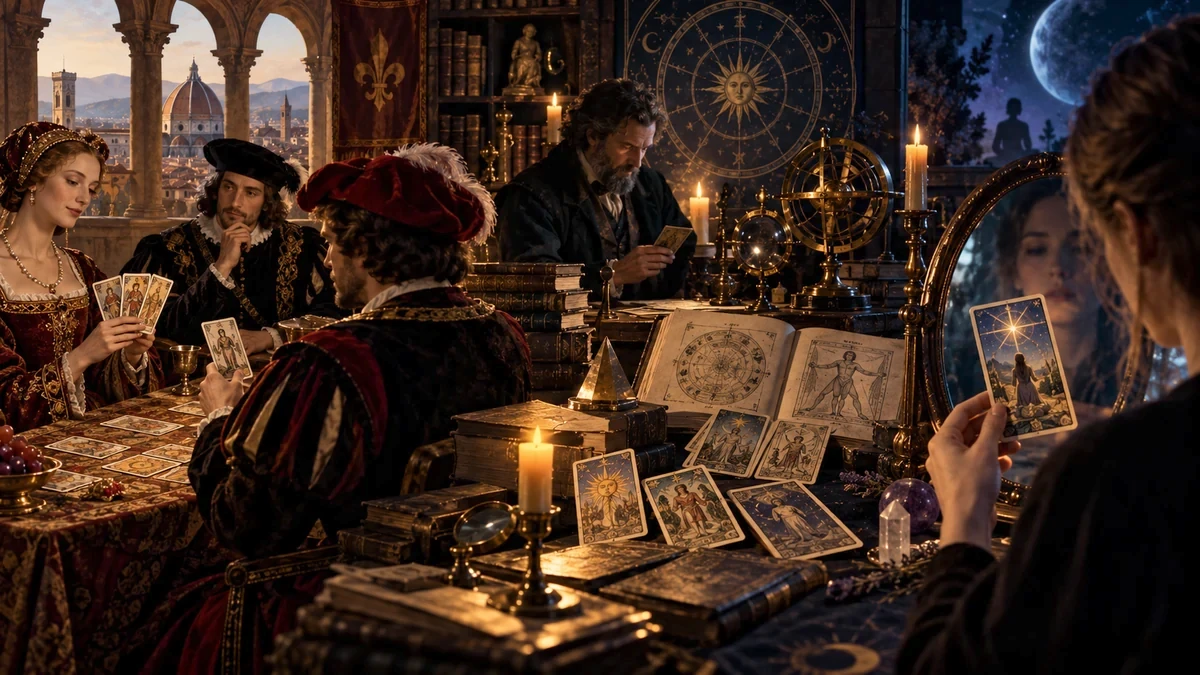
Tarot today is simultaneously a deck of cards, a symbolic system, a divinatory practice, an occult map and a tool for self-reflection. Because of this layered history, its development is often read backwards: since modern tarot is rich in Hermetic, Kabbalistic and psychological meanings, it is assumed to have been designed that way from the beginning.
The documented history points elsewhere. The earliest reliable traces of tarot lead to fifteenth-century northern Italy, where the cards belonged to a trick-taking game built around trump cards. The surviving Visconti-Sforza tarot from around 1450 is a luxury courtly object, not evidence of an Egyptian initiation school. Tarot’s association with fortune-telling and occult secrets arose only centuries later.
Modern occult accounts often connect the Minor and Major Arcana directly with ancient Egyptian, Hermetic and Vedic mystery traditions. No such historical chain has been established. Yet tarot can still function meaningfully as a map of the psyche — if that is identified as a later occult and psychological reinterpretation, rather than its proven original purpose.
The article therefore separates three layers: Renaissance tarot as a game, occult tarot of the eighteenth and nineteenth centuries, and modern tarot as a symbolic/psychological tool. In that historical distance we can see how the same images accumulated new meanings across centuries.
From Renaissance cards to a game of trumps
The earliest reliable references to tarot belong to the 1440s and 1450s and are connected with Milan, Ferrara, Venice, Florence and the broader northern Italian courtly world. The game used four Italian suits — Cups, Swords, Batons and Coins — together with additional trump cards.
Both the Metropolitan Museum and the Morgan Library emphasise that these cards were originally used in play. Their social context was the Renaissance court, aristocratic entertainment, heraldry, moral allegory and familiar imagery of the period.
The Visconti-Sforza set from around 1450–1480 is one of the most important early witnesses. A complete pack would contain 78 cards: 56 suit cards, 21 trumps and the Fool. Dozens of lavishly painted cards survive across several collections.
They include the Pope, Emperor, Love, Justice, Death, Sun, Wheel of Fortune and other figures that are easily read today as esoteric archetypes. In the Renaissance setting, however, these images were also intelligible as religious, moral, political and social allegories without requiring a secret Hermetic key.
Tarot is an early trump-taking card game. Its additional figural cards outranked the ordinary suits. Even the term tarot/tarocco became standard later; fifteenth-century sources used carte da trionfi — cards of triumphs or trumps.
This matters because the basic 56 + 22 structure was not demonstrably created as a secret psychology textbook. The imagery was rich from the beginning, but rich symbolism is not the same as a documented occult function.
The suits and the Major/Minor Arcana: what came later
Modern occult tarot commonly interprets Swords as thought, Cups as emotion, Wands as will or action and Pentacles as the material world or body. This is now a widespread occult reading.
In the early packs, however, Cups, Swords, Batons and Coins were first of all Italian playing-card suits. Their later associations with air, water, fire and earth and with psychological functions belong to later esoteric development. The V&A even notes a possible older association with social estates — although that too is not established with certainty.
Renaissance players did not speak of Major and Minor Arcana in the modern occult sense. According to the V&A, the terms Major Arcana and Minor Arcana were introduced in the nineteenth century by Éliphas Lévi, when tarot was already being absorbed into Western occultism.
The very language now used to frame macrocosm and microcosm is therefore part of a later interpretive layer.

The occult turn of the eighteenth and nineteenth centuries
The historical turning point comes only in the late 1700s. In 1781 Antoine Court de Gébelin interpreted tarot in Monde Primitif as a remnant of ancient Egyptian wisdom and associated it with a supposedly ancient symbolic book.
This Egyptian genealogy proved enormously influential, but no documentary chain connects it to the fifteenth-century cards. The Morgan Library explicitly describes the astrological/Egyptian attribution as scholarly misinformation. Much of the myth that tarot survived from Egyptian mysteries begins here.
Jean-Baptiste Alliette, known as Etteilla, was already teaching cartomancy with ordinary cards in the 1770s. After adopting the new theories about tarot’s Egyptian origin, he developed a system that deliberately transformed tarot into a divinatory instrument.
This is an important chronological boundary. Tarot was not demonstrably used from antiquity to predict the future; its divinatory function is a later historical development.
In the nineteenth century Éliphas Lévi connected tarot with Kabbalah, numerology, magic and a broader occult system. The cards moved from parlour cartomancy toward the idea of a universal esoteric key.
This layer closely resembles modern esoteric tarot language: tarot as a system linking human beings, cosmos, spiritual principles and initiatory paths. Historically this is a genuine occult tradition — but a nineteenth-century tradition, not the proven origin of Renaissance tarot.
Golden Dawn, Rider-Waite-Smith and the Fool’s Journey
The Hermetic Order of the Golden Dawn developed even more systematic correspondences between tarot, Hebrew letters, the Tree of Life, astrology, elements and ceremonial magic. Arthur Edward Waite and Pamela Colman Smith both emerged from this environment.
Here tarot becomes recognisably close to contemporary esoteric practice: no longer just a game or a means of prediction, but an integrated symbolic system of inner transformation.
The deck created by Arthur Edward Waite and Pamela Colman Smith around 1909–1910 became one of the most influential modern tarot forms. Its major innovation was Smith’s pictorial treatment of the numbered Minor Arcana cards as well as the trumps.
Modern readers can therefore derive psychological meanings directly from the scenes on the Minor Arcana — but many of those scenes are specifically modern artistic and occult interpretations rather than unchanged inheritance from the fifteenth century.
Modern esoteric interpretation often presents the Major Arcana as a journey of consciousness from the Fool to the World. This reading is now influential and can be psychologically useful.
Historically, however, early decks did not necessarily use one fixed numbering or even an identical trump order. The Metropolitan Museum notes regional variation in the hierarchy. The “Fool’s Journey” therefore cannot simply be presented as the original secret structure of all tarot.
The V&A adds an important nuance: Renaissance processions and moral pageantry may have produced sequences that resonate with later readings of movement from foolishness toward wisdom. The modern initiatory interpretation may therefore have older symbolic echoes without itself being the original design.
Egypt, Hermeticism and Vedic claims: genealogy versus reinterpretation
Some modern esoteric accounts say Egyptian mystery traditions used the Arcana as maps of consciousness. We have no historical cards, texts or transmission chain demonstrating that ancient Egyptian schools used tarot.
Egypt entered tarot history principally through eighteenth-century European esotericism, especially Court de Gébelin and Etteilla. Egyptian symbolism later became a genuine part of occult tarot — but as reinterpretation, not a documented birthplace of the cards.
The same distinction applies to Hermeticism. Tarot was later deeply integrated into Hermetic and ceremonial-magical systems. Lévi, the Golden Dawn, Waite and others developed elaborate links among tarot, Kabbalah, astrology and Western esotericism.
There is no need to say that “tarot has nothing to do with Hermeticism”. More precisely: tarot historically became a Hermetic instrument, but we do not currently have evidence that it was designed as one in Renaissance Italy.
A connection between tarot and Vedic mystery traditions is weaker still. Indian and other Asian symbolism was frequently woven into modern occult syntheses, but a historical genealogy from Vedic traditions to Italian tarot cards has not been demonstrated.
Using Vedic concepts to interpret tarot today may be a legitimate comparative or spiritual synthesis. It is not the same as evidence that Vedic schools used Tarot.

Tarot as a psychological and cosmological map
Here the modern psychological interpretation is at its strongest. Symbolic images can function as a projective mirror: a card can evoke associations, memories, emotions and narratives that help a person articulate internal conflicts or possibilities.
That is different from claiming that a card objectively reveals the future. Tarot can be a powerful reflective tool precisely because its images are open, archetypal and multivalent enough to stimulate interpretation.
The Fool, Empress, Hermit, Death, Tower, Star and World can all be read fruitfully as archetypes. Several also have obvious precedents in religious art, moral allegory and Renaissance social types.
But if an image functions as an archetype today, it does not follow that the first card makers created it according to a Jungian or secret initiatory programme. A symbol’s function can change and deepen across history.
The distinction — Minor Arcana as everyday psychology and Major Arcana as cosmic or universal lessons — is a coherent modern Hermetic interpretation.
Historically, it is more precise to say that the 56 suit cards derive from the playing-card pack, while the trumps form an added figural layer. Later occultists transformed this structural distinction into a metaphysical relation between microcosm and macrocosm.
Natural Law and what remains well supported after verification
When the Wheel of Fortune is linked to rhythm and consequence, Justice to Natural Law, the Tower to destruction of illusion and the World to integration, it is creating its own Hermetic-ethical synthesis.
That synthesis can be internally coherent, but it should not be presented as historically demonstrated content of the original tarot. A more accurate formulation is: older images are being used as a contemporary language of Natural Law.
First, tarot is an extraordinarily rich symbolic system that has supported new interpretations for centuries. Second, the modern distinction between Minor and Major Arcana can be useful for distinguishing everyday experience from larger life patterns.
Third, reading tarot as a mirror rather than a machine for fixed prediction is philosophically stronger. It does not require surrendering agency to cards; the images become prompts for reflection.
Fourth, linking inner and outer, personal and universal, is a genuine feature of later Hermetic tarot. The error lies mainly in moving that later tradition backwards into the Renaissance or ancient Egypt.
Limits of the claims and the final meaning of Tarot
The largest correction concerns the statement that ancient Egyptian, Hermetic and Vedic mystery traditions used the Arcana as maps of consciousness. No historical chain presently supports that claim.
The terms Major and Minor Arcana, Kabbalistic correspondences, psychological meanings of the suits and the initiatory journey through 22 cards all belong to later occult development rather than the demonstrated original purpose of the fifteenth-century pack.
This correction need not diminish tarot. The cards may be centuries old while their occult interpretation is younger — and both histories are worth understanding.
The most interesting history of tarot is not that an unchanged secret textbook travelled from Egypt into Renaissance Italy. The evidence shows something more dynamic: playing cards became, across centuries, an occult, artistic and psychological system.
That development is itself Hermetic in a broad sense: the same symbols change meaning as they pass between cultures and periods. A Renaissance trump becomes a Kabbalistic path, divinatory card, artistic icon or psychological mirror.
This preserves the core insight that Tarot can be a map for self-knowledge. Its power does not depend on the unproven claim that the cards were created by Egyptian or Vedic mystery schools. Its actual history is unusual enough on its own.
Sources and further reading
- The Metropolitan Museum of Art. Before Fortune-Telling: The History and Structure of Tarot Cards.
- The Metropolitan Museum of Art. The Visconti-Sforza Tarot / exhibition galleries.
- The Morgan Library & Museum. Visconti-Sforza Tarot Cards, MS M.630.1–35.
- The Morgan Library & Museum. Tarot! Renaissance Symbols, Modern Visions.
- Victoria and Albert Museum. A history of tarot cards.
- Dummett, Michael. The history of card games. European Review.
- The Metropolitan Museum of Art. The World in Play: Luxury Cards 1430–1540.
- Court de Gébelin, Antoine. Monde Primitif, Volume 8 (1781).
- Éliphas Lévi. Dogme et rituel de la haute magie, Volume 2 (1856).
- Victoria and Albert Museum. Rider-Waite-Smith tarot history and Pamela Colman Smith / Arthur Edward Waite.
- British Museum. Arthur Edward Waite — biographical record and Rider-Waite-Smith connection.
- The Morgan Library & Museum. The Chariot, Visconti-Sforza Tarot, ca. 1450–1480.
- The Morgan Library & Museum. The Wheel of Fortune, Visconti-Sforza Tarot, ca. 1450–1480.
- The Morgan Library & Museum. Time, Visconti-Sforza Tarot, ca. 1450–1480.
- Steele, Robert. A Notice of the Ludus Triumphorum and some Early Italian Card Games. Archaeologia.