The Seven Hermetic Principles: The Kybalion, ancient Hermetica and modern occultism
Where do the seven Hermetic principles actually come from, which of their themes appear in the ancient Corpus Hermeticum, and what in The Kybalion is a modern synthesis?
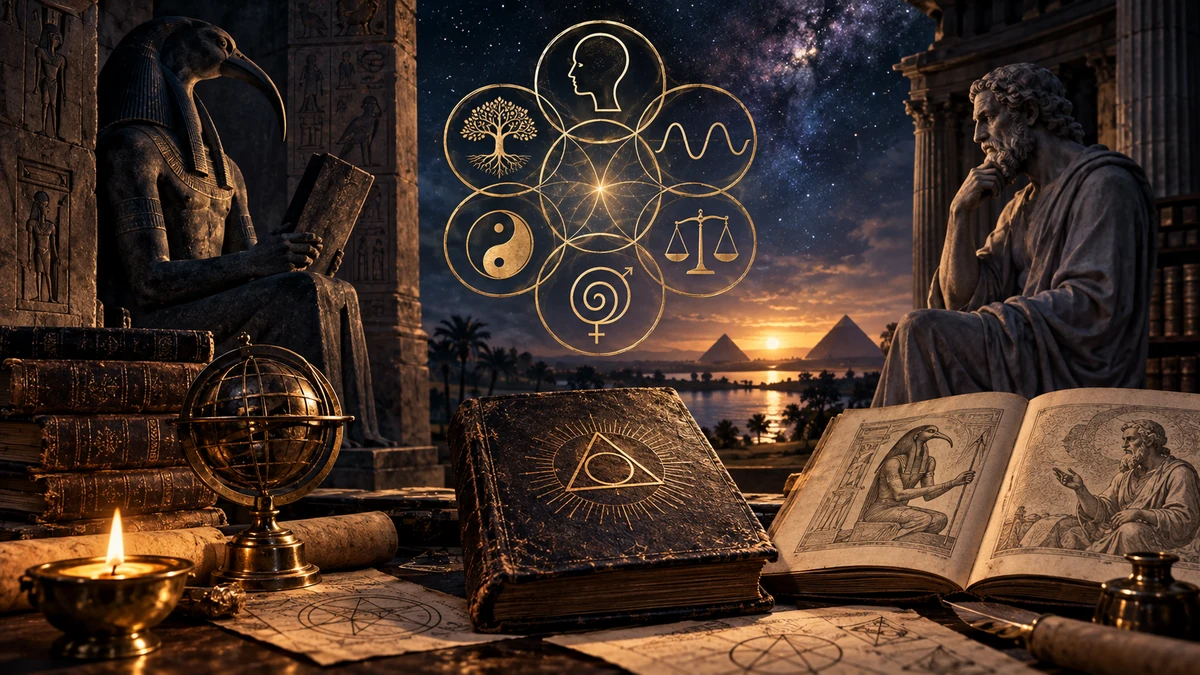
The seven Hermetic principles — Mentalism, Correspondence, Vibration, Polarity, Rhythm, Cause and Effect, and Gender — are often presented today as a very ancient system of wisdom from Hermes Trismegistus. In this exact sevenfold form, however, history does not trace them to pharaonic Egypt or to the ancient Corpus Hermeticum. The system is directly attested in The Kybalion, published in Chicago in 1908 under the name “Three Initiates”.
The seven principles are often presented as basic laws of Hermetic philosophy inherited from ancient Egypt and Greece, but the textual history does not support that formulation. Correcting the provenance does not require us to discard them. The Kybalion is a modern synthesis combining older Hermetic motifs, nineteenth-century occultism and American New Thought into an unusually influential metaphysical system.
The most useful approach is therefore to ask two separate questions about each principle: does it have an older Hermetic antecedent, and is its modern formulation philosophically or practically useful? Historical antiquity and spiritual value are not the same question.
The article preserves the experiential and symbolic value of the ideas while separating metaphysics from physics. When we discuss universal Mind, vibration of consciousness, cosmic polarity or archetypal gender, we are discussing philosophical or spiritual models — not propositions directly demonstrated by quantum physics.
Three different Hermeticisms: Hermes and the ancient Hermetica
The word Hermeticism now covers several historical layers. The first is the Greek and Latin Hermetic literature of late antiquity — above all the Corpus Hermeticum and the Asclepius — composed in a Graeco-Egyptian environment during the first centuries CE. The second is the medieval and Renaissance Hermetic-alchemical tradition, including the Emerald Tablet. The third is modern Western esotericism of the nineteenth and twentieth centuries.
The Kybalion belongs to the third layer. Its author or authors translated older motifs into the language of mental power, vibration, universal law and personal mastery characteristic of New Thought.
Hermes Trismegistus is a syncretic wisdom figure formed through the association of Greek Hermes with Egyptian Thoth. Ancient and later texts attributed philosophical, astrological, magical and alchemical teachings to him.
Modern historians of religion do not treat these works as the oeuvre of one historical Egyptian sage. The Hermetic literature is a corpus of different authors and periods united by the authority of the name Hermes. A resemblance between a modern idea and a Hermetic theme therefore does not establish that “Hermes” once wrote it down as a universal law.
The Corpus Hermeticum contains dialogues about God, Nous or divine Mind, the generation of the cosmos, the soul, knowledge and rebirth. The texts have strong metaphysical affinities with several later Hermetic ideas.
But the surviving ancient corpus does not present Mentalism, Correspondence, Vibration, Polarity, Rhythm, Cause and Effect, and Gender as seven foundational laws. This does not prove that no similar idea ever existed orally; it means that the sevenfold scheme cannot historically be presented as an attested ancient doctrine.
The Kybalion of 1908 and its Hermetic placement
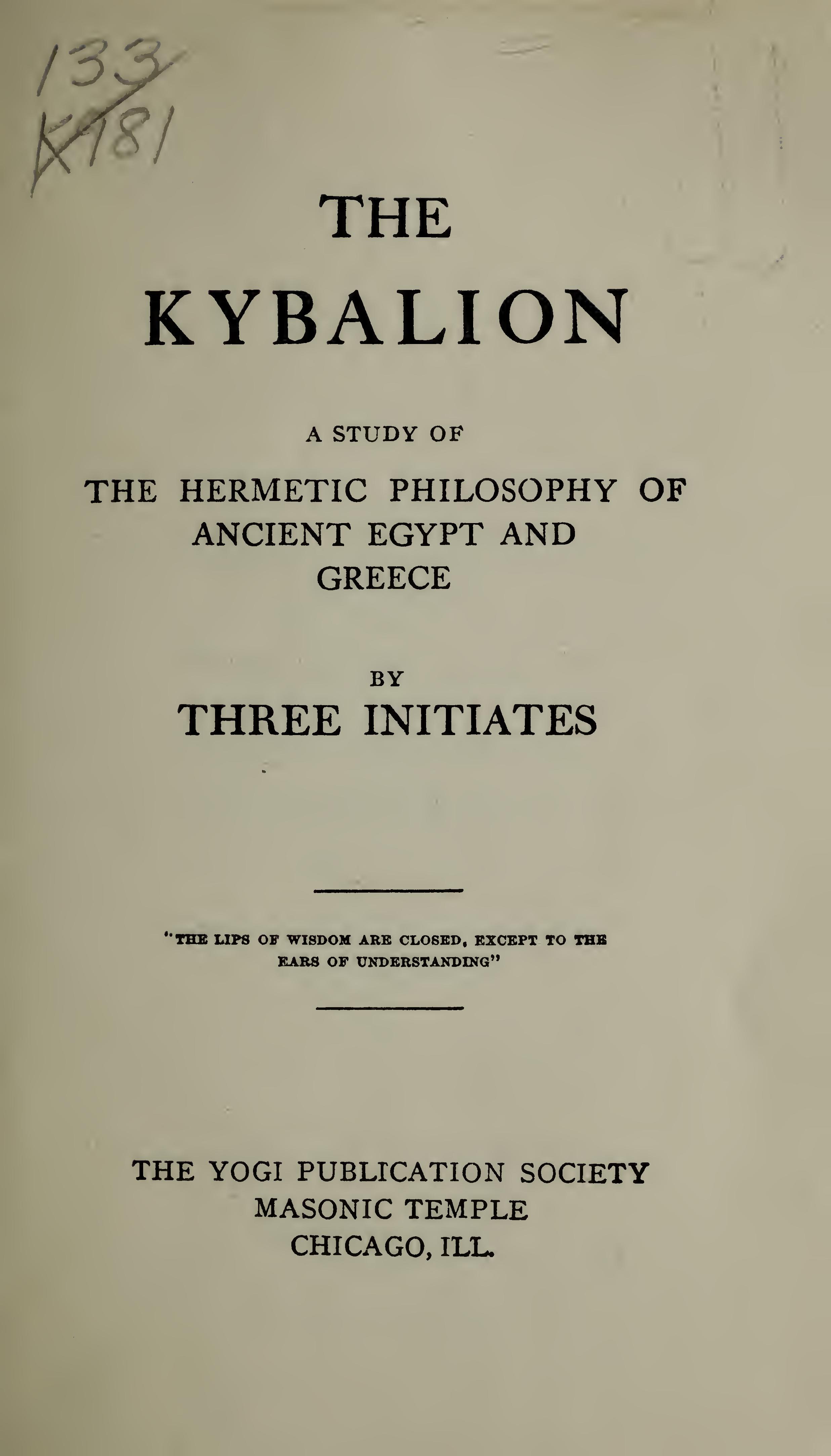
The original The Kybalion: A Study of the Hermetic Philosophy of Ancient Egypt and Greece was published in Chicago in 1908 by the Yogi Publication Society under the name “Three Initiates”. Chapter II directly lists all seven principles in the order now familiar.
The strongest modern attribution points to William Walker Atkinson, a prolific New Thought author and editor. Philip Deslippe assembled bibliographic, stylistic and thematic evidence for Atkinsonian authorship; complete agreement about possible collaborators is not necessary for the central conclusion: the book is modern, not ancient.
A modern book can genuinely continue an older tradition without itself being ancient. The Kybalion invokes Hermes Trismegistus, a universal divine source, microcosm and macrocosm, mental transmutation and relations between visible and invisible levels of reality.
The problem begins only when modern systematisation becomes a claim of direct ancient provenance. A more accurate description is therefore a modern or neo-Hermetic system with genuine older Hermetic echoes.
Mentalism and the limits of quantum analogies
Mentalism is among the principles with the strongest conceptual affinity to ancient Hermetica. In the Corpus Hermeticum, Nous — divine Mind or Intellect — is central to understanding God, cosmos and humanity’s spiritual origin. The cosmos is not treated as mere dead mechanism.
But the Kybalion formula “THE ALL is MIND; The Universe is Mental” is not simply a quotation from the ancient Corpus Hermeticum. It is a modern idealist and New Thought systematisation. It may be read as a metaphysical claim that consciousness is fundamental; it should not be presented as an experimental conclusion of physics.
The interpretation can therefore keep the distinction among personal perception, collective belief and metaphysical Divine Mind, while making clear that the first two can be studied psychologically and socially, whereas the third remains a philosophical or spiritual position.
In modern esoteric discussions of Mentalism, writers often invoke quantum observation as a hint that consciousness participates in creating reality. That connection is too strong. In physics, quantum measurement is a physical interaction between a system and apparatus or environment; successful laboratory formalism does not require human consciousness as a special collapse mechanism.
Interpretations of quantum mechanics remain a genuine philosophical field, and some are more realist while others emphasise information or relations. But the empirical success of quantum mechanics does not entail Kybalion Mentalism. Any connection between them should be labelled a philosophical analogy.
Correspondence and the false atomic analogy
The principle “as above, so below” has a much more direct historical connection. A related formula belongs to the Emerald Tablet, a short alchemical text attributed to Hermes Trismegistus.
An important correction is required: the earliest known trace of the Emerald Tablet is not a pharaonic hieroglyph but an Arabic tradition in the Book of the Secret of Creation, probably from the early medieval period. Later Latin forms profoundly influenced European alchemy and Hermeticism.
Correspondence between microcosm and macrocosm is therefore far older than The Kybalion. Yet it is a method of analogy, not proof that different scales of nature must possess literally identical structures.
Correspondence is often illustrated with a nucleus surrounded by electrons and a solar system surrounded by planets. It is a memorable image, but physically outdated.
Bohr once used a planetary model, whereas modern quantum mechanics describes electron states and probability distributions rather than tiny planets following definite circular paths. Correspondence can remain a symbolic method for noticing patterns, not an argument from atomic physics.
Vibration: spiritual metaphor and physical boundary
The Kybalion states that nothing rests and everything moves or vibrates. The dynamic nature of the physical world is not in doubt: sound involves oscillation, electromagnetic radiation has wave properties, molecules have vibrational states and quantum fields are dynamic.
But the Kybalion principle goes much further, placing material, mental and spiritual states on one universal spectrum of vibration. Historical analysis shows that this language is much closer to modern theories of vibration, Mesmerism and New Thought than to the ancient Corpus Hermeticum.
When modern spiritual language says love, truth or compassion “vibrate high” while fear and hatred “vibrate low”, this can function as a useful metaphor for psychological states, behavioural consequences and experiences of expansion or contraction.
There is no established physical measurement of these states analogous to the frequency of light or sound. Presenting spiritual language as physical fact weakens precisely the part of the idea that can remain symbolically powerful.

Polarity and rhythm
Opposites, complementarity and transitions between extremes are ancient philosophical themes and are not unique to The Kybalion. Hermetic literature also uses paired structures, hierarchies and the reconciliation of opposites.
The Kybalion turns this into a universal law in which opposites share one nature and differ mainly by degree. That works well for temperature; applying it to morality, truth and falsehood, or love and hatred is a philosophical interpretation rather than a self-evident natural measurement.
Polarity can remain as a tool of mental transmutation — fear toward courage, hatred toward compassion — without claiming that every opposition is physically one continuum.
Nature is full of rhythms: day and night, seasons, biological cycles, waves, orbital motions and many economic or social periodicities. This gives the principle intuitive force.
But the Kybalion law that every pendulum must swing from one extreme to the other in compensating measure is not a general scientific law of history or psychology. Recession does not follow every boom by Hermetic mathematical necessity, nor do civilisations obey one predetermined cycle.
As practical wisdom — that states pass and that balance is useful in both rise and fall — the principle can remain valuable without being universalised into cosmological necessity.
Cause, effect and gender
Causality is foundational to ordinary reasoning and scientific inquiry. Actions have consequences, habits shape later behaviour, political decisions have effects and ignorance of causes does not prevent consequences.
The Kybalion adds the stronger claim that chance is merely a name for a law not yet recognised. That is metaphysical determinism, not something modern physics simply proves. Quantum theory uses fundamental probabilities, and interpretations differ on underlying ontological determinism.
The moral extension of this principle also needs care. People may suffer because of their own decisions, social structures, other people’s actions or events beyond their control. Responsibility matters, but it must not become the claim that every victim caused their own suffering.
Ancient religions and Hermetic cosmology contain generative, androgynous, paternal and maternal imagery. The idea that creation involves complementarity among different powers is much older than The Kybalion.
But the Kybalion law that “gender manifests on all planes” is a modern metaphysical systematisation. When masculine principle is associated with activity, logic and projection, and feminine principle with receptivity, intuition and nurture, we are dealing with symbolic archetypes — not scientifically established traits of all men and women.
The most productive reading is inner complementarity: a person needs activity and receptivity, analysis and intuition, determination and nurture. That is different from prescribing biological or social roles.
The “eighth principle” and what is supported after verification
Some modern systems add a “lost” principle of Care. It is not an eighth principle in The Kybalion: the 1908 book explicitly says the principles are seven. Nor have we found a canonical ancient Hermetic eighth principle under that name.
The modern connection comes from Mark Passio’s Natural Law teaching environment, where Care is presented as the missing generative factor that turns knowledge and will into action. This can be an important element of a contemporary Natural Law synthesis, but it should be labelled accordingly: a modern addition, not a lost text of Hermes.
First, the seven principles form a coherent system for thinking about consciousness, analogy, change, opposites, cycles, responsibility and generation. Their practical force does not depend on whether they are three thousand or one hundred years old.
Second, several themes have genuine older Hermetic roots: divine Nous, cosmos as an ordered living whole, spiritual transformation, and relations between higher and lower or microcosm and macrocosm.
Third, Hermetic traditions have always lived through reinterpretation. Renaissance Hermetists were not identical to late-antique authors, and modern occultists are not identical to Renaissance Hermetists. The Kybalion belongs to that history of reinterpretation even if it is not its ancient origin.
The most important correction concerns the sentence that “in Hermetic philosophy originating in ancient Egypt and Greece there are seven basic principles”. More precisely: the modern Kybalion presents seven principles as the essence of Hermetic philosophy; individual principles have older parallels of very different strength.
Modern-physics arguments also need correction. Quantum observation does not prove Mentalism; the electron is not a planet; physical frequency does not establish the “vibration of love”; and quantum probability does not prove that every apparent chance event is merely an unknown cause.
Finally, Care should be identified as a modern addition from Natural Law teaching rather than a lost ancient eighth Hermetic principle.
Final meaning: historically younger does not mean spiritually empty
Removing the mistaken idea that The Kybalion is a literal transcript of a secret ancient Egyptian doctrine does not remove its importance. It becomes more interesting as a document of the moment when older Hermetic images met New Thought, mental self-discipline, modern occultism and the language of early modern science.
The seven principles can therefore be used as metaphysical and psychological lenses: ask how mind shapes experience; where patterns recur; what changes; which poles are in tension; what rhythms return; what consequences actions produce; and which complementary forces require balance.
But fidelity to truth requires that symbolic wisdom not be confused with historical provenance or physical proof. In this way we can preserve the core aim — the search for order, responsibility and inner transformation — while clearly stating what is ancient, what is modern and what remains a metaphysical hypothesis.
Sources and further reading
- Three Initiates. The Kybalion: A Study of the Hermetic Philosophy of Ancient Egypt and Greece. Yogi Publication Society, 1908.
- Project Gutenberg. The Kybalion — public-domain text, Chapter II: The Seven Hermetic Principles.
- Penguin Random House / Philip Deslippe ed. The Kybalion: The Definitive Edition (2011) — Atkinson/New Thought historical context.
- Chapel, Nicholas E. The Kybalion’s New Clothes: An Early 20th Century Text’s Dubious Association with Hermeticism.
- Cambridge Handbook of Western Mysticism and Esotericism — Renaissance Hermetism.
- Cambridge Handbook of Western Mysticism and Esotericism — Hermetism and Gnosticism.
- Copenhaver, Brian P. Hermetica: The Greek Corpus Hermeticum and the Latin Asclepius — Introduction.
- Copenhaver, Brian P. Hermetica — Corpus Hermeticum XI.
- Copenhaver, Brian P. Hermetica — Corpus Hermeticum XIII.
- Oxford Academic. The Emerald Tablet tradition and the early ninth-century Book of Secret Creation.
- Stanford Encyclopedia of Philosophy. Chance versus Randomness — quantum probability and chance.
- Stanford Encyclopedia of Philosophy. Causal Determinism — chance, determinism and quantum mechanics.
- Yu, Shan & Nikolić, Danko. Quantum mechanics needs no consciousness. Annalen der Physik (2011).
- OpenStax. College Physics 2e — wave nature of matter and the probability-cloud model.
- OpenStax. College Physics 2e — Bohr theory and the limits of planetary electron orbits.
- What On Earth Is Happening. The Kybalion — copy used in Mark Passio’s teaching archive.
- What On Earth Is Happening. Natural Law seminar videos and presentation materials, 19 Oct 2013.
- One Great Work Network. Natural Law: The Science of Morality — thesis explicitly based on Mark Passio’s Natural Law seminar.
- One Great Work Network. Drawing Nature In — series listing 'The Lost Principle of Care' separately from the seven laws.