The Frankfurt School: critical theory, the culture industry and later myths
What did Horkheimer, Adorno and Marcuse actually argue, how did their ideas influence the New Left, and where does documented history end and the later “Cultural Marxism” narrative begin?
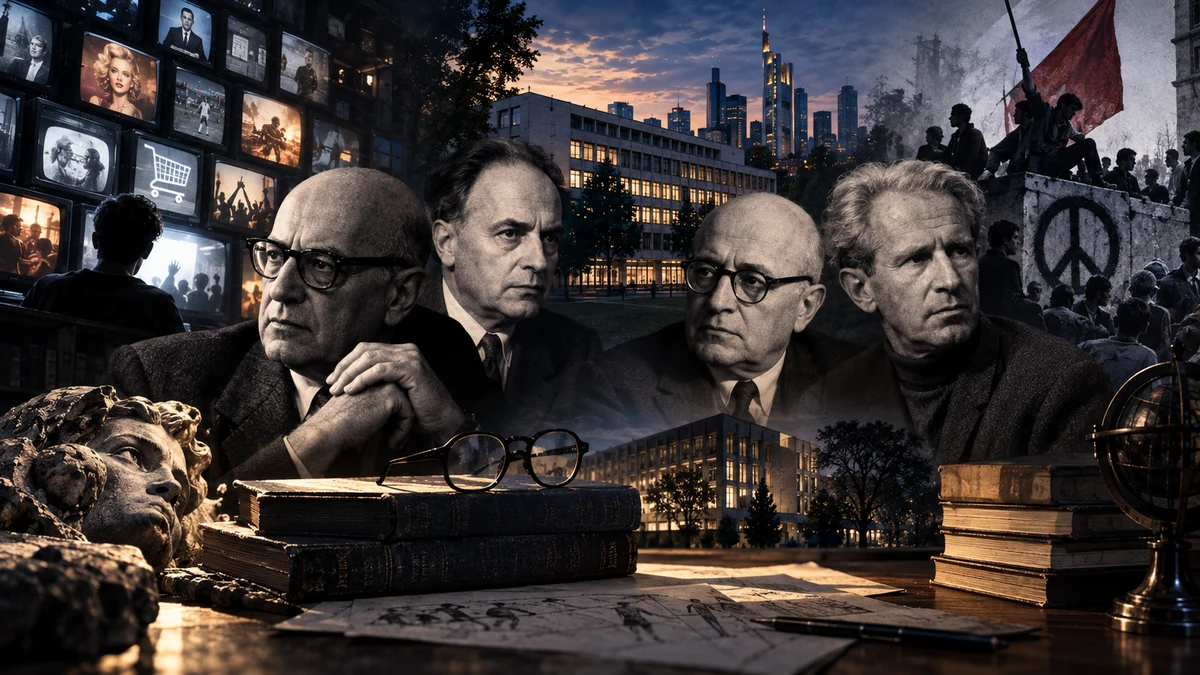
The Frankfurt School has become almost two different things. The first is a real intellectual tradition connected to Frankfurt’s Institute for Social Research: Horkheimer, Adorno, Marcuse, Fromm, Löwenthal, Pollock and associated thinkers tried to understand capitalism, fascism, mass culture, authority and the psychological mechanisms of modern society.
The second is a later political narrative in which very different developments — the sexual revolution, feminism, multiculturalism, political correctness, student protest, the weakening of the family and almost every modern cultural change — are assembled into one project of “Cultural Marxism”. Some connections have a genuine historical basis; others emerge only by combining authors, periods and intentions that do not appear in primary sources as a single operation.
An important starting question is how ideas can reshape institutions and culture over long periods. Some Frankfurt School texts are explicitly normative and radical rather than merely neutral academic observation. But understanding their real influence requires separating what individual authors actually wrote, their influence on the New Left, and later claims about a coordinated plan to dismantle Western society.
The article therefore does not ask whether the Frankfurt School was “good” or “bad”. It asks a more precise question: which ideas did its thinkers actually defend, how did those ideas influence later movements, and where does the historical evidence end and the political myth begin?
Origins of the Frankfurt School and the problem of social obedience
Its institutional core was the Institute for Social Research, founded in Frankfurt in 1923. Its early orientation was explicitly connected to the history of Marxism, the labour movement and political-economic analysis. Under Max Horkheimer, the programme moved away from orthodox Marxism and developed into the interdisciplinary social criticism now known as critical theory.
After the Nazi seizure of power the Institute was closed in 1933 and, after several moves, relocated to the United States, where it operated in association with Columbia University. It returned to Frankfurt after the war. This history matters because Frankfurt School theory developed between two major twentieth-century problems: the failure of the expected socialist revolution in the West and the rise of fascism.
The starting problem can be summarised as follows: why did workers not carry out the revolution Marxist theory expected? This is simplified, but it captures part of the issue. The Institute genuinely investigated why people accept social relations that critical theory regarded as exploitative or authoritarian.
This is why Freud became important alongside Marx. Erich Fromm and others used psychoanalysis to examine authority, family, character and political obedience. Marcuse later explicitly linked psychoanalytic categories with social and political criticism in Eros and Civilization. But this does not yield the simple formula “tradition prevented revolution, therefore tradition must be destroyed”; individual thinkers developed substantially different diagnoses.
Critical theory and the culture industry
In 1937 Horkheimer distinguished “traditional” from “critical” theory. Critical theory does not treat society as an external and fixed object; it asks how historical relations of power shape the economy, institutions and consciousness, and what possibilities for emancipation exist.
An important starting point is that critical theory was not politically neutral in the sense of merely describing the world. It had an emancipatory purpose. But “emancipation” did not mean a single operational plan, and the thinkers did not agree on which institutions should change or by what method.
Horkheimer and Adorno developed the concept of the culture industry in Dialectic of Enlightenment. Their point was not that every form of popular culture is propaganda for one political party, but that mass culture in a commercial system becomes standardised commodity production. Entertainment, advertising and mass media can reduce critical distance and reconcile people to the existing order.
This point has strong support in the primary work. Where the source moves directly from Hollywood to today’s algorithms, however, it is better to speak of an analogy, not direct inheritance. Platforms, personalisation and the attention economy can resemble their diagnosis of standardised entertainment, but they are not evidence that the Frankfurt School planned them.

Family, authority, Freud and Marcuse
Frankfurt researchers did treat the family as an important setting in which authority is formed. Studies on authority and family and the later Authoritarian Personality explored connections among early socialisation, conventionalism, submission to authority, aggression and susceptibility to fascist or antisemitic ideology.
But the claim that there was a common programme to “destroy the family” goes beyond the evidence. Criticism of patriarchal or authoritarian family structures is not identical to abolishing the family as an institution. Radical proposals about sexuality and socialisation can be found in particular writers, but they should be attributed to specific texts and authors rather than the entire tradition.
Herbert Marcuse went further than Horkheimer or Adorno on repression. In Eros and Civilization he asked how much sexual and psychological repression is genuinely necessary for civilisation and how much is produced by a particular historical organisation of society. He considered the possibility of a less repressive culture and different relations to work, pleasure and sexuality.
Criticism of traditional morality therefore has a real textual basis. Marcuse did not merely analyse existing norms; he argued for radical transformation. Yet his project was primarily a philosophical and psychoanalytic theory of liberation. The claim that it constituted a secret programme for later public policy requires an additional evidentiary chain.
False needs and repressive tolerance
In One-Dimensional Man, Marcuse distinguishes vital needs from “false needs” imposed on individuals by particular social interests and then experienced as their own. He includes needs connected with consumption, entertainment and lifestyles that reproduce relations of domination.
This is strongly supported by Marcuse’s own argument. Marcuse’s point is precisely that modern society controls not only through repression but also through comfort, consumption and the shaping of desire. This is a genuine critique of capitalist consumer culture, not a later invented attribution.
Marcuse’s 1965 essay Repressive Tolerance matters because it shows that his theory was not consistently liberal in the classical sense. He argued that formally equal tolerance within unequal power structures could preserve oppression and, under particular historical conditions, defended withdrawal of tolerance from regressive movements and greater tolerance toward the emancipatory Left.
This can be criticised as a dangerous asymmetry because someone must decide which views are “progressive” and which are “regressive”. At the same time, it would be inaccurate to turn the essay into proof that Marcuse invented modern censorship or that every contemporary speech restriction derives from him. The idea is documented; concrete lines of influence require separate evidence.
The New Left and the “long march through the institutions”
Marcuse became one of the most recognisable intellectual influences on the 1960s New Left. His criticism of consumerism, militarism, sexual repression and “one-dimensional” society resonated strongly with students and anti-war movements.
But the “Frankfurt School” divided sharply here. Adorno’s relationship with the student movement became increasingly conflictual and he resisted directly translating theory into revolutionary praxis; Horkheimer was also considerably more cautious. Marcuse was the clearest exception among the older generation in his direct political engagement.
The phrase “long march through the institutions” is associated with Rudi Dutschke and the West German New Left, not with the original programme of the Frankfurt Institute in the 1920s or 1930s. Marcuse later explicitly endorsed the strategy.
In a 1971 address he explained it as entering institutions, learning how their work is done, educating oneself and others, and building counter-institutions and alternative media. The strategy should therefore not be treated as a later invention. The correction is attribution: it was a Dutschke/New Left strategy embraced by Marcuse, not proof that Adorno, Horkheimer and every heir of critical theory followed one coordinated plan of infiltration.

Tradition, moral relativism and religion
Much of their work is unquestionably directed against traditional forms of authority, sexual morality, capitalist production and mass culture. Marcuse in particular developed radical ideas about sexuality and social norms. Adorno and Horkheimer were deeply sceptical of conformity and inherited authority, but also of the mass culture that dissolved older cultural forms and replaced them with commercial standardisation.
“Critique of tradition” is therefore defensible. Less defensible is the simple programme: destroy family, religion, morality and nation so people become easier to control. Their own texts overwhelmingly attack domination and manipulation rather than advocate them. The more interesting paradox is that an emancipatory theory can itself produce mechanisms critics understand as new forms of ideological coercion.
The Frankfurt School is often attributed the idea that universal moral values do not exist and morality is merely a social construction of power. As a collective label this is too broad. Critical theorists certainly attacked moral systems when they saw them as legitimating domination, but their own arguments relied on strong normative concepts: freedom, reduced suffering, non-domination, rationality and emancipation.
It is therefore difficult to describe them simultaneously as complete moral relativists and as thinkers who strongly condemn fascism, antisemitism, manipulation and domination. A more precise account is that they questioned traditional moral authorities and sought alternative grounds for normative criticism.
Marxist criticism of religion forms part of critical theory’s intellectual background, but the Frankfurt School cannot simply be reduced to the slogan “religion is the opium of the people”. Different members related very differently to religion, Jewish tradition, theology and secularisation.
Adorno, Benjamin and later critical theorists also drew on theological motifs and negative theology as sources of criticism of the existing world. A uniform programme to eliminate religion therefore lacks the evidentiary basis found for their documented critiques of capitalism or authoritarianism.
“Cultural Marxism”, members’ backgrounds and actual influence
The term “Cultural Marxism” is used in several senses. In a broad academic sense it can describe Marxist or neo-Marxist approaches to culture, ideology and media. In political rhetoric it has also become a label for a much wider theory in which a coordinated network of intellectuals supposedly captured education, media and culture in order to dismantle Western values.
The historical problem with the second version is that it combines the Frankfurt School, Gramsci, Dutschke, post-structuralism, feminism and many later movements into one organised genealogy despite significant disagreements, gaps and different historical contexts. Some scholars also note that certain political versions of this narrative adopted antisemitic motifs; this does not mean that every criticism of critical theory or the cultural Left is automatically antisemitic.
Several important Institute members were of Jewish background, and the Nazi regime itself forced many of them into exile. This is relevant to understanding their interest in fascism, antisemitism and the authoritarian personality.
It is not methodologically valid to infer from their ancestry a shared political conspiracy or an intention to “dismantle Western civilisation”. Ideas must be assessed through texts, institutional connections and documented influence. Ethnic or religious identity by itself does not prove political motive.
The influence was genuine but uneven. Marcuse strongly influenced parts of the New Left; critical theory became important in sociology, philosophy, media and cultural studies; Habermas and later generations developed it in new directions.
But the fact that some ideas became academically influential does not mean most changes in universities came from a single doctrine. Contemporary humanities and social sciences also draw from liberalism, feminism, post-structuralism, postcolonial studies, analytic philosophy, empirical sociology and many other traditions that often conflict with one another.
What is supported and what requires correction
First, ideas really can outlive their authors and influence institutions over long periods. Second, critical theory was not politically neutral: it intended to contribute to emancipation and social transformation. Third, Marcuse genuinely defended radical critiques of sexual repression, consumer “false needs”, asymmetrical tolerance and later the strategy of a long march through institutions.
Fourth, the culture-industry critique remains strikingly useful for understanding standardised entertainment, advertising and systems that monetise attention. This part of the Frankfurt School should not be dismissed merely because it is now invoked by very different political camps.
There is no demonstrated evidence that the Frankfurt School as a single organisation designed a plan to dismantle family, religion, morality and national identity so that people could later be controlled more easily. It is inaccurate to assign the “long march” to the original Frankfurt School without Dutschke and Marcuse’s later endorsement. It is also too broad to describe every member as a moral relativist or direct ideologue of contemporary identity politics.
It is also essential to distinguish influence from causation. A later idea resembling Marcuse does not by itself prove that it historically came from Marcuse. Citations, reception histories, curricula, political documents or direct genealogies are needed before similarity becomes an evidentiary chain.
The paradox: theory against control can become a tool of new control
The most productive part of the original theme is not the claim that the Frankfurt School simply created a “culture of control”. Its writers actually wrote extensively against administered society, fascism, manipulation, mass conformity and psychological domination.
The more difficult question is whether a project of liberation that classifies some needs as false, some forms of tolerance as repressive and some traditions as carriers of domination can itself create a new authority that tells people which consciousness is correct. That question arises from the texts themselves and does not require a conspiracy theory.
The article therefore preserves the core insight that ideas have consequences — but reformulates it more precisely: instead of searching for one hidden centre, it follows concrete texts, their actual successors and the moments when a critique of power itself begins to demand power over language, institutions or permissible ideas.
Sources and further reading
- Institut für Sozialforschung. History of the Institute for Social Research.
- Stanford Encyclopedia of Philosophy. Critical Theory (Frankfurt School).
- Stanford Encyclopedia of Philosophy. Theodor W. Adorno.
- Stanford Encyclopedia of Philosophy. Herbert Marcuse.
- Horkheimer, Max. Traditionelle und kritische Theorie (1937), bibliographic record.
- Horkheimer, Max & Adorno, Theodor W. Dialectic of Enlightenment — Culture Industry chapter.
- Adorno, Theodor W.; Frenkel-Brunswik, Else; Levinson, Daniel J.; Sanford, R. Nevitt. The Authoritarian Personality (1950), online book record.
- Marcuse, Herbert. Eros and Civilization — Introduction.
- Marcuse, Herbert. Eros and Civilization — contents and chapter structure.
- Marcuse, Herbert. One-Dimensional Man — Chapter 1, false needs and social control.
- Marcuse, Herbert. Repressive Tolerance (1965), full text.
- Marcuse, Herbert. The Movement in a New Era of Repression (1971) — long march through the institutions.
- Marcuse, Herbert. Counterrevolution and Revolt (1972), official bibliography page.
- Adorno, Theodor W. & Marcuse, Herbert. Correspondence on the German Student Movement.
- Freyenhagen, Fabian. Adorno’s politics: Theory and praxis in Germany’s 1960s.
- Jansen, Peter-Erwin. The Frankfurt School’s Interest in Freud and the Impact of Eros and Civilization on the Student Protest Movement in Germany.
- Therborn, Göran. The Frankfurt School. New Left Review I/63 (1970).
- Valenta, Martin. Critical Theory of the Frankfurt School and the German Leftist Protest Movement: discourse and reception analysis.
- Jamin, Jérôme. Cultural Marxism: A survey. Religion Compass 12 (2018).
- Marcuse, Herbert. Eros and Civilization — 1966 political preface.
- Marcuse, Herbert. Eros and Civilization — critique of neo-Freudian revisionism.
- Columbia University / archived Frankfurt School reading resources.