Human Bioelectricity and Biomagnetism: The Measurable Body and Unmeasured Interpretations
Humans are measurably bioelectric and biomagnetic organisms. But ECG, EEG, MEG, cellular voltages and wound electric fields do not by themselves show that an aura, qi or a therapeutic biofield is the same physical category.
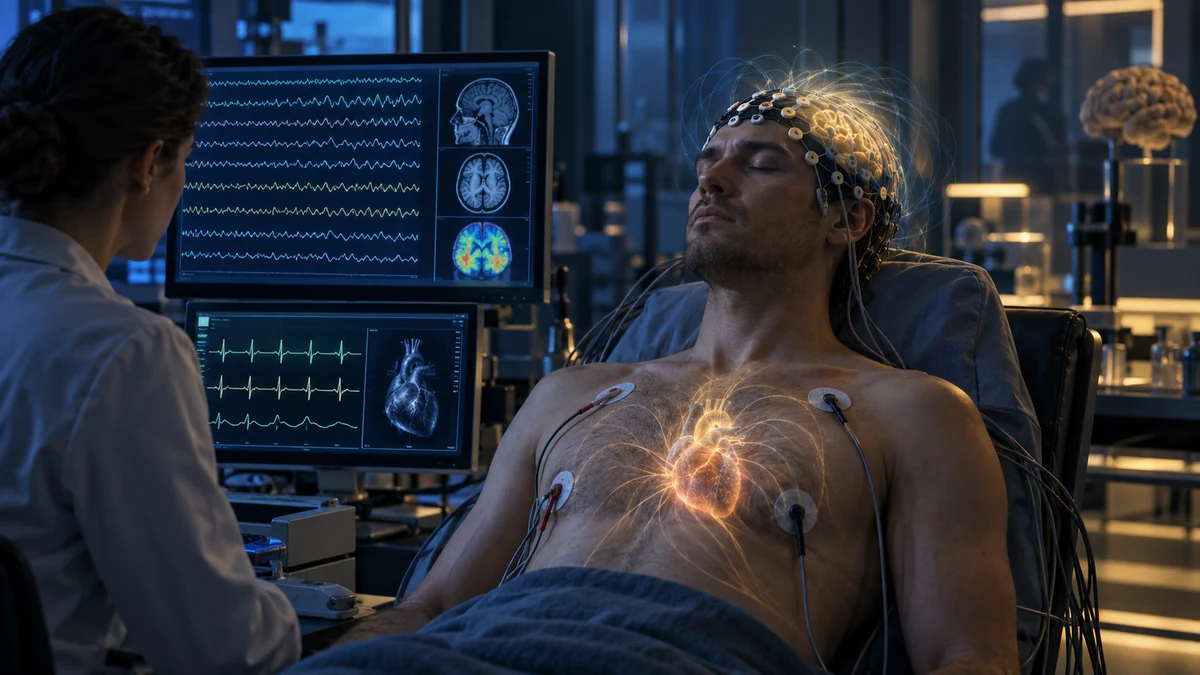
The human body is electrical in a literal, measurable sense. Every living cell maintains differences in electrical potential across its membrane, nerves transmit information through action potentials, and the heart produces electrical signals routinely measured by ECG. Brain activity is electrically organized enough to be detected at the scalp with EEG.
But the word 'energy' often skips several evidential steps in public discourse. The fact that the body uses electrical currents and generates magnetic fields does not automatically mean that an aura, qi, prana, or a therapeutic 'biofield' is already the same physical category. If something is claimed to be a physical field, the claim must specify what is measured, in what units, at what distance, with what detector, and how the signal is distinguished from noise.
This article therefore avoids the usual error in both directions. It does not dismiss bioelectricity as an 'alternative' topic, because much of modern physiology is bioelectricity. At the same time, it does not use real electrical phenomena as a rhetorical bridge to claims that do not yet have the same measurement support. The task is to separate the measurable body from interpretations attached to it.
Bioelectricity begins at the cell membrane
A cell is not a tiny battery in the popular sense, but its membrane really does separate electrical charge. Different concentrations of sodium, potassium, chloride and other ions on the two sides of the membrane, together with selective permeability through ion channels, create a membrane potential. In a typical resting neuron, the inside is negative relative to the outside, often roughly between −40 and −90 mV.
When a neuronal threshold is crossed, membrane permeability changes rapidly and an action potential is generated. This is a brief, reproducible voltage change that propagates along the axon. Electrical signaling is therefore not a metaphor for nervous function; it is part of its physical mechanism.
Electricity is not limited to neurons. Other cells also have membrane potentials. In muscle, glands, epithelia and embryonic tissues, ion flows are part of normal physiology even when they are not organized into fast nerve impulses.
ECG and EEG: the body has long revealed its electricity to instruments
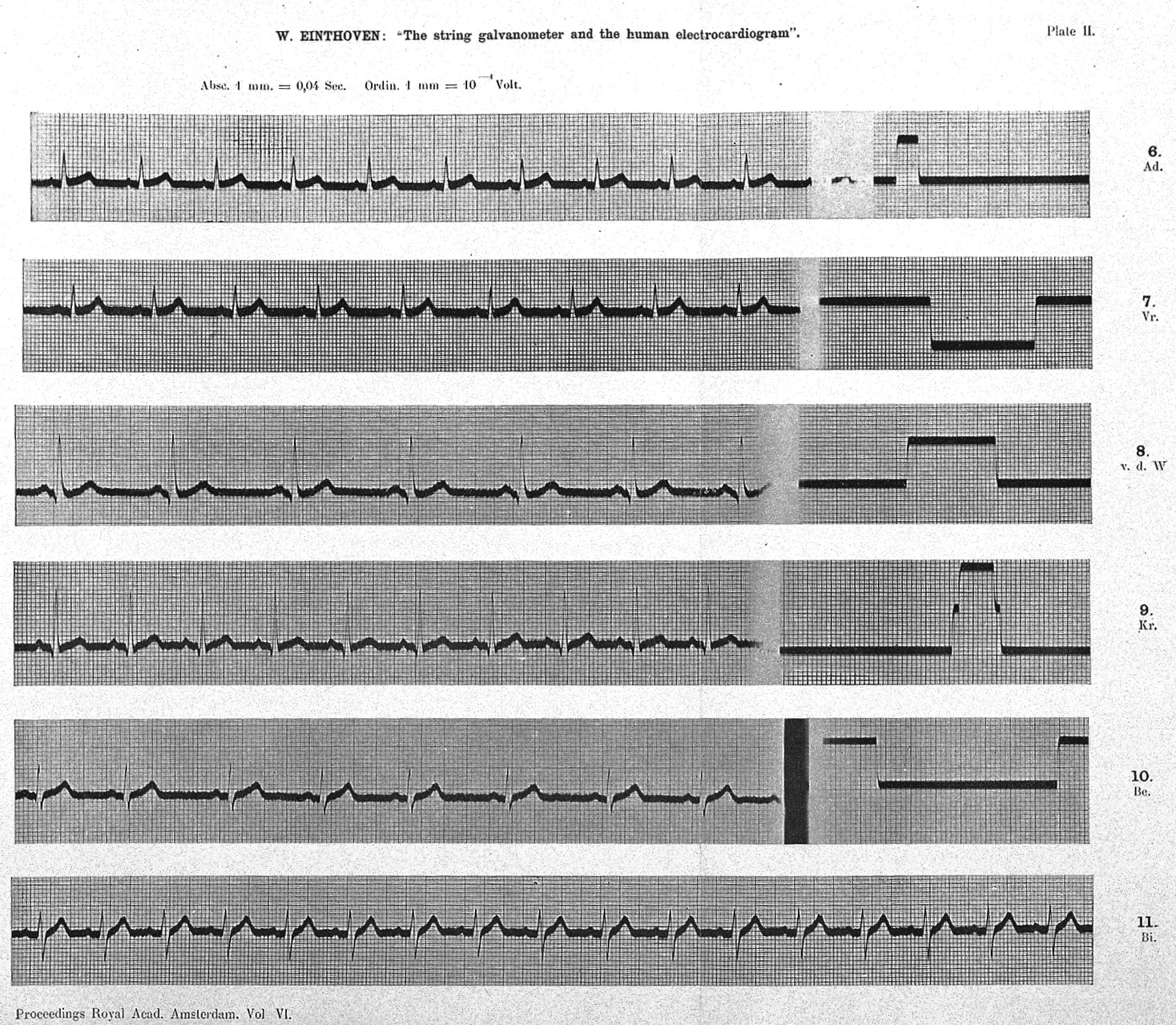
An electrocardiogram measures differences in electrical potential at the body surface produced by the coordinated depolarization and repolarization of millions of cardiac cells. The clinician is not measuring the 'energy of the heart' in a symbolic sense but defined voltage changes whose timing carries clinical information.
EEG is a comparable demonstration in the brain but records a different collective phenomenon. Scalp signals mainly reflect summed postsynaptic potentials from large, similarly oriented populations of cortical neurons. Individual action potentials are too brief and too small to be the main source of routine scalp EEG.
This distinction matters methodologically: the fact that an organ's electrical activity can be detected at the skin does not mean it broadcasts a strong information-rich field over arbitrary distances. Geometry, amplitude, tissue conductivity and detector sensitivity are part of the claim.
Electrical currents create magnetic fields — including in humans
Every electrical current creates a magnetic field. Because neural and cardiac activity involves moving charges, the body also produces biomagnetic fields. Magnetoencephalography measures magnetic signals associated with coordinated neuronal activity; cortical fields are extraordinarily weak, often in the femtotesla range, requiring extremely sensitive sensors and careful control of environmental noise.
Magnetocardiography similarly records magnetic fields generated by the electrical activity of the heart. The technology is real, but its existence does not imply that the human biomagnetic field is strong or that it carries arbitrary psychological information. On the contrary, the need for SQUIDs or other highly sensitive magnetometers illustrates how tiny these signals are compared with ordinary magnetic environments.
'Biomagnetism' is therefore a legitimate scientific term. The problem begins only when it is expanded without a measurement bridge into claims that the same field permits remote diagnosis, emotional reading or healing of another person.
Slow bioelectricity is more than a nerve impulse
In recent decades, research has expanded into slower bioelectric patterns outside the nervous system. All tissues possess transmembrane potentials, and groups of cells can form spatial voltage patterns through ion channels and gap junctions. Developmental bioelectricity research indicates that such patterns participate in the regulation of growth, differentiation, morphogenesis and regeneration.
This field is a useful example of why scientific skepticism should not become automatic rejection of an unconventional idea. For many decades electrical physiology was associated mainly with nerve and muscle; today a serious experimental program investigates electrical coordination in non-neural tissues as well.
Precision still matters. The phrase 'bioelectric code' is a research concept about informational patterns in membranes and tissues, not proof that cells possess human-like consciousness and not proof of an esoteric energy body.
A wound generates an electric field and cells respond to it
When an epithelial layer is disrupted, the normal ionic separation is broken and a current of injury, or endogenous wound electric field, appears. Such fields were observed at human skin wounds in the nineteenth century, and modern measurement has confirmed their existence and enabled controlled experimentation.
Many cells migrate directionally in electric fields comparable to physiological wound fields. This behavior is called electrotaxis or galvanotaxis and may help guide cells toward damaged tissue. Electrical stimulation is therefore studied and used as an adjunct in some hard-to-heal wounds, although optimal parameters and mechanisms are not uniform across clinical situations.
This is an important boundary for this article: the sentence 'the body can heal with electricity' can be true in a specific biomedical sense. It does not license the conclusion that every practice using the word energy works through the same mechanism.
Electricity and magnetism can be therapies — when dose, location and mechanism are concrete
Modern medicine deliberately intervenes in bioelectric function. Deep brain stimulation delivers programmed electrical pulses to selected brain structures. Vagus nerve stimulation uses electrical impulses, while transcranial magnetic stimulation uses a rapidly changing magnetic field to induce electric currents in the brain.
These therapies are a useful antidote to the claim that science 'does not recognize energy.' It recognizes it where quantities are defined: amplitude, frequency, duration, geometry, target tissue and clinical outcome. Effects depend on parameters; the wrong dose or target may be ineffective or harmful.
The label 'electromagnetic' is therefore neither a certificate of efficacy nor a warning label by itself. Mechanism and evidence are the standard, and the same standard should apply to a medical device, a commercial wellness product and an alternative therapy.
Magnetite in the brain and the question of human magnetoreception
Magnetite and magnetite-maghemite structures have been measured in human brain tissue. Later work showed that some magnetic nanoparticles in the brain may also originate in air pollution, so the mere presence of magnetite does not tell us its biological function.
In 2019, researchers reported a repeatable decrease in EEG alpha activity following certain rotations of Earth-strength magnetic fields. The result is interesting because it suggests a possible nonconscious brain response to geomagnetic stimulation. Yet the authors themselves began from the fact that human magnetoreception had not been conclusively established, and the experiment did not demonstrate a conscious behavioral compass.
The appropriate stance is therefore open and strict at the same time: the finding deserves independent replication and further work, but it is not permission to jump to claims of conscious magnetic navigation, telepathy or reading other people's fields.
Aura, qi, prana and the 'biofield': similar language is not the same mechanism
Many traditions have long spoken about qi, prana, vital force, subtle bodies or auras. These concepts can be studied historically, phenomenologically and as parts of lived experience. The problem begins when they are declared, without further evidence, to be the same thing as membrane voltage, an electromagnetic field or the magnetic signal detected by MEG.
That move sounds scientific because it borrows real words from physics, but it requires a measurement. If a practitioner claims to sense a physical energy field centimeters above the body, a blinded test should show detection above chance. In the well-known 1998 therapeutic-touch test, practitioners did not reliably identify which unseen hand of the investigator was positioned above theirs. NCCIH continues to state that scientific evidence for the energy field assumed in Reiki has not been established.
This does not imply that relaxation, attention, touch, ritual, expectation or interpersonal presence have no effects. It means that any psychological or bodily effect should not automatically be attributed to an unmeasured physical field.
External electromagnetic fields: between real effects, uncertainty and exaggeration
The human body is conductive, so external electric and magnetic fields can couple to it. At sufficiently strong low-frequency fields, currents are induced in the body that can stimulate nerves and muscles; this is a well-established physical mechanism. At radio frequencies, tissue heating becomes important at sufficiently high intensities.
Everyday low-level exposure is a different question. WHO and ICNIRP assessments distinguish established acute effects at high intensities from the epidemiology and remaining uncertainty surrounding weaker long-term exposures; WHO's extremely-low-frequency assessment, for example, retains the issue of limited evidence regarding childhood leukemia. An official exposure limit is therefore not metaphysical proof of absolute safety, but neither is it meaningless: it is an evidence synthesis that should be judged by methods and data rather than authority or automatic distrust.
It is equally wrong to take the fact that a strong field can produce a biological effect and conclude that every weak field must produce a clinically important effect. In physics, intensity, frequency, duration, distance and coupling are part of the question.
The measurable body needs neither materialist denial nor an esoteric add-on
Humans are bioelectric and biomagnetic organisms. This is not an alternative claim: without ionic gradients there is no nerve impulse, normal cardiac rhythm or many tissue processes. Bioelectric signals can be measured, manipulated and, under defined conditions, used therapeutically.
But that does not mean every traditional or modern use of the word 'energy' has already been described by physics. If a claim is metaphorical or spiritual, it should be labeled that way. If it is physical, it should specify what is measured. If it is therapeutic, it should show clinical effect and distinguish it from expectation, touch, natural history and other factors.
The most honest conclusion is therefore neither 'humans have no energy fields' nor 'science has finally proven the aura.' Measurable electrical and magnetic fields exist. Their functions are broader than a simplified nerve-and-muscle picture once suggested. The boundary between that knowledge and metaphysical interpretation remains a boundary until measurable, repeatable evidence crosses it.
Sources and further reading
- NCBI Bookshelf — Electrical Potentials Across Nerve Cell Membranes: resting membrane potential and action potentials in neurons.
- NCBI Bookshelf — The Ionic Basis of Action Potentials: sodium and potassium permeability underlying neuronal action potentials.
- NCBI Bookshelf — Ion Channels and the Electrical Properties of Membranes: voltage-gated channels and electrical excitability.
- NCBI Bookshelf — What is an electrocardiogram (ECG)?: surface measurement of cardiac electrical activity.
- NCBI Bookshelf — Scientific Basis of EEG: cortical neuronal populations underlying scalp EEG.
- NCBI Bookshelf — Reference Guide on Neuroscience: EEG and MEG as measurements of electrical activity and small magnetic fields generated by the brain.
- Singh (2018), PMC — Review of MEG: neuromagnetic cortical fields in the femtotesla range and measurement principles.
- Agarwal et al. (2019), PMC — Magnetocardiography systematic review: recording magnetic fields generated by cardiac electrical activity.
- Levin (2021), Cell — Bioelectric signaling in embryogenesis, regeneration and cancer: endogenous membrane-potential networks across tissues.
- Bates (2021), Development — Bioelectric signaling as a regulator of development and regeneration; all cell types possess membrane potential.
- McLaughlin & Levin (2018), Developmental Biology — Bioelectric signaling in regeneration and control of growth and form.
- Levin (2014), Journal of Physiology — Endogenous bioelectrical networks and non-genetic patterning information in development and regeneration.
- Zhao et al. (2009), PubMed — Electrotaxis and wound healing: endogenous wound electric fields as directional signals for cell migration.
- Zhao et al. (2009), PubMed — Electrical fields in wound healing: endogenous fields and directional epithelial migration.
- Gentzkow et al. (2016), PubMed — Electrical stimulation and cutaneous wound healing: review of clinical evidence and modalities.
- NINDS — Deep Brain Stimulation: implanted electrical pulses used to regulate targeted brain circuits.
- NIMH — Brain Stimulation Therapies: rTMS induces weak electrical currents in brain tissue with rapidly changing magnetic fields; VNS uses electrical pulses.
- Kirschvink, Kobayashi-Kirschvink & Woodford (1992), PNAS — Magnetite biomineralization detected in human brain tissue.
- Maher et al. (2016), PNAS — Magnetite pollution nanoparticles in the human brain and distinction between endogenous-like and combustion-derived particles.
- Wang et al. (2019), eNeuro — EEG alpha-band responses to rotations of Earth-strength magnetic fields; human magnetoreception remains an open research question.
- Rosa et al. (1998), JAMA — blinded test of practitioners claiming perception of a therapeutic-touch human energy field.
- NCCIH — Reiki: evidence review stating no scientific evidence supports the proposed energy field and effectiveness has not been clearly demonstrated.
- WHO — Electromagnetic fields Q&A: endogenous body currents, field coupling, established high-level effects and remaining research questions.
- WHO — Extremely Low Frequency Fields, Environmental Health Criteria 238: health-risk review and evidence classifications for ELF exposure.
- ICNIRP — Low-frequency fields: induced internal electric fields/currents, thresholds for nerve and muscle stimulation and health guidance.