Who Decides What Is True?
Authority, evidence, belonging, and the psychology of belief

Most of the things we regard as true, we have not verified ourselves. We have not personally measured the distance between Earth and the Sun. We have not sequenced our own genome. We were not present at most historical events we are convinced took place. We do not personally know the people who conducted most of the scientific research on which technology, medicine, and our understanding of the world are based.
Our knowledge is therefore unavoidably social. We rely on testimony, documents, experts, institutions, measurements, and systems of verification. Social epistemology—the branch of philosophy that studies how people acquire knowledge through other people and institutions—starts precisely from this problem.[1]
That means the question is not:
Should we believe authority?
Without authorities, experts, and testimony, modern life would be almost impossible. The better question is:
When is trust justified, how can we test its reliability, and what happens when an authority makes a mistake?
This is one of the central questions of the THY-REALITY project.
None of us builds reality alone
There is an appealing image of the completely independent thinker: a person who takes nothing on trust, verifies everything personally, and acts only on their own judgment. In real life, such a person does not exist.
Even an ordinary day rests on thousands of pieces of information we have not personally verified. The map has been measured correctly. A medicine contains what the label says it contains. A historical document is not fabricated. A scientific image really comes from the telescope named in its caption. A news report about a distant event describes something we did not see ourselves.
The Stanford Encyclopedia of Philosophy emphasizes that a large part of human knowledge comes from testimony—the testimony of other people and institutions.[2] Dependence on others is therefore not an intellectual weakness. It is an unavoidable consequence of living in a world where the amount of available knowledge exceeds any individual's capacity to verify it all.
The problem begins when:
justified trust becomes unlimited trust.
An expert is not a prophet
Social epistemology uses the concept of epistemic authority for a person who has greater knowledge and competence than the listener in a particular field.[2] If a plant is identified by a botanist who has studied it for decades, that judgment carries more epistemic weight than the guess of a random passerby. But it does not follow that the expert cannot be wrong.
Genuine expert authority usually has three important limits. First: its authority is domain-specific. An excellent physicist is not automatically an authority on ancient languages, epidemiology, or medieval history. Second: the knowledge remains open to checking within a wider community. The expert is not the only person allowed to inspect the data.
Third: a good system allows correction. If better evidence appears, the conclusion can change. That is the essential difference between:
“Believe me because I am an expert.”
and
“This is currently the best-supported conclusion; here are the evidence, the method, and the ways it can be checked.”
Evidence and authority are not the same thing
Authority helps us decide which information deserves attention. But authority itself is not evidence. Imagine two statements:
“This is true because a professor said so.”
and
“The professor argues this on the basis of these measurements; the data are available, other researchers checked the method, and the result has been replicated several times.”
The second statement contains something the first does not: a path from the claim to verification. This is one of the clearest ways to distinguish expert authority from bare authoritarianism. Expert authority can say: “Check it.”
An authoritarian epistemology often says: “If you check, you do not trust us.”
Popper and the question: “What would show that I am wrong?”
The philosopher Karl Popper became famous for the idea of falsifiability as a criterion for distinguishing empirical science from non-science.[3] A simplified version of his question is extremely useful:
What would have to be different for me to admit that my claim is false?
If the answer is:
“Nothing. Whatever happens, my theory remains correct.”
then we have a problem. Popper warned that theories can be protected from contrary evidence by adding ever more auxiliary explanations. But his model is not as simple as it is often presented. The Stanford overview emphasizes that serious scientific theories are not discarded because of every single anomalous observation; there may be measurement errors, false auxiliary assumptions, and other complications.[3]
So the more important question is: Does the system genuinely allow the possibility that it is wrong?
Falsifiability is not a test for God
An important boundary must be drawn here. Popper's falsifiability is not a universal test of whether a statement is meaningful, morally valuable, philosophically interesting, or religiously legitimate. The claim:
“God exists.”
is not the same kind of claim as:
“This substance boils at this temperature.”
The first is metaphysical or theological. The second is empirically measurable. Popper himself did not claim that everything that is not scientifically falsifiable is meaningless. The Stanford overview specifically notes that he acknowledged the possible intellectual value of non-scientific and metaphysical ideas.[3]
It is therefore a mistake to use science as a hammer against every religious claim. But if a religious institution makes a historically or physically testable prediction, that claim can be examined historically or empirically.
That is why “Christ will physically appear on October 22, 1844” is not the same kind of statement as “God loves human beings.”
People do not seek truth alone
We like to imagine that we first examine the evidence and only then form an opinion. Sometimes the process runs in the opposite direction. First come desire, identity, fear, belonging, moral commitment, or an earlier decision. Only then do we begin evaluating information.
Psychology studies several forms of this process. Confirmation bias describes the tendency to seek, interpret, or remember information in ways that support an existing expectation or hypothesis.[4] This is not an error that belongs only to “other people.”
Researchers develop blind procedures, randomization, and other methods precisely because experts are not immune to their own expectations either.[4]
Cognitive dissonance: when evidence hurts
Leon Festinger's theory of cognitive dissonance describes the uncomfortable psychological state that can arise when important beliefs, actions, or pieces of information are inconsistent with one another.[5] Imagine a person who has said for ten years:
“This organization is God's channel.”
Then they discover a document showing that the organization taught something important incorrectly for a long time. That is not merely new information. Accepting it may generate further questions: What about ten years of my life? What did I teach my children? What did I tell my friends? Why did I reject people who warned me? What else might be wrong?
The psychological cost of accepting the information can therefore become greater than the cost of rejecting it. Dissonance can be reduced by changing the belief. But a person can also devalue the source, reinterpret the evidence, seek people who reassure them, add a new explanation, or become even more active in defending the old belief.
The APA's contemporary presentation of the classic belief-disconfirmation paradigm emphasizes precisely this range of responses.[5]
The investment is not only money
In economics, a sunk cost is a cost that has already been incurred and cannot be recovered. But in life there can be an even more powerful investment: identity. A person may invest decades, relationships, reputation, career, marriage, friendships, religious identity, a sense of moral worth, and a picture of what gives their life meaning.
That is why the question:
“Why don't they simply admit they were wrong?”
can be extremely superficial. Sometimes admitting an error means losing one idea. Sometimes it means dismantling the entire architecture of the self.
Asch: an obvious line can become doubtful
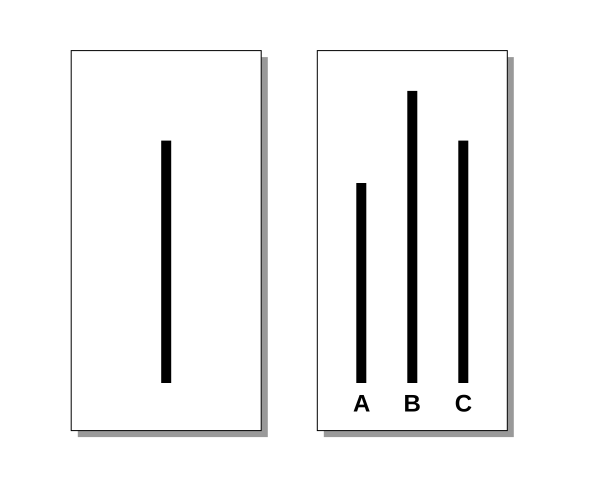
Solomon Asch's classic experiments examined how group consensus influences individual judgment. The task was intentionally simple: compare the lengths of lines. But when the other participants unanimously gave an obviously wrong answer, some subjects followed the group at least some of the time.[6]
The APA still uses the experiment as a classic example of conformity, while also pointing out its limitations—for example, the originally narrow sample of male college students.[6] The lesson is not: “People always follow the majority blindly.” The more uncomfortable lesson is:
Even a very simple perception becomes socially harder to defend when the correct answer requires publicly disagreeing with the group.
Why one ally matters so much
In variants of Asch's experiments, the unanimity of the group mattered greatly. When one person did not follow the incorrect majority, the individual's situation changed. This has a much broader significance. In a closed community, a person may think for a long time: “Apparently I am the only one who has noticed the problem.”
The first other person who says, “I see it too,” does not necessarily provide new evidence. They provide something else: social permission to doubt. That is why systems that want to preserve perfect agreement are often sensitive not only to arguments. They are sensitive to visible dissent.
Milgram: authority can shift the moral burden
In the early 1960s at Yale, Stanley Milgram conducted his famous experiments on obedience to authority. Participants believed they were delivering increasingly powerful electric shocks to another person for incorrect answers. The shocks were not actually administered, but the participants did not know that.
In the best-known baseline condition, 65 percent of participants continued to the highest labeled level on the apparatus.[7] The experiment became a symbol of the power of authority, but it is dangerous to turn it into a caricature: “65 percent of people will do anything if someone orders them to.” Milgram used different procedures, and the results varied with the circumstances. The experiment also generated major ethical and interpretive debates.[7]
The useful lesson is more modest: the context of legitimate authority can alter a person's sense of personal responsibility and their willingness to continue an action that makes them uncomfortable.
Conformity and obedience are not the same
This distinction matters. Conformity: I bring my answer closer to the group. Obedience: I change my behavior because of a direct demand from an authority. Belief: I internally accept an idea as true. A person can obey publicly without believing privately. They can conform because they want to avoid conflict. Or, after a long period of adaptation, they may begin to experience the idea as their own.
The APA distinguishes temporary outward compliance from deeper private conversion or private acceptance.[11] For the study of high-control groups, this distinction is crucial.

Groupthink: a useful idea, but not a universal law
Irving Janis used the term groupthink to describe a condition in which the desire for consensus within a cohesive group weakens realistic evaluation of alternatives. The APA lists features such as apparent unanimity, a sense of invulnerability, belief in the group's moral correctness, stereotyping of outsiders, pressure on dissenters, and self-censorship.[8]
The concept is highly intuitive. But scientifically it must be used with care. Reviews of the literature point out that empirical support for all parts of Janis's original model is uneven, and that groupthink is more useful as a heuristic framework than as a simple law that automatically predicts bad decision-making.[8]
This is a good example of scientific self-correction: even a theory about failures of group reasoning must itself remain open to criticism.
An epistemic bubble is not the same as an echo chamber
The philosopher C. Thi Nguyen proposed a very useful distinction.[9]
Epistemic bubble
Certain voices are simply missing. Perhaps algorithms do not show them. Perhaps we do not know about them. Perhaps we move only among people who think similarly. A person does not necessarily have a negative attitude toward outside sources. They simply do not encounter them.
Echo chamber
Here the structure is stronger. Outside sources are not merely absent. They are actively discredited. The member is taught: do not trust outside media; do not trust former members; do not trust critics; an independent document is proof that we are under attack.
In a bubble, a person does not hear the other side. In an echo chamber, they are taught why they must not listen to the other side.[9]
The most closed system defends itself
Imagine a group that teaches:
“The world will persecute us because we have the truth.”
If the world agrees with the group, that proves its persuasiveness. If it criticizes the group, the prophecy of persecution is being fulfilled. If a member leaves, they have fallen away. If they stay, the truth has kept them. If a prediction comes true, the prophet was right. If it does not, a deeper meaning is revealed.
Such a system has a special property: almost any possible outcome can be turned into confirmation of the system itself. We can call this a self-sealing epistemology. The problem is not that such a claim must therefore be false.
The problem is that it becomes increasingly unclear how it could ever be tested at all.
Criticism is not proof of the opposite
There is another trap. If an institution discredits criticism, a person can make the opposite mistake:
“Because the institution is hiding something, every criticism of it must be true.”
That does not follow. An institution can be wrong and its critic can also be wrong. Serious investigation therefore requires separating evidence, interpretation, speculation, motives, and rumor. THY-REALITY must be especially careful here. If we want to study systems of manipulation, we must not build our own echo chamber of opposing beliefs.
A primary source is not automatically a truthful source
A primary document is valuable because it shows what someone actually wrote, decided, or said. It does not necessarily tell us whether what they wrote was true. If an organization writes in 1970, “This is our belief,” the document is excellent evidence that the organization taught that belief.
It is not, for that reason alone, proof that the teaching was correct. The same applies to a government document, an expert report submitted to a court, a newspaper, a scientific paper, or a witness's memoir.
So the important question is:
What does this source actually prove?
A hierarchy of evidence is not a hierarchy of people
Research often requires different kinds of sources. For the question “What does the organization officially teach?” its own official publication may be the best source. For the question “Is this historical claim correct?” we need independent historical scholarship.
For the question “What was the outcome of the court proceeding?” a court or regulator document is appropriate. For the question “How did former members experience the event?” testimony is valuable. But one person's experience does not automatically prove the experience of everyone.
A sound research process therefore does not choose a source because it likes the conclusion, but asks:
Is this type of source appropriate for the question I am asking?
Source independence matters more than source count
Ten websites may repeat one original claim. That is not ten independent pieces of evidence. It may be one piece of evidence copied ten times. Serious verification therefore requires attention to provenance:
- Who first published the information?
- Who actually verified it?
- Are later sources using the same primary material?
- Is there an independent path to the same conclusion?
This is one of the greatest problems of the information internet: repetition can create the appearance of confirmation.
Replication: institutionalized doubt
One of the greatest strengths of the scientific method is not that scientists are exceptionally objective people. It is almost the opposite. Science developed procedures because human beings are not objective enough. These include controlled comparisons, randomization, blinding, statistics, public methods, expert criticism, and independent replication.
The APA defines replication as repeating a study in order to test or strengthen confidence in the original result.[10] A system is not strong because people never make mistakes. It is strong if it has mechanisms by which an error does not need the original author's permission in order to be discovered.
That is an important principle far beyond science.
The healthiest authority permits disobedience
There is a paradox in good authority:
the more reliable it is, the less it needs to prevent verification.
If an organization has strong evidence, criticism is not an existential threat. If a model is correct, independent people can test it again. If the historical record is well documented, old publications do not need to be hidden.
If leadership is accountable, there is a procedure by which it can be corrected. So it is important to distinguish between: authority that has earned trust and authority that demands that trust not be examined.
How power over reality is built
Epistemic power rarely begins with the order:
“From today on, you are not allowed to think.”
Much more often it begins with something entirely understandable:
“We will help you understand.”
A chain can then develop: 1. Special knowledge – the group has an explanation others do not. 2. Special identity – the member becomes part of the people who “see the truth.” 3. Special sources – internal publications become more trustworthy than outside ones.
4. Discrediting critics – critics are no longer simply people who reached a different conclusion. 5. The cost of doubt – doubt begins to threaten relationships and identity. 6. Self-censorship – leadership no longer needs to forbid every question.
The member begins forbidding the questions themselves. That is the point at which external control becomes internal control.
Religion is not the only setting
This mechanism is not limited to religion. Similar structures can appear in therapeutic communities, companies, political movements, investment groups, MLM systems, online communities, activist environments, academic circles, families, and groups of friends. This does not mean all of these phenomena are the same.
It means that the underlying human mechanisms—belonging, conformity, authority, identity, and defense of belief—are general. That is why studying extreme cases makes sense. At the extreme, the mechanism is easier to see. Once we recognize it there, we can notice milder versions elsewhere.
The greatest danger in studying manipulation
There is an interesting paradox. A person may begin studying propaganda, cults, concealment, and manipulation in order to become more independent. Then they gradually adopt a new rule:
“Official sources always lie.”
That is simply the inverted form of the same epistemological error. If we automatically reject everything official, we have not become independent. We have merely changed authorities. The same applies to alternative media, independent researchers, and online influencers.
An independent source can tell the truth. An official source can tell the truth. Either can be wrong. Either can mislead. The status of a source does not settle the question. Evidence does.
Skepticism needs a boundary
Radical skepticism can become useless. If we say, “I cannot trust anyone,” then we cannot know almost anything we have not directly experienced. If we say, “All documents can be forged,” then no document can ever change our mind.
If we say, “Every expert may be bought,” then we have built a system in which every contrary piece of information is neutralized in advance. That is another self-sealing epistemology. Healthy skepticism is therefore not:
“Believe nothing.”
It is:
“Adjust your level of confidence to the quality of the evidence.”
A better model: degrees of confidence
Instead of two boxes—TRUE / FALSE—it is often better to use a spectrum:
- well documented;
- very likely;
- likely;
- possible;
- disputed;
- poorly supported;
- unsupported by evidence;
- contradicted by the available evidence.
This is less satisfying than absolute certainty. But it is often more honest. It also allows something very important: we can change our mind without having to admit that our entire world was a lie.
Seven questions for testing your own belief
This article can be condensed into a practical test.
What would change my mind?
If the answer is “nothing,” the claim has become part of identity, protected from testing.
Do I use the same standard for evidence I like and evidence I do not like?
If I demand perfect proof from the other side but accept rumors from my own side, I am not using the same epistemic standard.
Can I fairly present the strongest argument on the other side?
Not a caricature. The strongest argument.
Is the source appropriate for the question?
An official religious website is a good source for official doctrine. It is not necessarily the best independent source for the historical truth of that doctrine.
Are my sources actually independent?
Five articles summarizing the same anonymous post are not five pieces of evidence.
What do I risk if I change my mind?
Money? Reputation? Family? Identity? The higher the stakes, the more cautious I should be about my own motivation.
What happens to the person who disagrees within my group?
If dissent is possible only at the cost of social destruction, agreement is difficult to interpret as pure evidence of truth.
The institutional test: who is allowed to say leadership is wrong?
We can apply a similar test to organizations. Ask:
- Is there independent oversight?
- Can the original documents be examined?
- Are past mistakes acknowledged publicly?
- Does leadership publish corrections?
- Can critics remain members?
- Is disagreement distinguished from disloyalty?
- Is there an appeal process?
- Is historical material preserved after a doctrinal change?
But the most important question is:
Who has the right to tell the supreme authority that it is wrong—and who decides whether the critic is right?
If the answer is always “the supreme authority itself,” we have an epistemological problem even if leadership happens to be right at the moment.
Why this connects to our articles on apocalyptic and high-control groups
The individual articles now take on a shared function. Jehovah's Witnesses show what can happen when testable apocalyptic expectations are reinterpreted while doctrinal authority is preserved. The LDS Church shows how personal prophetic charisma can become a lasting institution of continuing revelation.
The Unification Church shows how messianic authority can extend from theology into family, finance, business, and political networks. Aum Shinrikyo shows an extreme case in which epistemic closure, absolute guru authority, apocalyptic urgency, and the legitimation of violence converge.
“When Prophecy Fails” shows the psychological mechanism between a claim and its reinterpretation. Together these articles are not a catalogue of “strange religions.” They are different answers to the same question:
What happens when a group acquires the power to determine not only what its members do, but also which information is allowed to count as reality?
THY-REALITY must not become a new authority that demands belief
This is the most important editorial principle of the entire project. The goal of THY-REALITY must not be:
“We will tell you what is true.”
That would merely replace one epistemic authority with another. A better goal is:
“We will show the documents, explain the context, separate facts from interpretation, present uncertainty, and give you enough material to check the conclusion yourself.”
That means:
- a primary document when one exists;
- an independent source when verifying a factual claim;
- speculation clearly labeled as speculation;
- opinion clearly labeled as opinion;
- the possibility of correction;
- visible references;
- a history of changes;
- acknowledgment when the evidence is insufficient.
If the project criticizes self-sealing systems, it must itself be designed so that it can be corrected.
Conclusion: intellectual freedom is not life without authorities
Complete independence from other people is an illusion. We all live within networks of testimony, experts, documents, and institutions. And that can be a good thing. Civilization is possible precisely because every person does not need to rediscover knowledge from the beginning.
But there is an enormous difference between:
“I trust because there are good reasons to trust.”
and
“I believe because I am not allowed to verify.”
Perhaps the healthiest epistemological question is therefore very simple:
What would convince me that I am wrong?
And immediately after it:
Would my system of belief allow me to see that evidence at all?
If both questions are permitted, there is room for learning. If they are not, we are no longer talking only about belief. We are talking about power over reality.
Methodological note
This article uses psychological and philosophical concepts as analytical tools, not as diagnoses of individuals or groups. In particular:
- Popper's falsifiability is not a universal test of the meaningfulness of all religious or philosophical claims.
- Asch's experiments show the influence of social context, not universal blind conformity.
- Milgram's experiments do not prove that a fixed percentage of people will always obey any authority.
- Janis's concept of groupthink has substantial heuristic value, but not every element of the original model is equally well supported empirically.
- cognitive dissonance does not prove that a person confronted with a false belief will necessarily become even more committed to it.
The aim is to understand the conditions that can make independent reality-checking more difficult.
Sources and further reading
- Stanford Encyclopedia of Philosophy, Social Epistemology, substantive revision 2024. Used for the social nature of knowledge, testimony, and group and institutional epistemology. Source
- Stanford Encyclopedia of Philosophy, Epistemological Problems of Testimony, 2026 version. Used for testimony, expertise, and the concept of epistemic authority. Source
- Stanford Encyclopedia of Philosophy, Karl Popper and Scientific Method. Used for falsifiability, the problem of ad hoc rescue of theories, and limits of simplified falsificationism. Source 1 Source 2
- Richard T. Born, “Stop Fooling Yourself! (Diagnosing and Treating Confirmation Bias),” eNeuro, 2024. Used for confirmation bias and methodological ways of reducing it. Source
- Eddie Harmon-Jones & Judson Mills (eds.), Cognitive Dissonance: Reexamining a Pivotal Theory in Psychology, 2nd ed., American Psychological Association, 2019; APA Dictionary of Psychology. Used for cognitive dissonance and the belief-disconfirmation paradigm. Source 1 Source 2
- American Psychological Association, Social Psychology: Social Cognition and Social Influence; APA Dictionary, conformity. Used for the Asch experiments, conformity, and methodological limitations of the original sample. Source 1 Source 2
- Yale University Library, Obedience to Authority in the Archive; APA Dictionary, behavioral study of obedience. Used for the Milgram experiments, the period in which they were conducted, the baseline result, and historical ethical debates. Source 1 Source 2
- APA Dictionary, groupthink; Turner & Pratkanis, “Twenty-Five Years of Groupthink Theory and Research,” 1998; DiPierro et al., scoping review, 2022. Used for Janis's model and for caution regarding limited or mixed empirical support. Source 1 Source 2 Source 3
- C. Thi Nguyen, “Echo Chambers and Epistemic Bubbles,” Episteme 17(2), 2020. Used to distinguish the absence of relevant voices from the active discrediting of outside sources. Source 1 Source 2
- APA Dictionary of Psychology, replication. Source
- APA Dictionary of Psychology, compliance and conversion. Used to distinguish outward behavioral adaptation from private acceptance of a belief. Source 1 Source 2