Order of the Solar Temple
When Initiation Becomes a Hierarchy of Reality and “Transit” Merges Murder with Suicide
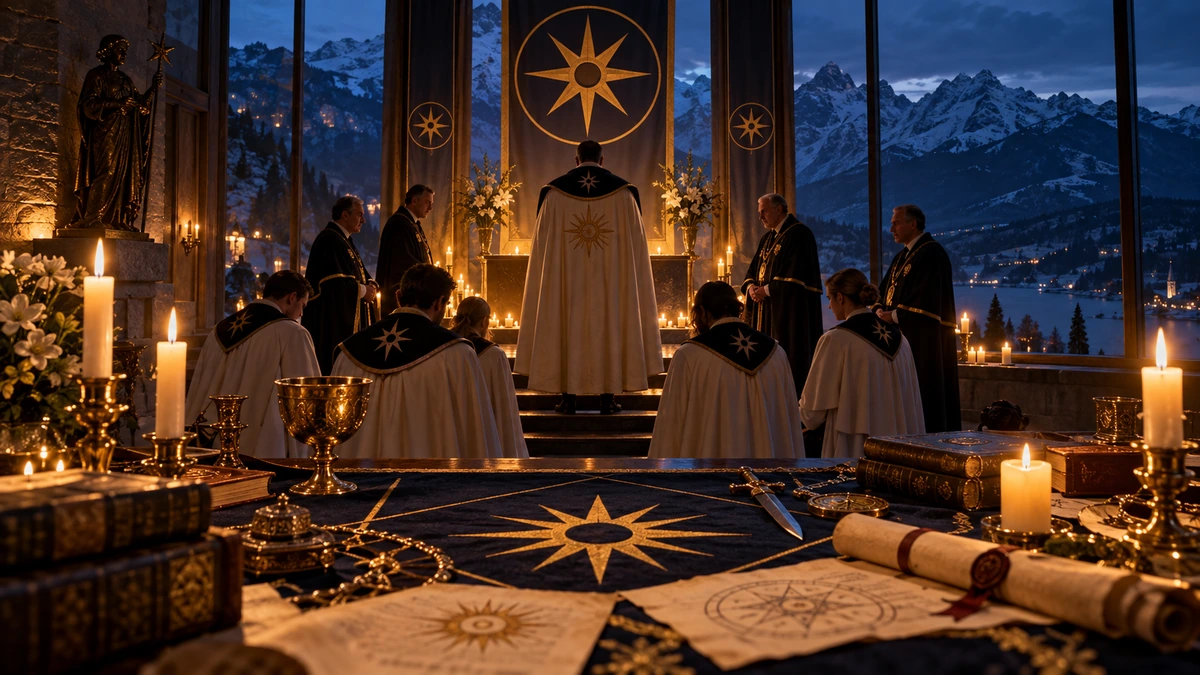
The Order of the Solar Temple — Ordre du Temple Solaire, OTS — is especially important for this series because it does not fit into one simple category. It is not only:
collective suicide.
It is not only:
a series of murders.
It is not only:
an apocalyptic religion.
It is not only:
a financially opaque esoteric organization.
Between 1994 and 1997, 74 people died in Canada, Switzerland, and France in three waves of deaths involving different combinations of:
- murder;
- organized suicide;
- assistance in death;
- ritual staging;
- fire;
- a doctrine of “transit.”[1][2]
That is precisely why OTS is methodologically more difficult than Heaven’s Gate. With Heaven’s Gate, we have strong evidence of an organized collective suicide by adults. With the Solar Temple, the first wave already makes something else clear:
some wanted to die, some were murdered, and some were, in the group’s own internal logic, “helped” into death.
The central question therefore has to be:
How does an organization divide its members into those allowed to know, those allowed to decide, and those for whom others make the decision?
OTS was not the historical Knights Templar
The name can create a false impression. The Order of the Solar Temple was not a direct continuation of the medieval Knights Templar. It was a modern esoteric movement drawing on:
- neo-Templarism;
- Rosicrucian traditions;
- Theosophy;
- New Age ideas;
- Christian apocalypticism.[3]
The CROI university center at Université Laval describes OTS as an organization founded in the 1980s whose intellectual sources included precisely these traditions.[3] This is an important distinction between:
historical genealogy
and
symbolic genealogy.
Two leaders, two different functions. The two most important leaders were:
- Joseph Di Mambro;
- Luc Jouret.
Their roles were not identical. Jouret was:
- a charismatic public speaker;
- a physician/homeopath;
- the visible face of the movement.
Di Mambro operated more:
- within the esoteric structure;
- in ritual matters;
- around finances;
- in the internal hierarchy;
- as a central authority regarding the hidden “Masters.”[1][3][4]
This division is extremely important. The public may see one leader. The internal center of power may be somewhere else.
OTS had layers
The movement did not function as one public group with one simple level of membership. Research describes a network of:
- more public lectures;
- outer clubs;
- inner esoteric structures;
- increasingly initiatory levels.[4]
A member therefore did not necessarily learn:
the whole system
at first contact. This is a classic graduated disclosure structure. Information is not hidden only:
from the outside world.
It is also hidden:
from lower levels of membership.
A hierarchy of information is a hierarchy of power. If leadership knows:
- what the next initiatory level contains;
- who belongs to the inner circle;
- which ritual “manifestation” is genuine;
- which member has been selected for a special task;
while an ordinary member does not, then organizational authority is not only:
formal.
It is:
epistemic.
Leadership controls what a member is even able to know about the system to which they belong.
Sirius and the “Masters”. An important part of OTS cosmology involved ideas about:
- higher or “ascended” beings;
- the Great White Brotherhood;
- spiritual evolution;
- the star Sirius.[3][5]
Academic literature describes the final “transit” as a transition to a higher state or toward Sirius.[5][6] This should be understood as:
an internal religious claim.
Not as an astronomical finding.
“Transit” is the essential word. Just as Heaven’s Gate did not use only the word:
death,
OTS did not use only:
suicide.
Death was presented as:
transit.
Susan Palmer, in academic analysis, describes religiously motivated mass suicide/homicide that the group’s documents interpreted as a transition or spiritual journey toward Sirius.[5] Changing the word changes:
- moral meaning;
- expectation;
- the relationship to the body.
But the Solar Temple is more troubling than a redefinition of suicide
At Heaven’s Gate, the final language of “exit” was used by a group of adults who died together as a collective. At OTS, leadership did not assign the same status to every dead person. Research literature on the group’s final documents distinguishes among people who:
- departed voluntarily;
- were “helped”;
- were treated as traitors.[4][7]
That is a critical boundary. If you decide for another person:
that death is spiritually right for them,
we are no longer talking only about suicide. We are talking about:
religiously legitimized murder.
“Helping” someone into transit is a redefinition of violence. The word:
help
is normally morally positive. But if it means:
killing someone because their higher spiritual identity supposedly requires it,
there has been a radical shift. The perpetrator may understand violence as:
serving the victim.
This is one of the most dangerous possible outcomes of absolute epistemic authority.
Joseph Di Mambro and ritual authority
Di Mambro was not merely an administrator. Researchers describe his role as central to the group’s ritual world.[4][5] An important element was the claim of contact with higher spiritual beings or Masters. A member who believes that the leader mediates:
a superhuman source of information
is not giving the leader only ordinary organizational trust. They are giving the leader:
access to a hierarchically superior reality.
The problem of staged “supernatural” phenomena
One of the most disturbing parts of OTS history is the evidence that some ritual “supernatural” effects were produced through technical means. Contemporary research syntheses drawing on Susan Palmer, James Lewis, and others describe the use of:
- projections;
- lighting effects;
- sound;
- other technical procedures
to create manifestations presented to members as evidence of the spiritual Masters.[7][8] If reconstructed correctly, that is much stronger than:
sincerely mistaken religious belief.
It is:
the material production of evidence for authority.
Why is this methodologically so important? Suppose a member doubts:
“Do the Masters really exist?”
Then they see:
a manifestation during a ritual.
For them, this can function as independent evidence. But if the same leadership system:
- claims that the phenomenon confirms its authority
and
- secretly controls the production of that phenomenon,
then there are not two sources. There is:
one source presenting itself as two.
That is an epistemic simulation of independent corroboration.
When the trick is exposed
Research literature also describes internal discovery that some such phenomena had been staged.[7][8] For a charismatic institution, this is an exceptionally dangerous moment. Not because a member discovers only:
a technical secret.
They discover:
that part of the evidence on which they built trust in leadership was produced by leadership itself.
That can trigger:
- departure;
- conflict;
- collapse of trust;
- crisis of legitimacy.
Crisis of charismatic authority. Henrik Bogdan emphasizes several factors in explanations of OTS’s later violence, including:
- charismatic authority;
- internal dissent;
- apocalypticism;
- external pressure.[6]
This matters. The final catastrophe is not well explained simply by saying:
“they held strange beliefs.”
A much more important question is:
What happens when a system of absolute authority begins losing its own members and its own credibility?
Departures are a double threat to such a system. A former member can:
- physically leave the group;
- take information with them.
If they know about:
- finances;
- ritual tricks;
- internal relationships;
they can threaten:
the structure of legitimacy itself.
That is why an “apostate” in a high-control organization can be perceived very differently from an ordinary former member.
Tony and Nicky Dutoit
The Dutoit family case is one of the most important pieces of evidence showing why OTS cannot be described only as a suicidal group. In its historical overview, Québec’s Sûreté du Québec states that the Dutoit family was murdered in Morin-Heights after Tony Dutoit wanted to leave the organization; their infant was treated within the leadership’s religious framework as a threat or an “Antichrist” figure.[1]
Academic literature adds the context of conflict over internal secrets and Di Mambro’s authority.[7]
We must be cautious about motive. Several reconstructions of the Dutoit killings exist:
- personal betrayal;
- exposure of ritual deception;
- disobedience;
- symbolic conflict surrounding the child;
- apocalyptic categorization.
One explanation does not necessarily account completely for the murders. A more accurate formulation is:
the motive appears multilayered, while the murder of the family itself is documented.
A child changes the category
An infant cannot:
choose transit.
So any universal description such as:
“53 members committed collective suicide”
already fails in the first wave. The more appropriate category is:
murder-suicide complex.
That is also language used in an important part of the academic literature.[5][6]
First wave: Québec and Switzerland, October 1994. The first fatal wave included:
- 5 deaths in Morin-Heights, Québec;
- 23 deaths in Cheiry, Switzerland;
- 25 deaths near Granges-sur-Salvan, Switzerland.[1][3]
Together:
53 deaths.
Among the dead in Switzerland were:
- Joseph Di Mambro;
- Luc Jouret.[1]
The two main leaders therefore died during the first wave.
The Swiss scenes were ritually staged. Swiss public and research sources describe:
- ritual positioning of some bodies;
- special clothing or bags;
- fires;
- gunshot injuries.[9]
This is very different from:
spontaneous collective suicide.
It was:
an organized and symbolically staged event.
Why fire? Susan Palmer analyzed OTS rituals through ideas of:
- purity;
- pollution;
- community boundaries.[5]
In the wider research literature, fire in “transit” also carries:
a purificatory role.[7]
That does not prove that every perpetrator personally thought in exactly the same way. But it shows that fire was not merely:
a practical means of concealment.
It also had:
ritual meaning.
The deaths of the leaders did not end the idea. If OTS had been simply:
an organization under the direct control of two leaders,
we might expect the system to end with their deaths. It did not. Further deaths in:
- 1995;
- 1997
show that an ideology can become:
distributed
after the death of a leader. That is an important concept.
Charisma can survive the charismatic leader. Members do not need to receive new orders from a dead leader if they still have:
- texts;
- rituals;
- memory;
- an inner circle;
- a doctrinal script.
Charismatic authority can become:
a posthumous norm.
This will also matter when comparing OTS with NXIVM, where the leader remained alive and was prosecuted.
Second wave: Vercors, France, December 1995. In December 1995, 16 people were found dead in the Vercors region, including three children.[2][10] Forensic and police information indicated:
- gunshot wounds;
- traces of drugs in some;
- ritual positioning of bodies;
- fire.[10]
Again, this is not a pure model in which:
sixteen people made an equal decision to die by suicide.
In Vercors there were both willing and unwilling participants. Research summaries of the French investigation note that some members left messages suggesting willingness to go to the “other world,” while voluntariness was not established for every person who died.[11] That again demonstrates the same problem:
one collective label cannot describe all sixteen individual deaths.
Children again prevent the phrase “pure collective suicide”
Three children died in Vercors.[2][10] Their presence alone requires us to preserve the category:
murder-suicide / ritual homicide-suicide.
The article must not allow the group’s language of:
“transit”
to overwrite the fact that some of the dead could not give valid consent.
Third wave: Saint-Casimir, Québec, March 1997. In March 1997, another five adults who were members or former members of the Solar Temple died in Saint-Casimir.[1][12] An important difference:
three teenagers survived.
Contemporary police and news reports state that the teenagers were found alive in a nearby building.[12][13]
The teenagers wanted to live
Research syntheses report that the teenagers expressed that they did not want to die and that the adults allowed them to withdraw.[14] This is an exceptionally important detail. It shows:
the ideology did not necessarily erase the possibility of dissent in every member or family member.
At the same time, it shows:
how different the dynamics of the third wave were from the first.
The three episodes are not the same thing. If we place everything under the heading:
Solar Temple mass suicide,
we lose the distinction among:
1994. central leadership, murders, suicides, and ritual “transit”;
1995. a posthumously continuing ideology and new deaths containing elements of homicide;
1997
a smaller group of adults in which teenagers rejected death. The common ideological framework exists. The operational configuration is not identical.
Seventy-four deaths. CROI and the Sûreté du Québec use the total:
74 deaths
in three waves between 1994 and 1997.[1][3] Breakdown:
- 53 in 1994;
- 16 in 1995;
- 5 in 1997.
That is the standard overall figure for Solar Temple deaths.
We cannot place all 74 into two clean boxes. The question:
how many were suicides and how many were murders?
is legitimate. But a complete individual classification of all deaths is not simple. The different events involved:
- clearly documented murders;
- suicides;
- people who probably knew of the plan;
- people whose degree of consent is unclear;
- children.
That is also why an academic title uses the term:
murder-suicides.[6]
This is the key difference from Heaven’s Gate. Heaven’s Gate:
strongly supported adult collective suicide.
Solar Temple:
a mixture of collective suicide and ritually legitimized murder.
This is not merely a quantitative difference. It is:
an organizational and moral difference.
The doctrine enabled decisions over another person’s life. When leadership categorizes a member as:
- a traitor;
- spiritually weak;
- someone who must be “helped”;
religious authority becomes:
power over that person’s physical death.
Here high-control reaches an extreme.
Apocalypticity
OTS developed expectations of:
- catastrophic change;
- collapse or ending of the present world;
- transition to another state.[5][6][15]
But Henrik Bogdan warns that the violence should not be explained through millennialism alone.[6] This is important. Apocalypticism is:
part of the causal architecture.
It is not:
sufficient by itself.
Crisis of authority. By the early 1990s, OTS was experiencing:
- departures;
- internal criticism;
- doubts concerning finances;
- exposure of ritual tricks;
- legal and media pressure.[6][7]
Such an environment is dangerous for an organization whose leadership depends on:
exceptional spiritual legitimacy.
External investigation can become internal evidence of persecution. We have already seen this mechanism in:
- Jonestown;
- Waco.
But with OTS, external opposition is only one element. Bogdan’s review specifically warns that scholarly explanations differ and that several factors have to be considered:
- external opposition;
- internal dissent;
- charismatic authority;
- catastrophic millennialism.[6]
None of these categories is sufficient on its own.
We should not say “they were persecuted, therefore they became violent”
That would shift too much responsibility onto the environment. The group had:
- its own internal hierarchy;
- its own violent acts;
- documented murders.
External pressure can help explain:
the crisis frame.
It does not justify:
murder.
Finances. The history of OTS also includes:
- real estate;
- money;
- internal financial tensions;
- allegations of irregularities.[7]
But we have to be very careful. From:
financial opacity
we will not automatically infer:
the deaths were merely a cover-up for financial crime.
That would be a new claim. It needs its own evidence.
Money and religion do not exclude one another as motives. A false dilemma would be:
either they believed
or
it was about money.
People can:
- sincerely believe;
- manage financial interests;
- use manipulation;
- rationalize their own conduct at the same time.
Motives do not have to be one-dimensional.
Luc Jouret and the public face. Jouret was a highly successful:
- lecturer;
- recruiter;
- public communicator.[1][4]
That is important for understanding the recruitment funnel. A person may initially encounter:
a lecture on health, ecology, or spirituality.
Not:
the deepest apocalyptic and initiatory doctrines.
Recruitment funnel. The model can be simplified as:
PUBLIC LECTURE ↓ OUTER CLUB / INTEREST GROUP ↓ ESOTERIC INITIATION ↓ INNER HIERARCHY ↓ SECRET DOCTRINES / RITUALS
This is an important mechanism. The initial offer and the final structure are not necessarily the same.
So “why did a member join?” is not the same as “why did they later remain?”
Joining may be motivated by:
- ecology;
- personal development;
- spirituality;
- community.
Remaining later may be shaped by:
- initiatory status;
- identity;
- social relationships;
- exclusive knowledge;
- eschatological fear.
Those are two different research questions.
Elitism of knowledge. An esoteric system can offer a person something powerful:
“You know something others do not.”
That increases:
- identity;
- status;
- a sense of being chosen.
External criticism can then be more easily understood as:
criticism from people who do not have access to the higher level of knowledge.
The information hierarchy becomes:
a moral hierarchy.
If outside verification is defined as “lower,” correction becomes harder
An astronomer. Police. A journalist. A former member. Within the internal model, all of them may lack:
initiatory access.
Their criticism therefore does not compete on the same level. Leadership can say:
“You cannot understand because you are not initiated.”
That is an exceptionally effective protection of authority.
Secret knowledge requires especially strong safeguards
Secrecy itself is not abuse. Many organizations have:
- confidential information;
- private rituals;
- professional secrets.
The problem arises when secrecy is simultaneously:
- a source of authority;
- inaccessible to independent control;
- used to justify major demands on members.
Then the member cannot distinguish between:
genuinely higher knowledge
and
an information monopoly.
Tabachnik: an important test of our evidentiary standard
Michel Tabachnik was a conductor and author of esoteric texts connected with the OTS milieu. After the Vercors deaths, he was prosecuted in France for an alleged role in creating an ideological environment said to have contributed to the deaths.
But:
- he was acquitted in 2001;
- an appeals court confirmed the acquittal in 2006.[16][17]
MIVILUDES later also documented that France’s Court of Cassation rejected a further legal challenge in 2007.[18]
So we must not write that Tabachnik “was proven to have prepared the suicides”
That would contradict his legal status. We can write:
he was investigated and criminally charged in connection with alleged ideological preparation.
But that must be followed by:
he was acquitted at both the first-instance and appellate levels.
That is the essence of our article:
“What Does ‘Proven’ Actually Mean?”
Acquittal does not mean there was no historical connection at all
That is the other side. The legal standard:
criminal responsibility
is not the same as the historical question:
who was connected to the organization’s intellectual environment?
We therefore have to distinguish:
- membership/association;
- authorship of texts;
- criminal responsibility.
Legal thresholds and historical explanation. A court must answer:
whether the defendant is criminally responsible under specific legal elements.
A historian can ask:
what role particular texts played in a group’s cosmology.
These are not the same standards. But historical interpretation must not overwrite a legal acquittal.
Conspiracy theories after the Solar Temple
Because of:
- ritual scenes;
- multiple countries;
- money;
- political acquaintances;
- uncertainties surrounding individual deaths,
OTS became a fertile environment for theories involving:
- intelligence services;
- organized crime;
- political networks;
- outside killers.
Some individual uncertainties are real. But the existence of uncertainty is not evidence for the broadest theory.
The Tabachnik trial tested part of the alternative claims
Even after further forensic and legal review, the French appeals court acquitted Tabachnik in 2006.[16][17] That does not resolve every historical uncertainty surrounding OTS. But it means:
this article will not present an external conspiracy as an established fact.
OTS is a case in which the “official story” is not one thing. There are:
- Québec police findings;
- Swiss investigations;
- French investigations;
- different court proceedings;
- academic reconstructions.
It is therefore inaccurate to say:
“the official version says X”
as though there were one document. We need:
jurisdiction-by-jurisdiction provenance.
Québec. The Sûreté du Québec now summarizes the historical case with:
- 74 deaths overall;
- five dead in the first Québec event;
- another five later in Saint-Casimir.[1]
That provides a useful official local framework.
Switzerland. In Switzerland, October 1994 brought the discovery of:
- 23 bodies in Cheiry;
- 25 near Granges-sur-Salvan.[9]
That gives:
48 Swiss deaths in the first wave.
France. In the Vercors in December 1995, authorities found:
16 bodies,
including three children.[2][10] The later criminal proceedings importantly separated:
- proven events at the scene
from
- the alleged criminal responsibility of Tabachnik.
Three countries also mean three institutional perspectives
That complicates research. Different states have:
- different rules;
- different archives;
- different investigative standards;
- different media cultures.
If one document is missing from one system, that is not automatically:
evidence of concealment.
It may reflect:
a different institutional process.
KNOWLEDGE CHAIN — OTS
EARLY SIGNALS. internal dissent, departures, doubts about rituals and finances.
AUTHORITY RESPONSE. authority becomes more centralized and conflict becomes increasingly moralized.
EXTERNAL PRESSURE. legal, police, and media problems intensify the crisis frame.
DOCTRINAL ESCALATION. “transit” becomes a solution to the problem of a collapsing world and a collapsing organization.
INTERNAL CLASSIFICATION. members are not treated equally; some are willing, some are “helped,” others are enemies.
VIOLENCE. murders + suicides + ritual staging.
POST-LEADER CONTINUITY. the idea survives the deaths of the main leaders and reappears in 1995 and 1997.
EVIDENCE CHAIN — “supernatural” rituals
CLAIM. leadership is in contact with superhuman Masters.
EVIDENCE PRESENTED TO MEMBERS. ritual manifestations.
PROVENANCE. at least some of these phenomena were, according to the research literature, technically managed by the inner circle.[7]
INDEPENDENCE. low.
IMPLICATION
apparently external confirmation may actually be production by the same center of authority. This is one of the clearest examples of fake independent corroboration in our series.
EVENT / ATTRIBUTION / INTENT / COMMAND
EVENT STATUS. DOCUMENTED 74 deaths in three waves.
MURDER STATUS. DOCUMENTED At least some deaths, including the Dutoit family and children in the broader events, cannot be treated as voluntary suicide.
SUICIDE STATUS. DOCUMENTED Some members intentionally participated in their own deaths.
INDIVIDUAL CONSENT STATUS. MIXED / NOT UNIVERSALLY RECONSTRUCTABLE It is not fair to label every one of the 74 deaths only as murder or only as voluntary suicide without individual evidence.
COMMAND STATUS — 1994. STRONGLY SUPPORTED CENTRAL LEADERSHIP ROLE Di Mambro and Jouret were the central leaders; in specific killings, Di Mambro’s leadership responsibility is especially important in investigative and scholarly reconstructions.[1][7]
HIGH-CONTROL TRI-AXIS MODEL
A. Apocalypticity
HIGH Catastrophic transformation of the world and “transit” out of present earthly reality.
B. Organizational control. HIGH
- initiatory hierarchy;
- information asymmetry;
- secrecy;
- personal authority;
- ritual legitimation.
C. Legitimation of violence. EXTREME IN THE FINAL PHASE
- suicide is redefined as transit;
- the killing of some is redefined as “help” or punishment;
- children and dissenters lose an equal right to decide about their own lives.
COST OF ERROR. If a member falsely believes Di Mambro’s cosmology:
they may lose their life.
If a member accepts the cosmology but doubts leadership:
they may lose initiatory status, community, and supposed access to transit.
More dangerous still:
leadership may decide that it knows better than the member what the member’s “spiritual path” requires.
At that point, the member’s own judgment is no longer the final boundary.
The greatest difference from Heaven’s Gate. At Heaven’s Gate the key problem was:
how adult members gradually came to accept collective self-destruction as spiritually meaningful.
At the Solar Temple:
leadership developed, in addition to suicide, a category of people it considered legitimate to kill.
That is a qualitatively higher level of danger.
The greatest difference from Jonestown. Jonestown was:
- a physically isolated community;
- highly centralized around a living leader;
- a final event concentrated largely in one main day.
OTS was:
- an international network;
- spread across multiple jurisdictions;
- marked by several separate waves of death;
- driven by an ideology that survived the deaths of its principal leaders.
OTS is therefore a better example of:
posthumous reproduction of lethal doctrine.
The greatest difference from Waco. Waco requires analysis of:
group + state intervention + feedback loop.
The Solar Temple developed lethal dynamics without:
a comparable siege.
External pressure existed. But the final violence cannot be reduced to a reaction to the state.
Why “the cult made them do it” is not enough. Because it does not explain:
- why some people left;
- why some stayed;
- why some became perpetrators;
- why others became victims;
- why the idea survived the leaders.
We need:
- hierarchy;
- cosmology;
- authority;
- social relationships;
- crisis context;
- legitimation of violence.
What can we say with high confidence?
- OTS was a modern neo-Templar/esoteric NRM, not a direct continuation of the medieval Knights Templar.[3][15]
- Di Mambro and Jouret held different but central leadership roles.[3][4]
- The movement developed an apocalyptic doctrine of “transit.”[5][6]
- In 1994, 53 people died in Québec and Switzerland.[1][2]
- In 1995, another 16 died in the Vercors.[2]
- In 1997, another 5 adults died in Saint-Casimir.[1][12]
- The standard overall total is 74 dead.[1][3]
- Among the dead were people who were murdered and people who participated in their own deaths.[2][5][6]
- Michel Tabachnik was prosecuted in France but acquitted twice.[16][17][18]
What remains partly open?
- the exact degree of individual consent among all those who died;
- the psychological motive of every perpetrator;
- the relative weight of apocalypticism, crisis of authority, finances, and external pressure;
- the full influence of individual internal texts on later groups;
- some disputed alternative theories concerning outside actors.
In these areas, we do not use:
DOCUMENTED
when the evidence does not justify it.
What is not fair to claim? Not:
“all 74 committed suicide.”
Not:
“all 74 were murdered.”
Not:
“it is proven that state or intelligence services organized the deaths.”
Not:
“Tabachnik was legally responsible for the deaths.”
Not:
“apocalyptic religion itself automatically causes violence.”
Each of those claims goes beyond the evidence base.
Conclusion: when secret knowledge becomes permission to decide for another person. The Order of the Solar Temple is one of the darkest examples of our broader question:
Who decides what is true?
At first the question appears abstract:
who understands the ritual?
who knows the Masters?
who has the higher initiation?
But if we grant the same center enough power, the question can change:
who decides who is spiritually ready?
Then:
who decides who is a traitor?
And finally:
who decides who is allowed to live?
That is the point at which epistemic hierarchy becomes physical power. OTS is therefore an exceptionally important case because it shows that a lethal high-control structure does not necessarily begin with:
weapons or fire.
It can begin with a much less conspicuous idea:
some people have access to a higher reality and can therefore decide on behalf of those who do not.
If the system has no way to independently test that claim, its internal “knowledge” can become permission for almost anything. Even for giving murder another name.
THY-REALITY CASE STATUS
FACT STATUS. DOCUMENTED
TOTAL-DEATH STATUS. 74 DEATHS / DOCUMENTED STANDARD TOTAL
MASS-DEATH TYPE. MIXED MURDER / SUICIDE / ASSISTED OR COERCED DEATH
1994 STATUS
53 DEATHS — QUÉBEC + SWITZERLAND / DOCUMENTED
1995 VERCORS STATUS. 16 DEATHS / MURDER-SUICIDE CONFIGURATION / DOCUMENTED CORE
1997 SAINT-CASIMIR STATUS. 5 ADULT DEATHS / THREE TEENAGERS SURVIVED
PHYSICAL-COERCION STATUS. DOCUMENTED FOR PART OF THE OVERALL DEATH SERIES
INDIVIDUAL VOLUNTARINESS STATUS. MIXED / NOT UNIVERSALLY RECONSTRUCTABLE
CENTRAL-LEADERSHIP STATUS — 1994. STRONGLY SUPPORTED
TABACHNIK CRIMINAL-RESPONSIBILITY STATUS. ACQUITTED — FIRST INSTANCE 2001 / APPEAL 2006; CASSATION CHALLENGE DISMISSED 2007
EXTERNAL-CONSPIRACY STATUS. The cited evidence does not establish this.
INTERPRETATION STATUS
STRONGLY SUPPORTED HIGH-CONTROL/APOCALYPTIC CORE / MULTICAUSAL EXPLANATION
Methodological note
This article does not use the term “collective suicide” as a universal label for all 74 deaths. For OTS, the broader category: murder-suicide complex is more consistent with the evidence. Primary and official sources from different countries have different scope. Therefore:
- the Québec police source supports the Québec chronology;
- French court outcomes support Tabachnik’s legal status;
- academic sources are used for theology, organizational structure, and interpretive models.
Disputed theories involving state, political, or intelligence connections are not presented as fact without additional independent evidence.
Sources and further reading
- Sûreté du Québec, Affaire de l’Ordre du Temple solaire. Official historical overview by Québec police; used for Morin-Heights, the Dutoit family, Swiss deaths, Saint-Casimir, and the total of 74. Source
- Henrik Bogdan, The Order of the Solar Temple, in Controversial New Religions, Oxford University Press, 2014. Academic overview of the movement’s history and murder-suicide events. Source
- Université Laval, CROI, Ordre du temple Solaire (OTS). Used for origins, main intellectual influences, geographic spread, membership, and the standard chronology of 74 deaths. Source
- James R. Lewis (ed.), The Order of the Solar Temple: The Temple of Death, Routledge/Ashgate. Principal collected academic monograph on OTS. Source
- Susan J. Palmer, Purity and Danger in the Solar Temple, Journal of Contemporary Religion 11(3), 1996, 303–318. Used for authority structure, the purity model, and “transit” as religiously motivated mass suicide/homicide. Source
- Henrik Bogdan, Explaining the Murder-Suicides of the Order of the Solar Temple: A Survey of Hypotheses, in Violence and New Religious Movements, Oxford University Press, 2011. Used for multicausal analysis: charismatic authority, internal dissent, catastrophic millennialism, external opposition. Source
- Center for the Study of New Religious Movements / CDAMM, Order of the Solar Temple. Contemporary research synthesis drawing on Palmer, Lewis, Walliss, Mayer, and others regarding rituals, “Masters,” technically staged phenomena, and the three transits. Source
- John Walliss, Crises of Charismatic Authority and Millenarian Violence: The Case of the Order of the Solar Temple, in Lewis (ed.), The Order of the Solar Temple: The Temple of Death. Used through academic synthesis for the crisis of authority and the exposure of simulated ritual manifestations. Source
- SRF, 48 Tote, ein Rätsel: Wie es 1994 zum Sonnentempler-Massaker kam, 2023. Swiss public-service media source; used for Cheiry/Granges-sur-Salvan and the 48 deaths in Switzerland. Source
- UPI, French conduct autopsies on cult victims, December 26, 1995; Washington Post, December 24, 1995. Contemporary reports on the 16 Vercors victims, three children, gunshot injuries, drugs, and ritual positioning. Source 1 Source 2
- James R. Lewis, The Solar Temple “Transits”: Beyond the Millennialist Hypothesis, in Controversial New Religions, Oxford University Press, 2004. Used for comparative interpretation of the “transits” and a warning against a single millennialist explanation. Source
- UPI, Five die in Solar Temple cult fire, March 23, 1997. Contemporary source for Saint-Casimir: five dead adults and three surviving teenagers. Source
- Reuters/Washington Post, Cult Members Found Dead in Quebec, March 24, 1997. Used for identification of the five dead and the teenagers found alive. Source
- CDAMM, Order of the Solar Temple, section on Saint-Casimir. Used for the research reconstruction that the three teenagers expressed a wish to live and were excluded from the final transit. Source
- Massimo Introvigne, Ordeal by Fire: The Tragedy of the Solar Temple, Religion 25(3), 1995, 267–283. Used for the neo-Templar historical context and the first wave of deaths. Source
- SWI swissinfo, Swiss conductor acquitted of sect killings, December 20, 2006. Used to confirm Michel Tabachnik’s acquittal on appeal. Source
- Le Monde, Ordre du Temple solaire : Michel Tabachnik relaxé, December 21, 2006. Independent French source for the appellate acquittal. Source
- MIVILUDES, Annual Report 2008, French government review of legal cases. Notes confirmation of the acquittal on December 20, 2006 and rejection of a further challenge by the Cour de cassation on May 16, 2007. Source
- French National Assembly, Commission of Inquiry on Sects, Report No. 2468 (1995). Official parliamentary source for the French institutional context shaped in part by the Solar Temple tragedies. Source
- Swiss federal report, Extremismusbericht / BBl 2004 5011. Official Swiss public-authority source for the wider context of violent religious extremism and discussion of the Solar Temple tragedies. Source