When Prophecy Fails: From the Great Disappointment of 1844 to 1914, 1975, and “New Interpretation”
Why a failed prediction often does not destroy a movement—and how failure can become new doctrine, stronger identity, or a lasting institution

If someone predicts an event for a specific date and it does not happen, we might expect a simple outcome: the prediction was wrong, so people stop believing. The history of religion shows that reality is much more complicated.
In some groups, a failed prophecy causes members to leave and the movement to collapse. Elsewhere, the date is reinterpreted, the event is moved from the earthly world into an invisible spiritual realm, blame is assigned to believers' misunderstanding, or a new phase of interpretation begins. Sometimes a group becomes more organized after the failure.
This is not unique to one religion. It is a broader human problem: what do we do when a fact collides with a belief into which we have invested years, relationships, reputation, money, and identity?
An American laboratory of apocalyptic expectation
To understand modern apocalyptic movements, we need to return to the United States in the first half of the nineteenth century. During the Second Great Awakening, northern and western New York became so densely populated with revival movements, new churches, and reform ideas that the region became known as the Burned-over District—as if waves of religious fire had swept through the landscape so many times that little remained to burn.[1]
Within this wider environment appeared or developed:
- new restorationist movements;
- Joseph Smith's Mormonism;
- Adventist expectations;
- Spiritualism;
- numerous projects of moral and social reform.
This does not mean these movements were the same or directly descended from one another. What mainly connects them is the cultural environment in which the idea was widespread that an individual could reread the Bible, rediscover lost truth, and identify signs in history of an approaching new age.
William Miller and calculating the end
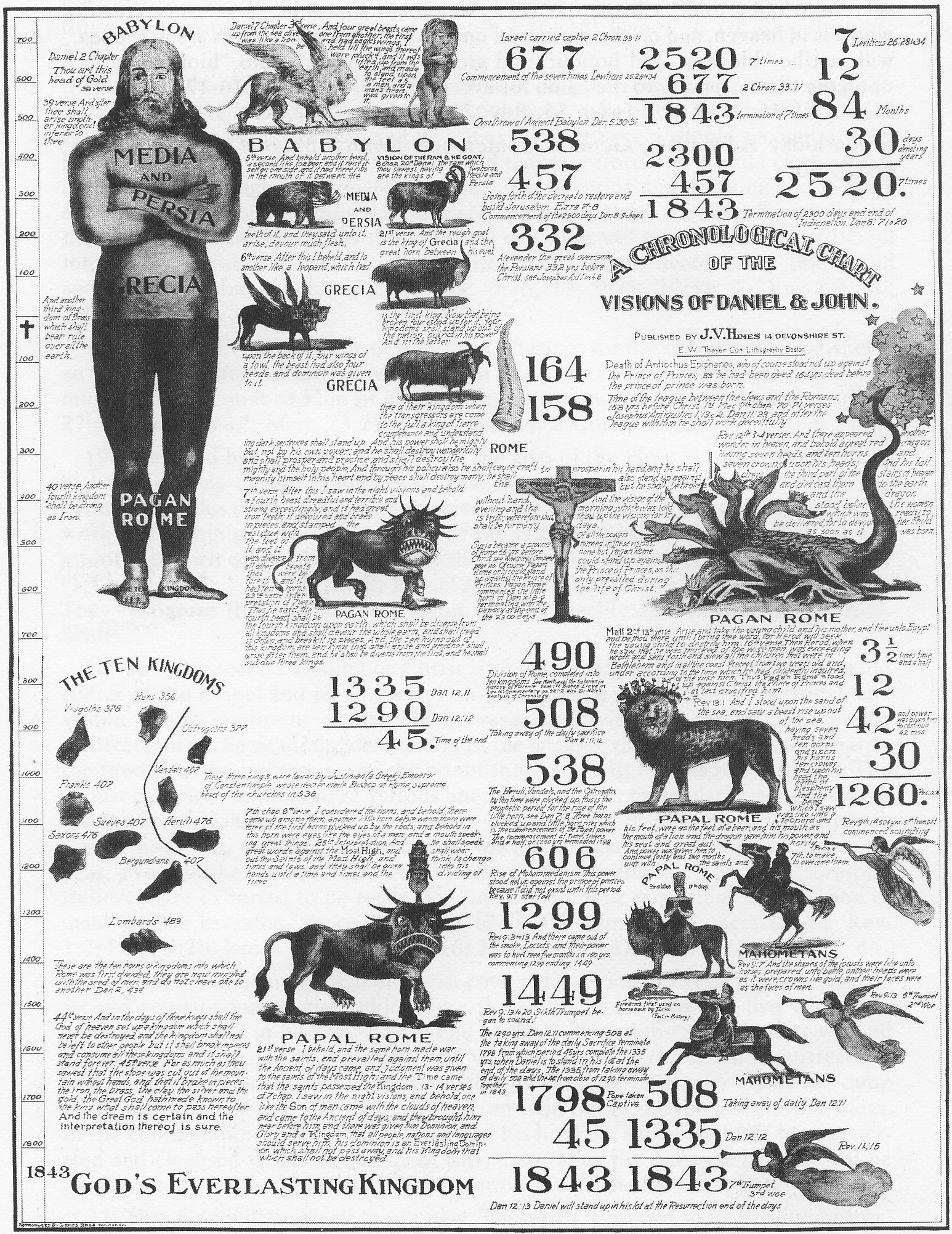
One of the most influential figures of the period was William Miller, a Baptist preacher and former soldier. After years of studying the Book of Daniel and other biblical prophecies, he concluded that Christ's return was approaching. At first he spoke of a period between 1843 and 1844.
When the original window passed, Miller acknowledged disappointment. But the movement did not immediately end. Another preacher, Samuel Snow, proposed a new calculation: October 22, 1844.[2] On that date, believers expected Christ's arrival. The day passed.
Christ did not appear. The event became known in Adventist history as the Great Disappointment.[2]
The most important moment is not the prophecy—it is the day after
Historically, October 23, 1844 may be almost more important than October 22. What does a community do when a testable prediction fails? There are several possibilities: First: people leave the movement. Second: the leader admits the mistake while retaining the broader religious belief.
Third: the date is recalculated. Fourth: the event is reinterpreted: the date was correct, but believers misunderstood what was supposed to happen. The fourth option is historically especially important. Different post-Millerite currents gave rise to new Adventist groups. Among the predecessors of today's Seventh-day Adventist Church, an interpretation developed that 1844 did not mark Christ's physical return to Earth, but the beginning of an important heavenly phase of Christ's ministry.[3]
The date was therefore not discarded. The meaning of the event changed.
From Miller to Russell
Charles Taze Russell was not simply a direct successor to William Miller. But the early history of the Bible Students was strongly connected to the Second Adventist environment. A modern Cambridge history of Jehovah's Witnesses notes that the young Russell listened in 1869 to preacher Jonas Wendell, a member of the Second Adventist tradition. He later worked with Adventist preacher Nelson H. Barbour, who persuaded him that biblical chronological prophecies could be tied to a specific historical period.[4]
The Cambridge overview therefore describes Adventist influence on the early Bible Students as crucial.[4] Russell adopted the expectation that the prophetic period of the “Gentile Times” would end in 1914.
1914: when the date survives failure
Before 1914, the Bible Students circulated different expectations about what the year would mean. The Cambridge historical overview notes that some expected a great “time of trouble,” the collapse of human institutions, or the departure of believers to Christ. Russell also warned that a failure of expectations should not destroy faith.[4]
The year 1914 did bring a world war. But the expected end of the old system did not occur in the form many had anticipated. The date nevertheless remained. Later interpretation associated it with Christ's invisible heavenly kingship and the beginning of the “last days.”
Structurally, this response resembles the post-Millerite pattern:
a date can remain correct if the interpretation of the event changes.
This does not prove that the two doctrines are substantively identical or that the change was necessarily a conscious deception. It does show a recognizable mechanism of religious reinterpretation.
1925 and 1975: the date becomes less precise, but expectation remains
Among Jehovah's Witnesses, temporal expectation appeared several more times. For 1925, many Bible Students expected the resurrection of Abraham, David, and other biblical figures as well as major changes on Earth. Jehovah's Witnesses' current official publication itself describes these expectations under the heading “Unfulfilled Expectations.”[5]
The mechanism surrounding 1975 was somewhat different. The organization did not issue an official statement that Armageddon would occur on a specific day. But its literature strongly emphasized that 6,000 years of human history would end in 1975 and that time was extremely short.[6]
After 1975, The Watchtower acknowledged that some published formulations had created more certainty than was appropriate.[7] Here we can see an evolution in strategy: less exact calendar prediction, while a strong sense of immediate historical urgency remains.
Cognitive dissonance: why a wrong prediction does not necessarily destroy belief
In 1956, Leon Festinger, Henry Riecken, and Stanley Schachter published When Prophecy Fails. They studied a small group that believed much of the world would be destroyed by a flood and that its members would be rescued by extraterrestrial beings.
The catastrophe did not occur. But not all members reacted in the same way. A later American Psychological Association overview summarizes that people who were more isolated from the group at the moment of failure found it easier to abandon the belief, while members who waited together were more likely to retain faith. The leader reinterpreted the failure by saying the catastrophe had been prevented because of the group's spiritual significance. Proselytizing also increased after the failed prediction.[8]
Festinger developed the broader theory of cognitive dissonance from this line of work. When two important beliefs conflict—for example:
“our source is reliable”
and
“its prediction did not happen”
psychological discomfort arises. A person can reduce the tension in several ways:
- abandon the belief;
- devalue the evidence;
- change the meaning of the prediction;
- seek support from people who believe the same thing;
- add a new explanation that makes the two facts fit together again.
Importantly: the theory does not mean that every believer necessarily becomes more committed after failure. Festinger's own case showed different responses.
Investment changes the cost of admitting error
Imagine two people. The first read a prophecy online yesterday. The second, because of the same prophecy:
- lost friends;
- left another church;
- spent ten years preaching;
- raised children in the same system;
- donated money;
- publicly defended the organization;
- linked their identity to the belief that they had found the truth.
For the first person, admitting error is unpleasant. For the second, it can require reconstructing an entire life. So psychological responses cannot be explained simply by intelligence or gullibility. The greater the investment, the more expensive the possibility:
“Maybe we were wrong.”
A group can turn failure into proof
In a closed interpretive system, something even more powerful can happen. Failure of the prediction becomes evidence that the broader doctrine is correct. If the date fails:
- “God tested us.”
- “We understood the date, but not the event.”
- “Our expectations were human, but the prophecy was correct.”
- “The event happened in the invisible realm.”
- “God postponed the catastrophe because of our faithfulness.”
Such explanations can be difficult to refute directly because the claim has moved from the observable world into a realm where it can no longer be tested in the same way. This is a crucial epistemological shift:
a prediction that was empirical before the date becomes metaphysical after it.
But reinterpretation is not always manipulation
An important boundary is needed here. People sincerely reinterpret past events all the time. Science changes models. Historians revise interpretations. Religions develop theology. Individuals understand their own past differently over time. So doctrinal change itself is not evidence of deception.
The key question is: After failure, does the institution allow open examination of its own mistake—or does it reshape the explanation so that its authoritative position remains intact regardless of the outcome? That matters more than the mere fact that a doctrine changes.
From charismatic prophet to lasting institution
Here psychology meets sociology. Max Weber classically described the problem of charismatic authority: pure charisma is tied to an exceptional individual and is therefore unstable in the long term. Movements may try to transfer or transform it into more durable forms of authority.
Such institutionalization can take the form of:
- an office;
- hierarchy;
- ritual;
- succession rules;
- a council of leaders;
- sacred text;
- administration.
Weber called this process the routinization of charisma.[9] A contemporary study of Joseph Smith shows precisely this process: his personal revelations were gradually institutionalized into a hierarchical religious system in which communal revelatory authority is tied to the highest church offices.[9]
Four examples, four different outcomes
Joseph Smith → LDS
Smith's personal prophetic authority was transferred after his death into a system of president-prophet, apostles, and institutional hierarchy. The church survived its founder and became a durable global organization.
Russell and Rutherford → Watch Tower → Governing Body
After Russell's death, the Bible Students experienced a severe succession conflict and schisms. The main organization became significantly more centralized under Rutherford. Today doctrinal authority is concentrated in the Governing Body. The founders' charisma became institutional charisma.
Sun Myung Moon → True Parents and succession conflict
The Unification movement had an even more personal connection between the founder and world history. Moon and Hak Ja Han were presented as the “True Parents.” After Moon's death, conflicts emerged among family and organizational branches. Here routinization did not create one stable path of succession, but also competing claims to the legitimate inheritance of charisma.
Shoko Asahara → Aum's successors
In Aum, the problem was different. Asahara was such an absolute center of doctrine that his removal could not simply be replaced by ordinary administrative succession. Aum fragmented into successor groups such as Aleph and Hikari no Wa, with different relationships to the founder's authority.
This shows that routinization of charisma is not automatically successful.
“New light” as an institutional solution
A religion that accepts the possibility of continuing revelation or progressive understanding has an important advantage: it can adapt without necessarily abandoning its basic identity. That can be healthy. An institution can correct:
- a historical error;
- a racial policy;
- a medical rule;
- an interpretation of scripture;
- an organizational practice.
But the same ability can create another problem. If every previous mistake is retroactively transformed into a necessary step on the path toward new truth, it becomes almost impossible to determine what could ever show that the central authority is not a special channel of truth.
So the key question is:
Can the system distinguish between “development of understanding” and a straightforward institutional error?
A prediction that cannot lose
Imagine a system in which:
- if the prediction is fulfilled → the prophet was right;
- if it is not fulfilled → the prediction was symbolic;
- if the date passes → the event happened invisibly;
- if members leave → they were not faithful enough;
- if members stay → that proves the truth;
- if persecution occurs → the prophecy of persecution is being fulfilled;
- if there is no persecution → God is protecting his people.
Such a system is almost unfalsifiable. What happens no longer matters. Every outcome can become confirmation. At that point, the question is no longer only religious. It becomes a question of epistemology: how can a person test a claim at all if the system is built so that no possible result can count against it?
The most important protection is not skepticism—but the possibility of correction
No institution has a perfectly correct view of the world. A healthy structure therefore does not need infallible people. It needs a mechanism that can detect and correct error without destroying the person who points it out.
Useful warning indicators include:
- whether old publications may be studied;
- whether today's and yesterday's doctrine may be compared;
- whether a member may publicly say leadership is wrong;
- whether the organization can say “we taught this wrongly” without rewriting history;
- whether a critic loses family or the entire community because of that;
- whether departure is a legitimate personal option.
If all of those answers are negative, then the problem is not merely a failed prophecy. The problem is a system with no safe way to confront its own fallibility.
Conclusion: prophecy is also a test of the institution
The Great Disappointment of 1844, the year 1914, and later apocalyptic predictions tell us less about whether someone is religious or nonreligious than about how groups behave under the pressure of contradiction. Some people leave.
Some admit error. Some retain the core faith while rejecting the date. Some move the event into an invisible realm. Some communities disintegrate. Others become stronger. So the most important question is not:
Why did these people believe a false prediction?
A better question is:
What did the institution do after the prediction failed—and did the later explanation increase or decrease the possibility that the next error could even be recognized?
That is where the truly interesting history begins.
Sources and further reading
- U.S. National Park Service, historical overview of the Second Great Awakening and the “Burned-Over District.” Used for the cultural environment of early nineteenth-century northern and western New York. Source
- Encyclopedia of the New American Nation, “Millennialism”; Adventist Family. Used for William Miller, 1843–1844, October 22, 1844, and the Great Disappointment. Source 1 Source 2
- Encyclopedia.com, “Adventism” and “Branch Davidians.” Used for the post-Millerite reinterpretation of 1844 as a heavenly event and for development of Adventist currents. Source 1 Source 2
- Jolene Chu & Ollimatti Peltonen, Jehovah’s Witnesses, Cambridge University Press, 2024/2025. Used for Jonas Wendell, Nelson Barbour, Adventist influence, 1914, and responses after unfulfilled expectations. Source
- The Watchtower, “1925—One Hundred Years Ago,” 2025. Source
- The Watchtower, “Why Are You Looking Forward to 1975?”, August 15, 1968. Source
- The Watchtower, “Choosing the Best Way of Life,” March 15, 1980. Source
- Eddie Harmon-Jones & Judson Mills (eds.), Cognitive Dissonance: Reexamining a Pivotal Theory in Psychology, 2nd ed., American Psychological Association, 2019. The introduction summarizes Festinger's belief-disconfirmation paradigm and When Prophecy Fails. Source
- Claudia Jetter, “Continuing Revelation and Institutionalization: Joseph Smith, Ralph Waldo Emerson and Charismatic Leadership in Antebellum America,” Studies in Church History 57, Cambridge University Press, 2021. Used for Weber's concept of routinization of charisma and the institutionalization of Smith's revelatory authority. Source
- Sarah Harvey, Abuse in New Religious Movements, Cambridge University Press, 2025. Used for high-demand/high-control terminology, exit costs, and structural factors of control. Source