Occultism in Music: Documented Influences, Ritual Aesthetics, and Marketing
From Crowley on Sgt. Pepper and Jimmy Page to JAY-Z, Beyoncé, Kanye West, Lady Gaga, Doja Cat and Playboi Carti: where is an occult link documented, where is symbolic aesthetics deliberate, and where must the question remain open?
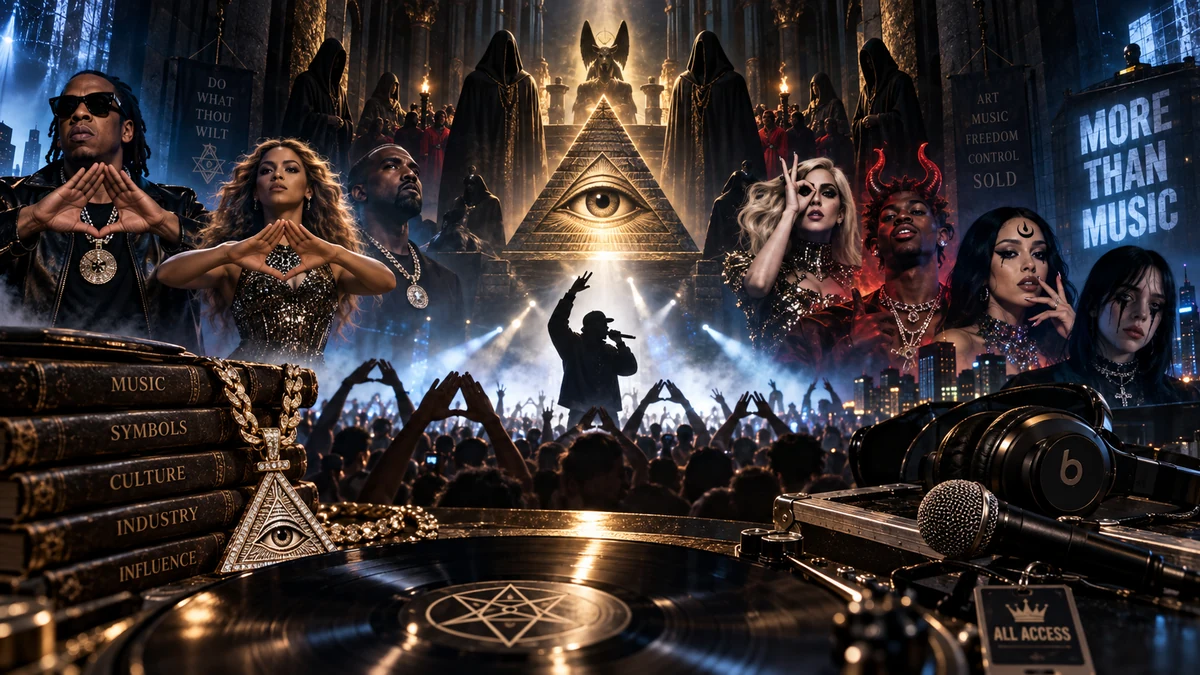
The word occultism in popular music covers very different things. It can mean a musician’s documented personal interest in magic or esotericism, direct involvement with an occult organisation, the use of symbols and ritual language in art, theatrical provocation, shock marketing, or an interpretation imposed later by audiences. Collapsing all of these into one category produces either sensationalism or premature dismissal.
The historical record shows that real connections do not need to be invented. Aleister Crowley really is on the Sgt. Pepper cover; Jimmy Page had a documented interest in Crowley, Boleskine and occult publishing; Kenneth Anger directly connected Crowleyan symbolism with experimental film and rock musicians; and Psychic TV functioned as the artistic mouthpiece of Thee Temple ov Psychick Youth. There are even explicitly Satanist musical recordings released by the Church of Satan itself.
The counterexamples are equally important. Black Sabbath used Satanic imagery, yet Geezer Butler described the song as a warning against Satanism. In the Judas Priest case, after a highly publicised trial the families failed to prove that the band intentionally inserted the alleged subliminal command or that it caused the deaths, even though Rob Halford acknowledged a separate, later experiment involving a deliberately reversed phrase. Dark aesthetics, genuine occult interest and proof of a hidden message are therefore not the same thing.
This article therefore does not ask whether ‘occultism in music’ is true or false as a single claim. It asks what kind of connection can actually be established in each case: worldview, ritual practice, artistic quotation, visual language, theatre, marketing, or later projection. Where a documentary trail exists, we name it. Where it does not, a possibility is treated as neither proven nor impossible.
First separate five levels of evidence
The biggest mistake in this subject is often the starting category. Documented affiliation or practice is the strongest level: an organisational record, first-person statement, ritual document or clearly described participation. The second is documented personal interest—collecting books, publishing, owning a historically significant property or repeated statements. The third is artistic borrowing: a name, symbol, text, film motif or person is intentionally incorporated into a work. The fourth is ritual or shock aesthetics, which may function as theatre or branding without demonstrable religious affiliation. The fifth is later interpretation, where the connection is constructed by audiences, media or critics.
The same artist can occupy several levels at once. That is why ‘is this musician an occultist?’ is often too imprecise. Jimmy Page is a case where much more can be documented than visual aesthetics alone; with the Beatles, Crowley’s deliberate presence on the Sgt. Pepper cover is demonstrable, but membership in Thelema does not follow from the cover itself. Black Sabbath’s Satanic language is obvious, while the lyricist later described an anti-Satanic warning.
This article applies the same rule used for symbols: evidence for one layer does not prove every other layer, but neither does it automatically exclude them. An artistic quotation may be only a quotation or a sign of deeper interest; deciding between those possibilities requires another trace.
Before rock: Scriabin and music as a mystical event
The relationship between modern music and esotericism did not begin with rock. Alexander Scriabin developed an early twentieth-century artistic world in which colour, sound, ecstasy and mystical transformation became part of the same project. His Prometheus is associated with colour-light ideas and the so-called mystic chord, while the unfinished Mysterium envisioned a synthesis of art, religious event and transformation of its audience.
Scriabin scholarship also cautions against using the label ‘mystic’ as a substitute for analysing the music itself. Yet his case establishes a recurring pattern: an esoteric idea can demonstrably shape an artistic programme without turning every note into a secret code. The mystical layer may be historically documented at the level of ideas while the musical structure remains open to ordinary musicological analysis.
Sgt. Pepper: Crowley really is on the cover — what follows?
Aleister Crowley’s appearance on Sgt. Pepper’s Lonely Hearts Club Band is not an internet invention. A museum record identifies him in the upper part of the collage, while Christie’s history of the cover preserves a production recollection in which Crowley’s figure had to be physically tilted during the arrangement. His image was therefore intentionally present in the final composition.
The next step is harder. Peter Blake asked the Beatles for lists of people to populate the crowd; the project became a broad cultural pantheon containing gurus, artists, actors and writers. Crowley’s presence proves the deliberate inclusion of Crowley, but the cover by itself does not establish why a particular Beatle wanted him there or what worldview followed from that decision.
This is a useful open boundary. We can confirm an iconographic quotation. To establish a deeper Thelemic programme for the album, we would need additional independent evidence—statements, notes, correspondence or a coherent chain of decisions. A further meaning remains possible; the cover alone does not decide it.

Jimmy Page: when the connection becomes much more documentary
With Jimmy Page, the evidentiary level changes. Page confirmed in interview that Boleskine House had belonged to Aleister Crowley. His interest did not end with the property: in London he opened Equinox, a specialist occult bookshop, and through The Equinox published a facsimile of Crowley’s 1904 edition of the Goetia. Weiser Antiquarian’s bibliographic record explicitly identifies the 1976 edition as a short-lived venture by Jimmy Page.
It is therefore no longer adequate to speak only of coincidental imagery. Active collecting, publishing and cultural interest in Crowley and occult literature is documented. This is still not proof that Led Zeppelin as a band conducted secret rites, or that every ambiguous graphic on an album derives from one occult scheme. It does show that Page’s historical link is substantially stronger than a later fan association.
The distinction matters when evaluating Led Zeppelin symbols. Where no creator explanation survives for a particular sign, we may speak of a documented environment of interest, not automatically of a documented meaning for every sign. Strong context can make deliberate allusion more plausible, but the individual allusion still needs its own evidence.

Kenneth Anger: a direct bridge between ritual film and rock
Experimental filmmaker Kenneth Anger is one of the clearest bridges between occult imagery and late-1960s/1970s rock culture. The BFI notes that Invocation of My Demon Brother features Mick Jagger and uses a repetitive synthesizer score created by Jagger. Anger’s Lucifer Rising was inspired by Crowley’s ‘Hymn to Lucifer’; Marianne Faithfull, Jimmy Page and others participated, and Page created a score that Anger discarded after their falling-out.
Here the ritual and Crowleyan language is programmatically documented in the film project itself, and the participation of major musicians is also documented. But participation in a film is not automatically a declaration of personal faith. Jagger’s score for an Anger film proves collaboration with that artistic project; without further evidence it does not prove that Jagger adopted Anger’s or Crowley’s complete religious system.
Anger’s case shows why the phrase ‘capture of music’ is too broad. It is more precise to speak of contact between experimental cinema, ritual theatre, counterculture and rock, in which ideas and people demonstrably intersected.
David Bowie: Kabbalah and Crowley as a documented artistic layer
David Bowie’s official archive provides a particularly useful source. In its discussion of Station to Station, Bowie’s own website explicitly says the track evokes the occult and includes references to Aleister Crowley and Kabbalah. That is strong evidence that the esoteric layer is not merely a later listener invention.
Again, the levels must remain separate. A documented lyrical and artistic reference does not by itself settle Bowie’s personal metaphysical beliefs at every stage of his life, nor the meaning of every symbol associated with him. Artists can research, quote, dramatise, ironise or use such material to construct a persona.
For a source-critical article, the firm point is sufficient: occult, Crowleyan and Kabbalistic material forms part of the documented interpretive history of the song itself. It need not be dismissed as audience fantasy, and it need not be expanded into claims for which no source exists.
Black Sabbath: Satanic imagery, but the author describes a warning
If one judged only from the title, sound and lyrics of Black Sabbath, the label ‘Satanic music’ might look almost self-evident. The verified lyrics do contain a black figure, Satan, fire and terror. Yet Geezer Butler has repeatedly explained that he understood the song as a warning against Satanism and the occult, not an endorsement of them.
Butler has also described a period in which he read literature about Satanism. The occult background is therefore not invented: the lyricist genuinely investigated the subject. But according to his own testimony, the song’s intended direction is the opposite of what part of the audience and media attributed to the band.
The case is methodologically valuable. Dark iconography can emerge from genuine interest in an occult subject and still be used as a warning. Ignoring the author’s explanation turns aesthetics into doctrine.
Psychic TV and TOPY: when music and a magical organisation actually overlap
With Psychic TV and Thee Temple ov Psychick Youth (TOPY) the connection is much more direct. Peer-reviewed musicological literature describes TOPY as Genesis P-Orridge’s chaos-magick network or sect, with Psychic TV functioning as an artistic mouthpiece. Research in Nova Religio describes TOPY as a geographically dispersed occult collective engaged in ‘magickal media activism’.
Genesis P-Orridge also publicly described how a community around music developed into a network using essays, mail, local nodes and an occult or ritual identity. This is a case where ‘occultism in music’ is not merely a description of imagery or a critic’s theory: the organisational and ritual layer is part of the project’s documented history.
Such cases give us a calibration point for weaker claims. When a connection is real, it often leaves multiple traces: texts, organisational names, member networks, archives, interviews and academic studies. A triangle or pentagram alone should not be treated as equivalent evidence.
When Satanism is literal — and when it is mainly aesthetics, marketing or panic
There are also cases where the phrase Satanic music is literal in an organisational sense. The Church of Satan maintains a musical archive of Anton LaVey and describes The Satanic Mass as an authentic recording of one of its rituals. That is a different evidentiary category from an artist who uses horns, inverted crosses or demonic scenery as provocative stage imagery.
Academic research on heavy metal therefore makes an important distinction between ‘Satanism’ and ‘Satan stuff’. Metal contains abundant references to the Devil, demons and occult lore, but they carry diverse meanings: from professedly occult or Satanic artists to anti-Satanic and Christian bands, with a large middle territory of horror, irony, theatricality, subcultural identity and marketing.
In the United States this distinction also became a political issue. At the 1985 Senate hearing on record labeling, advocates of warnings cited songs said to promote the ‘practice of the occult’ among several categories, while Frank Zappa, John Denver and Dee Snider argued against the proposed labeling approaches. It is a historical example of how real provocative symbolism can become part of a broader moral and regulatory conflict over popular culture as a whole.
The Judas Priest case is even more instructive. Families of two young men alleged that Stained Class contained hidden commands. The court did not accept that the disputed ‘do it’ had been intentionally inserted by the band or shown to cause the deaths. At the same time, Rob Halford acknowledged that the later song Love Bites did contain a deliberately reversed phrase as an artistic experiment. The lesson is not that backmasking never exists; it is that the specific recording, intent and alleged effect must each be demonstrated separately.
The contemporary U.S. scene: from the Roc diamond to Horus, demons and ritual iconography
When the lens widens to contemporary American popular music, the recurring visual vocabulary becomes difficult to ignore: triangular and diamond hand gestures, the single eye, pyramids, Horus, horns, demons, inverted or reworked religious iconography, the Kabbalistic red string, and direct quotations from Crowleyan language. These signs do not all come from one tradition. Freemasonry, Thelema, Kabbalah, ceremonial magic, Satanism, ancient Egyptian iconography and Christian inversion have different histories even though modern visual culture frequently lets them overlap.
The useful approach is therefore to survey prominent U.S. examples without turning resemblance into automatic proof of membership in one hidden organisation. For some artists the origin of a gesture or the artist’s own explanation is known; for others there is a documented esoteric phrase or practice; elsewhere we can securely establish only the repeated image. A public explanation for one layer does not logically prove that no additional layer existed, but an additional layer cannot be promoted to fact without a documentary trail.
| Artist | What can be directly documented | What remains open |
|---|---|---|
| JAY-Z | His diamond hand sign is documented as the Roc-A-Fella/Roc Nation sign, and JAY-Z has linked its origin to the idea of “diamond” sales. Separately, he was publicly filmed wearing “Do What Thou Wilt,” a phrase directly rooted in Crowley’s Thelema; an NPR discussion with Mitch Horowitz also noted Masonic/esoteric motifs in some Rocawear design. | Whether the Roc sign was chosen only as branding or also because of its resemblance to older triangular/esoteric signs; these sources do not establish formal Freemason membership or one hidden organisation. |
| Beyoncé | At the 2013 Super Bowl she used the same Roc diamond sign; later, “Formation” directly addressed Illuminati rumours. | Whether recurring triangular, eye or ritualised motifs carry an additional intentional esoteric layer beyond branding and staging. The gesture itself does not settle that question. |
| Kanye West | The “Power” video uses a Horus pendant, monumental columns, horned/allegorical figures and a religious-neoclassical tableau. Director Marco Brambilla described it as an image of power, decadence and an empire on the verge of collapse. | Whether particular elements consciously quote Freemasonic or mystery-school meanings, or a broader art-historical and esoteric repertoire. The documented authorial explanation does not close the possibility of additional symbolic layers. |
| Madonna | Madonna publicly confirmed sustained involvement with Kabbalah, wore the red string and adopted the Hebrew name Esther; religious and mystical iconography therefore intersects with documented personal practice in her case. | It does not follow that every later symbol or performance is Kabbalistic, Freemasonic or ritual in a narrow sense. |
| Lady Gaga | “Judas” deliberately uses biblical characters and dark religious iconography; Gaga described the song as a metaphor for betrayal, forgiveness and the relationship between darkness and light. “Alejandro” likewise uses convent, cross and church aesthetics. | Whether other recurring eye, triangle or ceremonial motifs carry an additional occult or Freemasonic reference where no design trail is public. |
| Lil Nas X | In “MONTERO (Call Me By Your Name),” hell, Satan and religious inversion are openly intentional; the artist said he wanted to flip religious stories and meanings for his own narrative. | Whether that iconography expresses personal occult belief or primarily artistic, sexual and cultural provocation. The visual alone does not decide it. |
| Doja Cat | The “Scarlet” era deliberately used demons, the devil, blood, death and other occult-coded motifs; the Recording Academy explicitly described the “Demons” and “Paint the Town Red” visuals as featuring occult themes. | Whether this reflects personal religious/occult practice or provocative aesthetics and marketing. The imagery is documented; organisational affiliation is not. |
| Billie Eilish | “all the good girls go to hell” uses a fall from the sky, wings, black tar, fire and hell language; official music coverage simultaneously links the visual to her climate-crisis message. | Whether individual demonic or angelic motifs carry additional esoteric references beyond the documented environmental allegory. |
| Playboi Carti | In an XXL interview he was directly asked about Satanic symbols in his clothing, merchandise and branding; he did not deny the imagery, instead placing it within his preference for going against expectations and expressing himself freely. | Whether this amounts to a sustained occult doctrine or primarily identity, countercultural and commercial aesthetics. His answer does not determine that. |
This survey shows why the question is poorly framed as “are these musicians Freemasons?” A more precise inquiry asks which symbol is actually present, what its older history is, whether the designer or commissioner is known, whether the performer explained the intent, and whether an independent trail links the use to a specific tradition. Where that trail is absent, the resemblance remains real while its genealogy remains open.
Evidence matrix: from documented practice to open interpretation
| Case | What is documented | What still does not follow |
|---|---|---|
| Scriabin | Mystical programme, colour-sound ideas and the ‘mystic chord’ are part of the documented reception of his late works | That every musical structure is a secret occult code |
| Sgt. Pepper / Crowley | Crowley’s image is intentionally included in the cover collage | That the cover itself proves Beatles membership in Thelema or a unified occult programme for the album |
| Jimmy Page | Boleskine, Crowley collecting, the Equinox bookshop/publisher and the Goetia edition have a documentary trail | That every Led Zeppelin symbol has one proven Crowleyan meaning or that the band as a whole was a ritual organisation |
| Kenneth Anger / Jagger / Page | Crowley’s influence on the films and participation of rock musicians are documented | That participation in the film alone proves personal religious affiliation for every participant |
| David Bowie | Station to Station has documented references to Crowley and Kabbalah | Bowie’s entire worldview or the meaning of every symbol associated with him |
| Black Sabbath | Satanic imagery and Butler’s interest in the subject are documented; Butler describes the song as a warning | That dark imagery by itself means advocacy of Satanism |
| Psychic TV / TOPY | An occult collective, ritual practice, network and musical medium are academically documented | That every listener or later industrial/witch-house artist belongs to TOPY |
| Anton LaVey / Church of Satan | The organisation itself issued musical and ritual recordings | That heavy music in general is therefore Satanic |
| Contemporary U.S. scene | JAY-Z, Beyoncé, Kanye West, Madonna, Lady Gaga, Lil Nas X, Doja Cat, Billie Eilish and Playboi Carti all have documented gestures, symbols, esoteric references or religious/occult visual strategies, though the strength and type of evidence differ sharply | That repetition of a similar symbolic vocabulary by itself proves one secret network, Freemason membership or a shared ritual programme |
| PMRC 1985 | The occult was among themes raised in the political conflict over music content and record labeling | That political concern itself proved occult intent in any specific song |
| Judas Priest | The alleged subliminal ‘do it’ was not established as intentional causal manipulation; a later reversed recording was acknowledged as a separate experiment | That backmasking is never used, or conversely that every ambiguous sound is an intentional hidden message |
The matrix describes a continuum rather than a single explanation. Some cases are organisationally and ritually direct, some are documented cultural quotations, some are theatrical or commercial aesthetics, and others are claims whose evidentiary chain is too weak. The distinction lets us acknowledge real connections without turning unproven ones into certainty.
Occultism in music is real — but it is not one hidden story
After reviewing the sources, it is not credible to reduce the occult layer of popular music to nothing but moral panic. There are clearly documented influences, collaborations, publications, organisations, ritual recordings and artistic references. In some cases the connection is superficial and iconographic; in others it reaches into personal collecting, publishing or organised magical practice.
The evidence also does not produce a single centrally directed ‘capture of music’. Scriabin, the Beatles, Page, Anger, Bowie, Black Sabbath, Psychic TV and LaVey represent different histories, motivations and degrees of directness. A shared vocabulary of symbols does not prove a shared command centre.
The most productive question is therefore not ‘Are occult symbols present in music?’—they often are. The better question is: what kind of connection does the evidence establish in this particular case? If we have a creator statement, publishing record, film credit, organisational archive or ritual document, we can say considerably more. If we have only a similar gesture, sign or rumour, the historical explanation must remain open.
The article therefore ends without either comfortable extreme. It does not claim everything is just marketing. Nor does it claim that the music industry is proven to be one unified hidden cult. Documented occultism should be acknowledged as documented; symbolic and undocumented claims should remain open until a trace appears that can decide more.
Sources and further reading
- Library of Congress, NLS Music Notes — “Mysticism, Magic and Music” (2021): Scriabin, synesthesia, the mystic chord and late works.
- Cambridge University Press / Boydell & Brewer — Vasilis Kallis, “Demystifying the Mystic,” in Demystifying Scriabin (2022).
- Museum of Witchcraft and Magic — Beatles album with Aleister Crowley image: museum object record for Sgt. Pepper.
- Christie’s — Sgt. Pepper’s Lonely Hearts Club Band cover-production history; Crowley identified among the intentionally arranged figures.
- Rolling Stone — “The Durable Led Zeppelin” (1975): interview in which Jimmy Page confirms that Boleskine had belonged to Aleister Crowley.
- Rolling Stone — “Jimmy Page: The Rolling Stone Interview” (2012), biographical discussion including his long-standing interest in Crowley and the occult.
- Boleskine House Foundation — history of Boleskine House, including Crowley and later ownership by Jimmy Page.
- Weiser Antiquarian Books — 1976 Crowley Goetia facsimile, published by The Equinox (Booksellers and Publishers) Ltd., identified as Jimmy Page’s venture.
- LedZepNews — historical reconstruction of Jimmy Page’s Equinox occult bookshop, including contemporary interview material.
- BFI — “Where to begin with Kenneth Anger”: Mick Jagger’s score for Invocation of My Demon Brother; Lucifer Rising, Crowley inspiration, Jimmy Page and Marianne Faithfull.
- Frameline archive — Invocation of My Demon Brother (1969): Kenneth Anger film with original synthesizer score by Mick Jagger.
- David Bowie official site — “The Bowie Years Volume 2”: Station to Station described as evoking the occult with references to Aleister Crowley and Kabbalah.
- Black Sabbath Online — verified lyrics for “Black Sabbath,” including Satanic imagery and a plea for divine help.
- Denver Westword — interview with Geezer Butler: he describes “Black Sabbath” as a warning against Satanism and recounts his reading about Satanism.
- Sonic Perspectives — interview with Geezer Butler: he again describes “Black Sabbath” as a warning against Satanism and occult involvement.
- Journal of Musicological Research — Daniel Siepmann, “Unholy Progeny: Psychic TV and Witch House at the Crossroads of Occultism in the Information Age” (2018).
- Nova Religio — Eden Consenstein, “Yes, We Do Want to Subvert and Corrupt Young People”: TOPY as a geographically dispersed occult collective and its media activism (2022).
- i-D — interview with Genesis P-Orridge on Thee Temple ov Psychick Youth, its network model and occult identity.
- Cambridge University Press — “Esoterrorism and the Wrecking of Civilization: Genesis P-Orridge and the Rise of Industrial Paganism,” in Pop Pagans.
- Cambridge University Press — Asbjørn Dyrendal, “Satanism and Popular Music,” in The Lure of the Dark Side.
- Cambridge University Press / Amsterdam University Press — Kennet Granholm, “Why all that Satanist Stuff in Heavy Metal?” in Hermes Explains.
- Journal of Musicological Research — “Introduction: The Musicological Occult, or Show Us the Dragons” (2018), framing modern occult currents and musicological study.
- Church of Satan — “Satanic Sources – Music”: official list of recordings by Anton LaVey and Peter H. Gilmore.
- Church of Satan — “Music by Anton Szandor LaVey”: The Satanic Mass described by the organization as an authentic recording of a Church of Satan ritual.
- U.S. Senate Committee on Commerce, Science, and Transportation — Record Labeling hearing, Sept. 19, 1985, S. Hrg. 99-529 (Google Books bibliographic record).
- UPI Archives — report on the Sept. 19, 1985 Senate record-labeling hearing; testimony included concerns about songs said to promote occult practice, among other themes.
- Dee Snider official site — retrospective on the 1985 PMRC Senate hearings and the proposed content categories, including an occult category.
- Los Angeles Times — Aug. 25, 1990 verdict report in the Judas Priest subliminal-message case; the families failed to prove intentional insertion or causation.
- UPI Archives — Aug. 1, 1990: Rob Halford denied deliberate hidden messages on Stained Class while acknowledging a deliberately reversed phrase on the later song “Love Bites” as an artistic experiment.
- Los Angeles Times — July 21, 1990 coverage of the Judas Priest trial and the plaintiffs’ subliminal-message allegations.
- VPM / NPR — “Jay-Z: A Master Of Occult Wisdom?” (2009): documents the “Do What Thou Wilt” sweatshirt and quotes historian Mitch Horowitz on Crowleyan and Masonic/esoteric references around JAY-Z/Rocawear while stopping short of claiming secret-society membership.
- iHeartRadio — JAY-Z explains the origin of the Roc-A-Fella diamond hand sign (2023), linking it to the aspiration of “diamond” record sales and its later crowd/brand use.
- UPI — Beyoncé’s 2013 Super Bowl diamond-shaped hand gesture and its documented identification as the Roc-A-Fella/Roc sign rather than evidence of Illuminati membership.
- The Guardian — review of Beyoncé’s “Formation” noting her explicit lyrical dismissal of Illuminati rumours; useful as evidence that the conspiracy reading had become part of the public conversation she consciously addressed.
- Marco Brambilla Studio — official project page for Kanye West’s “Power”: a neoclassical tableau of allegorical creatures portraying an empire collapsing under excess, decadence and corruption.
- Cool Hunting — interview with Marco Brambilla on “Power” (2010): he describes Kanye as an icon of power about to fall and explains the baroque, decadent visual programme.
- CBS News / Associated Press — Madonna confirms years of Kabbalah practice, adoption of the Hebrew name Esther and the red-string symbol (2004).
- Rolling Stone Australia — retrospective on Lady Gaga’s “Judas” and “Alejandro,” documenting the deliberate biblical/convent iconography and Gaga’s literal use of the Judas story in the video.
- Vogue — Lil Nas X on “MONTERO (Call Me By Your Name)” (2021): the artist says he intentionally wanted to flip religious stories and meanings; the video openly depicts hell and Satan.
- Recording Academy / GRAMMY — “5 Takeaways From Doja Cat’s New Album Scarlet” (2023): explicitly describes the “Demons” and “Paint the Town Red” visuals as featuring occult themes, death and the devil.
- Recording Academy / GRAMMY — Billie Eilish visual retrospective: documents the winged fall, tar, fire and hell imagery in “all the good girls go to hell” and connects the visual to climate-change messaging.
- XXL — Playboi Carti interview (2022): directly asks him about Satanic symbols in clothing, merchandise and branding; Carti frames the imagery through nonconformity and self-expression rather than giving a doctrinal explanation.