Shincheonji Church of Jesus
When Revelation becomes a map of reality — and the question is not only what you believe, but who gets to explain what has already been fulfilled
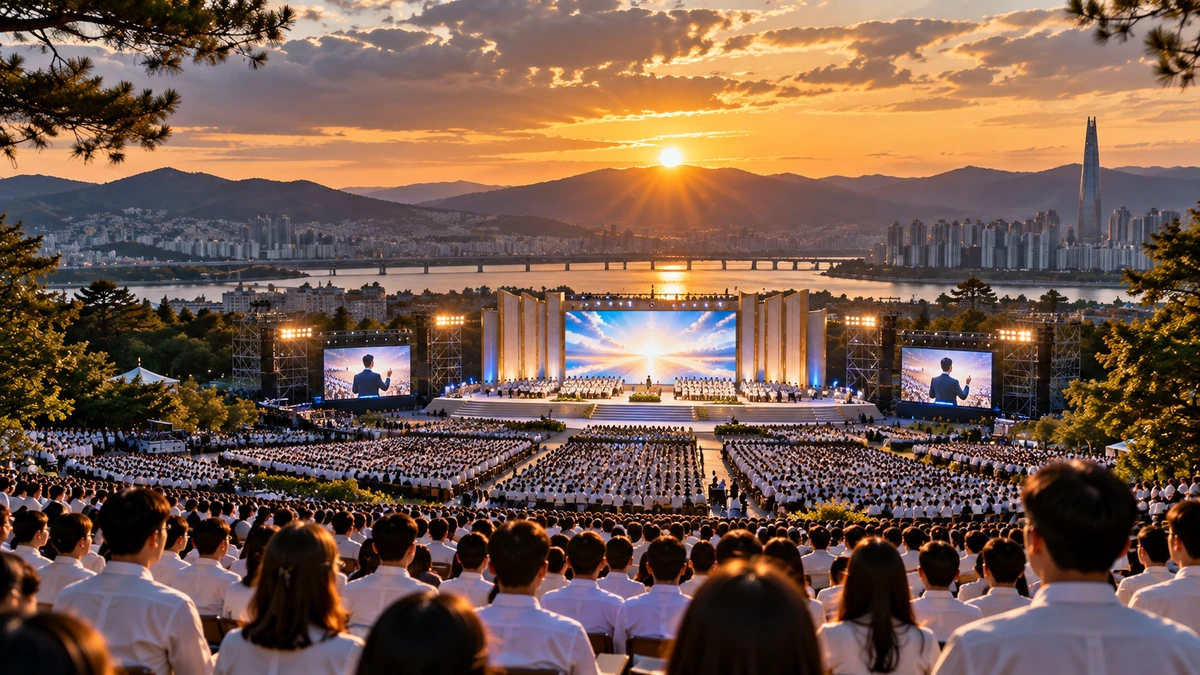
With the Shincheonji Church of Jesus, the Temple of the Tabernacle of the Testimony, there is a strong temptation to explain the case with a single word. For critics, that word is often “cult.” For the group itself, it is the Kingdom of God created according to the pattern of Revelation, with twelve tribes and a promised pastor who testifies to the physical fulfillment of prophecy.[1][3]
But neither label does the research work by itself. If we want to understand how the group operates, we need to separate at least five different questions: what it actually teaches; how it understands the authority of its leadership; how its Bible education works; how people encounter the organization and when they learn its identity; and what happens when the religious system comes into conflict with public health, a regulator, or criminal law.
It is equally important to state what the evidence does not allow us to conclude. Apocalyptic belief is not, by itself, harm. Intensive Bible study is not, by itself, coercion. The testimony of a former member is not automatically the experience of every member. An epidemiological cluster is not proof of deliberate disease transmission. A regulatory investigation is not a finding of wrongdoing. An indictment is not a conviction.[10][12][13][18]
The central question of this article is therefore more precise:
What happens when a religious community claims not only that it correctly understands the Bible, but that it has special access to prophecy that has already been fulfilled — and when belonging to that understanding is tied to organized study, evangelization, internal authority, and a concept of salvation?
A movement founded in 1984, but rooted in an older Korean religious history
Shincheonji is neither an ancient church nor simply a branch of Western Protestantism. Academic research by David W. Kim and Won-il Bang places it within the broader history of Korean Christian new religious movements and links it to indigenous religious currents of the twentieth century. Before founding his own movement, Lee Man-hee had been associated with other Korean religious environments, and he founded Shincheonji in 1984 in Gwacheon, Gyeonggi Province.[17]
The name Shincheonji means “new heaven and new earth.” For the group, this is not merely a poetic metaphor. Its current official website states that the creation of Shincheonji was promised in advance in the Bible and that the community represents a unique Kingdom of God and temple on earth.[1]
That distinction matters. Many churches believe that they interpret the Bible correctly. Shincheonji publicly teaches something more specific: that the prophecies of Revelation have received a physical fulfillment, that this fulfillment can be identified in concrete history, and that there is a “promised pastor” or messenger who testifies to it.[1][3]
That is an epistemologically powerful claim, because the dispute is no longer only about how to interpret a text. The dispute becomes a question of who has the authority to say which events in the world have already fulfilled prophecy.
The “promised pastor”: authority grounded in testimony about fulfillment
On the official website, Lee Man-hee is described as a “messenger who speaks on behalf” and as the promised pastor who, according to the movement’s own explanation, is sent to the churches to testify to the physical fulfillment of Revelation.[1] That does not mean this article accepts the supernatural claim as fact. It does establish, however, that Lee’s special role is not merely a label imposed on him by opponents. It is part of the movement’s public self-presentation. Current statements by the chairman from March 2026 still speak of the promised pastor, the fulfillment of Revelation, sealing, and the twelve tribes.[3]
In such a structure, the distinction between charismatic authority and coercion is important. A person can entirely voluntarily believe that a particular teacher correctly understands God’s plan. Special theological authority by itself therefore does not prove that members lack the capacity to consent or that they are automatically under coercion.
But when the same authority determines how prophecy is to be understood, who belongs to God’s kingdom, and which historical events constitute fulfillment, the question of independent verification becomes much more important. If the interpreter is also part of the fulfillment he interprets, the internal system of verification is necessarily different from a system in which the foundational claim can be tested without his authority.
This is an analytical problem, not a judgment about the sincerity of an individual believer.
The twelve tribes, 144,000, and sealing
Current official sources very clearly connect Shincheonji’s identity with the twelve tribes. The organization explains its structure through Revelation 7 and 14 and the number 144,000 sealed people.[1] More importantly, this framework is not presented merely as symbolic history.
On the official Zion Christian Mission Center website, education is described as a process that “seals” the harvested people with the revealed word and thereby creates the twelve tribes.[2] Current statements by the chairman from 2026 also include the claim that those who belong to the twelve tribes, believe in Revelation, and are sealed will enter the promised heaven.[3] This creates a very strong connection between knowledge, organizational belonging, and salvation. In many religions, salvation is associated with faith, sacraments, ethical life, or divine grace. Here, correct understanding of fulfillment and placement within the organizational structure that the group identifies as the twelve tribes also carry particular weight.[1][3]
That raises the cost of epistemic doubt. If a person is not merely disagreeing with one pastor but begins to doubt a system that determines who is sealed and who belongs to the promised Kingdom of God, doubt can acquire existential significance.
That is still not proof of psychological coercion for every member. It is, however, a documented reason to pay particular attention in this case to the relationship between theological uncertainty and organizational loyalty.
Zion Christian Mission Center: Bible school or entry system?
Shincheonji does not revolve only around Sunday worship. A central role is played by the Zion Christian Mission Center, a structured and, according to the group, free Bible education program.[2] The current official website describes it as a center that teaches the revealed word of fulfilled prophecy and prepares people to be sealed into the twelve tribes. For 2025, the organization itself reports 59,192 graduates, more than 757,000 graduates over time, and approximately 443 centers in 92 countries.[2]
Those figures must be presented with considerable caution. They are self-reported organizational data. They do not establish that every graduate is a unique currently active member, that every listed location is comparable in size, or that the figures can be used to calculate current global membership.[2]
More important than the number is the existence of a large and structured system of instruction. Intensive religious education is not inherently problematic. People voluntarily attend seminaries, meditation retreats, theological programs, and multi-month catechetical courses.
The question therefore is not whether nine months or more of study is “too much.” The question is what information a person has when deciding to enter the program, when they learn the identity of the organization, and what social or spiritual costs arise if they begin to doubt or want to leave.[14][15]
Intensity is not coercion — we need a concrete mechanism
With groups that have demanding schedules, it is very easy to make a methodological mistake: a great deal of time, many lectures, and extensive evangelization are declared proof of “brainwashing.” That conclusion is too fast.
Someone can voluntarily devote almost all of their free time to sport, a political campaign, an academic program, a monastery, or religion. Time intensity alone does not tell us whether consent is free. To support a claim of coercion, we therefore need to look for concrete mechanisms: deception at entry, systematic concealment of material information, threats, sanctions, restriction of contacts, financial consequences, information control, or other behavioral practices that reduce a person’s realistic ability to choose.
This standard also matters because the Parliament of Victoria explicitly emphasizes a behavioral approach in its July 2026 report. The inquiry was not intended to decide which religion is true or false, but to examine coercive behaviors and harm in high-control groups.[11]
That framework is useful for Shincheonji as well. Apocalyptic theology is not, by itself, proof of harm. But if it is accompanied by a documented system of delayed identity disclosure, profiling of candidates, or sanctions for doubt, then the object of evaluation is no longer theology but concrete behavior.[14][15]
Recruitment: when does a candidate learn who is actually teaching them?
The most concrete and recurring criticism of Shincheonji concerns identity disclosure during recruitment. ABC Australia published testimony from former members and recruitment materials in 2025. In one documented case, a university student was invited to take a survey and then to join a Bible group without initially being told that it was connected to Shincheonji. According to her testimony, she learned the group’s identity only about six months later.[14]
ABC also published videos and instructions on digitally identifying potential recruits, inviting people to unnamed events, and using surveys as an initial point of contact.[14] In 2026, ABC also reported on internal or obtained documents concerning regional recruitment in Australia. According to the reporting, they contained detailed profiles of candidates, including their interests, spiritual background, life plans, and even a “potential serpent” field for people who might obstruct a candidate’s entry.[15]
This is important evidence because it does not rest on the memory of a single former member alone, but includes multiple testimonies and concrete recruitment materials.[14][15] But the boundary must remain clear: evidence of delayed identity disclosure in documented recruitment pathways does not mean that every contact between Shincheonji and a new person is deceptive. We do not have evidence for such a universal conclusion.
What the group itself says about deception
Shincheonji does not accept the critical interpretation that deception is a legitimate method of the organization. On an affiliated New Zealand FAQ page, the organization addresses questions about secrecy, the cult label, and recruitment; ABC summarized the page’s position as saying that “deception is not a tactic that Shincheonji encourages.”[7][14]
That position must be retained in the article. At the same time, an official denial cannot by itself erase documented cases in which candidates did not initially know the identity of the group.[14][15] We therefore have two different levels of evidence.
The first is normative self-presentation: the organization says that it does not encourage deception.[7] The second is documented practice in particular recruitment systems: investigative reporting and former members describe and show pathways in which Shincheonji was not disclosed immediately.[14][15] The fairest conclusion is therefore neither “all recruiters lie” nor “because the organization denies deception, it did not happen.” The conclusion is narrower:
there are well-documented cases and materials supporting delayed identity disclosure in some recruitment pathways; the extent and consistency of that practice across all countries and teams are not established by the available evidence.
The information environment: when external criticism can become a spiritual danger
Several former members interviewed by ABC described an environment in which external critical material about Shincheonji was presented as spiritually dangerous or as something that could draw a person away from God’s word.[14][15] One former member described warnings that searching for critical information online was comparable to “spiritual suicide.”[15] Such testimony is research-relevant, but it must be categorized correctly. These are not judicial findings, nor are they proof that every member received the same instruction.
They are, however, directly relevant to epistemic closure: whether a system allows members to test its foundational claims against outside sources, or whether external doubt is framed in advance as a sign of spiritual danger. If an organization believes external criticism is wrong, it of course has the right to say so. The problem would arise only if information were systematically restricted or if access to it were tied to threats, sanctions, or fear concerning salvation.
The available sources support the existence of such descriptions in some Australian settings, not a universal conclusion about every Shincheonji member worldwide.[14][15]
Money: testimony about tithes and additional offerings is not the same as a finding of financial abuse
In February 2026, ABC published a separate financial investigation in which former members of Australian communities described tithing, additional contributions, and pressure to donate.[16] The report cites testimony that members were expected to give ten percent of their income as well as additional contributions for events, construction, travel, or other needs. Some former members said they continued giving even when they themselves were under financial strain.[16]
That is enough to make financial pressure a legitimate research question. It is not enough to claim that Shincheonji as a whole has been legally found to engage in financial exploitation. At present, what we primarily have is journalistically documented testimony from former members. An Australian regulatory investigation is ongoing, but the ACNC has not publicly disclosed the reasons for the investigation and has not published a finding of wrongdoing.[10][16]
The article must therefore preserve the distinction: testimony about financial pressure ≠ a regulatory finding of systemic financial abuse. If the regulator later publishes findings, this section will need to be reassessed.
February 2020: when a religious community became the center of a national epidemic
Shincheonji entered global public awareness most dramatically in February 2020, as South Korea experienced rapid spread of the novel coronavirus. Official data from the Korean disease-control authority reported 1,595 confirmed cases nationwide on February 27, 2020, of which 731 were linked to the Shincheonji Daegu Church.[8]
A later scientific modeling study described even faster spread in the following days: within two weeks of the index case being confirmed on February 18, 3,081 linked cases had been identified. The authors estimated a very high reproduction factor within the cluster and emphasized that communities of this kind can provide settings in which close contact and mass gatherings sharply accelerate transmission.[19]
Another epidemiological reconstruction described the early course of the outbreak, Patient 31, religious events, and the use of membership registries for contact tracing.[20] These are strong data about an epidemiological event. They do not establish intent.
Very rapid spread of disease within a particular community does not mean the group deliberately spread the virus or that its leadership automatically committed a criminal offense.[8][19][20]
COVID-19: a large cluster is not the same as criminal guilt
During the outbreak, South Korean authorities accused Lee Man-hee of obstructing the epidemiological response by providing incomplete information about members and locations. But the legal proceeding did not end the way one might have assumed from the harshest headlines of 2020.
In August 2022, the South Korean Supreme Court upheld Lee’s acquittal on the specific allegation that, by submitting incomplete data, he violated provisions of the infectious-disease law. Lower courts had held that the requested data belonged to an information-gathering stage rather than to the epidemiological investigation itself as defined by the criminal provision being applied.[9]
At the same time, Lee was not acquitted of every charge. A separate conviction for embezzlement and obstruction of public duty remained in place; he received a three-year prison sentence suspended for five years.[9] That distinction is essential.
It would be wrong to write: “Shincheonji was finally found guilty of obstructing the epidemic response.” It would also be wrong to write: “Lee was acquitted, therefore all allegations against him were unfounded.” The legal record is more complicated: he was acquitted of the specific COVID-19 allegation under the provision used, while a separate conviction for other conduct remained in place.[9]
Why the COVID-19 case also requires a corrective against stigmatization
An academic analysis by Kin Cheung and Minjung Noh argues that the story of Shincheonji during the pandemic cannot be understood only as a technical public-health issue. The authors examine how a religious minority, secretive or gradually disclosed proselytizing, state power, public health, and social ideas of “good” and “bad” religion intersected in South Korea.[18]
That is an important corrective. When a state faces a major epidemiological problem, it may and must trace contacts, limit transmission, and require relevant information. But that does not mean every expression of public hostility toward a religious minority is automatically justified.
Likewise, the fact that a group experienced stigmatization does not erase legitimate questions about its recruitment or information practices. Both can be true at the same time: a community can be subjected to excessive collective demonization and also be a legitimate object of criticism for certain concrete behaviors.[18]
This matters for our series because the question “who determines reality” often breaks precisely at this point: public conflict pushes people to choose between two total stories even when the evidence supports a more complicated picture.

Australia 2026: the regulator is investigating, but has not published a finding
On February 4, 2026, the Australian Charities and Not-for-profits Commission publicly confirmed that it was investigating a registered Melbourne charity entity associated with Shincheonji.[10] That is an official fact. But the ACNC explicitly explained that statutory confidentiality rules prevent it from disclosing the reasons for or content of the investigation. Publicly, it confirmed only that an investigation or regulatory assessment was underway.[10]
We therefore must not infer that the regulator has already established a financial violation, misuse of charitable status, or any other specific wrongdoing. An investigation means the regulator is examining. It does not mean the regulator has already proved.
This is especially important because the investigation overlaps in time with journalistic reporting about recruitment and alleged financial pressure.[15][16] The temporal connection is a reason for continued monitoring, not permission to speculate about the outcome. On the ACNC’s current public investigation-disclosures page, the Melbourne Shincheonji entity remains listed among the 2026 disclosures. This supports the formulation that, as of October 1, 2026, the investigation was still publicly listed as ongoing; the page does not publish a finding of wrongdoing or a final outcome.[22]
The Victorian parliamentary inquiry: a behavioral framework, not a judgment on theology
In July 2026, the Parliament of the Australian state of Victoria published the final report of its inquiry into the recruitment methods and impacts of cults and organised fringe groups. The report contains 98 findings and 39 recommendations and explicitly states that the purpose of the inquiry was not to judge beliefs, but to examine coercive behavioral patterns and harm.[11]
Shincheonji appears in testimony, submissions, and public discussion connected with that inquiry.[11] But here again we need to preserve the legal and evidentiary boundary. A parliamentary committee’s general findings about patterns in high-control groups are not the same as a judicial or regulatory finding that Shincheonji carried out every described behavior.
Likewise, anonymous questionnaires and testimony are not final legal findings about an individual organization. Their value is different: they help create a behavioral vocabulary for examining isolation, information control, financial pressure, fear of leaving, and other mechanisms without first having to decide whether a particular religion is a “cult.”[11]
That is methodologically consistent with our approach.
The political proceeding in South Korea in 2026: what is currently established and what remains an allegation
In 2026, Shincheonji also became involved in a separate criminal proceeding connected with the People Power Party (PPP) and the alleged organized enrollment of members in a political party. According to Yonhap reporting carried by The Korea Times, Lee Man-hee was indicted on allegations that between July 2021 and January 2024 he coerced at least 56,472 members to join the PPP in order to influence the party’s primary processes.[12]
By August 31, 2026, a joint prosecution-police team had completed a 237-day investigation. It reported that four Shincheonji officials, including Lee, had been arrested and indicted, while an additional twelve were indicted without detention. At this stage, the figure 56,472 is a finding or allegation asserted by the investigative team within the prosecution record, not a final judicial finding of guilt.[13]
At the first substantive hearing on September 21, 2026, Lee Man-hee’s defense denied coercion, intent, and agreement in the alleged violation of the Political Parties Act.[21] At the next preparatory hearing on September 28, Newsis reported that the defense acknowledged that members had joined the People Power Party while continuing to deny that the memberships were coerced.[23] This procedural record also has a clear limit: acknowledging the fact of party membership while denying coercion is not a judicial finding, just as an indictment is not a conviction. As of October 1, 2026, the reviewed sources did not show a final judgment in the case.[21][23]
Because this is a politically and criminally sensitive matter, the language here is especially important. It would not be acceptable to write: “Shincheonji systematically interfered in elections,” as though that were already an adjudicated fact.
It is appropriate to write: prosecutors and investigators allege that an organized PPP membership program existed for the purpose of influencing internal party processes; the defense acknowledges that members joined the PPP but denies coercion, intent, and agreement; as of October 1, 2026, the case remained open and without a final judgment.[12][13][21][23]
Shincheonji’s response to the political allegations
Shincheonji publicly denies the political allegations. In January 2026, the organization issued an official statement calling for a broader cross-comparison of party membership lists and rejecting the interpretation that there had been a unilateral, systematic organizational instruction to enroll members in one political party.[5]
In June 2026, during proceedings concerning Lee Man-hee’s detention, it emphasized cooperation with authorities and challenged the need for detention.[6] These statements also have a clear evidentiary status. They are primary positions of the accused organization, not an independent exoneration.[5][6]
The fairest approach is therefore to preserve both sides of the procedural record: there are publicly documented allegations and indictments, there is an official denial by the organization, and the defense denied coercion, intent, and agreement on September 21 while acknowledging only the fact of PPP memberships on September 28, not their alleged coercive nature. As of October 1, 2026, there was no final judicial answer.[5][6][12][13][21][23]
That is enough to inform the reader, not to deliver a political or moral verdict.
Shincheonji in 2026: what we can reliably say
The official website is active in 2026 and publishes doctrinal material, statements by the chairman, information about the twelve tribes, international churches, and the Zion Christian Mission Center.[1][2][3][4] We can therefore reliably say that Shincheonji is an active international religious organization. We can also say that its public doctrine in 2026 continues to use the framework of the promised pastor, the physical fulfillment of Revelation, the twelve tribes, sealing, and salvation.[1][3]
We can cite the official self-reported graduation figures for the Zion Christian Mission Center, but only as figures reported by the organization itself.[2] We cannot use those figures to calculate a reliable number of active members. Nor can we automatically infer from the Australian cases that every country, every local church, and every recruiter uses identical methods.
An international organization is not evidentially uniform simply because it shares a name and doctrine.
Analysis: where does the problem of high control actually begin?
If we strip away sensational labels, the case leaves us with a useful model. The first dimension is epistemic authority. Shincheonji teaches that Revelation has received a concrete physical fulfillment and that there is a promised pastor who can testify to that fulfillment.[1][3] The more salvation is linked to sealing and the twelve tribes, the greater the weight carried by the internal interpretation.[2][3]
The second dimension is recruitment and informed consent. If a person enters a Bible program without clearly knowing which organization runs it, the informational basis of that initial decision is not the same as that of someone who knows the group’s identity from the beginning.[14][15]
The third dimension is the information environment. If external criticism is presented as a spiritual danger, the space for independent verification may shrink. But the extent of such a practice still has to be established in specific settings rather than assumed globally.[14][15]
The fourth dimension is time and social investment. Months of study, intensive evangelization, close group ties, and a sense that one’s future salvation depends on correct belonging can increase the practical cost of doubt or departure. This is a rational hypothesis about the structure, not proof that every member is trapped.
The fifth dimension is external oversight of power. The COVID proceeding, the ACNC investigation, the Victorian parliamentary inquiry, and the current Korean criminal case show the organization encountering different institutions of oversight. But those institutions do not serve the same evidentiary function: an epidemiologist measures transmission, a regulator examines compliance, a parliament collects broader behavioral patterns, and a criminal court determines specific guilt.[8][9][10][11][12][13]
Mixing those levels produces false conclusions.
What the evidence does not currently allow us to say
The available material does not allow us to fairly claim that every contact with Shincheonji is covert recruitment. We cannot claim that every member is isolated from family or the internet. We cannot claim that every member gives money under coercion or that the ACNC has already proved a financial violation.[10][16]
We cannot claim that the Daegu COVID cluster proves deliberate spread or final criminal guilt for obstructing the epidemic response; the Supreme Court ruled differently on the specific allegation.[8][9] We cannot claim that the figure 56,472 in the political case has been finally proven in court to be the result of coercion. At present it forms part of the prosecution and investigative record.[12][13]
Nor can we claim that the organization is free of problematic practices merely because some past allegations did not end in criminal convictions. An acquittal on one allegation does not erase evidence concerning other practices; an allegation in another case is not yet a conviction.
That is basic evidentiary discipline.
What would change our assessment?
The assessment of Shincheonji should change if the evidentiary record changes. If the organization introduced a publicly verifiable rule requiring its identity to be disclosed at the first recruitment contact, and independent research showed that the rule was actually followed consistently, the weight given to allegations of concealed identity should be reduced.[7][14][15]
If the ACNC concluded its investigation without finding violations, that should be stated clearly. If it published findings of specific violations, their actual scope should be described just as clearly.[10] If the Korean criminal proceeding concerning alleged organized party membership ended in an acquittal, conviction, or partial ruling, the current-status section of the article should change immediately.[12][13]
If high-quality independent studies showed that most members leave the group without major social, material, or psychological consequences, the weight of the high-exit-cost hypothesis should be reduced. If, conversely, multiple legal, regulatory, or longitudinal sources showed systematic sanctions for doubt and departure, the basis for a high-control assessment would become stronger.
A good research article does not lock itself into a label. It locks itself into the rule that the assessment must follow the evidence, even when the evidence changes.
Conclusion
Shincheonji is an important research case because it connects prophecy, special interpretive authority, structured education, organizational belonging, and salvation within a single system.[1][2][3] That alone does not prove harm. Strong religious communities can require a great deal of time, discipline, and faith from members without automatically crossing the line into coercion.
The boundary becomes more concrete where the questions arise of whether a person knew at entry who they were dealing with; whether they can test foundational claims outside the system; whether doubt, money, relationships, and departure are tied to sanctions; and whether external allegations have survived independent legal or regulatory testing.[10][11][14][15][16] In Shincheonji’s case, there is enough evidence that delayed disclosure of identity in some recruitment systems cannot simply be dismissed as fabrication.[14][15] There is enough evidence that the COVID cluster was exceptionally large, but not enough to turn an epidemiological event into a claim of deliberate criminal guilt; the Supreme Court rejected the specific allegation concerning obstruction of the epidemiological response.[8][9][19][20] There is an officially confirmed regulatory investigation in Australia, but still no published finding.[10] And there is an open Korean criminal proceeding involving serious political allegations, but no basis for converting an indictment into an adjudicated fact.[5][6][12][13] The most important question is therefore broader than Shincheonji itself:
How does a person verify the reality of a system in which the correct interpretation of the world is simultaneously linked to salvation, belonging, and the authority of the person who claims to have been sent to explain the fulfillment?
The answer cannot simply be: “believe the group.” Nor can it be: “believe its opponents.” What remains is the harder method: separate doctrine from behavior, testimony from judgment, investigation from finding, epidemiological association from intent, and indictment from conviction.
Only then can we assess the power of a system without first deciding which side must be right because of its name.
Sources and further reading
- Shincheonji Church of Jesus, Church Introduction / Promised Pastor / Twelve Tribes. Current primary source for the promised pastor, the physical fulfillment of Revelation, the organization of the twelve tribes, and the movement’s public self-presentation. Source
- Shincheonji Church of Jesus, Zion Christian Mission Center. Primary source for the free Bible program, sealing, the creation of the twelve tribes, and self-reported figures for graduates and centers. Source
- Lee Man-hee / Shincheonji, Words of the Chairman (2026). Current doctrinal source for sealing, the twelve tribes, the promised pastor, and the soteriological framework. Source
- Shincheonji, Press Release / Official Position index (2026). Current primary channel for the organization’s public statements and current-status verification. Source
- Shincheonji, The Joint Investigation Headquarters Must Conduct a Joint Inquiry by Cross-Referencing Party Membership Lists, January 20, 2026. Primary response by the organization to allegations of organized enrollment of members in political parties; a denial is not an independent exoneration. Source
- Shincheonji, Statement by Shincheonji Church of Jesus, June 22, 2026. Primary response to proceedings concerning the detention of Lee Man-hee. Source
- Shincheonji New Zealand, FAQs. Affiliated primary source for the public response to questions about secrecy, deception, the cult label, and other criticisms. Source
- Korea Disease Control and Prevention Agency, regular briefing, February 27, 2020. Official epidemiological source for 1,595 confirmed cases nationwide and 731 cases linked to the Shincheonji Daegu Church on that date. Source
- Yonhap / The Korea Times, Supreme Court upholds acquittal of Shincheonji leader, August 12, 2022. Secondary legal source confirming the acquittal on the specific COVID-19 allegation and the separate conviction for embezzlement and obstruction of public duty. Source
- Australian Charities and Not-for-profits Commission, ACNC confirms an investigation, February 4, 2026. Primary regulatory source confirming an investigation into a registered Melbourne charity entity, but not the reason for the investigation or a finding of wrongdoing. Source
- Parliament of Victoria, Inquiry into the recruitment methods and impacts of cults and organised fringe groups, final report, July 29, 2026. Official behavioral framework, 98 findings and 39 recommendations; the general findings are not a Shincheonji-specific judicial determination. Source
- Yonhap / The Korea Times, Shincheonji leader's trial over forced party memberships to begin July 24, July 7, 2026. Source for the indictment, procedural status, and allegation concerning at least 56,472 memberships in the People Power Party; an allegation is not a conviction. Source
- Yonhap / The Korea Times, Prosecution-police team wraps up probe into political-religious collusion, August 31, 2026. Current procedural source for the completion of the 237-day investigation, indictments, and figures asserted by the investigative team; it does not constitute a final judicial finding of guilt. Source
- ABC News Australia, Shincheonji is billed as a church based on teachings of the Bible. Former members believe otherwise, April 3, 2025. Independent journalism containing multiple testimonies and recruitment materials concerning surveys, Bible groups, and later disclosure of identity. Source
- ABC News Australia, 'Apocalyptic Christian cult' Shincheonji using 'special force teams' to spread across the country, January 16, 2026. Independent reporting on regional recruitment teams and documents used to profile potential recruits. The headline label “cult” is not a THY-REALITY editorial conclusion. Source
- ABC News Australia, Ex-Shincheonji members accuse church of pressure to make large donations, February 7, 2026. Journalistically documented testimony from former members concerning tithes, additional contributions, and alleged financial pressure; it is not a general regulatory finding of financial abuse. Source
- David W. Kim & Won-il Bang, Guwonpa, WMSCOG, and Shincheonji: Three Dynamic Grassroots Groups in Contemporary Korean Christian NRM History, Religions 10(3), 2019, 212. Academic historical framework for the movement’s origins, Korean religious roots, and doctrinal development. Source
- Kin Cheung & Minjung Noh, COVID-19, Shincheonji, and the limits of South Korean secularism: The Devil in Patient 31, Religion, State & Society 50(3), 2022. Academic corrective concerning public health, religious freedom, proselytizing, and the political construction of “good” and “bad” religion. Source
- Kim et al., Rapid transmission of coronavirus disease 2019 within a religious sect in South Korea: A mathematical modeling study, Epidemics 37, 2021. Scientific source for 3,081 linked cases within two weeks and the dynamics of rapid transmission within the cluster. Source
- Characteristics of the COVID-19 Outbreak in Korea From the Mass Infection Perspective (2020). Secondary epidemiological reconstruction of the early outbreak, Patient 31, and contact tracing. Source
- Yonhap, “Shincheonji leader Lee Man-hee side denies charges: ‘There was no coercion’” (September 21, 2026; Korean original). Latest procedural source before this draft: at the first substantive hearing, the defense denied coercion, intent, and agreement in the alleged forced enrollment of members in the People Power Party. A defense denial is not an acquittal; the proceeding remains open. Source
- Australian Charities and Not-for-profits Commission, Investigation disclosures (current status rechecked October 1, 2026). The current regulatory page still lists the investigation into the Melbourne Shincheonji charity entity; public disclosure of an investigation is not a finding of wrongdoing. Source
- Newsis, 신천지 이만희 측 "신도 국민의힘 가입은 인정…강요는 아냐", September 28, 2026. Procedural source for the subsequent preparatory hearing: the defense acknowledged that members joined the People Power Party but denied coercion. This is not a judicial finding about coercion or guilt. Source