The World’s “True Parents”: The Unification Church, Messianic Theology, Mass Weddings, Money, and Political Influence
How Sun Myung Moon built a global network of churches, businesses, media organizations, and political projects from a Korean religious movement—and why Japan stripped the organization of its religious-corporation status
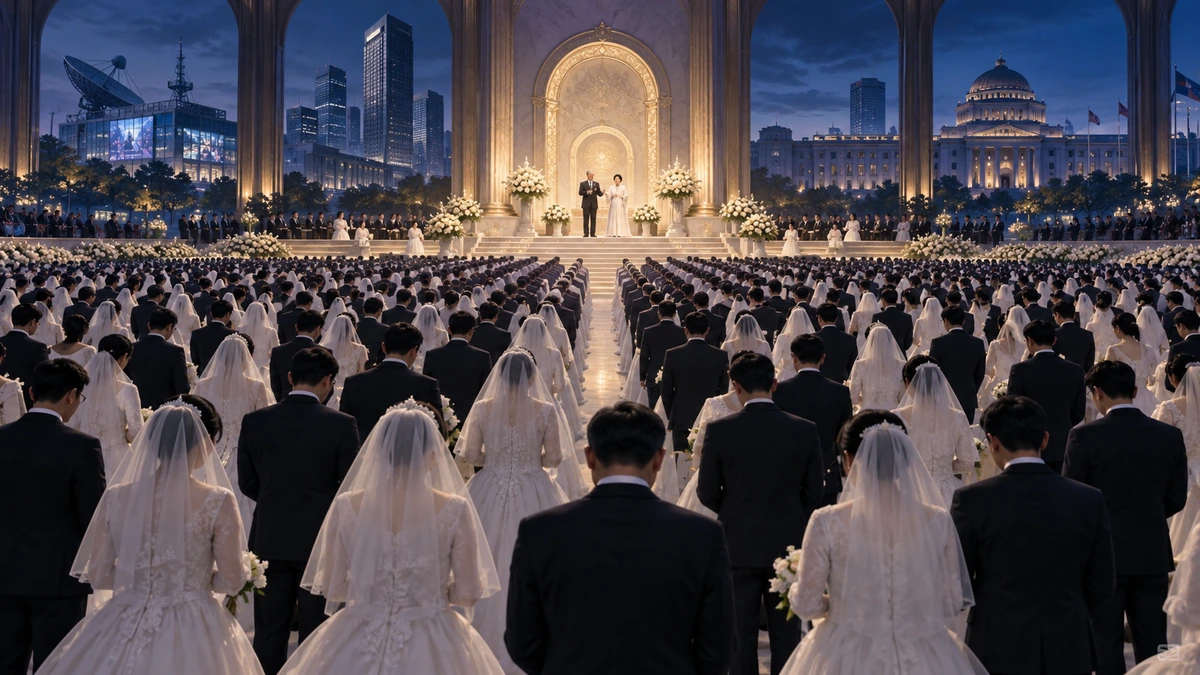
The term “Moonies” is a historical nickname for members of the Unification Church, but many believers experience it as pejorative. The main organization today uses the name Family Federation for World Peace and Unification (FFWPU). This article uses “Unification Church” because of its historical recognizability.
This is not merely a story about unusual theology. It is the story of a movement that connected religion, family ethics, mass weddings, anti-communist activism, media projects, business networks, and relationships with political elites. In 2026, the subject acquired new relevance. The Tokyo High Court in March upheld the dissolution of the Japanese religious corporation because of long-running harmful fundraising practices, and in June Japan’s Supreme Court rejected the special appeal and finalized the dissolution; liquidation proceedings continue.[10] In South Korea, leader Hak Ja Han was sentenced in August 2026 to two years in prison for illegal political financing and bribery; she denies wrongdoing, and her legal representatives filed an appeal in September.[11]
Sun Myung Moon and the beginning of the movement
Sun Myung Moon was born in 1920 in what is now North Korea. According to his own religious account, Jesus appeared to him in 1935 and asked him to complete a mission that Jesus had been unable to finish during his earthly life.
In 1954 in Seoul, Moon founded the Holy Spirit Association for the Unification of World Christianity, the organization that became known as the Unification Church.[1] The central teaching was systematized in the work Divine Principle. An early version emerged after the Korean War, Explanation of the Divine Principle was published in 1957, and Exposition of the Divine Principle followed in 1966 and became the movement’s standard theological text.[2]
In 1996, the central organization was reorganized or renamed as the Family Federation for World Peace and Unification.[1]
The most radical idea: Jesus’ earthly mission was not completed
Unification theology differs from mainstream Christianity at the level of salvation itself. According to Divine Principle, God intended Adam and Eve to mature into perfect human beings, unite in a God-centered marriage, and become the first “True Parents” of humanity. The human fall prevented the establishment of God’s true lineage.
Jesus is understood to have come as the new Adam to restore humanity, but because of the crucifixion his mission was completed only spiritually, not physically and familially. In this framework, the Messiah was supposed to establish an ideal marriage and family and thereby begin a new, purified lineage.[3]
Without this foundation, the mass weddings and the status of the “True Parents” are difficult to understand. Moon publicly claimed in his own speeches that he was the Lord of the Second Advent, or Messiah, while his wife Hak Ja Han together with him represented humanity’s “True Parents.”[4]
Today’s FFWPU explains the matter somewhat more softly, saying that members do not “worship” the Moons but “serve” or honor them as the True Parents. At the same time, the official site teaches that they were called to make possible a restored family and “true lineage” for humanity.[1]

The human fall as a problem of corrupted sexual lineage
The Unificationist interpretation of Genesis is explicitly sexualized. According to Divine Principle, the fall involved the misuse of love: Eve is said to have entered an illicit spiritual union with Lucifer and then an improper sexual union with Adam. Humanity thereby inherited “Satan’s lineage.”[5]
In this theology, original sin is not only moral disobedience. It is a corrupted line of descent transmitted through the family. Salvation therefore does not mean personal faith alone. Restoration of family and lineage through the Messiah and the True Parents is required.
This is the source of the exceptional importance of marriage, sexual purity, and the “Blessing” ceremony.
Mass weddings: religion as a project to renew human lineage
The best-known public image of the Unification Church is its enormous wedding ceremonies. Sun Myung Moon and Hak Ja Han received their own “Marriage Blessing” in 1960. Over subsequent decades they expanded mass blessing ceremonies to ever larger numbers of couples.[1]
In earlier periods, Moon personally selected or matched marriage partners, often across national and racial lines. The official FFWPU site acknowledges this and adds that young people today usually participate more actively in choosing a partner in cooperation with their parents.[1]
For believers, the ceremony is not an ordinary wedding. It is understood as an act that frees the family from the false historical lineage and incorporates it into the restored lineage of God. In his speeches, Moon said that the Blessing makes it possible to break with original sin and restore “true life, true love and true lineage.”[6]
From outside the movement, it is therefore striking that the marriage of two adults is placed within a cosmic hierarchy in which the founders are declared the only True Parents of humanity.
“Absolute faith, absolute love, absolute obedience”
The movement’s historical speeches frequently use the language of complete loyalty. One internal sermon preserved in the movement’s archive calls members to “absolute faith, absolute love and absolute obedience” to the True Parents and explicitly identifies Moon as the Messiah.[7]
It would not be fair to project this automatically onto every contemporary member or every local congregation. The Unification movement changed over the decades, and after Moon’s death it also fragmented institutionally. But such rhetoric is important for understanding the movement’s historical culture: the founder’s charismatic authority was not merely symbolic, but reached into marriage, members’ lives, work, finances, and their interpretation of world history.
That is one reason the Unification Church often appears in literature on so-called high-demand or high-control religious movements.
From a church to a network of organizations
Moon did not build only a church. Around the movement emerged a broad network of organizations in areas including:
- media;
- interfaith dialogue;
- academic conferences;
- business;
- education;
- women’s and youth organizations;
- anti-communist political activism;
- “world peace” projects.
Moon’s own writings explicitly describe numerous organizations as different instruments of the same broader mission.[6] Among the best known is The Washington Times, the newspaper Moon founded in 1982. Moon and his associates presented the newspaper as an important anti-communist project. The wider movement was also connected with business activities ranging from media and hotels to fishing and seafood processing.[8]
This is a central feature of the movement: its boundaries were never simply the boundaries of Sunday worship.
Anti-communism as a cosmic struggle
Moon interpreted the Cold War theologically. Communism was not merely, in his view, a mistaken political system but part of the struggle between God’s world and Satan’s world. The movement therefore invested in anti-communist organizations, conferences, media, and political networks. In the United States it was linked to organizations such as CAUSA International and to the media empire surrounding The Washington Times.[8]
Historical reporting documents contacts with various conservative political figures in the United States, South Korea, and Japan. Precision matters here: political contact, speaking at a conference, or support for a particular project does not necessarily mean that a politician belongs to the church or agrees with its theology.
Nor is it necessary to build a conspiracy theory. The publicly documented strategy is interesting enough: Moon understood political, media, and business institutions as instruments of a broader providential project.
Japan: money, “spiritual sales,” and families that lost assets
The movement’s largest contemporary legal crisis developed in Japan. For decades, former members, lawyers, and family members warned about aggressive fundraising and so-called spiritual sales—selling expensive objects or encouraging very large financial contributions within a context of religious pressure.
After the assassination of former Japanese prime minister Shinzo Abe in 2022, the issue became national. The accused attacker said his mother had financially supported the movement to the point of family ruin and that he chose Abe because of Abe’s perceived connections with the organization. This does not mean the church was responsible for the assassination; the event became the trigger for a much broader government investigation.[9]
The Japanese ministry submitted thousands of documents to the court and testimony from more than 170 people. In March 2025, the Tokyo District Court ordered the dissolution of the Japanese religious corporation after finding long-running and widespread fundraising practices that caused severe financial and psychological harm.[9]
In March 2026, the Tokyo High Court upheld the ruling. The organization filed a special appeal on March 9, but Japan’s Supreme Court rejected it in June 2026 and thereby finalized the dissolution. Liquidation therefore continues under a final judicial order.[10]
Importantly, dissolution of the legal religious corporation is not a ban on the religion. The organization may continue operating as a voluntary association, but it loses its special legal and tax status, and its assets enter liquidation proceedings.[10]
What does the organization say?
FFWPU criticized the Japanese proceedings as a violation of religious freedom and argued that the state and the courts were improperly treating past disputes and donations. That position should be included because judicial dissolution of a religious legal entity is an exceptionally strong state intervention.
At the same time, the court decision was not based merely on a political label such as “sect” or “cult.” It followed an extensive evidentiary process, civil claims, and findings concerning concrete financial harm.[9][10] That is precisely why the case matters in the broader discussion of high-control groups: more useful than the label “cult” is the question of whether an institution can use its authority systematically to induce members to act against their own financial interests and those of their families.
A new crisis in South Korea: Hak Ja Han
After Moon’s death in 2012, leadership of the main branch of the movement passed to his wife, Hak Ja Han Moon, whom followers call “True Mother.”[1] In August 2026, the Seoul Central District Court sentenced Han to two years in prison for illegal political financing and bribery. The case involved 100 million won connected to a political official and luxury gifts to former first lady Kim Keon Hee; the court linked the conduct to efforts to gain political influence and advance the movement’s interests.[11]
Han denied guilt and argued that the disputed actions were carried out by subordinates without her authorization. Her legal representatives filed an appeal on September 4, 2026; the special counsel also appealed the sentence.[11] Because the appellate proceedings are not concluded, this article presents the matter as a first-instance conviction with appeals filed, not as a final, unappealable judgment.
Is the Unification Church an apocalyptic movement?
Yes—but in a different way from Aum Shinrikyo or Heaven’s Gate. Divine Principle is strongly millenarian. It understands history as a process of restoring fallen humanity. Moon spoke of the arrival of the “Completed Testament Age,” the Second Advent, the True Parents, and the establishment of God’s Kingdom or a world of peace.[4]
But the contemporary main movement is not built around an immediate prediction of the physical destruction of the world. Its eschatology is primarily transformational: the old world is expected to be transformed into a new providential age through the restoration of families, religions, nations, and institutions.
That distinction matters. Apocalyptic does not necessarily mean “violent,” and it does not necessarily mean “suicidal.”
Is the Unification Church “high-control”?
This is a more useful question than simply applying the label “cult,” although there is still no single universal academic test. The historical Unification Church displayed several features commonly examined in literature on high-demand/high-control environments:
- exceptionally strong charismatic authority of the founder;
- a theological claim that the founder and his wife were the True Parents of all humanity;
- strong regulation of marriage;
- a historical culture of intensive missionary work and fundraising;
- demands for large donations in some settings;
- a wide organizational network that made it harder to understand which projects were religious, business, media, or political;
- rhetoric of complete loyalty.
But member experiences differ by country and period. Today’s FFWPU is not identical to the organization of the 1970s, and different competing branches arose after Moon’s death. The best analysis is therefore behavioral rather than label-driven.
The central paradox: family as salvation—and family as a pressure point
Moon’s system appears, at first sight, intensely family-centered. The family is said to be a “school of love,” marriage a foundation of world peace, and parents the center of ethical education.[1] But precisely because of this, the family can also become a domain of exceptional religious authority.
If an organization explains:
- who is a suitable marriage partner;
- which marriage is providential;
- which descendants belong to the “true lineage”;
- how much a family should contribute;
- to whom it owes spiritual loyalty;
then family theology is no longer only a moral ideal. It also becomes a system of organizational governance over private life. That duality is probably the most important feature for understanding the Unification Church.
What can we conclude?
The easiest approach would be simply to call Moon’s claim to be the Messiah absurd. Historically, however, something else is more interesting. Sun Myung Moon built, from a very small Korean religious movement, a global system that connected:
- messianic religion;
- mass weddings;
- family ethics;
- businesses;
- media;
- political networking;
- academic and peace conferences;
- anti-communist activism.
This was a real institutional project, not only unusual theology. Contemporary court proceedings in Japan and South Korea further show why movements of this kind need to be studied not only in terms of what they believe, but also in terms of how religious authority is converted into money, political access, and influence over members’ life decisions.
And that is where serious research into high-control groups begins.
Methodological note
The term “Moonies” is used only as a historically recognizable nickname. The article gives preference to the names Unification Church and Family Federation for World Peace and Unification. In political and judicial matters, claims are limited to documented court findings and reliable reporting. Contact with a political figure is not presented as proof of membership or ideological subordination.
Sources and further reading
- Family Federation for World Peace and Unification USA, About Us. Used for the movement’s history, the 1954 founding, Hak Ja Han, True Parents, the Marriage Blessing, and the organization’s current self-description. Source
- FFWPU, The Divine Principle—official presentation of the development of Wolli Wonbon, Wolli Hesul, and Wolli Kangron. Source
- Divine Principle / Encyclopedia.com overviews of Unification theology. Used for the teaching on Adam’s family, the uncompleted physical dimension of Jesus’ mission, and the need for the Messiah as a new Adam. Source 1 Source 2
- SunHak Institute / Unification archival texts, The Messiah and the Completed Testament Age and True Family and World Peace. Primary sources for Moon’s own messianic claims. Source 1 Source 2
- SunHak Institute, Essentials of the Unification Principle—The Human Fall. Primary internal source for the sexual/lineage interpretation of the fall. Source
- Sun Myung Moon, archival speech concerning organizations and the Marriage Blessing. Source
- SunHak Institute archive, The Affirmation of True Parents: A Confession of Faith. Used for the historical internal rhetoric of “absolute faith, absolute love and absolute obedience.” Source
- Historical reporting on the movement’s media and business network: UPI Archives, Washington Post, and Los Angeles Times. Source 1 Source 2 Source 3
- Associated Press, Court in Japan orders the dissolution of the Unification Church, March 25, 2025. Used for the evidentiary proceedings, fundraising, scale of the documentary record, and the church’s position. Source
- The Japan Times, March 4, March 9, and June 23, 2026. Used for the Tokyo High Court ruling, the special appeal, and the Supreme Court decision that finalized the dissolution. Source 1 Source 2 Source 3
- Reuters, South Korea court sentences Unification Church leader to jail in political influence case, August 31, 2026; The Korea Times, September 7, 2026. Used for the Hak Ja Han judgment, her denial, and the appeals filed by the defense and special counsel. Source 1 Source 2
- Sarah Harvey, Abuse in New Religious Movements, Cambridge University Press, 2025. Methodological framework for high-demand/high-control terminology. Source