When Apocalypse Becomes a Program: Aum Shinrikyo, Sarin, and the Transformation of a Spiritual Movement into a Terrorist Organization
From a small yoga group to the chemical attack on the Tokyo subway—and why Aum’s successors still remain under special state surveillance in 2026
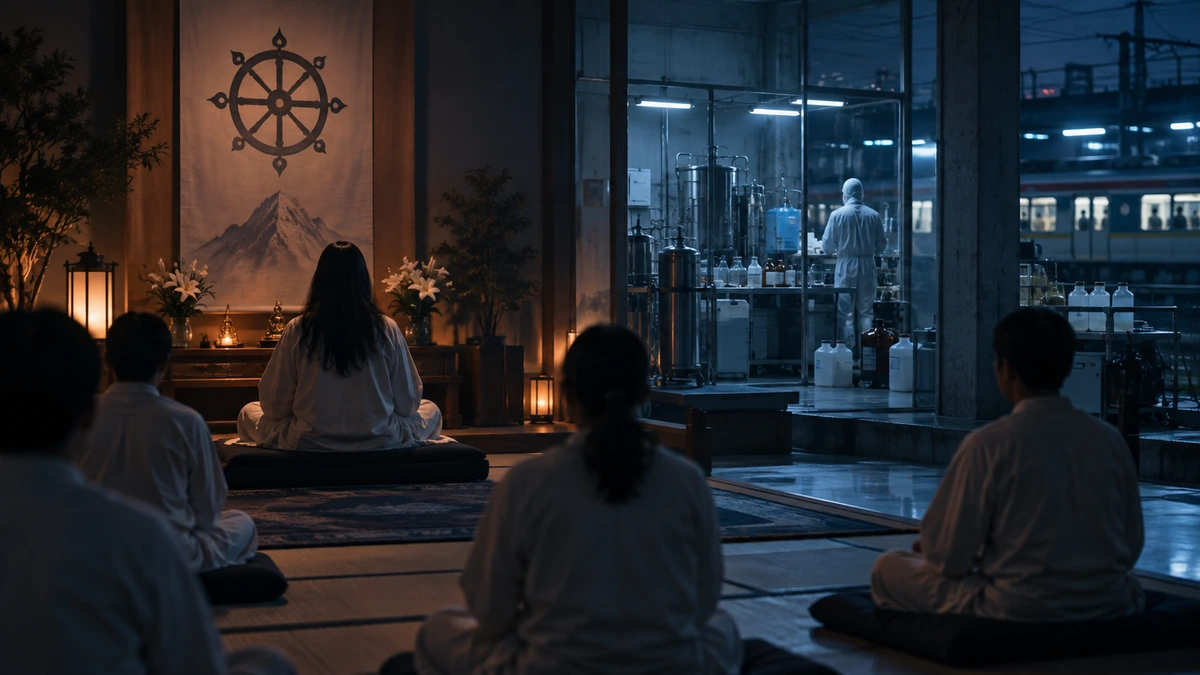
Aum Shinrikyo is one of the most important cases for the study of apocalyptic and high-control religious movements because something happened there that is extremely rare among most such groups: a religious apocalyptic vision became linked with internal militarization, scientific laboratories, and actual attacks involving weapons of mass destruction. That is also why it makes little sense to place Aum in the same category as every unusual religious community. Most new religions never become violent. Aum is an extreme case in which several factors—charismatic leadership, complete obedience, isolation, apocalyptic urgency, a persecutory interpretation of the outside world, and access to technical knowledge—combined into a catastrophic system.[1]
From yoga to the “Supreme Truth”
The movement was founded in the first half of the 1980s by Chizuo Matsumoto, later known as Shoko Asahara. It did not begin as a terrorist organization. It was a small group associated with yoga, meditation, and spiritual practices. In 1987 it adopted the name Aum Shinrikyo, roughly “Aum—religion of the supreme truth.”[1]
Asahara built a syncretic theology from elements of:
- Hinduism;
- Tibetan and other forms of Buddhism;
- yogic traditions;
- Christian apocalypticism;
- modern esotericism;
- ideas about karmic catastrophe and the end of the world.
Over time, he no longer presented himself merely as a meditation teacher, but as a uniquely enlightened master and savior capable of leading his disciples through the coming global catastrophe.
Why did young educated people join?
Aum was not a movement made up only of socially marginalized people. Research shows that it attracted many young people, university students, graduates in science and engineering, and people disappointed with the highly competitive Japanese society of the 1980s.[2]
Many members initially participated as outside believers. They were then encouraged to become shukkesha—full renunciants of secular life. Such a transition usually required them to:
- leave ordinary life;
- hand over much or all of their property to the organization;
- live in its communities;
- limit contact with family;
- follow an intensive regime of work and religious practice.[2]
Aum portrayed the outside world as spiritually polluted. Outside information, media, and social contacts were said to bring “bad data” and negative karma.[2] Here we already see a classic mechanism of a high-control environment: the organization does not control only behavior, but also the information space within which a member evaluates the organization itself.
The guru as an absolute epistemic authority
A social-psychological study of former members and accused Aum followers found a very strong pattern of absolute obedience to the guru. Members involved in crimes had, on average, been exposed to stronger psychological manipulation and linked their obedience with a sense of doctrinal superiority and fear of the consequences of disobedience.[3]
This is a crucial point. High control does not necessarily mean that someone physically locks a person in. It is often more effective if the belief system itself causes the member to understand doubt as:
- spiritual decline;
- evidence of bad karma;
- betrayal of the guru;
- danger to one’s own salvation;
- danger to the entire world.
When a leader becomes at once teacher, prophet, interpreter of reality, and judge, the space for independent verification closes rapidly.
Apocalypse: world war as confirmation of prophecy
Asahara’s eschatology gradually became more radical. He predicted an approaching Armageddon, world war, and catastrophic destruction of most of humanity. At different times he shifted the projected timetable of the coming catastrophe. Under this logic, Aum became more than a religion of salvation. It became a community preparing to survive the coming end of the world.
When apocalyptic belief combines with total authority of the leader, every failure can receive a new interpretation:
- if prophecy fails, the catastrophe was merely postponed;
- if the public rejects the leader, that proves the moral corruption of the world;
- if state authorities investigate the group, that proves persecution;
- if an opponent obstructs the guru, that person becomes part of the forces preventing salvation.
The world is thus transformed into a closed interpretive loop.
1990: electoral defeat as a turning point
In 1990, Aum attempted to enter Japanese parliamentary politics. Asahara and several of his closest associates stood as candidates in the election. The result was disastrous. None was elected, and Asahara received very few votes.[4]
Several researchers regard the political defeat as an important turning point. Instead of the idea that society would accept Aum’s message, leadership increasingly embraced the interpretation that society was hostile, manipulated, and unworthy of salvation.[1][4]
This does not mean that losing an election “causes” terrorism. Many movements lose elections and never become violent. In Aum’s case, the defeat mattered because it occurred within an already existing system of apocalyptic thought and absolute authority.
“Poa”: when murder is reinterpreted as salvation
The most dangerous doctrinal turn was the reinterpretation of the Buddhist concept poa. In traditional Tibetan practices, the term refers to a ritual or meditative concept involving the transfer of consciousness. Within Aum, it acquired a radically different function. Under Asahara, a person’s death could be reinterpreted as an act that prevented that person from accumulating even worse karma and therefore, in the most extreme logic, could supposedly benefit them.[2]
When a leader can call murder “spiritual help,” the ordinary moral boundary disappears. This is one of the clearest examples of how dangerous sacralized renaming of violence can become: the act remains the same, but the internal language of the group transforms it from crime into religious duty.
Murders before sarin
The violence did not begin in 1995. In 1989, Aum murdered lawyer Tsutsumi Sakamoto, who represented members’ families and publicly criticized the movement, together with his wife and young son.[5] Before and after that, individual members or former members who resisted the organization or attempted to leave were also killed.[5]
This matters because it breaks the image that the Tokyo sarin attack suddenly emerged from a single moment of collective madness. Mass terrorism was preceded by years of escalating normalization of violence.
An organization that began building its own capabilities for mass violence
Aum had something most apocalyptic groups do not: money, technically educated members, and the ambition to create its own technological infrastructure. It developed programs connected with chemical and biological agents, sought military equipment, and attempted to acquire or manufacture weapons.[6]
We deliberately do not provide technical procedures, concentrations, synthesis methods, or other reproducible details here. For historical understanding, it is enough to note that Aum:
- developed laboratory capabilities;
- produced toxic chemical agents;
- experimented with biological agents;
- acquired military equipment through Russia;
- considered its own production of firearms.[6]
It was an almost unbelievable fusion of monastery, business, laboratory, and secret paramilitary organization.
Russia: the globalization of Aum
In the early 1990s, Aum also grew rapidly in Russia. After the collapse of the Soviet Union, a large market emerged for new spiritual ideas. Aum purchased radio time, organized large events, and appealed particularly to younger and educated people.[2]
Estimates of membership vary greatly. Some claims from the period speak of tens of thousands of Russian followers, but academic sources caution that the figures probably often included event attendees and sympathizers rather than only committed members.[2]
The Russian branch was also important because it gave leadership contacts and access to materials that were harder to obtain in Japan.
Matsumoto 1994: the first mass sarin attack
On June 27, 1994, sarin was dispersed in a residential area of Matsumoto. According to Japan’s Public Security Intelligence Agency, eight people were killed and about 140 were injured.[7] The attack had a specific conflict context, but historically it is most important as proof that Aum had already used a chemical weapon against civilians nine months before the Tokyo attack.
Police and media failed at the time to identify Aum promptly as the perpetrator.
Tokyo, March 20, 1995
On March 20, 1995, Aum members carried out a coordinated sarin attack on several Tokyo subway trains during the morning rush hour. Japan’s PSIA lists 13 directly recognized deaths and more than 5,800 injured people under the victim-support system; one long-term survivor died in 2020 from the consequences, so some later sources use a higher death toll.[7]
This was not a symbolic attack and not an ordinary criminal act. It was an indiscriminate chemical-agent attack on a civilian crowd. Aum thereby became one of the rare non-state actors in modern history to successfully use a chemical warfare agent in a mass terrorist attack.
The collapse of Aum and the executions
Asahara was arrested in May 1995. Lengthy trials exposed a wider series of murders, attempted murders, kidnappings, and attacks. In 2018, Japan executed Asahara and twelve other convicted Aum members who had been sentenced to death for participation in the organization’s gravest crimes.[8]
The death of the leader, however, did not mean the complete disappearance of the movement.

Aleph, Hikari no Wa, and other successors
In 2000, Aum adopted the name Aleph. Later, Hikari no Wa, associated with former spokesperson Fumihiro Joyu, split from it, and a smaller group also emerged that Japanese authorities identify by reference to its leader Yamada.[9]
These successor groups differ in their relationship to Asahara. Aleph has preserved his religious authority to a greater extent. Hikari no Wa publicly presents itself as a break from Asahara’s personality cult and violent past.
Japanese security authorities are more skeptical of that distinction and claim that Hikari no Wa also retains elements of the original system. This is the position of Japanese authorities, not a neutral academic fact, and should therefore be identified as such.[9]
Why is Aleph still under surveillance in 2026?
After Aum’s attacks, Japan adopted a special law for monitoring organizations that had carried out acts of indiscriminate mass killing. In 2026, PSIA continued to conduct unannounced inspections of Aleph facilities. In August 2026, for example, it inspected a facility in Shiga Prefecture and confirmed that members were residing there.[10]
On September 4, 2026, Japan’s Public Security Examination Commission, at PSIA’s request, adopted the eighth special recurrence-prevention measure against Aleph. For six months beginning September 21, the measure restricts, among other things, the use of certain organizational properties and the receipt of monetary or other property donations.[11]
Japanese police currently estimate that Aum successor groups together have about 1,600 members in Japan, around 30 facilities in 15 prefectures, as well as followers in Russia.[9] These numbers and threat assessments should be attributed to Japanese security authorities because they are state security assessments.
Aum as an almost complete laboratory of high-control dynamics
Aum displays almost the entire cluster of mechanisms researchers often analyze in high-control environments: Charismatic absolute authority. Asahara was not merely a spiritual teacher. He became the only reliable interpreter of reality. Information isolation. Full members were separated from ordinary media and often from their families.
Financial surrender. On entering the inner order, members could relinquish property. Regulation of everyday life. Work, meditation, food, sleep, and religious exercises were organizationally structured. Special language. Concepts such as “poa” enabled a moral reinterpretation of violence.
Apocalyptic urgency. If the world is on the verge of destruction, ordinary ethical rules become secondary. An external enemy. Media, police, critics, and families could be understood as obstacles to salvation. A technical elite. The organization directed the education and skills of its members into projects that became progressively more dangerous.
None of these elements alone causes terrorism. Aum became catastrophic when they combined and reinforced one another.
The most dangerous point is not “strange belief”
People can hold highly unusual religious beliefs and never harm anyone. Aum is therefore a poor example for the thesis that danger comes from “strangeness.” The real turning point came when the system began to determine:
- that the leader was the only reliable source of truth;
- that the outside world was not merely mistaken but hostile;
- that the end of the world was immediately approaching;
- that death could be presented as salvation;
- that the goal justified secret violence;
- that the organization was wealthy and technically capable enough to turn its fantasies into a material program.
At that point, apocalyptic belief was no longer merely myth. It became the organization’s operational policy.
What can we actually learn from Aum?
Aum is an extreme case, but precisely for that reason it reveals several universal warning signs. Dangerous groups do not necessarily arise because one day a peaceful community decides to become criminal. Radicalization can be gradual:
spiritual community → exclusive truth → absolute guru → isolation → demonization of critics → apocalyptic urgency → moral exception → secret violence → institutionalized violence. The final stage is not inevitable. But in Aum’s case, it occurred.
And that is why Aum Shinrikyo remains one of the most important historical examples for understanding how a high-control apocalyptic movement can transform from a space of personal spiritual seeking into an organization of mass violence.
Safety and methodological note
This article deliberately does not describe sarin synthesis, biological procedures, dispersal methods, or other reproducible details of Aum’s weapons programs. They are not necessary for historical analysis. Current assessments of Aleph and other successor groups are attributed to Japanese security authorities; they are not presented as neutral findings without a source.
Sources and further reading
- Martin Repp, Aum Shinrikyo and the Aum Incident: A Critical Introduction, Oxford Academic, 2014; and Religion and Violence in Japan: The Case of Aum Shinrikyo, Oxford, 2011. Used for the development from spiritual community to apocalyptic violence and as a warning against monocausal explanations. Source 1 Source 2
- Rin Ushiyama, Aum Shinrikyo and religious terrorism in Japanese collective memory, British Academy/Oxford Academic, 2022. Used for organizational life, shukkesha, property, isolation, Russia, and early militarization. Source
- Kimiaki Nishida, A social psychological analysis of AUM Shinrikyo's criminal behavior, Japanese Journal of Social Psychology, 2001. Source
- U.S. congressional staff report, A Case Study on the Aum Shinrikyo – Background of the Cult, 1995. Used for the 1990 election as a historical turning point. Source
- Japan Ministry of Justice / PSIA, digital archive of Aum crimes and overview of major incidents. Source 1 Source 2
- U.S. congressional staff report, The Operation of the Aum in Overseas Operations, 1995. Used only at the level of the historical scope of the programs, without technical procedures. Source 1 Source 2
- Public Security Intelligence Agency, 25 Years After the Tokyo Subway Sarin Gas Attacks. Used for Matsumoto and official victim figures for the Tokyo attack. Source
- Reuters, July 2018, on the execution of Asahara and the remaining convicted members. Source
- Japanese National Police Agency and Public Security Intelligence Agency, current overview of Aum successor organizations. Source 1 Source 2
- PSIA, result of inspection of an Aleph facility, August 27, 2026. Source
- PSIA, decision on a recurrence-prevention measure against Aleph, September 4, 2026. Source 1 Source 2
- Sarah Harvey, Abuse in New Religious Movements, Cambridge University Press, 2025. Methodological framework for high-control terminology. Source