Fourth Step: Break Their Trust
When a person no longer believes anyone, someone can begin deciding what is true for them
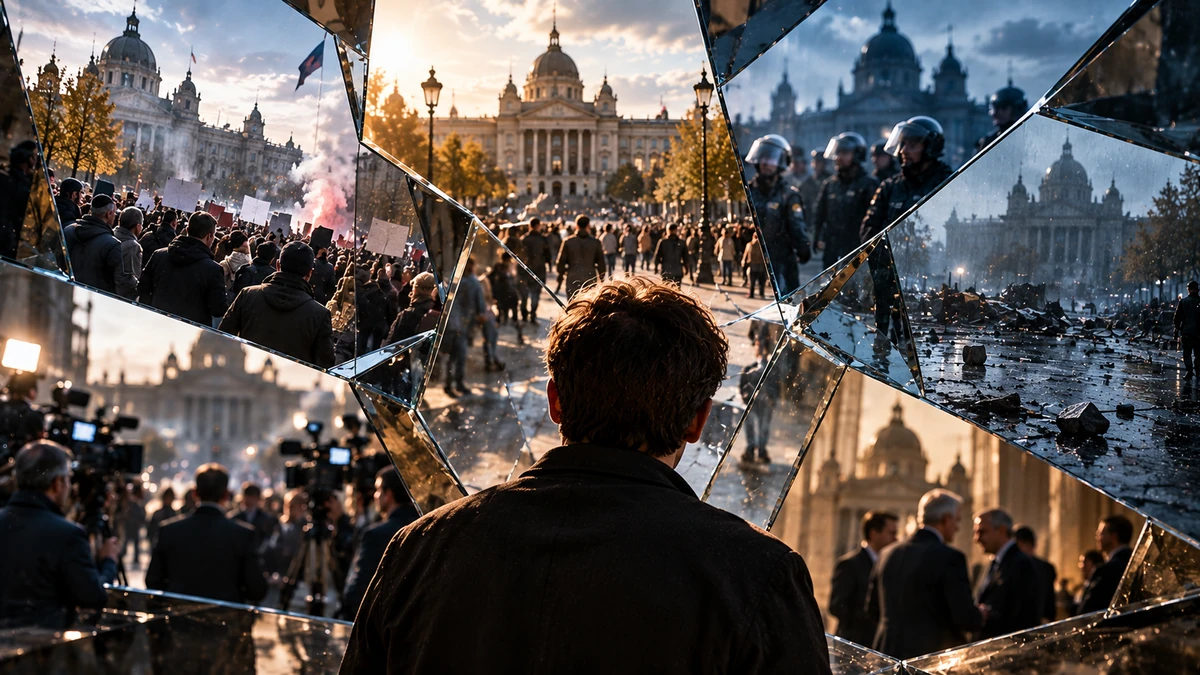
A frightened, divided and isolated person has another problem: fewer and fewer people and places where they can test their picture of reality. As personal trust weakens, they begin looking for a substitute — an authority, platform, label, certificate or algorithm that will tell them which source can be trusted.
Fear opens the door. Division breaks people into camps. But for truly deep control you need something more. You must bring a person to the point where they no longer trust their own eyes, their own judgement, another person, or any institution that once helped them understand the world. This does not happen in a day. Trust crumbles slowly. With a wrong prediction. With a withheld fact. With a headline that says something different from the article.
With a government that says one thing and does another. With a media outlet that gets something wrong but never admits the error. With a “fact” that is forbidden today and becomes a legitimate question six months later. With an algorithm that does not show you the world, but a selection of the world. And when a person watches for long enough as truth seems to change with the government, platform, editor or current consensus, something dangerous happens. They do not merely begin to doubt them. They begin to doubt everything. Then a vacuum appears. And someone always fills a vacuum.
First they tell you that the problem is the lie
Of course lies exist. Propaganda exists. Fraud exists. Foreign influence operations exist. False health claims can harm people. False rumours can trigger violence. Manipulated photographs, forged videos and coordinated disinformation campaigns can affect elections, wars and public health. That is why the idea that harmful disinformation should be limited can initially seem almost self-evident. The problem comes later. Who decides what is disinformation? Who decides when a scientific debate is over?
Who decides which source is “reliable”? Who decides whether something is a lie, a misinterpretation, satire, doubt or simply an uncomfortable question? And what happens when those doing the deciding are wrong?
What is “false” today can be an allowed question tomorrow
During the pandemic, Facebook developed an exceptionally broad system for removing and reducing the reach of content it classified as COVID-19 misinformation. Meta later wrote that it had removed more than 25 million pieces of content and that its list covered around 80 categories of claims.[1] One of the claims sanctioned by the system was the possibility that the virus had been artificially created or manufactured.
On 26 May 2021 Facebook changed the policy. Its official explanation was clear: in light of new investigations into the origins of COVID-19, it would no longer remove such claims.[2] This does not prove that a laboratory origin of COVID-19 is true. It proves something else that matters more for this article: for a period, the platform treated a particular claim as false enough to remove, and later acknowledged that the question was no longer closed enough to justify that prohibition.
In the meantime, the content had not merely been part of a debate. It could be hidden, labelled or removed. That is the problem with any system that tries to administer truth in real time. Science changes. Evidence changes. Investigations uncover new information. But a censored discussion cannot later recover the months during which it could not be conducted normally.
Then came the admission of pressure
In August 2024 Mark Zuckerberg wrote in a letter to the U.S. House Judiciary Committee that senior officials in the Biden administration, including the White House, had for months pressured Meta over certain COVID-19 content, including humour and satire.[3] Zuckerberg emphasised two things at the same time. First, that in his view the pressure was wrong. Second, that the final decision to remove or restrict content remained Meta’s.
That distinction matters. There is no need to claim that the government directly ran Facebook. It is enough to see the documented problem: government can exert strong pressure on a private platform that controls the information flow of billions of people, and the platform can partially adapt to that pressure. The White House responded at the time that, during a deadly pandemic, it had encouraged responsible action to protect public health and that technology companies still had to make their own decisions about content.[4]
So this is not a simple one-sentence story. But that is precisely why it is dangerous. The state can say it is only raising concerns. The platform can say it decides for itself. A fact-checker can say it is only adding context. The algorithm can say nothing, because algorithms do not speak. And in the end the content can still disappear from public view.
The Supreme Court did not say the pressure did not exist
The case Murthy v. Missouri became the central American dispute over contacts between government officials and platforms. In 2024, the U.S. Supreme Court did not rule that every form of such pressure was constitutional or that pressure did not exist. The majority resolved the case primarily on standing and causation: the plaintiffs had not shown with sufficient specificity that a particular communication from a particular government actor caused a particular restriction of their particular content.[5]
The Court also stressed that platforms have their own interests and moderation rules and that not every one of their decisions can automatically be attributed to the state.[5] That is an important legal correction to an overly simple story. But it does not erase the underlying problem. A channel of communication exists between government and the private operators of the public information space. The question is therefore not merely whether a specific removal was legally proven to be the result of coercion. The question is how much power a system gains when the state, the platform, the health authority, the fact-checker and the algorithm all operate in the same information ecosystem.
The censorship of the future does not need a DELETE button
The old model of censorship was primitive. Ban the book. Close the newspaper. Arrest the author. Switch off the transmitter. A digital system is more elegant. You do not have to formally ban anything. You simply reduce its reach. Do not recommend it. Label it. Put a warning in front of it. Exclude it from search. Demonetise the creator. Slow its spread. Temporarily block the user. Mark the page as a recurring source of “misinformation”. Facebook itself explained in 2021 that for content rated false by fact-checkers it reduced distribution, added warnings and could further reduce the reach of pages, groups and domains that repeatedly shared such content.[6]
The platform also stated that about 95% of users did not click through to labelled content after seeing the warning screen.[6] Think about what that means. You do not have to remove the book from the library. It is enough to put a door in front of it that almost no one walks through.

The most powerful editor in the world has no face
In the past, a newspaper editor decided what appeared on the front page. Today every person’s front page is assembled by a different algorithm. Facebook publicly described how its News Feed used thousands of signals to rank content.[7] In 2021 it also began deliberately reducing the amount of political content seen by some users. It later globally reduced the weight of comments and shares in ranking political posts.[8] In 2025 it changed direction again and announced that it would begin including more political content for users who wanted to see it.[9]
This is a perfect illustration of the new information reality. A person does not merely choose what to read. Someone upstream chooses what will even have a chance to appear before their eyes. And that choice can change overnight. Not because the world changed, but because one line of code, one business decision or one moderation policy changed.
Even the platforms now admit they went too far
In January 2025 Meta announced the end of its U.S. third-party fact-checking programme and a transition to Community Notes. Its own explanation was extraordinarily direct. The company wrote that the system had become too restrictive over time, that too much legitimate political speech was receiving fact-check labels, that there were too many erroneous sanctions and that a programme intended to inform too often became a tool for censorship.[9] Meta even estimated that by the end of 2024 perhaps one or two out of every ten automated or moderator enforcement actions may have been mistakes.[9]
This is not a claim made by a Facebook critic. It is Facebook’s own correction of its own system. In April 2025, third-party fact-checking actually stopped operating in the United States and Community Notes began replacing it.[10] That does not mean Community Notes will never be wrong. It does mean that one of the world’s largest information systems, after years of use, acknowledged that the mechanism intended to limit false information had begun restricting too much legitimate speech as well.
Truth thus becomes an infrastructure problem
Here lies the next step on the path. If most people read news through a handful of platforms, search engines and apps, those who shape their algorithms do not merely control technology. They control visibility. And visibility is a precondition of public reality. An event no one hears about is, for most of society, almost the same as an event that never happened. An opinion an algorithm hides from 99% of its potential audience is formally permitted. In practice, however, it is almost invisible. This is the essential difference between classical and digital censorship. You do not have to prohibit speech. It is enough to control its distribution.
But does the solution mean leaving everything without rules?
No. That would be a cheap caricature of the problem. Platforms contain fraud, child sexual exploitation, threats, terrorist propaganda, fake financial schemes, manipulated recordings and organised influence operations. No serious society can simply say that everything is permitted and consequences do not matter. That is precisely why the European Union’s Digital Services Act requires very large platforms to assess systemic risks associated with recommender systems, including effects on elections, public discourse, mental health, addictive use and so-called rabbit holes.[11] That too is a legitimate issue. But every solution recreates the same problem: Who will draw the line? And who will oversee the one drawing it?
First destroy trust. Then introduce certified trust.
This is where the direction becomes especially interesting. When people lose trust in newspapers, fact-checkers appear. When they lose trust in posts, labels appear. When they lose trust in images, systems appear to prove file provenance. When they lose trust in users, verified digital identity appears. When they lose trust in human judgement, artificial intelligence arrives to help filter, summarise and rank reality. Each new layer is supposed to repair the problem created by the previous one.
But each new layer also creates a new central point of trust. A certificate. An algorithm. A platform. An identity. An AI model. An institution. What if the greatest consequence of the information crisis is precisely that we have become willing to exchange our own judgement for a system that tells us what we may trust?
What if complete confusion is not a flaw in the system?
Imagine a society in which half the people believe that all major media lie. The other half believe that all alternative media are dangerous disinformation. One side trusts health authorities without question. The other does not trust them even when they are right. One side calls every form of censorship safety. The other calls every act of moderation totalitarianism. No one listens to anyone anymore. What do you get? Not a free society. You get a society without a shared reality.
And a society without a shared reality struggles to organise, struggles to demand accountability and struggles to distinguish a genuine scandal from a false alarm. Such a society is a perfect environment for manipulation. Everyone does not have to believe the same propaganda. Sometimes it is enough that no one believes anything anymore. Then the person becomes tired. Stops checking. Stops thinking. Stops participating. And begins searching for the easiest answer.
You do not need to ban the truth if you can drown it
This may be a more modern method than classical censorship. Do not remove the information. Surround it with a million other things. A counterargument. A meme. A fake recording. A comment. A fact-check. A counter-fact-check. A bot. An AI-generated article. A video without provenance. An anonymous channel. An “expert” on both sides. The person feels as if they have access to everything. In reality, they no longer have the time, energy or knowledge to work out what deserves belief. This is information hell. Not silence. Noise.
When you lose truth, you also lose the possibility of collective resistance
Free people can argue. But collective action requires at least a minimal common foundation. That a document is a document. That a recording is genuine. That an event happened. That a particular number means the same thing to both sides. When even that disappears, society can be more than divided. It can be paralysed. Every scandal has two realities. Every statistic two interpretations. Every war two completely separate histories. Every piece of evidence receives the label of propaganda.
Meanwhile, the systems that rank, filter and certify information only grow stronger. This is the fourth step. Do not merely convince a person that the other side is evil. Convince them that truth itself is no longer reachable without an intermediary. Then the intermediary gains enormous power.
The next step is almost natural
The person is frightened. Divided. They no longer know whom to trust. What do they need now? Someone to tell them what is safe. Someone to guarantee food. Energy. Medicine. Housing. Credit. Access. A platform. And the less they trust the world around them, the more easily they begin seeking security in the system on which they are already dependent. That is how the fourth step prepares the fifth. Make Them Dependent.
Sources and further reading
- Meta — Asking the Oversight Board to Advise on COVID-19 Misinformation Policies, 26 July 2022. Meta reported more than 25 million pieces of COVID-19 content removed and around 80 categories of prohibited claims Source
- Meta — An Update on Our Work to Keep People Informed and Limit Misinformation About COVID-19, update of 26 May 2021. Facebook announced that it would no longer remove the claim that COVID-19 was “man-made or manufactured” Source
- Mark Zuckerberg, letter to the House Judiciary Committee, 26 August 2024, also reported by Reuters/AP: Zuckerberg described repeated pressure from senior Biden administration officials regarding some COVID content and stressed that final decisions were made by Meta Source
- Associated Press / PBS — White House response to Zuckerberg letter, 27 August 2024. The White House said it had encouraged responsible action for public-health reasons, while platforms were expected to make their own decisions Source
- Supreme Court of the United States — Murthy v. Missouri, 603 U.S. 43 (2024). The majority decided the case on standing/traceability grounds and also stressed the platforms’ independent moderation interests; the judgment was not a merits-level confirmation or rejection of every allegation of political pressure Source
- Meta — How We’re Tackling Misinformation Across Our Apps, 22 March 2021. Description of reduced distribution, warnings, sanctions against repeat sharers and the effect of warning screens Source
- Meta — Changes to News Feed in 2021, 20 December 2021. Meta describes personalised ranking based on thousands of signals Source
- Meta — Political Content in Feeds, from 10 February 2021 onward. Documented changes in ranking and reduction of political content and later changes of approach Source
- Meta — More Speech and Fewer Mistakes, 7 January 2025, updated 2026. Meta itself described over-enforcement, errors and the transition from external fact-checking to Community Notes in the United States Source
- Meta — Testing Begins for Community Notes on Facebook, Instagram and Threads, 13 March 2025; update 7 April 2025 Source
- European Commission — Requests for information on recommender systems under the Digital Services Act, 2 October 2024. The Commission explicitly mentions elections, civic discourse, mental health and “rabbit holes” among systemic risks Source