Fifth Step: Make Them Dependent
A person who cannot survive without the system finds it harder to say no to it
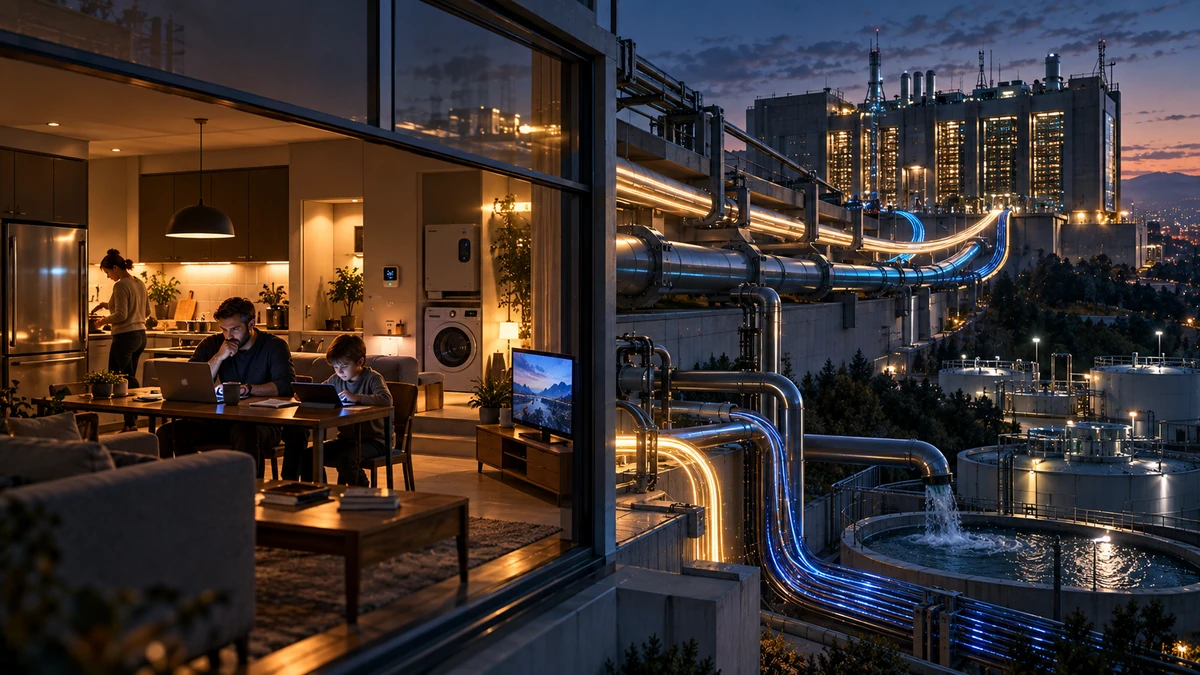
Fear opens the door. Division breaks people apart. Loss of trust takes away their common language. But if you truly want to weaken a person, you need something deeper. You must make them dependent. Not necessarily on one state. Not necessarily on one company. Not necessarily on one politician. On the system. On infrastructure they do not control. On suppliers they do not know. On a bank that can change its terms. On an electricity grid they cannot replace themselves.
On a retail chain without which there is no food in the refrigerator. On medicine they need every day. On a platform without which they cannot do business. On a home they can use only for as long as they can service the debt or pay the rent. On digital infrastructure without which they cannot work, communicate or access services. This does not have to be a conspiracy. It can simply be the result of decades of specialisation, centralisation, convenience, debt and technological efficiency. Yet the end effect can be the same. A person remains formally free while their ability to say no diminishes.
Freedom is not only a right
We like to talk about freedom as though it were primarily a legal concept. Freedom of speech. Freedom of movement. Property rights. Privacy rights. But real freedom also has a material dimension. Can you survive if you lose your job? Can you heat your home if energy becomes more expensive? Can you feed your family if the supply chain breaks? Can you work if a platform closes your account? Can you last a few months without credit?
Is there anything at all you still know how to do for yourself? Is there anything essential in your life that does not depend on distant infrastructure? These are uncomfortable questions because they reveal the difference between the right to freedom and the ability to live freely.
Food is the first boundary
A person without food is not a political subject. They are a person who will do almost anything to feed themselves and their children. The modern food chain is extraordinarily efficient. Millions of people can live in cities without ever seeing the field, stable or bakery their bread comes from. But efficiency has another side. Dependence. The European Commission itself notes that the food supply chain is characterised by different degrees of concentration and that, although most businesses in food processing and retail are small, a small number of large companies dominate the market as buyers.[1]
That is precisely why the EU introduced rules against unfair trading practices: farmers and smaller suppliers are often the weakest link in the chain.[1] This is not theory. It is an official description of the market structure. A farmer may grow food and still depend on seed, fertiliser, fuel, credit, buyers, logistics, processing, cold storage and a handful of large purchasers. The consumer is often even more distant. Produces nothing. Simply pays.
As long as the system works, this is convenience. When the system fails, dependence becomes visible. In 2024, 8.5% of the EU population could not afford a proper meal every other day; among people at risk of poverty the share was 19.4%.[2] This is not hunger because food is physically absent from the continent. It is something more modern. The food exists. The person lacks sufficient economic access to it. And that distinction matters. In a world where most people do not produce food, access has become more important than the physical presence of food.

Energy is the second boundary
Without energy, modern life stops almost immediately. Heating. Cooling. Water. Communications. Payments. Transport. Hospitals. Data centres. Industry. Shops. Everything is tied to energy. In 2024 the EU was 57% dependent on net energy imports.[3] Almost 60% of its energy needs were therefore covered by energy coming from outside.[3] That is not a moral judgement. It is a measure of vulnerability. When you depend on imported energy, a political crisis on the other side of the continent can become your heating bill.
A war can change the price of electricity. A sanction can change a supply route. A diplomatic dispute can change the price of fuel. A decision by a handful of major producers can change the cost of living for millions. And again the same principle applies: a person is not necessarily unfree because they lack the legal right to choose. They can be unfree because they have no realistic alternative.
Housing: the largest silent contract of obedience
Housing is probably the largest financial obligation in most people’s lives. One person pays rent. Another a mortgage. A third pays both during different periods of life. In the EU in 2024, around 8.2% of the population lived in households where housing costs exceeded 40% of disposable income; in some countries the share was considerably higher.[4] That is only the most severe category. The wider picture is even more telling: housing, energy, utilities and debt often consume a large part of monthly income before a person has even begun to live.
What happens to someone with a thirty-year mortgage? They become more cautious. Not necessarily politically. In life. It is harder to leave a job. Harder to take risks. Harder to say no to a boss. Harder to withstand several months without income. Harder to withdraw from a system they disagree with, because every month the system demands an instalment. A mortgage is not in itself an instrument of control. But long-term financial dependence narrows the space for disobedience. It is simple arithmetic.
A person with one month of reserves has different bargaining power from someone with a year of reserves. A person without debt has a different range of choices from someone who has to satisfy a creditor every month.
Health can become the hardest dependence
Care is needed here. Medicines save lives. Long-term treatment can give a person decades of normal life. The problem is not treatment. The problem is the vulnerability that arises when survival depends entirely on uninterrupted access to a complex healthcare and supply system. WHO warns that chronic diseases often mean years or even a lifetime of treatment and repeated contact with health services.[5] For many chronic conditions, regular access to medicines is simply essential.[6]
That means a disruption in manufacturing, distribution, insurance, prescription systems or health infrastructure can affect a person almost immediately. Again, this does not prove that the system was created to make people dependent. But the consequence is objective. The more people can live normally only while a complex system functions continuously, the greater the power attached to uninterrupted access to that system. What if access were one day linked to behaviour, identity or political conditions? Today we have no evidence of such a universal arrangement. But the infrastructure of dependence would already exist. And that is precisely why the question is worth asking before the answer comes too late.
The state as a safety net — and as a possible point of dependence
The welfare state is one of modern Europe’s greatest civilisational achievements. Pensions. Sickness benefits. Disability support. Unemployment assistance. Child benefits. Help for people who could not live with dignity without it. But every support system has another side: a person who has nothing else left becomes completely dependent on the rules of that system. In the EU in 2024, more than a quarter of median equivalised disposable income came from government social transfers, including pensions and other benefits.[7]
There is nothing inherently wrong with that. But it shows how deeply modern life is intertwined with state mechanisms of redistribution. And so the question is legitimate: what happens if assistance created as a safety net becomes the only net still keeping a person above water? Such a person is no longer only a citizen of the state. They are also its beneficiary. And every beneficiary is vulnerable to a change in the rules.
Digital dependence is almost invisible
Twenty years ago it was possible to run a business without Facebook, Amazon, Google, Microsoft cloud services, Apple’s app store or digital payment intermediaries. Today, for many people, that is almost unimaginable. The European Commission therefore formally named the largest platforms gatekeepers in the Digital Markets Act.[8] It is an extraordinarily revealing word. A gatekeeper does not necessarily make your product. It controls the gate through which you must reach your customer. The Commission has designated Alphabet, Amazon, Apple, ByteDance, Meta, Microsoft and Booking, along with their core platform services, as gatekeepers.[9]
In 2026 it went further and, in a preliminary position, assessed that AWS and Microsoft Azure may have such a strong position in cloud services that they constitute important gateways between businesses and their customers. The Commission explicitly pointed to lock-in effects and high switching costs.[10] That is a clean definition of dependence. When switching is too expensive, freedom of choice exists mainly on paper. You can change providers. But the cost of doing so is so high that in practice you do not.
The same applies to the user. When photographs, documents, business communications, customer identities, advertising, payments, files and software are scattered across a handful of large ecosystems, a person no longer merely uses a service. They live inside somebody else’s infrastructure.
Dependence is always sold as efficiency
This is the most important part. No one tells you: “From today you will be more dependent.” They tell you: this is faster. this is cheaper. this is more convenient. this is more efficient. this is safer. And often they are right. Specialisation is efficient. Global logistics are efficient. The cloud is efficient. Digital banking is efficient. A large retail chain is efficient. A centralised health system is efficient. But every efficiency has a price if it removes redundancy.
A person who once had five ways to solve a problem may now have one — but a very convenient one. As long as it works. And so a civilisation can become ever more sophisticated and at the same time ever more fragile.
First you lose knowledge
Dependence does not begin with money. It begins with forgotten skills. You no longer know how to grow food. You no longer know how to repair a machine. You no longer know how to make a fire without automation. You no longer know how to travel without navigation. You no longer know how to run a business without a platform. You no longer know how to store data without the cloud. You no longer know how to be alone without digital stimulation. Every lost skill means one more service somebody else must perform for you. And every service is a new dependence. This is not a call to return to a cave. It is a call to understand that technological progress without personal resilience can create a civilisation of extraordinarily capable systems and extraordinarily helpless individuals.
Then you lose the emergency exit
The most dangerous dependence is not when you use something. It is when you no longer have an alternative. When the only account is digital. When the only identity is digital. When the only route to the customer is a platform. When the only source of food is a shop. When the only source of heat is a central system. When all your money is in accounts that you can access only through third-party infrastructure. When all your work is in the cloud. When your home depends on the next pay cheque. Then nothing has to be formally forbidden. It is enough for you to lose access.
What if that is the path?
What if total control does not require taking away a person’s rights first? What if you first take away their ability to live without the system? Then the rights can remain written in the constitution. The person simply finds it increasingly difficult to exercise them. They may have the right to protest. But will they dare risk their job if they have a mortgage, two children and no savings? They may have the right to reject a platform. But can they reject it if all their customers are there?
They may have the right to reject a digital service. But can they reject it if the analogue route is ten times slower or no longer exists at all? They may have a right to privacy. But can they actually exercise it if almost every service requires data? They may have the right to say no. But how much does their no cost? That is the real measure of freedom.
A dependent person is the ideal citizen of any system of control
Not because they are bad. Because they are vulnerable. They have too much to lose. A home. Income. Access. Treatment. Customers. An account. A profile. A pension. A normal life. So there is no need to command them with a weapon. It is enough that they understand the consequences of disobedience. Perhaps this is the greatest difference between the old and new models of power. The old system forced the person. The new system can simply create conditions in which the person forces themselves.
Co-responsibility begins with convenience
The easiest thing is to say that “they” did all of this. But much of this path we chose ourselves. We wanted cheaper. We wanted faster. We wanted delivery tomorrow. We wanted one app for everything. We wanted someone else to take care of our data, our money, our food, our news, our photographs and our memories. We wanted convenience. And convenience arrived. With it came dependence.
Every time we remove a fallback option for the sake of convenience, we take another small step. Every time we exchange knowledge for a service, we take another. Every time we exchange ownership for access, we take another. Every time we exchange the ability to say no for convenience, we take another. And none of them alone is frightening enough. That is the point. The abyss is not built by one great decision. It is built by millions of small decisions that make life without the system increasingly difficult.
When a person is dependent enough, the next step no longer needs to be imposed. They will accept it because without it they will no longer know how to live normally. And that is why the next stage of the path does not begin with bread, electricity or credit. It begins with something the system needs to know about you in order to turn dependence into precise control. Your data. The next step is therefore inevitable: Take Away Their Privacy.
Sources and further reading
- European Commission — Unfair trading practices in the food supply chain (2024). The Commission describes different levels of concentration and the dominance of a small number of large buyers in parts of the food supply chain Source
- Eurostat — Almost 9% in the EU could not afford a proper meal (2025; 2024 data). Source
- Eurostat — Energy in Europe: imports dependency (2026; 2024 data). Source
- Eurostat — Living conditions in Europe: housing (2024 data). Source
- WHO/Europe — Living with NCDs / continuity of care (2026). Source
- WHO — Solutions for access to NCD medicines. Source
- Eurostat — Living conditions in Europe: income distribution and social transfers (2024 data). Source
- European Commission — About the Digital Markets Act. Source
- European Commission — DMA Gatekeepers Portal. Source
- European Commission — preliminary position on AWS and Azure under the DMA (2026). The Commission explicitly mentions lock-in effects, high switching costs and the role of important gateways to users Source