Masaru Emoto and the “Memory of Water”: What Did the Experiments Actually Show?
Masaru Emoto claimed that words, music and intention affect ice crystals. What do blinded tests, crystal-growth physics and the older “memory of water” debate actually show?
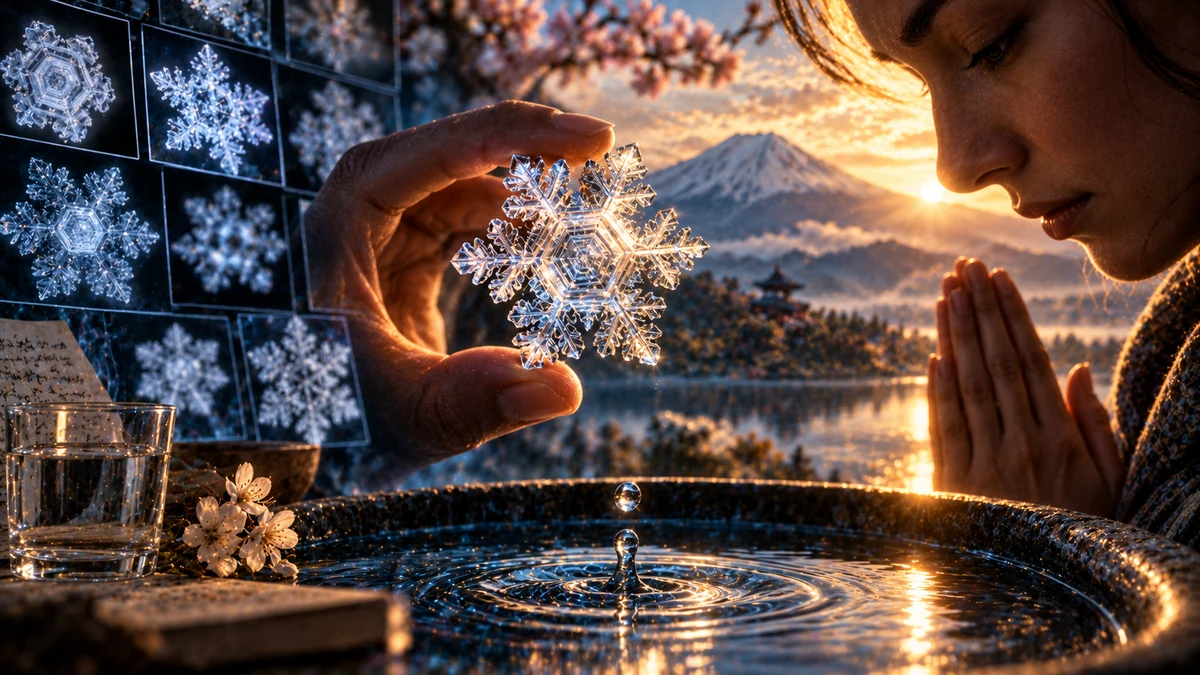
The photographs are extraordinarily persuasive. Under a microscope we see a beautiful, almost perfect six-armed ice crystal beside the word “love,” and an irregular fragmented pattern beside an insult. In another version, crystals differ after Mozart, heavy rock, prayer or human intention. The implied message seems immediate: water receives information, emotion or intention and stores it in its structure. [1][2]
This story became world-famous largely through the work of Japanese author Masaru Emoto. Yet the phrase “memory of water” now blends at least three different claims: Emoto’s claim about the beauty of frozen crystals, the older homeopathic problem of ultra-high dilutions, and the ordinary chemical fact that a sample’s history — impurities, gases, surfaces, temperature and preparation — can affect measurable properties. These are not the same thing. [3][4][5]
The most interesting answer is therefore not simply “water has memory” or “water has no memory.” We need a more precise question: what information is water supposed to retain, for how long, in what physical form, and how was it measured?
What Did Masaru Emoto Actually Claim?
According to Emoto’s own account, around 1994 he began freezing water samples and observing the resulting crystals under a microscope. He first compared water from different sources, then exposed water to written words and pictures, played music to it, and subjected it to prayer or focused intention. [1]
His official legacy site claims that “good words,” “good music” and “pure prayer” consistently produced beautiful crystals, while negative treatments produced deformed forms. Emoto explicitly described “beauty” as the selection criterion for crystals. [1]
That detail matters. Emoto’s core result was not a spectroscopic measurement of the molecular structure of liquid water, electrical conductivity or chemical composition. It was a visual selection and comparison of ice crystals after freezing, with aesthetic quality as a central category.
In The Hidden Messages in Water, Emoto extended these photographs into the broader claim that thoughts, words and emotions affect water, with implications for human beings and the environment. [2]
A Photograph of an Ice Crystal Is Not a Photograph of “Liquid-Water Structure”
This is the first major methodological boundary.
When water freezes, its molecules reorganize into ice. The crystal seen under the microscope is therefore the product of nucleation, freezing and subsequent crystal growth. It is not a direct image of the molecular network that existed in the liquid before freezing.
Ice morphology is sensitive to physical conditions. Temperature, humidity or vapour supersaturation, growth rate, impurities, surfaces, initial nucleation and local thermal differences can strongly alter crystal form. [6][7]
This is why snow crystals take such varied forms. Their hexagonal symmetry arises from the crystal structure of ice, while the eventual plates, columns, branches and dendrites depend on growth conditions. [6]
A different ice crystal therefore does not by itself tell us what caused the difference.

Why Does Image Selection Matter So Much?
If many droplets from one sample are frozen, they will not all generate identical crystals. Emoto himself emphasized that he did not observe two completely identical crystals. [1]
This creates an important sampling problem: which photographs are shown?
If an investigator knows which sample carried “love” and which carried an insult, then selects a “representative” or “beautiful” example from many crystals, expectation can enter the result without deliberate fraud. Human aesthetic judgment is intrinsically selective.
Such a study therefore requires coded samples, a blinded photographer, prespecified sampling rules, quantitative criteria, blinded judges, random allocation and analysis of all results rather than only photogenic examples.
Emoto’s early public photograph collections did not document such a protocol in enough detail for the spectacular images alone to constitute strong controlled evidence. This is why later blinded tests became important. [3][8]
The 2006 Double-Blind Experiment
In 2006 Dean Radin, Gail Hayssen, Masaru Emoto and Takashige Kizu published a pilot double-blind experiment. Approximately 2,000 people in Tokyo focused positive intention toward water samples in California while similar controls were not intentionally targeted. Crystal photographs were then blindly rated for aesthetic appeal. [3]
The authors reported higher beauty ratings for crystals from the treated water, with a one-tailed result of p = 0.001. [3]
This is substantially stronger than choosing striking photographs for a book. Blinding and external judgment were introduced.
Yet the pilot was small at the level of the actual crystal images: the analysis received only 40 photographs from four bottles, and the number of crystal images differed across bottles. [8] A single positive pilot was therefore not enough to establish a novel physical effect.
The 2008 Triple-Blind Experiment: More Important, but More Complicated
The same research line then conducted a larger triple-blind experiment. Six water bottles were randomly allocated to three conditions: two intention targets, two proximal controls and two distant controls. Around 1,900 people in Austria and Germany, across three groups, directed prayer or intention toward the target bottles in California. [9]
Fifty droplets were prepared from each bottle, for 300 samples in total. They were randomly positioned in a freezer, photographed under blinded conditions, and all 300 images were submitted for judgment. More than 2,500 online judges produced nearly 129,000 aesthetic ratings. [9]
This was methodologically much stronger than the original public crystal displays.
The authors reported a condition effect on beauty ratings of p = 0.03, while the comparison they treated as primary — treated versus proximal control — yielded p = 0.05, one-tailed across all photographs. [9]
The details, however, are less dramatic than the popular summary “a triple-blind experiment proved Emoto.”
What Does the Fine Print of the Same Experiment Show?
First, the effect was small and statistically marginal.
Second, the distant control condition was rated slightly more beautiful than the intention-treated condition across all 300 images, although this difference was not statistically significant. The main positive result therefore depended especially on comparison with the proximal controls rather than with controls in general. [9]
Third, the researchers included a more objective image measure: photographic contrast. Across all three conditions this outcome was not significant (p = 0.25). A planned treated-versus-proximal comparison was suggestive, but the broader overall test did not show a clear three-group difference. [9]
Fourth, when the exploratory rating of “interest” was included as a covariate in the beauty model, the main condition effect was no longer statistically significant. [9]
None of this requires ignoring the result. It means that the accurate description is a weak positive signal in particular comparisons, not a robust demonstration that intention alters water.
Was This an Independent Replication of Emoto’s Claim?
Not in the strict sense.
The 2008 experiment replicated the earlier protocol, but Dean Radin, Masaru Emoto and Takashige Kizu were again among the authors. Crystal formation and photography again occurred within Emoto’s experimental infrastructure. [3][9]
It is therefore reasonable to call it a repeat experiment with stronger controls, but not an independent laboratory replication.
Strong confirmation of an unusual effect would ideally involve multiple groups independent of the original investigators, preregistration, prespecified primary outcomes, stable effects under two-sided statistics and results that survive reasonable changes in analysis.
That broad independent replication base does not currently exist for Emoto’s crystal claim.
Emoto’s Own Surprising Boundary: “This Is Not Science”
Emoto’s official site contains a remarkably important statement. After describing his crystal experiments, he writes that crystal photography is neither science nor religion, and should be enjoyed as a new kind of art; he nevertheless also says that what it reveals is true. [1]
This is useful for understanding his project.
If crystal photographs are treated as symbolic art — a visual meditation on language, attention and our relationship with nature — they need not be assessed as laboratory physics.
The problem begins when the same image is used as scientific evidence that a word attached to a bottle directly changes the molecular structure of water. At that point the standards of experimental chemistry, physics and statistics apply.
Artistic value and evidential value are different things.
Benveniste’s “Memory of Water” Was a Different Claim
In 1988 Jacques Benveniste and colleagues published a very different result in Nature. They claimed that extremely diluted anti-IgE solutions could still trigger degranulation of human basophils even at dilutions where essentially none of the original molecules should remain. [10]
This gave rise to the phrase “memory of water”: after dilution and vigorous shaking, water was hypothesized to retain biological information from a previously dissolved substance.
This is not directly about beautiful ice crystals or written words. It asks whether an ultra-dilute preparation exhibits repeatable biological activity unexplained by ordinary dissolved-molecule chemistry.
Nature published the paper with an unusual editorial reservation and then sent a team to observe repetitions. Under tighter blinded conditions the effect was not confirmed; the subsequent report criticized statistical control, systematic error and exclusion of measurements inconsistent with the claim. [10][11]
Chemical Water Can Have a History — Without “Memory” in the Popular Sense
The slogan “water has no memory” can itself become too crude if memory is used in an extremely broad sense.
A real water sample can contain dissolved ions, gases, organic contaminants, particles leached from containers, nanoparticles, nanobubbles, different pH and temperature histories, and surface effects.
Preparation history can therefore influence later measurable properties. Systematic reviews of physicochemical work on homeopathic preparations have reported some differences between highly diluted samples and controls, while simultaneously emphasizing substantial methodological weaknesses, inadequate blinding and randomization, and the need for stronger replication. [12][13]
Such findings do not automatically show that pure water stores a semantic record of a molecule or human intention. They may show instead that physical preparation is not an ideal mathematical dilution of H₂O but a process involving additional material and interfacial factors.
What Does Hydrogen-Bond Dynamics Tell Us?
Liquid water does not contain a static crystal lattice. Molecules constantly exchange neighbours, while hydrogen bonds break and reform on extremely short time scales.
Ultrafast spectroscopy has shown loss of some local structural correlations in the hydrogen-bond network on the scale of tens of femtoseconds, while other definitions of local structural relaxation yield characteristic times on the order of a picosecond. [14][15]
This is a serious problem for a simple picture in which pure liquid water preserves the same molecular arrangement for minutes, days or years as a three-dimensional “imprint” of a word or formerly dissolved substance.
Precision still matters. Rapid hydrogen-bond reorganization does not prove that no historical effect can ever persist in any real aqueous sample. Longer-lived effects can arise through solutes, surfaces, interfaces, particles, dissolved gases or another physical carrier.
A long-term memory hypothesis therefore requires identification of an information-bearing mechanism, not merely the word “water.”

“Water Responds to Music” Is Not Yet a Mechanism
Sound is a physical phenomenon and can affect liquids. Strong acoustic waves can generate pressure changes, vibration, mixing, cavitation and, with ultrasound, significant chemical effects.
So the generic statement “music can physically affect water” is not surprising.
Emoto’s stronger claim is semantic and aesthetic: water supposedly distinguishes “good” and “bad” music, loving and insulting words, or positive and negative intention. [1][2]
That requires an additional mechanism. If two written words do not produce different measurable physical signals in the water encoding their meaning, the ordinary chemical sensitivity of water cannot explain semantic discrimination.
“Water responds to physical stimuli” and “water understands the meaning of words” are very different propositions.
What Would a Strong Emoto Experiment Look Like?
The claim is surprisingly testable.
A strong modern protocol would specify in advance:
- many identical samples from one homogenized source;
- computer-randomized allocation to positive, negative and neutral conditions;
- identical containers without visible labels;
- complete blinding of preparation, freezing and photography staff;
- automated imaging of every prespecified field or crystal;
- continuous measurement of temperature, position, time and other physical variables;
- an objective prespecified primary outcome — geometric symmetry or automated image classification rather than beauty alone;
- preregistered two-sided statistics;
- open raw images and data;
- independent replication in multiple laboratories.
If such a protocol repeatedly showed that semantic content or distant human intention predictably changed crystallization, it would be a major scientific discovery.
The unusualness of the claim is not a reason not to test it. It is a reason to make the test exceptionally resistant to expectation, selection and hidden physical variables.
What Can We Say Today?
Emoto created a real and culturally influential photographic project. His basic method involved freezing water and aesthetically comparing resulting crystals after different treatments. [1][2]
The famous early photographs alone are not strong experimental evidence, because highly variable crystal forms make sampling, blinding and image selection crucial.
Two controlled studies with Emoto as a coauthor reported positive results. The 2006 double-blind pilot reported a strong statistical result; the larger 2008 triple-blind experiment reported a more modest effect in aesthetic ratings. [3][9]
The 2008 result was not robust across every comparison. Distant controls were rated slightly more beautiful than treated samples across all images, and the overall objective image-contrast test was not significant. [9]
This is not yet a broad independent replication base. Key members of the original research line were also involved in the repeat experiment.
Benveniste’s “memory of water” is a different experimental claim, concerning biological activity in high dilutions rather than ice-crystal aesthetics. His original effect was not confirmed under the later tightly blinded observations. [10][11]
Pure liquid water has extremely rapid molecular dynamics. A simple long-lived static molecular imprint is therefore physically problematic. [14][15]
Yet the correct scientific boundary is not that water is a boring or simple liquid. Water is an unusually complex solvent, freezing is sensitive to conditions, and real samples can carry a history through impurities, surfaces, gases and other physical factors.
The crucial distinction is: “a water sample has a measurable physical history” ≠ “water stores the meaning of words, emotions or prayer.”
The latter requires repeatable, independent and mechanistically specified evidence. Emoto’s photographs remain an extraordinarily effective symbolic image — but current evidence does not justify saying that water has been shown to read human intention or semantic meaning.
Sources and further reading
- Primary source for Emoto’s description of the crystal work, beauty criterion and his own art/science boundary. Source
- Primary book source for Emoto’s broader claims about words, music, emotion and water.
- 2006 double-blind pilot, used for the reported positive result and small-image-sample limitations. Source
- Skeptical scholarly review of water-memory claims and physical constraints. Source
- A more permissive review of water and history-dependent effects, used as a counterpoint to the skeptical review. Source
- Authoritative review of ice-crystal growth physics and morphology dependence on conditions. Source
- Primary source on nucleation and surface effects in water freezing. Source
- Methodological details of the same pilot, especially image counts and sample allocation. Source
- Triple-blind experiment, used for the main and control results, image-contrast outcome and replication limits. Source
- Primary Benveniste paper on reported biological activity of ultra-high dilutions. Source
- Report on tighter blinded observed repetitions and methodological problems with the original effect. Source
- Systematic review of physicochemical measurements of high dilutions and experimental quality. Source
- Follow-up systematic review of proposed mechanisms and limitations in the high-dilution literature. Source
- Ultrafast spectroscopy constraining timescales for loss of local structural correlations in liquid water. Source
- Primary physical-chemistry source for hydrogen-bond definitions and dynamics in liquid water. Source